[:]
I. In the desert, we heal
The desert is our home, the place from which everything comes. The Tohono O’odham Nation, also called the Desert People, to which I belong, straddles the United States and Mexico, encompassing the deserts of Arizona and Sonora. Although we are divided by a wall, we are still one nation. In Mexico, the territory is not clearly delimited but is governed by seven representative communities located from Puerto Peñasco to Sonoyta, and Caborca to Altar. In the United States, our people are organized along eleven districts. Beyond political divisions lies the land, which is what unites us. Our connection to the desert is deep and fundamental. We are earth, fire, water, and wind.
Living in these territories makes us see the world differently. The Tohono O’odham communities live in remote regions, where nature takes on a strong and intimate meaning. From here, we connect with everything: the clay, the hills, the volcanoes, the elements. The desert is like a compass that allows us to orient ourselves and remember who we are. Sometimes, city life distances us from this essence, but there always comes the time when we must return. In the desert, we heal.
For both our descendants and our ancestors, the land is the most important thing: it is our home. In places like El Pinacate, we find everything we need. What the desert gives us is essential to our rituals, our medicine, and our daily lives. Everything in nature has a purpose, from the smallest to the largest; everything has a reason for being in the world. For example, to make a clay piece, we need earth, we need water, we need fire, and of course we need air. If one of those elements is missing, it wouldn’t be possible. If I’m not there, if I’m not part of that work, it won’t happen. So it’s about being connected to everything. Ultimately, all of the elements are important. We live connected to everything around us.
Salt, for example, is one of the most important elements we can share for conservation, healing, food, rituals, and care. Our communities use everything the desert gives them. We ourselves are part of the land. Traditional medicine, based on what we obtain from the desert, is more than a pharmaceutical. True medicine is found in nature. So going to these places heals you, both physically and emotionally. The plants, the salt, and other elements provide us with healing. I have seen how these practices transform people, myself included. Visiting places like El Pinacate and the salt flats not only heals the body, but also the mind and spirit.
II. The Salt Pilgrimage
There are ancestral paths—some longer than others—linked to the salt pilgrimage, a tradition reserved exclusively for men in our community. This doesn’t mean our ethnic group is sexist; on the contrary, we protect and deeply value the role of women. However, certain activities are reserved for men and others for women, and this balance is respected. Although I would have liked to experience the pilgrimage, my participation as a woman occurs differently.
The trekkers cross the desert from sunrise to sunset for several days. The longest journey, twenty-one days, runs from Ajo, Arizona, to the salt flats of Sonora. However, only those who participate fully understand the spiritual significance of this journey and decide how much of it to share. My son is a salt pilgrim; he made his first pilgrimage at age fifteen, guided by one of the oldest leaders, now deceased. I hope this tradition continues with new leaders, because its spiritual and cultural value is immense.
My son has told me that certain aspects of the pilgrimage must remain secret, and I respect that decision. As a mother, my role is different: while he walks, I must keep a candle lit and pray for him every day. That candle cannot be extinguished until his return. In addition, the women play a crucial role as makai, healers endowed with the gift of traditional medicine. They purify the pilgrims before they enter the desert and, upon their return, cleanse them again. These ceremonies prepare them and free them from the burdens of the outside world, allowing them to face the desert with clarity. Once my son has been cleansed, I can no longer speak to him, touch him, or see him until he returns. Only then do the makai perform a final cleansing, returning him to the everyday world.
The main purpose of the pilgrimage is to collect salt, which will later be used to preserve hides, carry out rituals, treat illnesses, and for other essential purposes. But the crossing goes beyond collection; it’s a transformative spiritual experience. Walking for twenty-one days from dawn to dusk, and sleeping wherever the sun catches up to you at the end of the day changes those who do it. It’s a physical and emotional challenge that marks one deeply. Even though I’ve never experienced it, I am sure it must be profoundly transformative.
III. The Heart in the Crater
The Pinacate Desert is our origin. It’s where it all began; it’s where we were created. Both the Pinacate Peaks and Baboquivari, a mountain in Tucson, Arizona, are sacred places for us. The latter is home to I’itoi, our older brother and creator. But I’itoi is not a distant or supreme god, as in other traditions. He is part of us, of the Earth and of nature. His wisdom taught us the dances, songs, and traditional medicine that sustain us to this day.
Our most important symbol is the labyrinth, laden with meaning and mysticism. The labyrinth represents the life of each person. Every curve, every path, is a reflection of the decisions, obstacles, and lessons we face. Reaching the center symbolizes death, where I’itoi awaits to welcome us. It is a journey of falls and ascents, of constant learning. Many of us have the labyrinth tattooed on our skin for its profound meaning. It is a reminder that life is a path full of learning and also a tribute to our spirituality. The labyrinth is life.
In addition to I’itoi, we have many stories, like that of the Ho’ok O’ks, which means “old woman.” She is connected to myths about the formation of Mount Pinacate, its craters, like El Elegante, and its communities. Ho’ok O’ks was a mysterious woman who arrived in the community of Pozo Verde, near Altar. She was always hungry and devoured everything she found: hares, birds, coyotes, and deer. When she ran out of animals, she began stealing children. One day, she offered to take care of the baby of a community member who distrusted her. After much insistence, she managed to gain her trust; thus, she took the baby and disappeared.
Ho’ok O’ks lived in a nearby cave, where she would take children who collected water or plants. When the disappearances became frequent, the community decided to take action. They knew Ho’ok O’ks was powerful, so they sent their strongest warrior to seek help from I’itoi, in Baboquivari. After an exhausting journey, the warrior finally found I’itoi, who fed him and listened to his plea.
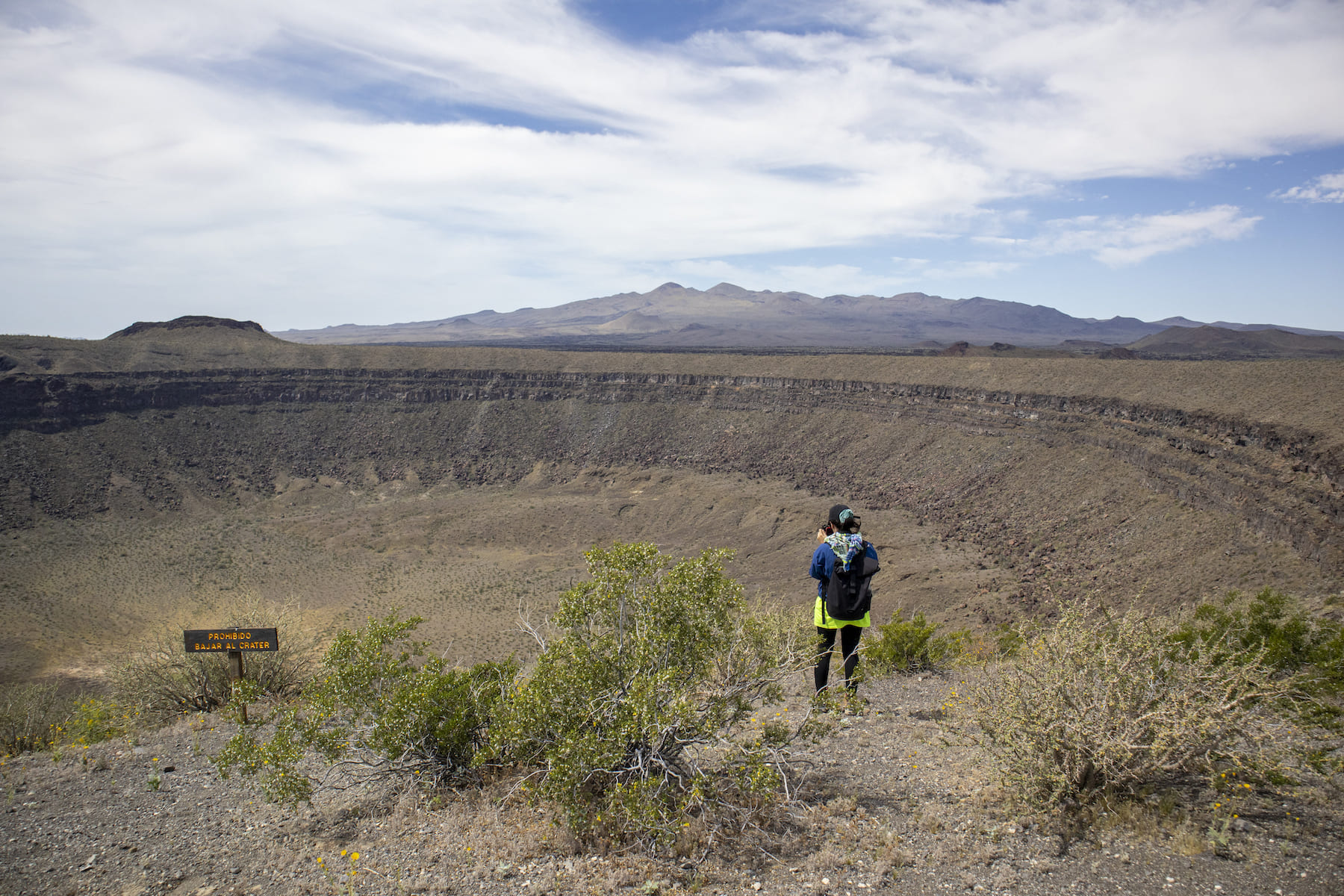
Upon returning, I’itoi devised a plan: they invited Ho’ok O’ks to a celebration in her honor. During the party, she ate, drank, and danced until she was exhausted. Then, I’itoi took her to his cave, enclosed it with a large rock and set it on fire. When the cave exploded, it sent the remains of Ho’ok O’ks tumbling across the land. Her heart fell into El Pinacate, forming the El Elegante crater. Inside, a petrified heart seems to beat, a reminder of this story.
For us, the New Year begins with the first rain of summer, usually in June, when we celebrate the Vi’ikita ceremony. It is an important ritual in which we offer dances and offerings to the great creator to pray for rain. There are also other celebrations influenced by Catholicism, such as those dedicated to Saint Francis, but I personally prefer to focus on the original traditions, those that existed before evangelization.
The arrival of Father Kino brought with it evangelization and the adoption of the Catholic religion. This influence altered many of our spiritual practices, but the original spirituality remains in our collective memory. The Vi’ikita ceremony, in which people dance all night to pray for rain, is one of the traditions that remains alive, reaffirming our relationship with the Earth and the cosmos.
Our people have been preserved thanks to the zeal with which we guard our rituals and customs. There are things that cannot be shared openly because the sacred is protected by silence. This secrecy, far from isolating us, has allowed us to resist and continue to exist, even when many don’t even know we’re here.
IV. The Re-enchantment of the World
How can we re-enchant the world? It isn’t about remaking, returning, or recreating, but about recognizing that our essence lies in the land. We, as Indigenous peoples, share who we are, what we do, and where we live. However, the land isn’t just ours; it belongs to everyone. The planet belongs to all of us. The key is to respect, protect, and care for it. Everyone needs to find their own way to reconnect with the land, whether in the forest, on the beach, in the desert, or in the mountains.
Our language is called O’odham ñiok, which means “the language of the people.” O’odham is “people,” and ñiok is “language” or “tongue.” From a young age, my father taught us about our roots. He always told us: “You are O’odham, you have O’odham blood, you belong to the desert, you are Indigenous, and you should be proud of your roots. There are people who don’t know where they come from and yearn for it, but you have that knowledge. You are genuine, you are your identity.” I know that language is fundamental, but so are the traditions, culture, knowledge, and practices we carry out. All of that also counts, and it shouldn’t be minimized. Language is extremely important, but it is not the only element that defines our identity and cultural resilience.
In our family, we constantly strive to keep our culture alive, talk about it, and share our traditions. Over the years, I’ve seen how visitors to places like Sonora and El Pinacate seek that sense of belonging. Many express a desire to learn about their own roots and deeply value our connection to our traditions. This has led me to appreciate my father’s teachings even more. Now, I try to pass on that same essence to my children.
I recognize that the O’odham ñiok language has largely been lost, but we do our best to preserve and share what we know. My father, who knows a little more, constantly tells us stories from the communities and our family, strengthening that connection. As a cultural promoter, my work is deeply connected to our culture. I use social media as a tool to spread our traditions and share my work. Whether at home, in the communities, or in the desert, we live our identity to the best of our ability and work to ensure that these traditions remain a part of us and future generations. Passing these traditions on to my children is my commitment, although I know it will be their decision whether or not to continue sharing them. I involve them in every activity possible so they can experience and feel our culture. We work with clay pots, participate in rituals, and share stories. Although the language has largely been lost, our identity lives on in the daily practice of our knowledge and traditions.
The re-enchantment of the world begins with reconnection. Our culture is a bridge for remembering that we all belong to the Earth and that its protection is everyone’s responsibility. Beyond borders, ancestral roots teach us that spirituality, land, and memory are paths to experiencing the magic of the world again.
I. In the desert, we heal
The desert is our home, the place from which everything comes. The Tohono O’odham Nation, also called the Desert People, to which I belong, straddles the United States and Mexico, encompassing the deserts of Arizona and Sonora. Although we are divided by a wall, we are still one nation. In Mexico, the territory is not clearly delimited but is governed by seven representative communities located from Puerto Peñasco to Sonoyta, and Caborca to Altar. In the United States, our people are organized along eleven districts. Beyond political divisions lies the land, which is what unites us. Our connection to the desert is deep and fundamental. We are earth, fire, water, and wind.
Living in these territories makes us see the world differently. The Tohono O’odham communities live in remote regions, where nature takes on a strong and intimate meaning. From here, we connect with everything: the clay, the hills, the volcanoes, the elements. The desert is like a compass that allows us to orient ourselves and remember who we are. Sometimes, city life distances us from this essence, but there always comes the time when we must return. In the desert, we heal.
For both our descendants and our ancestors, the land is the most important thing: it is our home. In places like El Pinacate, we find everything we need. What the desert gives us is essential to our rituals, our medicine, and our daily lives. Everything in nature has a purpose, from the smallest to the largest; everything has a reason for being in the world. For example, to make a clay piece, we need earth, we need water, we need fire, and of course we need air. If one of those elements is missing, it wouldn’t be possible. If I’m not there, if I’m not part of that work, it won’t happen. So it’s about being connected to everything. Ultimately, all of the elements are important. We live connected to everything around us.
Salt, for example, is one of the most important elements we can share for conservation, healing, food, rituals, and care. Our communities use everything the desert gives them. We ourselves are part of the land. Traditional medicine, based on what we obtain from the desert, is more than a pharmaceutical. True medicine is found in nature. So going to these places heals you, both physically and emotionally. The plants, the salt, and other elements provide us with healing. I have seen how these practices transform people, myself included. Visiting places like El Pinacate and the salt flats not only heals the body, but also the mind and spirit.
II. The Salt Pilgrimage
There are ancestral paths—some longer than others—linked to the salt pilgrimage, a tradition reserved exclusively for men in our community. This doesn’t mean our ethnic group is sexist; on the contrary, we protect and deeply value the role of women. However, certain activities are reserved for men and others for women, and this balance is respected. Although I would have liked to experience the pilgrimage, my participation as a woman occurs differently.
The trekkers cross the desert from sunrise to sunset for several days. The longest journey, twenty-one days, runs from Ajo, Arizona, to the salt flats of Sonora. However, only those who participate fully understand the spiritual significance of this journey and decide how much of it to share. My son is a salt pilgrim; he made his first pilgrimage at age fifteen, guided by one of the oldest leaders, now deceased. I hope this tradition continues with new leaders, because its spiritual and cultural value is immense.
My son has told me that certain aspects of the pilgrimage must remain secret, and I respect that decision. As a mother, my role is different: while he walks, I must keep a candle lit and pray for him every day. That candle cannot be extinguished until his return. In addition, the women play a crucial role as makai, healers endowed with the gift of traditional medicine. They purify the pilgrims before they enter the desert and, upon their return, cleanse them again. These ceremonies prepare them and free them from the burdens of the outside world, allowing them to face the desert with clarity. Once my son has been cleansed, I can no longer speak to him, touch him, or see him until he returns. Only then do the makai perform a final cleansing, returning him to the everyday world.
The main purpose of the pilgrimage is to collect salt, which will later be used to preserve hides, carry out rituals, treat illnesses, and for other essential purposes. But the crossing goes beyond collection; it’s a transformative spiritual experience. Walking for twenty-one days from dawn to dusk, and sleeping wherever the sun catches up to you at the end of the day changes those who do it. It’s a physical and emotional challenge that marks one deeply. Even though I’ve never experienced it, I am sure it must be profoundly transformative.
III. The Heart in the Crater
The Pinacate Desert is our origin. It’s where it all began; it’s where we were created. Both the Pinacate Peaks and Baboquivari, a mountain in Tucson, Arizona, are sacred places for us. The latter is home to I’itoi, our older brother and creator. But I’itoi is not a distant or supreme god, as in other traditions. He is part of us, of the Earth and of nature. His wisdom taught us the dances, songs, and traditional medicine that sustain us to this day.
Our most important symbol is the labyrinth, laden with meaning and mysticism. The labyrinth represents the life of each person. Every curve, every path, is a reflection of the decisions, obstacles, and lessons we face. Reaching the center symbolizes death, where I’itoi awaits to welcome us. It is a journey of falls and ascents, of constant learning. Many of us have the labyrinth tattooed on our skin for its profound meaning. It is a reminder that life is a path full of learning and also a tribute to our spirituality. The labyrinth is life.
In addition to I’itoi, we have many stories, like that of the Ho’ok O’ks, which means “old woman.” She is connected to myths about the formation of Mount Pinacate, its craters, like El Elegante, and its communities. Ho’ok O’ks was a mysterious woman who arrived in the community of Pozo Verde, near Altar. She was always hungry and devoured everything she found: hares, birds, coyotes, and deer. When she ran out of animals, she began stealing children. One day, she offered to take care of the baby of a community member who distrusted her. After much insistence, she managed to gain her trust; thus, she took the baby and disappeared.
Ho’ok O’ks lived in a nearby cave, where she would take children who collected water or plants. When the disappearances became frequent, the community decided to take action. They knew Ho’ok O’ks was powerful, so they sent their strongest warrior to seek help from I’itoi, in Baboquivari. After an exhausting journey, the warrior finally found I’itoi, who fed him and listened to his plea.
Upon returning, I’itoi devised a plan: they invited Ho’ok O’ks to a celebration in her honor. During the party, she ate, drank, and danced until she was exhausted. Then, I’itoi took her to his cave, enclosed it with a large rock and set it on fire. When the cave exploded, it sent the remains of Ho’ok O’ks tumbling across the land. Her heart fell into El Pinacate, forming the El Elegante crater. Inside, a petrified heart seems to beat, a reminder of this story.
For us, the New Year begins with the first rain of summer, usually in June, when we celebrate the Vi’ikita ceremony. It is an important ritual in which we offer dances and offerings to the great creator to pray for rain. There are also other celebrations influenced by Catholicism, such as those dedicated to Saint Francis, but I personally prefer to focus on the original traditions, those that existed before evangelization.
The arrival of Father Kino brought with it evangelization and the adoption of the Catholic religion. This influence altered many of our spiritual practices, but the original spirituality remains in our collective memory. The Vi’ikita ceremony, in which people dance all night to pray for rain, is one of the traditions that remains alive, reaffirming our relationship with the Earth and the cosmos.
Our people have been preserved thanks to the zeal with which we guard our rituals and customs. There are things that cannot be shared openly because the sacred is protected by silence. This secrecy, far from isolating us, has allowed us to resist and continue to exist, even when many don’t even know we’re here.
IV. The Re-enchantment of the World
How can we re-enchant the world? It isn’t about remaking, returning, or recreating, but about recognizing that our essence lies in the land. We, as Indigenous peoples, share who we are, what we do, and where we live. However, the land isn’t just ours; it belongs to everyone. The planet belongs to all of us. The key is to respect, protect, and care for it. Everyone needs to find their own way to reconnect with the land, whether in the forest, on the beach, in the desert, or in the mountains.
Our language is called O’odham ñiok, which means “the language of the people.” O’odham is “people,” and ñiok is “language” or “tongue.” From a young age, my father taught us about our roots. He always told us: “You are O’odham, you have O’odham blood, you belong to the desert, you are Indigenous, and you should be proud of your roots. There are people who don’t know where they come from and yearn for it, but you have that knowledge. You are genuine, you are your identity.” I know that language is fundamental, but so are the traditions, culture, knowledge, and practices we carry out. All of that also counts, and it shouldn’t be minimized. Language is extremely important, but it is not the only element that defines our identity and cultural resilience.
In our family, we constantly strive to keep our culture alive, talk about it, and share our traditions. Over the years, I’ve seen how visitors to places like Sonora and El Pinacate seek that sense of belonging. Many express a desire to learn about their own roots and deeply value our connection to our traditions. This has led me to appreciate my father’s teachings even more. Now, I try to pass on that same essence to my children.
I recognize that the O’odham ñiok language has largely been lost, but we do our best to preserve and share what we know. My father, who knows a little more, constantly tells us stories from the communities and our family, strengthening that connection. As a cultural promoter, my work is deeply connected to our culture. I use social media as a tool to spread our traditions and share my work. Whether at home, in the communities, or in the desert, we live our identity to the best of our ability and work to ensure that these traditions remain a part of us and future generations. Passing these traditions on to my children is my commitment, although I know it will be their decision whether or not to continue sharing them. I involve them in every activity possible so they can experience and feel our culture. We work with clay pots, participate in rituals, and share stories. Although the language has largely been lost, our identity lives on in the daily practice of our knowledge and traditions.
The re-enchantment of the world begins with reconnection. Our culture is a bridge for remembering that we all belong to the Earth and that its protection is everyone’s responsibility. Beyond borders, ancestral roots teach us that spirituality, land, and memory are paths to experiencing the magic of the world again.