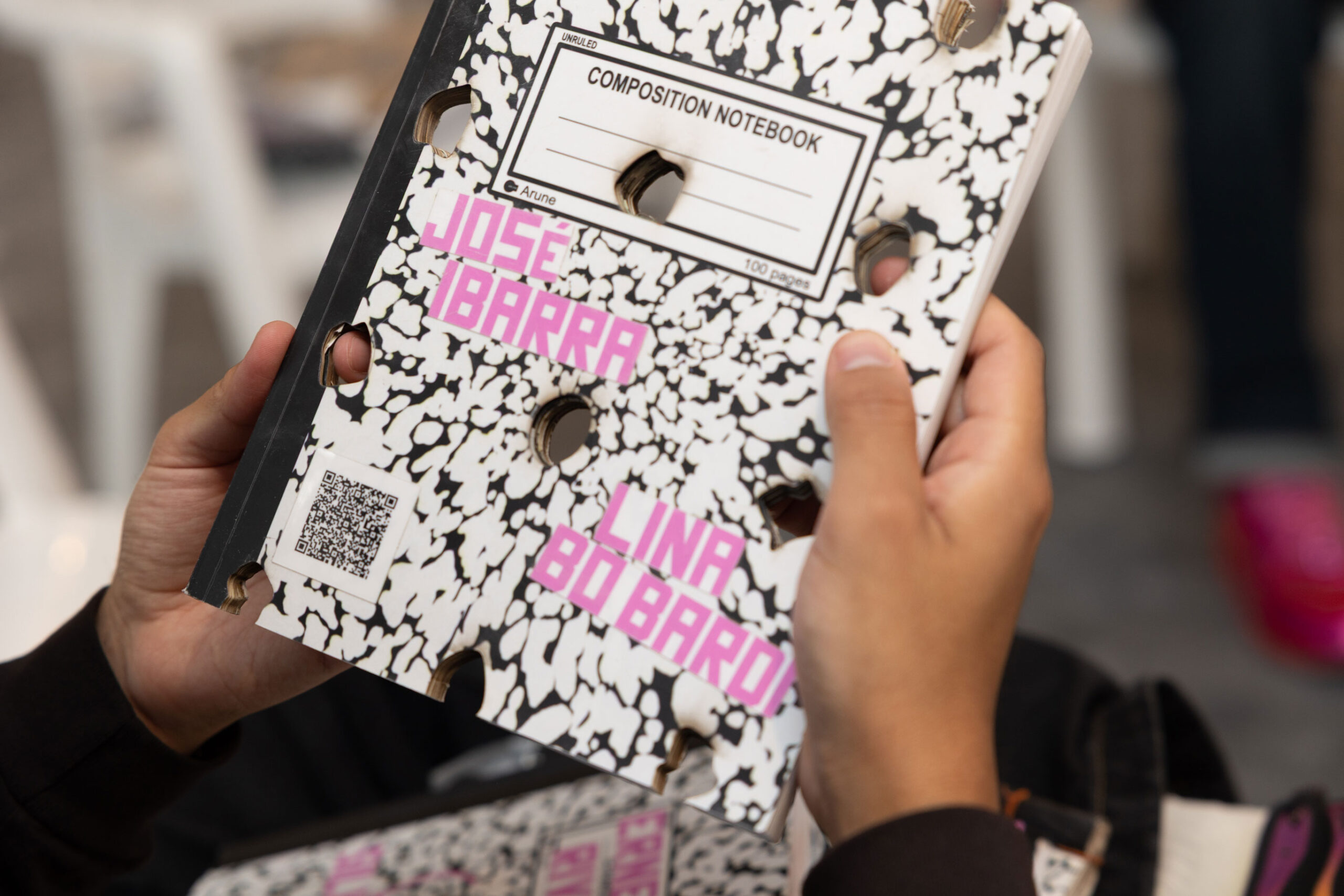
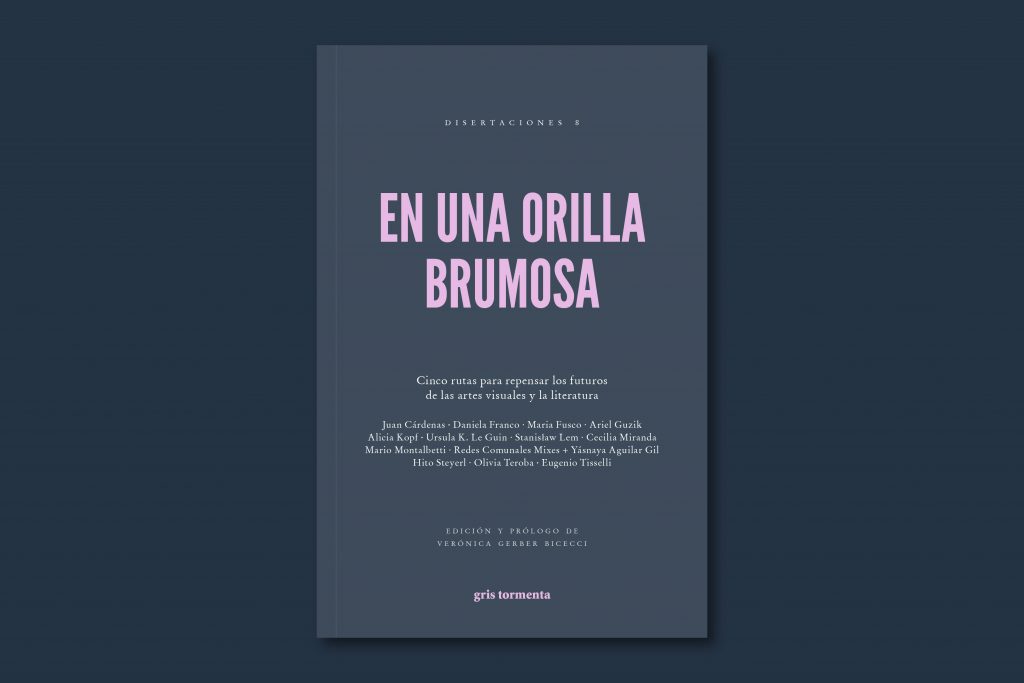
Our editor, Diego del Valle Ríos, talks with Verónica Gerber Bicecci, a visual artist who writes, about the relationship between imagination, language, and writing that is presented in the book «En una orilla brumosa» recently published by Gris Tormenta as an effort to speculate on the futures of art and literature.
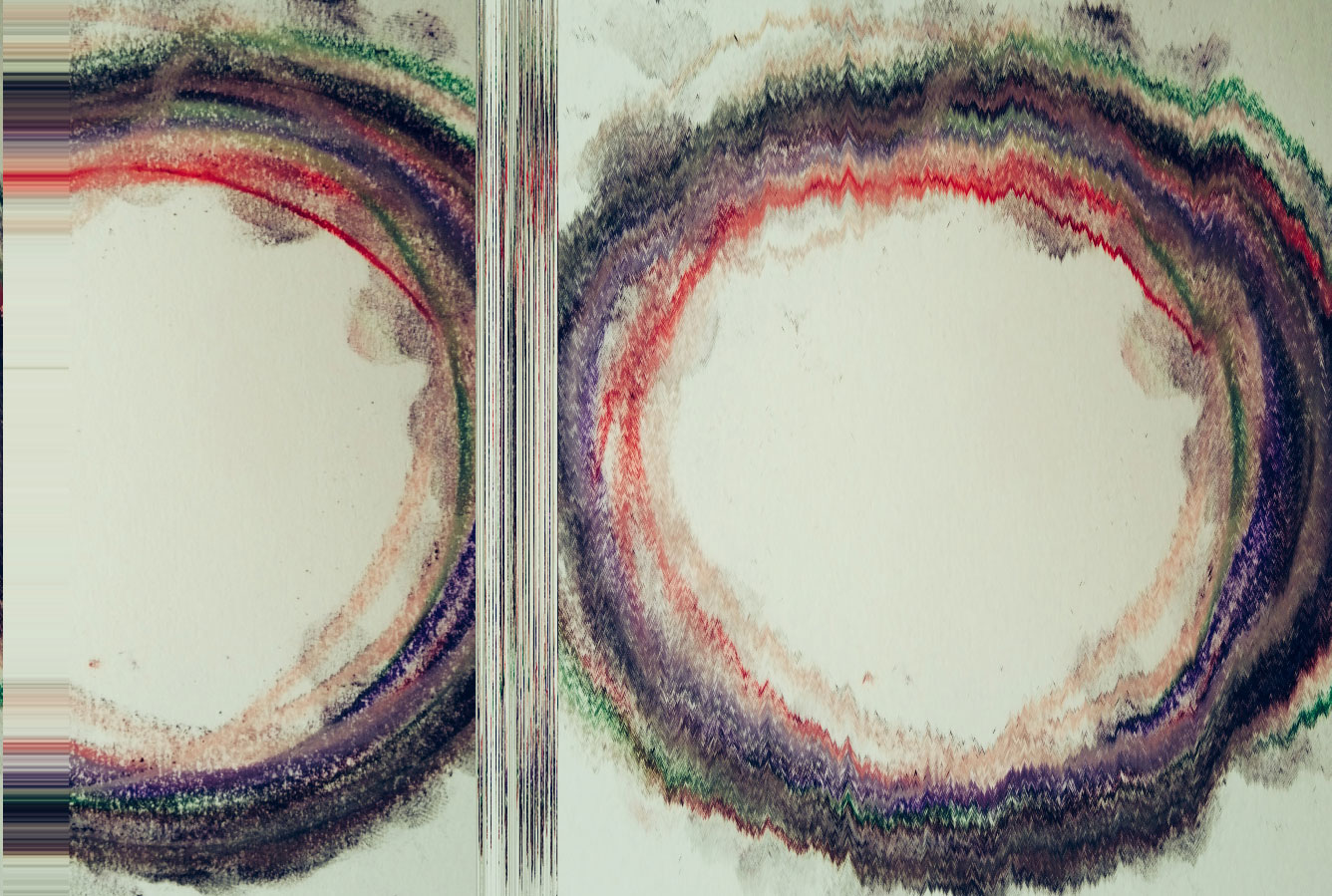
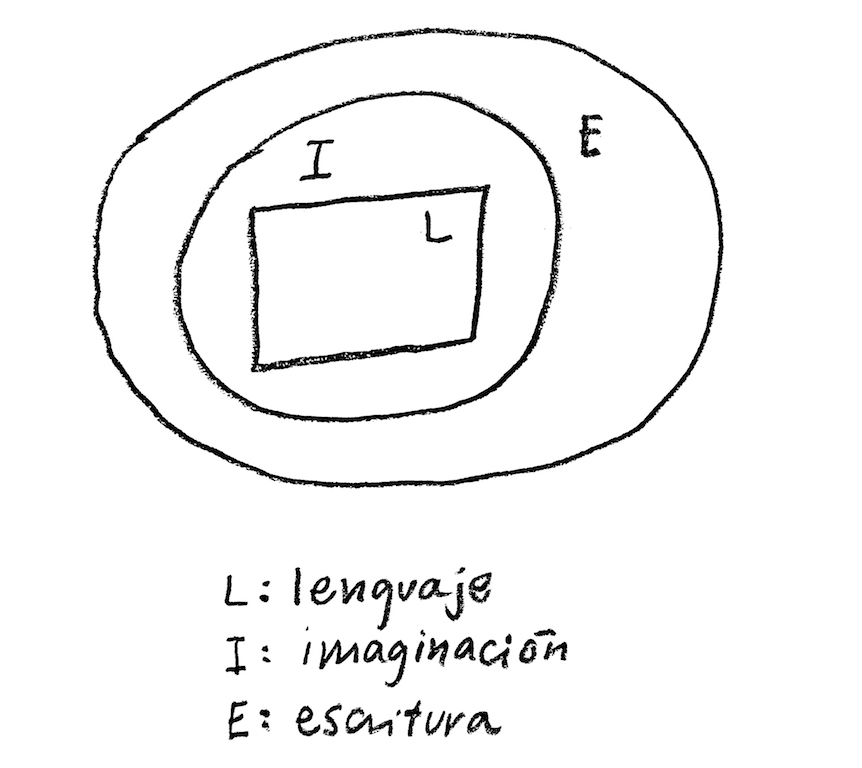
Verónica Gerber Bicecci (VGB): I try to visualize the relationships in the triad you propose and the first thing I see is this: (see drawing 1). We know that everything leaves a trace or some form of writing: pencils and charcoal, but also living beings in movement, the landscape, the rings on tree trunks, etc. I would like to think that those writings are the source of the imaginations that shape our languages. But the reality is, for the time being, a different one, and if I think about that reality then I see this: (see drawing 2 below). Language is a system that delimits our imaginative possibilities, and writing ends up being found halfway between language and imagination. But it tries to approach, at least as far as En una orilla brumosa is concerned, the margins. In search of possible futures, in my opinion, the writings that are contained in this book wish to cross those margins. Or at least they are the testimony of that attempt.
DdVR: Each assembled text incites us to defy the sensory relationship with the environment we inhabit and that inhabits us: they are proposals to sabotage the very language with which we create worlds. In coexistence, these writings remind us not to underestimate the power of contradictions. In the prologue to the book, you share that the texts were written by explorers of the calligram: “That is, artists who unfold verbal language, visual language, or both, and who assume and confront the discordances or tensions that result from that action.” Each text is, then, an inhabiting of the contradiction implicit in the calligrammatic era in which you say we find ourselves. Could you talk a little more about this era?
VGB: Contradiction is often a mechanism that tends to be hidden in artistic manifestations. More than inhabiting contradictions, because we have always inhabited them, I think it’s about opening them up, making them visible, facing them, discussing them, or even assuming their consequences and implications.
Talking about our complex and contradictory intersections seems to me an urgent exercise in any project or practice of plurality.
VGB: Perhaps the proposal outlined in this anthology is more on the side of “how” rather than “what”, that is, how do we take control? In that sense, I tried to make the prologue a direct result of an in-depth reading of all the texts that make up the anthology, as well as a space to record the editing process as completely as possible. What I discovered, and what I propose to readers, is to imagine a kind of compass with five cardinal points: autonomous and unintelligible writings, non-human writings, migrant writings, antonymous writings, and unearthed writings. I say it’s a kind of compass and not a compass in itself because these writings do not try to be isolated strategies or unique Norths but spaces of possible intersections to answer the question of how. The calligrammatic strategy, which I understand as a way of doubting the assumed language, could be the sixth point of intersection.
messing up language is the possibility of seeking and proposing poetic and political licenses with which, little by little, our ways of thinking and experiencing the world could be transformed.
DdVR: I don’t think you are being a naive optimist. When you mention the possibility of poetic and political licenses in relation to non-binary language as a power of disruption, you are referring to a question about the autonomy of imagination that inevitably entails an ethical sense. To better understand this, the proposal made by the Ludditas Sexxxuales on ethics against the tyranny of the ego, the individual (heterocapitalist language) is useful: “An Ethics is opposed to morality. Ethics, following Spinoza and Deleuze, is the discipline of what is good for my body, that is, that which stimulates and increases my joyful passions and my potencies, that which combines me with more bodies and more affinities and joys”.[3] A proposal that leads me to this last question about your relationship with “contemporary art” and “literature”; categorical systems of imagination capture indissolubly linked to capitalism and colonialism, as the text of the Redes Comunales Mixes written in the year 2172 and that springs from the pages of En una orilla brumosa points out. What discomfort do these systems arouse in you today to motivate your proposal in this book?
To purchase the book, visit the website of Gris Tormenta.
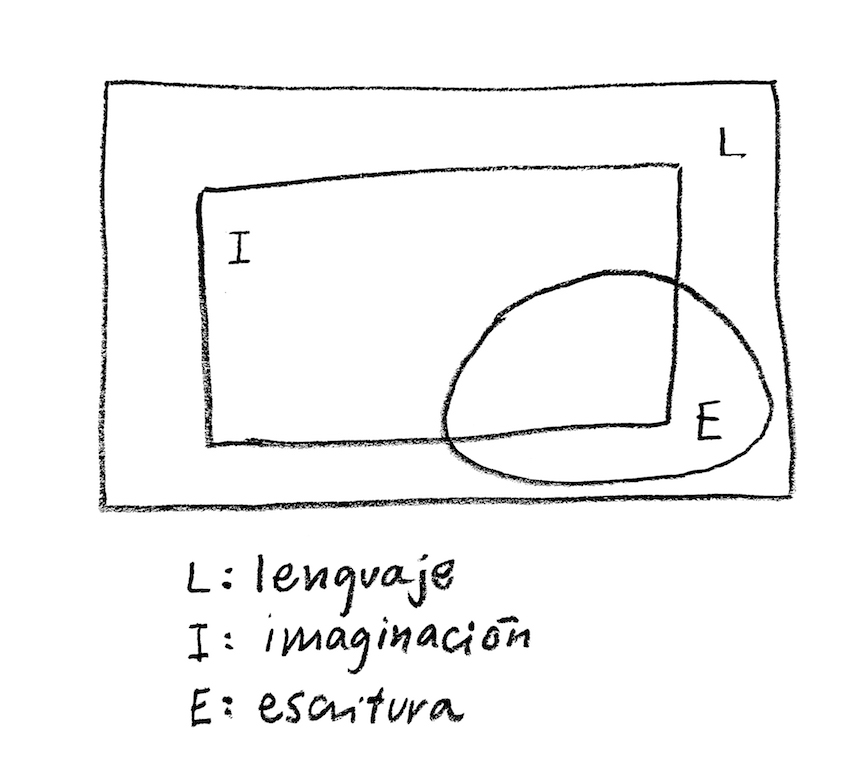
Verónica Gerber Bicecci (VGB): I try to visualize the relationships in the triad you propose and the first thing I see is this: (see drawing 1). We know that everything leaves a trace or some form of writing: pencils and charcoal, but also living beings in movement, the landscape, the rings on tree trunks, etc. I would like to think that those writings are the source of the imaginations that shape our languages. But the reality is, for the time being, a different one, and if I think about that reality then I see this: (see drawing 2 below). Language is a system that delimits our imaginative possibilities, and writing ends up being found halfway between language and imagination. But it tries to approach, at least as far as En una orilla brumosa is concerned, the margins. In search of possible futures, in my opinion, the writings that are contained in this book wish to cross those margins. Or at least they are the testimony of that attempt.
DdVR: Each assembled text incites us to defy the sensory relationship with the environment we inhabit and that inhabits us: they are proposals to sabotage the very language with which we create worlds. In coexistence, these writings remind us not to underestimate the power of contradictions. In the prologue to the book, you share that the texts were written by explorers of the calligram: “That is, artists who unfold verbal language, visual language, or both, and who assume and confront the discordances or tensions that result from that action.” Each text is, then, an inhabiting of the contradiction implicit in the calligrammatic era in which you say we find ourselves. Could you talk a little more about this era?
VGB: Contradiction is often a mechanism that tends to be hidden in artistic manifestations. More than inhabiting contradictions, because we have always inhabited them, I think it’s about opening them up, making them visible, facing them, discussing them, or even assuming their consequences and implications.
Talking about our complex and contradictory intersections seems to me an urgent exercise in any project or practice of plurality.
VGB: Perhaps the proposal outlined in this anthology is more on the side of “how” rather than “what”, that is, how do we take control? In that sense, I tried to make the prologue a direct result of an in-depth reading of all the texts that make up the anthology, as well as a space to record the editing process as completely as possible. What I discovered, and what I propose to readers, is to imagine a kind of compass with five cardinal points: autonomous and unintelligible writings, non-human writings, migrant writings, antonymous writings, and unearthed writings. I say it’s a kind of compass and not a compass in itself because these writings do not try to be isolated strategies or unique Norths but spaces of possible intersections to answer the question of how. The calligrammatic strategy, which I understand as a way of doubting the assumed language, could be the sixth point of intersection.
messing up language is the possibility of seeking and proposing poetic and political licenses with which, little by little, our ways of thinking and experiencing the world could be transformed.
DdVR: I don’t think you are being a naive optimist. When you mention the possibility of poetic and political licenses in relation to non-binary language as a power of disruption, you are referring to a question about the autonomy of imagination that inevitably entails an ethical sense. To better understand this, the proposal made by the Ludditas Sexxxuales on ethics against the tyranny of the ego, the individual (heterocapitalist language) is useful: “An Ethics is opposed to morality. Ethics, following Spinoza and Deleuze, is the discipline of what is good for my body, that is, that which stimulates and increases my joyful passions and my potencies, that which combines me with more bodies and more affinities and joys”.[3] A proposal that leads me to this last question about your relationship with “contemporary art” and “literature”; categorical systems of imagination capture indissolubly linked to capitalism and colonialism, as the text of the Redes Comunales Mixes written in the year 2172 and that springs from the pages of En una orilla brumosa points out. What discomfort do these systems arouse in you today to motivate your proposal in this book?
To purchase the book, visit the website of Gris Tormenta.