Janila Castañeda approaches Carlos Vielma's work through the lens of ruin and the notion of the ghost, tracing his career up to 7 Fantasmas [7 Ghosts] (2026), presented in Tolvanera at Galería Gobernador, which reclaims the panels of the seven white obelisks from Plaza Coahuila in Saltillo. From the Greek phántasma (ghost), "apparition," and the root bha-, "to shine," the ghost is not what hides but what becomes visible. Thus, between ruin and work in progress, the piece turns the rumors, graffiti, and repairs of public space into ghosts, and asks what is preserved and to whom the public belongs.
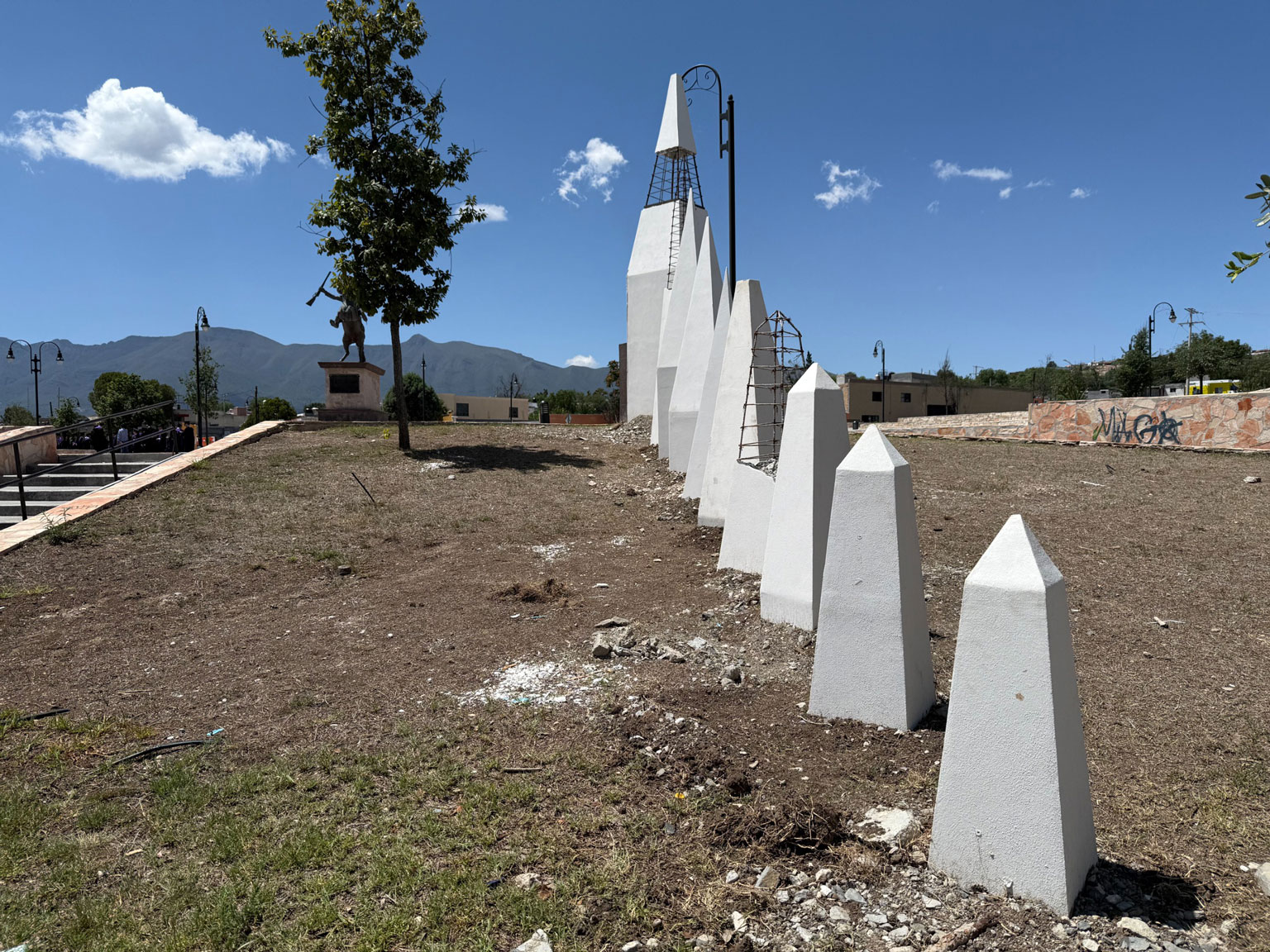
No one really knows what happened. As with everything in this town, stories circulate by word of mouth, but the original voice that first conjured those words is never known. The facts, however, were undeniable: seven white obelisks had mysteriously appeared in Plaza Coahuila, in downtown Saltillo. How long had they been there, and who had put them up? There was no plaque, nor any indication of the person responsible for this unofficial gift, supposedly placed for the benefit of Saltillo’s residents.
Every day, as she leaves her home on Arroyo Street, an anonymous woman walks past the new monument, just a few meters from where it appeared. She is on her way to the Senior Citizens Center, arriving just in time for lunch. Since her husband’s death, the Center has become her refuge, a place for leisure, and the destination that gives shape to the hours of her days. Having lived in the same house for more than forty years, she notices even the slightest changes in her surroundings. Perhaps she is the only chronicler who remembers the exact day the obelisks arrived in this rather barren plaza, where the few pine trees and palm trees offer little shelter from the sun’s imposing rays. An otherwise ordinary day, marked by the usual household routines, was abruptly interrupted by a subtle tragedy: another anonymous soul had dared to deface the untouchable whiteness of the new monument the government had installed in the plaza, scrawling little drawings and messages such as “I don’t love my country” and “Smile, it’s free.”
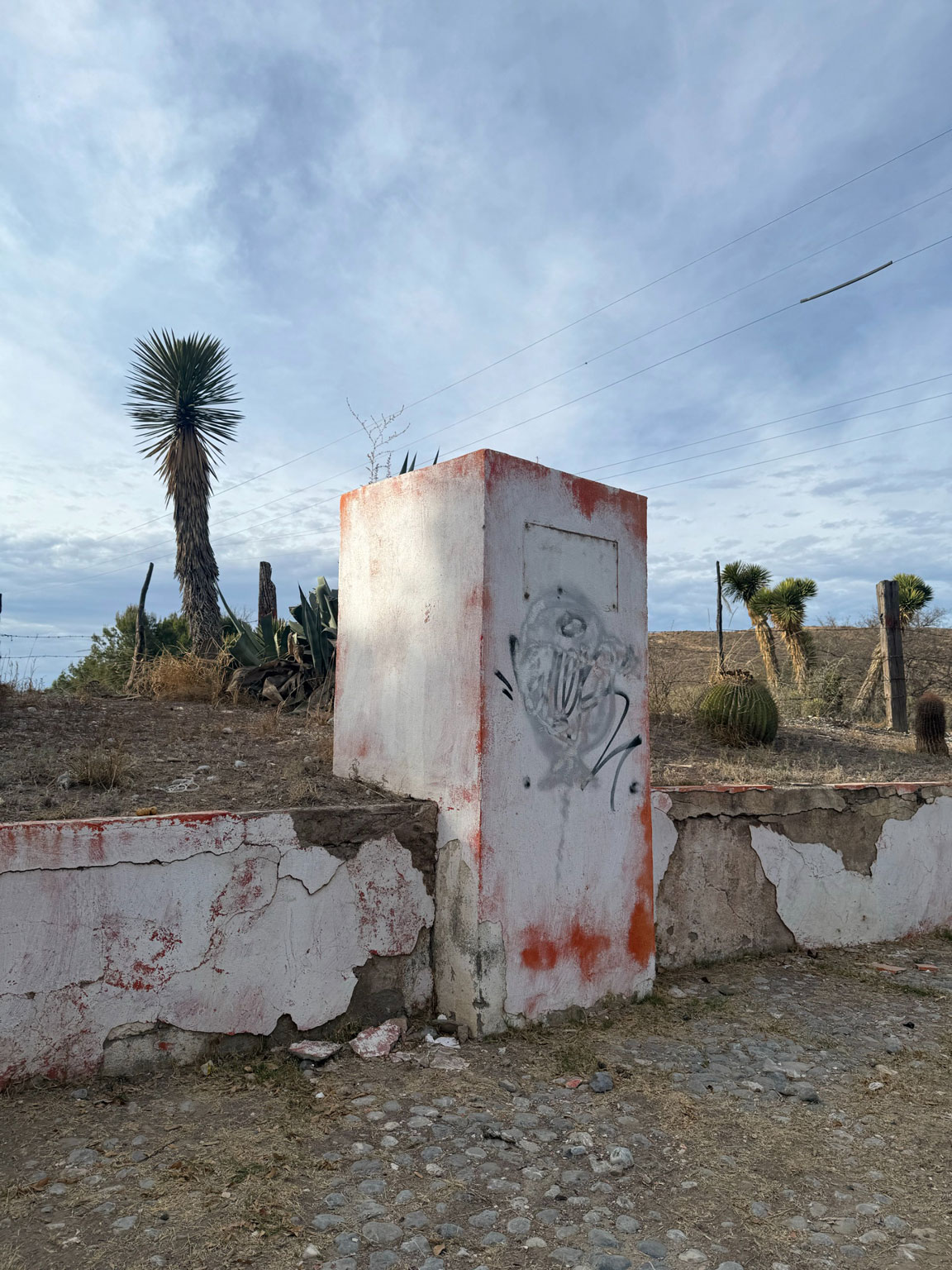
She liked things done properly: protocol, and respect for the established order. Although she had retired after years of service to the state, her commitment to her city led her to take it upon herself to look after this gift. Who knew what it meant or what it was for, but surely the government had put it there for a reason. That was reason enough to protect it. That afternoon, after finishing her usual Tuesday game of lotería, she stopped on her way home to buy a paintbrush and some ghostly white paint. Without a second thought, she set out, determined to cover each of the seven obelisks, from base to tip. She finished exhausted but satisfied. Unbeknownst to her, she had just inaugurated a new ritual. Every week, she would set out with her paint and brush to erase the obscenities left behind by inconsiderate people who had no respect for anything or anyone. People who failed to understand that something was important simply because it had been placed there, in the plaza, beside the bronze equestrian statue of Zapata. This self-imposed duty occupied much of her afternoons for nearly a year, until one day she stepped out of her house and was met with the devastating surprise that the obelisks had vanished without a trace.
A second version of the stories that emerged around this sudden appearance involves the same woman (a ghost), who, armed with all her civic training, is said to have called the police. The police, in turn, supposedly contacted the state tourism authorities, who ordered the obelisks to be repainted and restored to their pristine white. Georgina Cebey writes that “to be read, the monument is positioned vertically in the minds of citizens: an official narrative erects it and, insofar as possible, the population acts upon it.”1 What political and spatial predispositions are at play in this need to whiten what is destined to deteriorate under the elements? What is worth preserving, and why? Where does the desire—or the call—to protect public space as though it belonged to someone originate? What does one do with that which, in theory, belongs to everyone and no one?
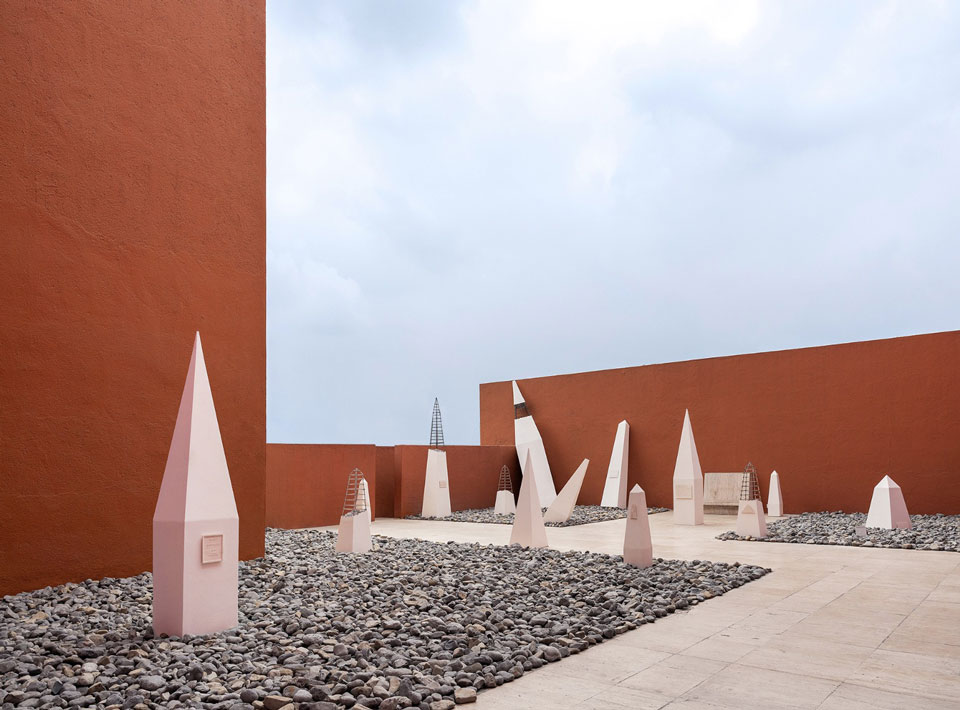
Falsos monumentos [False Monuments] (2025–2026) is a work by Carlos Vielma that found its success in error. After being on view from April to June 2025 in the Sculpture Patio at the Museo de Arte Contemporáneo (MARCO) in Monterrey, the obelisks that make up Aquí empieza la patria [Here the Homeland Begins] (2025) were relocated to the public space of Saltillo—the artist’s hometown—with the intention of observing, over the course of nearly a year, the deterioration, dirt, and neglect of an idea of what a monument should be.
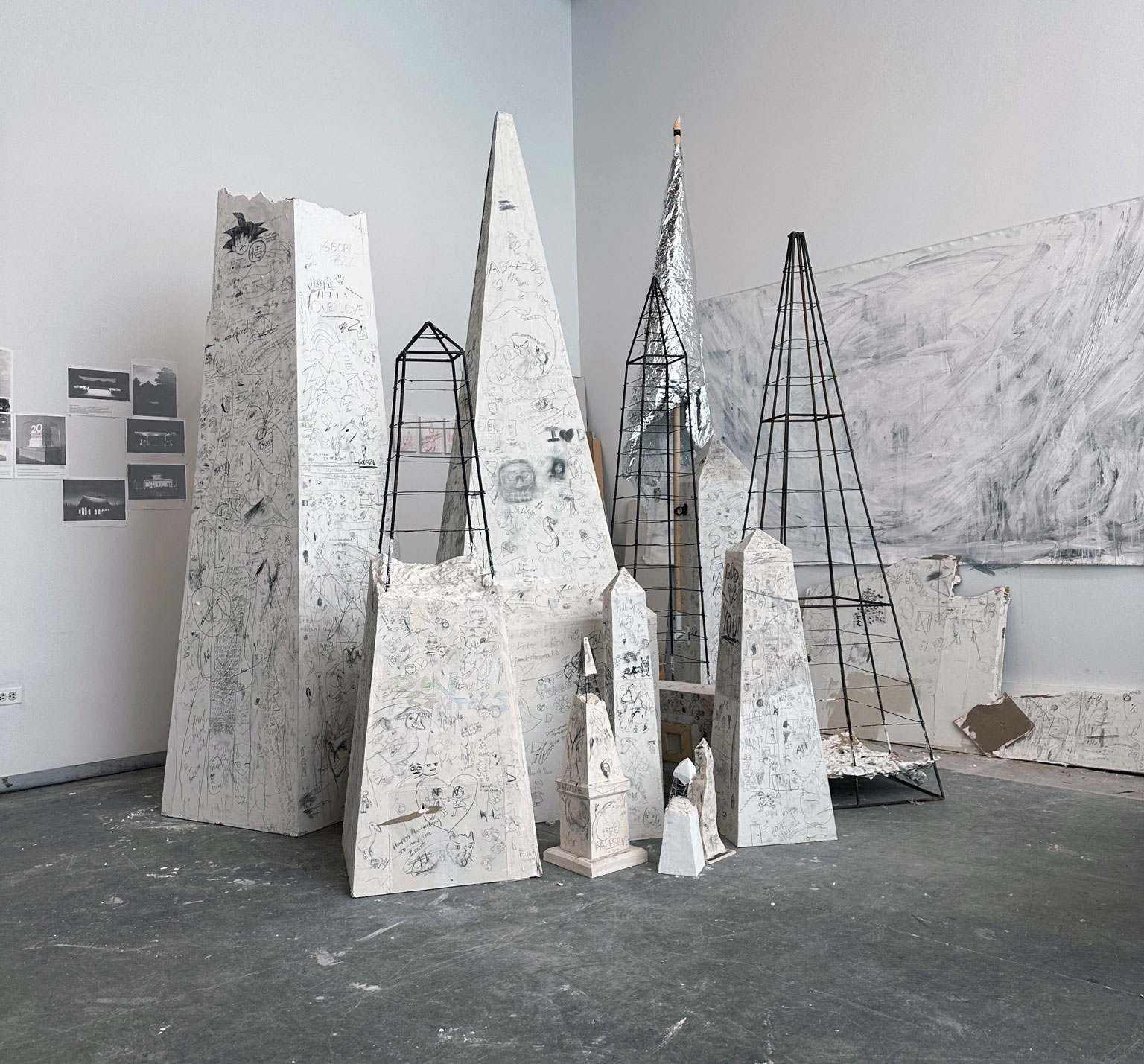
Throughout a career spanning just over a decade, a recurring thread is evident in Vielma’s work: error, iteration, and reinterpretation. This piece is only one part of a larger trajectory whose conceptual, material, and formal origins can be traced to Here the Homeland Begins (2024), presented at the Museum of Fine Arts, Houston. For this work, the artist created a series of obelisks made of drywall and, although they were situated within an institutional space, invited visitors to freely intervene on them using pencils and crayons. The monument’s simulacrum thus became a forum for political and social expression during the election in which Donald Trump was elected once again.
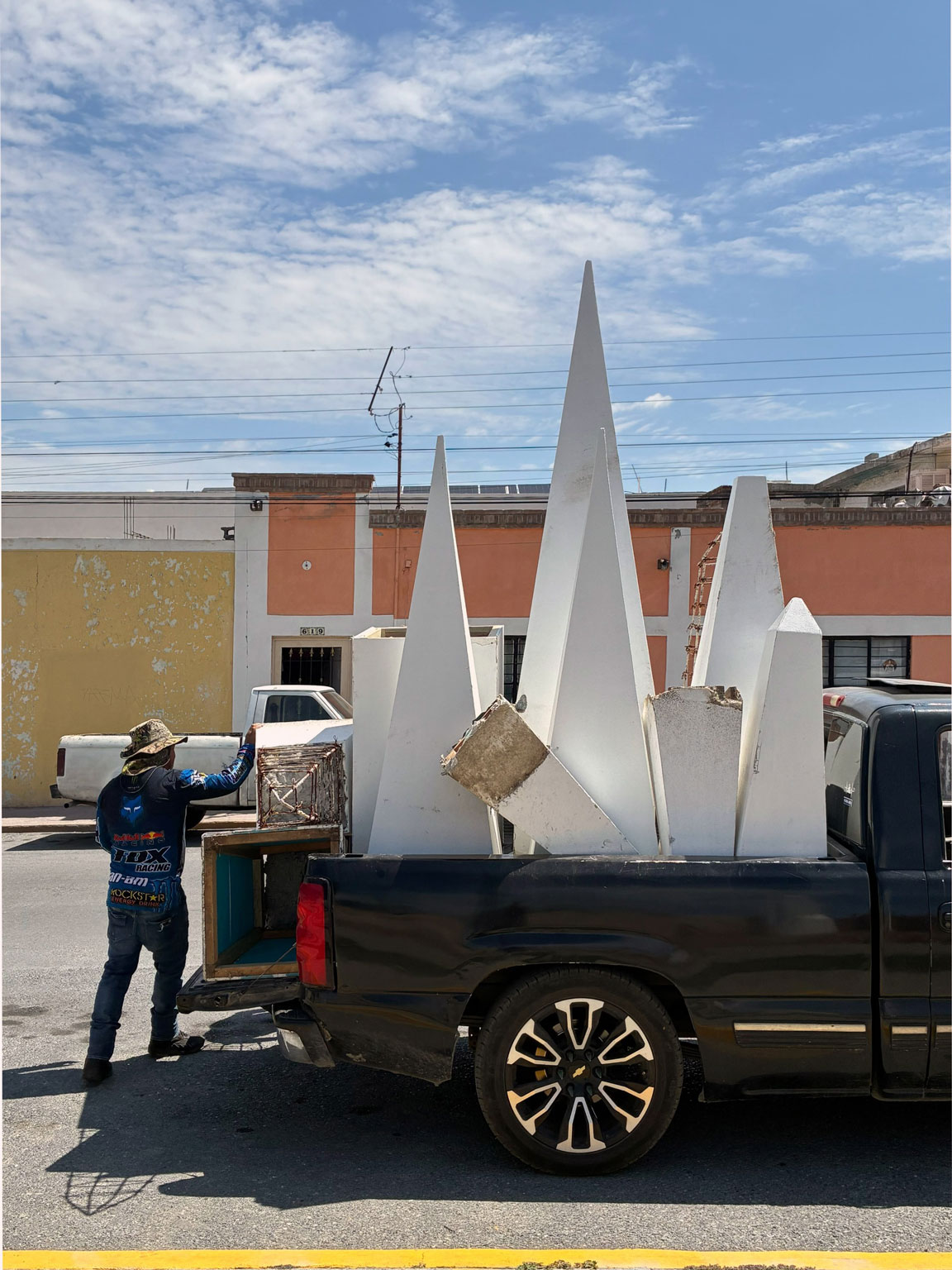
Against all expectations, the seven obelisks were removed from Plaza Coahuila in May 2026 in perfect condition, covered in solid layers of white paint and surrounded by the rumors sparked by their sudden appearance and disappearance. “Fiction is also part of the work,”2 the artist reflects upon learning what had happened. The structures were then dismantled and reworked once again by Vielma, renewing their material and symbolic trajectory. From Rosalind Krauss’s perspective, the logic of the monument links sculpture to a specific site, imbuing it with meaning through commemorative representation.3 In Vielma’s work, mobility and iteration disrupt this fixed relationship, opening up the possibility of observing how these objects relate to the space and the people who inhabit it. Through a process of hammering, polishing, and scraping, he sought to corrupt the unexpected process of preservation the pieces had undergone, exposing their fissures and the blue emerging from their backs.
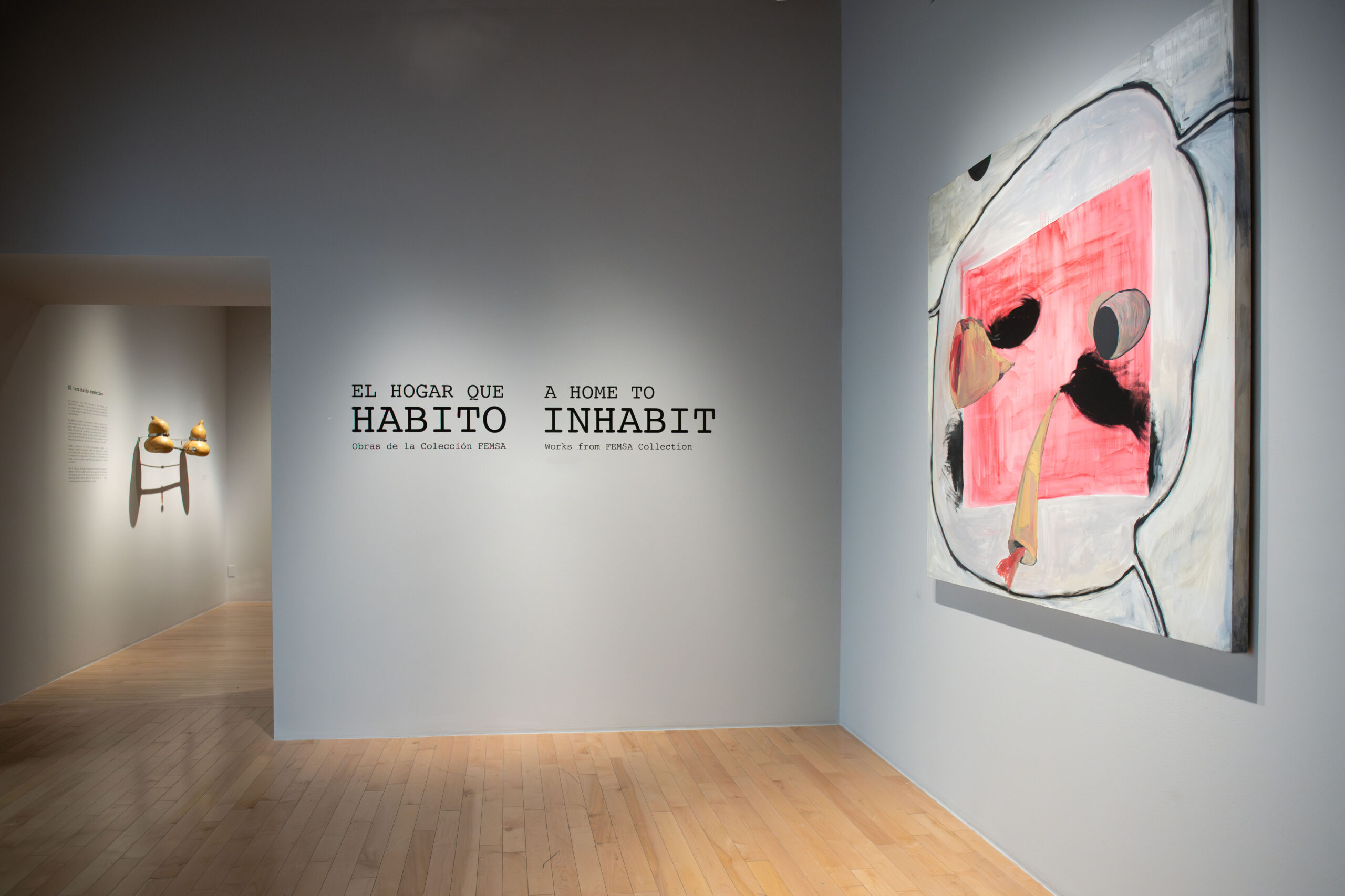
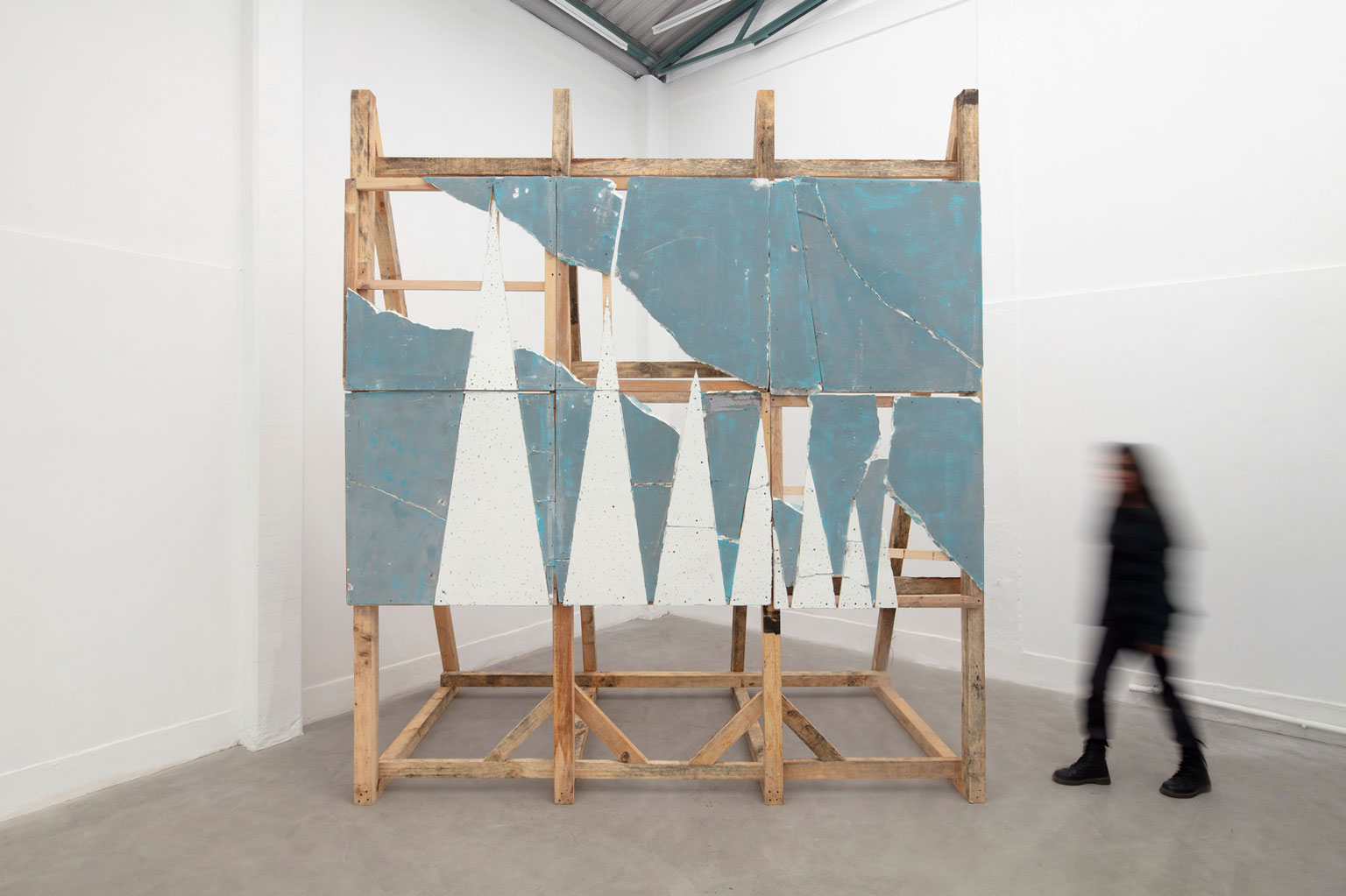
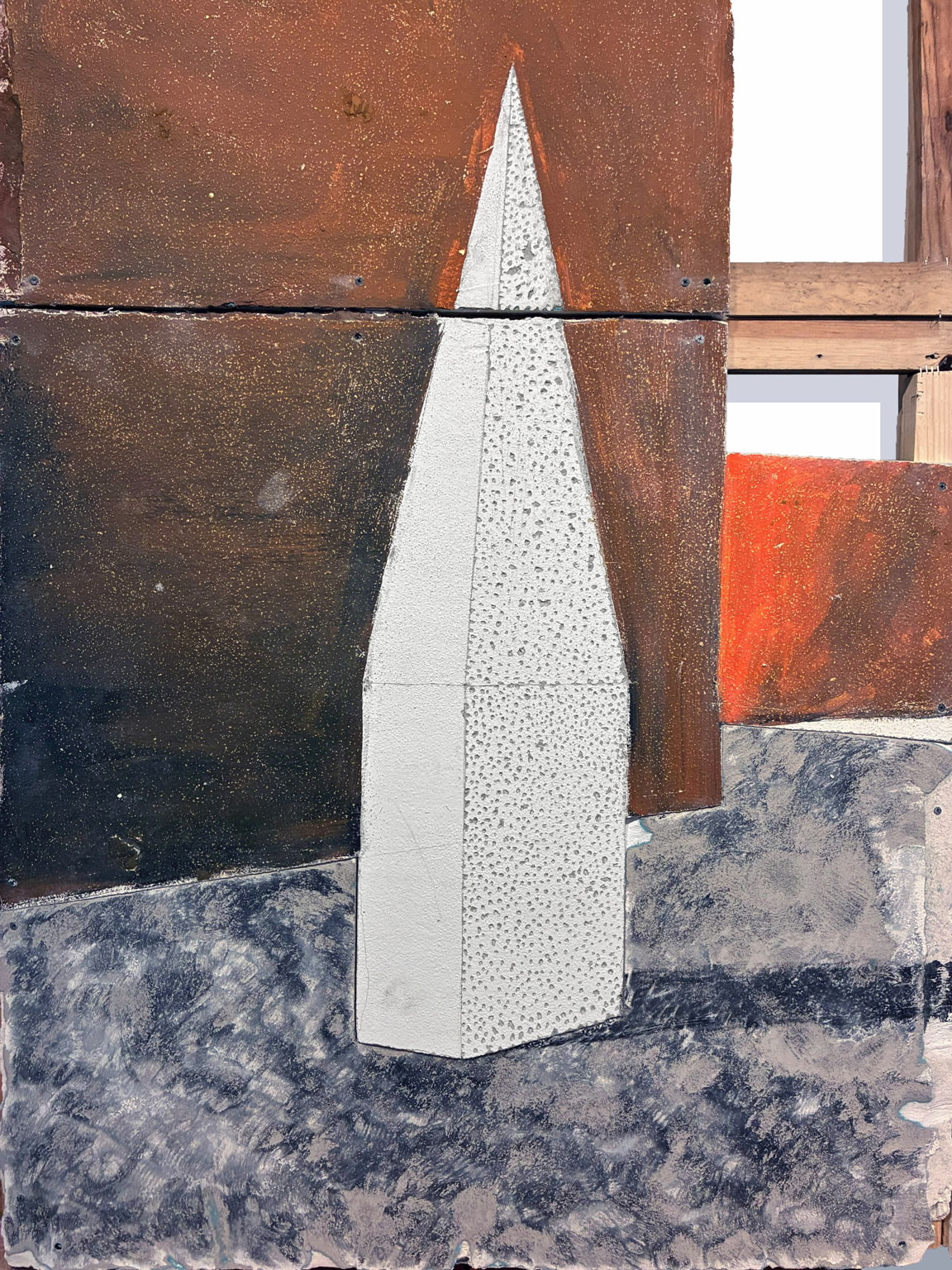
The most recent iteration of the piece took shape in Tolvanera [Dust Storm] (2026), Carlos Vielma’s solo exhibition at Galería Gobernador, curated by Rodrigo Torres Ramos. 7 Fantasmas [7 Ghosts] (2026) is the structure that now incorporates some of the panels whose journey began at MARCO. Are we looking at a ruin or a work in progress? In this reinterpretation, it is unclear whether the wooden scaffolding that supports it symbolizes an abandoned architectural project or the skeleton of something that was once a work of public sculpture. The artist describes it as “an installation-sculptural gesture, a kind of ruin and fresco unfolding in space.”4
The word fantasma (ghost) comes from the Greek phántasma, meaning “apparition,” and its oldest root, bha-, means to shine. A ghost, then, is not something that hides, but something that becomes visible, something that appears and shines. By definition, a ghost can be the image of a deceased person manifesting itself to the living, a chimerical vision, a dream, or an idea conjured by the mind. Specter, spirit, vision, soul, apparition. The word can also refer to the imminent threat of something terrible about to happen, to a latent tragedy. It can evoke what is false, nonexistent, or unreal. A town can become a ghost town when it is forgotten or abandoned. In public space, these seven ghosts multiplied through the fleeting presences of those who scribbled on them, those who tried to repair them, those who transported them, and those who speculated about their origins. For Vielma, the image of a white monolith standing in the middle of nowhere evokes a ghostly manifestation, something that should not be there. This image originates in the desert boundary markers that delineated the border long before the idea of a wall emerged.
Following the Treaty of Guadalupe Hidalgo, which brought an end to the war between Mexico and the United States in 1848, the new boundary line was to be “religiously respected by each of the two Republics.”5 The first marker indicating the division of the territory was established in 1849 as a mound of stones. Eventually, fifty-two markers were placed along the land border, stretching from Ciudad Juárez to Tijuana. Between 1891 and 1894, a binational commission rebuilt and expanded the system to include 258 obelisk-shaped monuments. Most were iron columns approximately 1.80 meters (six feet) tall, topped with pyramidal caps and mounted on concrete bases.6 These boundary markers bear plaques that, in writing, simultaneously indicate the beginning and the end.
The artist’s observations on the border began to take shape in Polvo doméstico [Domestic Dust] (2018), a work in which Vielma walks the streets of downtown Juárez, dragging a piece of fabric along the pavement to collect the layers of dirt accumulated through neglect on this side of the border. Since then, dust has become both a metaphorical device and the material substrate through which he explores different visions of the border.
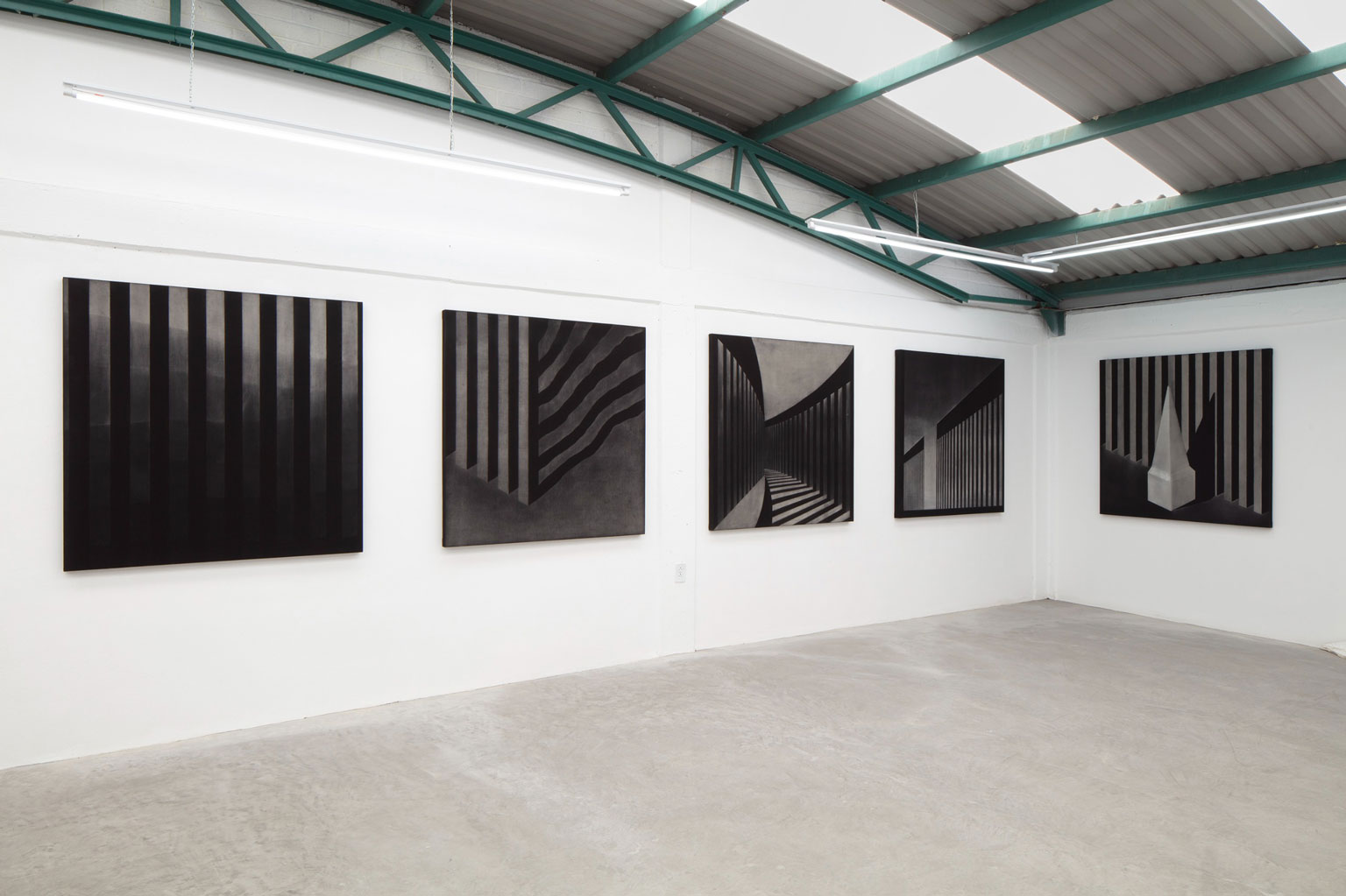
“A landscape temporarily erased by dust; a cloud that conceals individuals and territories alike”:7 so begins the curatorial text for Tolvanera, which foregrounds “the observation of territory, the dislocation of history, the persistence of migratory processes, and the transformations of the ideological representations of states,”8 through the symbolic and political charge of the materials the artist employs. The exhibition also featured several works from the series El peso relativo del polvo [The Relative Weight of Dust] (2019), ghostly images made by rubbing earth onto canvas, depicting abstract scenes of the border with metaphysical atmospheres reminiscent of those created by Giorgio de Chirico in his paintings. Here, the obelisk begins to emerge as a metaphor for the border. In the series Caminata nocturna [Night walk] (2021–2022), it assumes an increasingly prominent—and no less ghostly—presence. Made with cement on canvas, these abstractions emphasize the constructed nature of the division, reflecting on the wall as a system and the monolith as a catalyst for an imposed narrative.
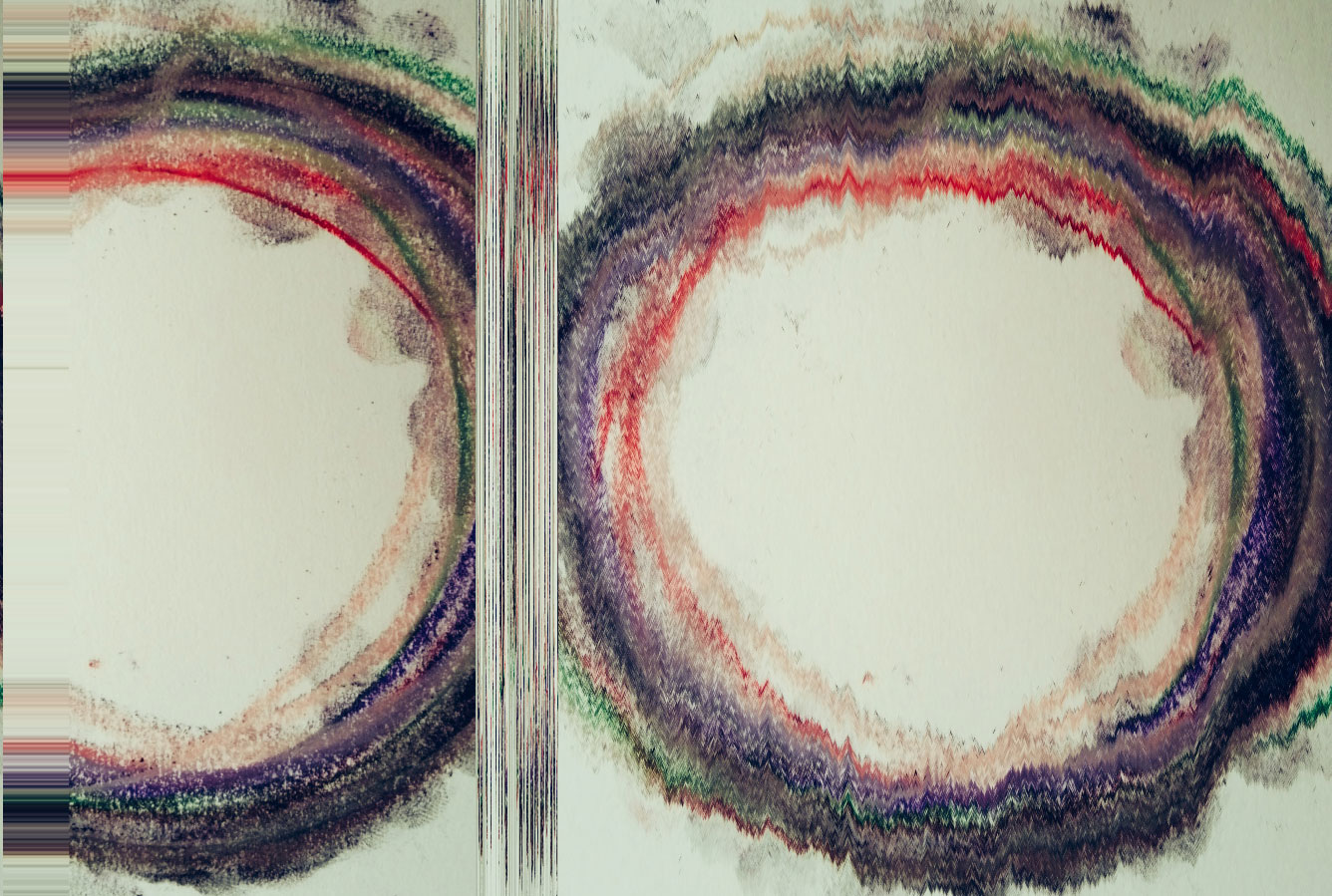
Aquí empieza la patria (2025), the title it shares with the obelisks presented at MARCO, also gave rise to a series of ceramic plaques that play with a narrative construction inhabiting, as the exhibition’s curator describes it, “an intermediate state between territorial designation and modernist concrete poetry.”9 In doing so, they highlight the “fragility of the written word”10 when it comes to defining a boundary—not only in its material form, but also in the symbolic construction that determines the identities of those on either side of the line.
“What is durability, after all, if not the will to endure?”11 asks Henri Lefebvre, reflecting on the imposing power of the monument. By proposing a shifting spatial hierarchy, Vielma plays with the monumental object as something devoid of fixed meaning, one that traverses a “horizon of meaning”12 and embraces a multiplicity of values that shift according to the moment and the actions of those who encounter it. While the sky is what the obelisk seeks to reach, dust will always be what remains. In Plaza Coahuila, the sky was above, the dust below, and in the distance, as every day, the Sierra de Zapalinamé.
“Falsos monumentos” (“False Monuments”), 2025–2026. Carlos Vielma. Plaza Coahuila, Saltillo.
No one really knows what happened. As with everything in this town, stories circulate by word of mouth, but the original voice that first conjured those words is never known. The facts, however, were undeniable: seven white obelisks had mysteriously appeared in Plaza Coahuila, in downtown Saltillo. How long had they been there, and who had put them up? There was no plaque, nor any indication of the person responsible for this unofficial gift, supposedly placed for the benefit of Saltillo’s residents.
Every day, as she leaves her home on Arroyo Street, an anonymous woman walks past the new monument, just a few meters from where it appeared. She is on her way to the Senior Citizens Center, arriving just in time for lunch. Since her husband’s death, the Center has become her refuge, a place for leisure, and the destination that gives shape to the hours of her days. Having lived in the same house for more than forty years, she notices even the slightest changes in her surroundings. Perhaps she is the only chronicler who remembers the exact day the obelisks arrived in this rather barren plaza, where the few pine trees and palm trees offer little shelter from the sun’s imposing rays. An otherwise ordinary day, marked by the usual household routines, was abruptly interrupted by a subtle tragedy: another anonymous soul had dared to deface the untouchable whiteness of the new monument the government had installed in the plaza, scrawling little drawings and messages such as “I don’t love my country” and “Smile, it’s free.”
She liked things done properly: protocol, and respect for the established order. Although she had retired after years of service to the state, her commitment to her city led her to take it upon herself to look after this gift. Who knew what it meant or what it was for, but surely the government had put it there for a reason. That was reason enough to protect it. That afternoon, after finishing her usual Tuesday game of lotería, she stopped on her way home to buy a paintbrush and some ghostly white paint. Without a second thought, she set out, determined to cover each of the seven obelisks, from base to tip. She finished exhausted but satisfied. Unbeknownst to her, she had just inaugurated a new ritual. Every week, she would set out with her paint and brush to erase the obscenities left behind by inconsiderate people who had no respect for anything or anyone. People who failed to understand that something was important simply because it had been placed there, in the plaza, beside the bronze equestrian statue of Zapata. This self-imposed duty occupied much of her afternoons for nearly a year, until one day she stepped out of her house and was met with the devastating surprise that the obelisks had vanished without a trace.
“Falsos monumentos” (“False Monuments”), 2025–2026. Carlos Vielma. Public space, Saltillo.
A second version of the stories that emerged around this sudden appearance involves the same woman (a ghost), who, armed with all her civic training, is said to have called the police. The police, in turn, supposedly contacted the state tourism authorities, who ordered the obelisks to be repainted and restored to their pristine white. Georgina Cebey writes that “to be read, the monument is positioned vertically in the minds of citizens: an official narrative erects it and, insofar as possible, the population acts upon it.”1 What political and spatial predispositions are at play in this need to whiten what is destined to deteriorate under the elements? What is worth preserving, and why? Where does the desire—or the call—to protect public space as though it belonged to someone originate? What does one do with that which, in theory, belongs to everyone and no one?
Falsos monumentos [False Monuments] (2025–2026) is a work by Carlos Vielma that found its success in error. After being on view from April to June 2025 in the Sculpture Patio at the Museo de Arte Contemporáneo (MARCO) in Monterrey, the obelisks that make up Aquí empieza la patria [Here the Homeland Begins] (2025) were relocated to the public space of Saltillo—the artist’s hometown—with the intention of observing, over the course of nearly a year, the deterioration, dirt, and neglect of an idea of what a monument should be.
“Aquí empieza la patria” (“Here the Homeland Begins”), 2025. Carlos Vielma. Sculpture Patio, MARCO, Monterrey.
Throughout a career spanning just over a decade, a recurring thread is evident in Vielma’s work: error, iteration, and reinterpretation. This piece is only one part of a larger trajectory whose conceptual, material, and formal origins can be traced to Here the Homeland Begins (2024), presented at the Museum of Fine Arts, Houston. For this work, the artist created a series of obelisks made of drywall and, although they were situated within an institutional space, invited visitors to freely intervene on them using pencils and crayons. The monument’s simulacrum thus became a forum for political and social expression during the election in which Donald Trump was elected once again.
“Here the Homeland Begins”, 2024. Carlos Vielma. Museum of Fine Arts, Houston.
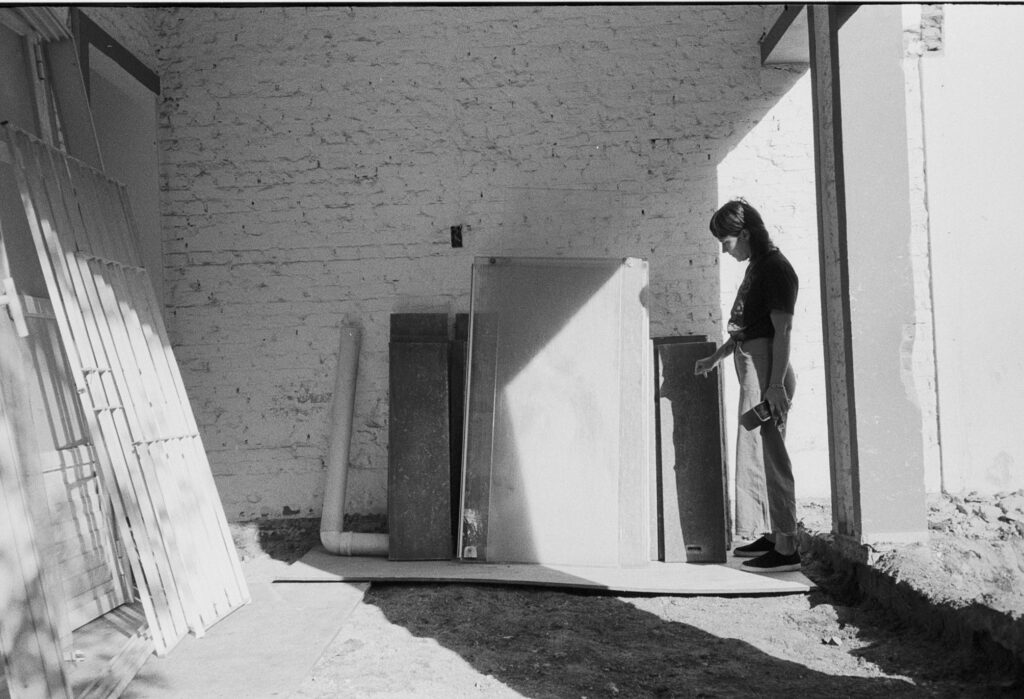
Against all expectations, the seven obelisks were removed from Plaza Coahuila in May 2026 in perfect condition, covered in solid layers of white paint and surrounded by the rumors sparked by their sudden appearance and disappearance. “Fiction is also part of the work,”2 the artist reflects upon learning what had happened. The structures were then dismantled and reworked once again by Vielma, renewing their material and symbolic trajectory. From Rosalind Krauss’s perspective, the logic of the monument links sculpture to a specific site, imbuing it with meaning through commemorative representation.3 In Vielma’s work, mobility and iteration disrupt this fixed relationship, opening up the possibility of observing how these objects relate to the space and the people who inhabit it. Through a process of hammering, polishing, and scraping, he sought to corrupt the unexpected process of preservation the pieces had undergone, exposing their fissures and the blue emerging from their backs.
“Falsos monumentos” (“False Monuments”), 2025–2026. Carlos Vielma. Transport of the pieces.
The most recent iteration of the piece took shape in Tolvanera [Dust Storm] (2026), Carlos Vielma’s solo exhibition at Galería Gobernador, curated by Rodrigo Torres Ramos. 7 Fantasmas [7 Ghosts] (2026) is the structure that now incorporates some of the panels whose journey began at MARCO. Are we looking at a ruin or a work in progress? In this reinterpretation, it is unclear whether the wooden scaffolding that supports it symbolizes an abandoned architectural project or the skeleton of something that was once a work of public sculpture. The artist describes it as “an installation-sculptural gesture, a kind of ruin and fresco unfolding in space.”4
“7 Fantasmas” (“7 Ghosts”), 2026. Carlos Vielma. Galería Gobernador, Mexico City.
The word fantasma (ghost) comes from the Greek phántasma, meaning “apparition,” and its oldest root, bha-, means to shine. A ghost, then, is not something that hides, but something that becomes visible, something that appears and shines. By definition, a ghost can be the image of a deceased person manifesting itself to the living, a chimerical vision, a dream, or an idea conjured by the mind. Specter, spirit, vision, soul, apparition. The word can also refer to the imminent threat of something terrible about to happen, to a latent tragedy. It can evoke what is false, nonexistent, or unreal. A town can become a ghost town when it is forgotten or abandoned. In public space, these seven ghosts multiplied through the fleeting presences of those who scribbled on them, those who tried to repair them, those who transported them, and those who speculated about their origins. For Vielma, the image of a white monolith standing in the middle of nowhere evokes a ghostly manifestation, something that should not be there. This image originates in the desert boundary markers that delineated the border long before the idea of a wall emerged.
Following the Treaty of Guadalupe Hidalgo, which brought an end to the war between Mexico and the United States in 1848, the new boundary line was to be “religiously respected by each of the two Republics.”5 The first marker indicating the division of the territory was established in 1849 as a mound of stones. Eventually, fifty-two markers were placed along the land border, stretching from Ciudad Juárez to Tijuana. Between 1891 and 1894, a binational commission rebuilt and expanded the system to include 258 obelisk-shaped monuments. Most were iron columns approximately 1.80 meters (six feet) tall, topped with pyramidal caps and mounted on concrete bases.6 These boundary markers bear plaques that, in writing, simultaneously indicate the beginning and the end.
The artist’s observations on the border began to take shape in Polvo doméstico [Domestic Dust] (2018), a work in which Vielma walks the streets of downtown Juárez, dragging a piece of fabric along the pavement to collect the layers of dirt accumulated through neglect on this side of the border. Since then, dust has become both a metaphorical device and the material substrate through which he explores different visions of the border.
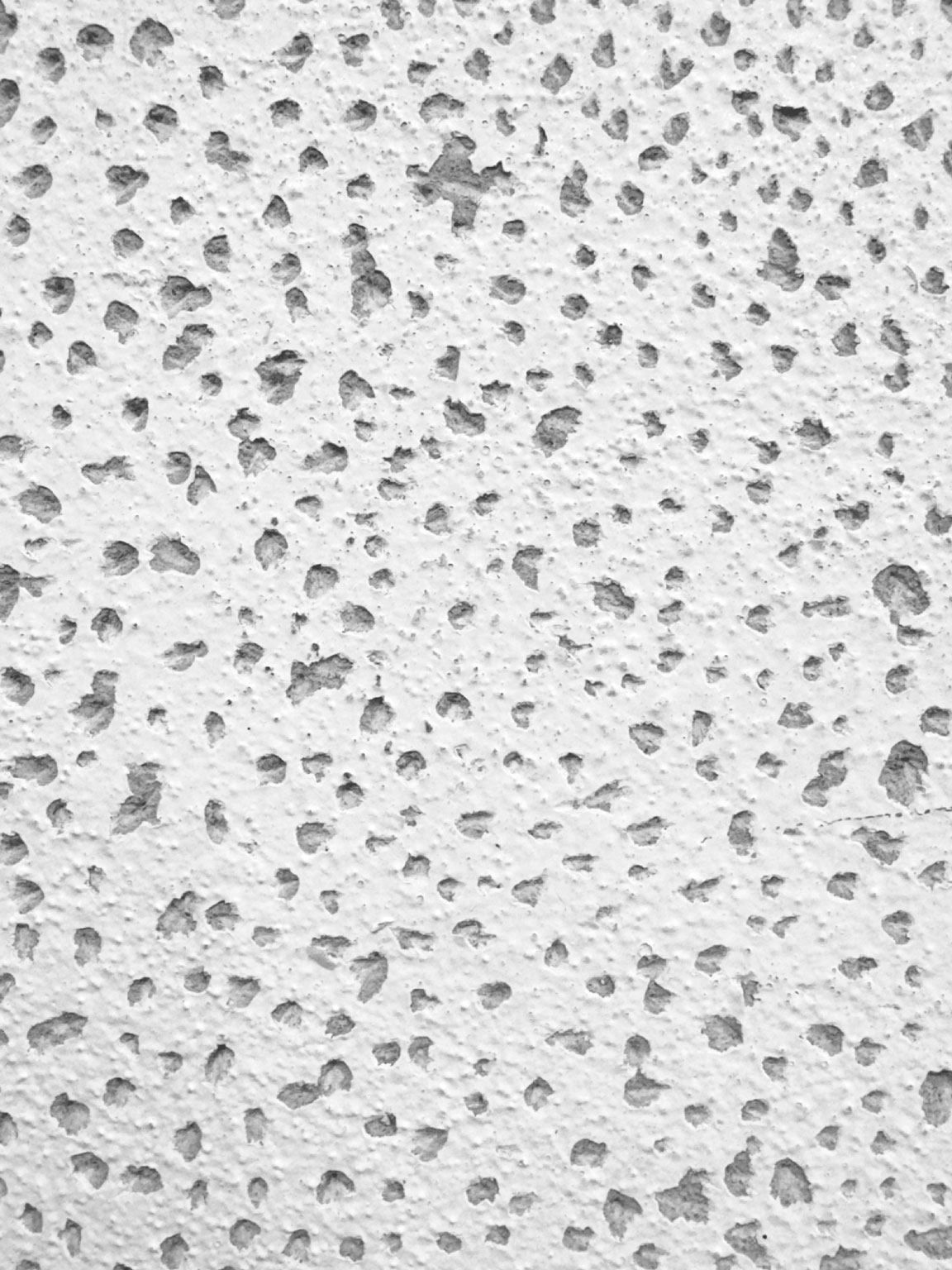
Detail of “Falsos monumentos” (“False Monuments”), 2025–2026. Carlos Vielma.
“A landscape temporarily erased by dust; a cloud that conceals individuals and territories alike”:7 so begins the curatorial text for Tolvanera, which foregrounds “the observation of territory, the dislocation of history, the persistence of migratory processes, and the transformations of the ideological representations of states,”8 through the symbolic and political charge of the materials the artist employs. The exhibition also featured several works from the series El peso relativo del polvo [The Relative Weight of Dust] (2019), ghostly images made by rubbing earth onto canvas, depicting abstract scenes of the border with metaphysical atmospheres reminiscent of those created by Giorgio de Chirico in his paintings. Here, the obelisk begins to emerge as a metaphor for the border. In the series Caminata nocturna [Night walk] (2021–2022), it assumes an increasingly prominent—and no less ghostly—presence. Made with cement on canvas, these abstractions emphasize the constructed nature of the division, reflecting on the wall as a system and the monolith as a catalyst for an imposed narrative.
Exhibition view of “Tolvanera” (“Dust Storm”), 2026. Carlos Vielma. Galería Gobernador, Mexico City.
Aquí empieza la patria (2025), the title it shares with the obelisks presented at MARCO, also gave rise to a series of ceramic plaques that play with a narrative construction inhabiting, as the exhibition’s curator describes it, “an intermediate state between territorial designation and modernist concrete poetry.”9 In doing so, they highlight the “fragility of the written word”10 when it comes to defining a boundary—not only in its material form, but also in the symbolic construction that determines the identities of those on either side of the line.
Process for “Falsos monumentos” (“False Monuments”), 2025–2026. Carlos Vielma.
“What is durability, after all, if not the will to endure?”11 asks Henri Lefebvre, reflecting on the imposing power of the monument. By proposing a shifting spatial hierarchy, Vielma plays with the monumental object as something devoid of fixed meaning, one that traverses a “horizon of meaning”12 and embraces a multiplicity of values that shift according to the moment and the actions of those who encounter it. While the sky is what the obelisk seeks to reach, dust will always be what remains. In Plaza Coahuila, the sky was above, the dust below, and in the distance, as every day, the Sierra de Zapalinamé.