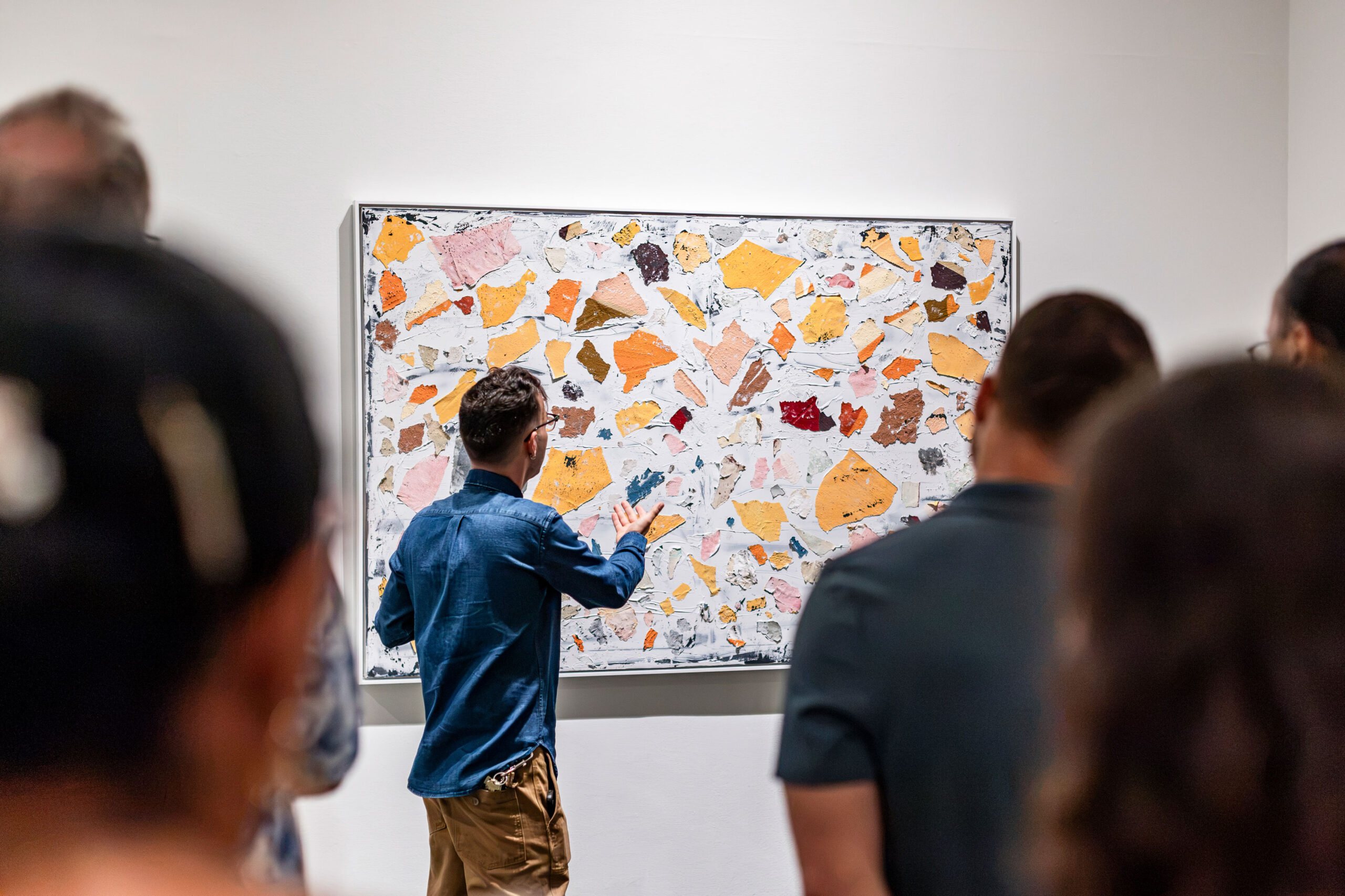
Abdiel D. Segarra Ríos, curator of Diasporican Abstraction: Identities Beyond Representation, proposes a shift in perspective: to read abstraction through the diaspora, through the ongoing movement between Puerto Rico and other territories. In this view, abstraction is not only a consequence of physical displacement but also a site of cultural production and diasporic enunciation. Sofía Acosta-Varea speaks with Abdiel to explore a central question: what happens to Puerto Rican identity when it is no longer defined through representation?
A Conversation with Abdiel D. Segarra Ríos, Curator of Diasporican Abstraction: Identities Beyond Representation, an exhibition at the Museo de Arte Contemporáneo de Puerto Rico.
October 14, 2026
The history of abstraction has largely been constructed through the hegemonic narratives of the Global North. With Diasporican Abstraction: Identities Beyond Representation, curator Abdiel D. Segarra Ríos proposes a shift in perspective: to read abstraction through the diaspora, through the ongoing movement between Puerto Rico and other territories—a dynamic shaped not only by displacement, but also by cultural production and new forms of enunciation. Bringing together more than sixty artists across generations, the exhibition explores this space through a central question: What happens to Puerto Rican identity when it is no longer defined through representation?
I spoke with Abdiel amid internet outages, technological glitches, and inexplicable abstractions. Perhaps it was no coincidence: we were talking about what gets lost, what transforms, and what continues to be said in transit.
SOFÍA: What led you to approach the exhibition through the lens of the diaspora rather than positioning the island as its center?
ABDIEL: I lived outside Puerto Rico for eight years. I left with a one-way ticket to Madrid, thinking I would never return. As I lived through that migrant experience and became part of the diaspora, I realized how my own place of enunciation gradually shifted. You change in transit; you never entirely leave behind the place you came from, because that place travels with you, too. The journey shapes you, as you learn to understand yourself within the logic of another place.
Here’s an anecdote. While I was living in Spain, I worked as a nanny. The children’s mother would often say to me, “Oh, I see, you’re part of a diaspora!” At first, I would reply, “Well, I hadn’t realized that.” It was through her repeated remarks that I came to understand that most of the people I had studied with at university, or gone to school with, no longer lived in Puerto Rico—and neither did I. So I began to look more closely at the archipelago’s cultural, social, and political history over the previous six or seven decades.
That made me think about where my Puerto Ricanness is located. From where is it articulated? What other experiences shape the production of meaning around it? For me, it was revealing to realize that, while living abroad, I crossed paths with more Caribbean people from other territories than I had when I lived in the Caribbean itself. This led me to question where the idea of Puerto Ricanness is constructed from, and what imaginaries shape that project of identity. Who gets to take part in that conversation? While living in Spain, I made friends from the Dominican Republic, Colombia, Cuba, Honduras, Ecuador, and various African countries who, in different ways and without even realizing it, were participating in, extending, and broadening the conversation about the Caribbean. Perhaps more than I had been able to see while living in Puerto Rico.
I remember Cuban curator Gerardo Mosquera, who lives in Madrid, speaking about an expanded Caribbean—a notion that went beyond cartographic or geographical boundaries, extending across the Americas and even reaching other continents. This made me think about the sense of dislocation I was experiencing and led me to question the validity and limits of a national narrative that insists on articulating itself within geopolitical borders.
Puerto Rico is also home to people who have come from elsewhere, and we share these diasporic spaces with other communities: the Dominican diaspora, for instance, which we encounter in New York, as well as Cuban, Colombian, Venezuelan, and just about any other diaspora you can think of. Ultimately, the Caribbean is a place of movement, and it has been so since before colonization.
SOFÍA: If we understand the Puerto Rican experience beyond political borders and the geography of the archipelago, we must acknowledge that Puerto Rico lives under a colonial condition that has driven entire generations to migrate. How does abstraction engage with this reality? Can an “abstract” practice also be a form of resistance or critique?
ABDIEL: Ever since I was a child, Puerto Rico has been—and continues to be—a colony. As a result, we often speak from a position where the ideas of colonialism and nationhood are contested.
Perhaps this has to do with matters of political administration, with how this territory is governed. But it undoubtedly has repercussions for the construction of a collective identity and for the ways in which we discuss who we are and who we are not. Puerto Rico’s visual culture, shaped by a discursive modernity that took hold—more or less—with the establishment of the Commonwealth in the 1950s, emerged and consolidated itself within a figurative imaginary, constructed through a state-funded propaganda project.
This project was carried out through institutions such as the Division of Community Education and the Institute of Puerto Rican Culture. This entire network of cultural institutions also encompassed the University of Puerto Rico, which, although founded in 1903, opened itself up in the 1950s to the island’s new political status. As a result, a substantial body of work by artists from the 1940s was rendered invisible in the process of constructing that imaginary.
There was a need to affirm a sense of Puerto Ricanness through an image that reflected this discursive form of mestizaje, which the new political paradigm, together with its cultural institutions, used to declare: “Here, we are a mixture of Taíno, European, and African peoples; we are one big Puerto Rican family, the result of a happy and fortuitous process of racial and cultural mixing in which Castilian, or Spanish, is the fundamental vernacular language, the backbone of national identity.” The people invited to sit at this table played a very particular role: they did not choose it for themselves; rather, those who were already seated decided what it meant—and what it did not mean—to be Puerto Rican.
In the 1950s, abstraction was associated with the boom of American Abstract Expressionism, and was therefore understood in Puerto Rico as a market-driven trend. It was taken for granted that artists who practiced abstraction had been seduced by these aesthetics and were traitors to the national cause, because their images did not affirm the project of identity that needed to be defended against the wave of American cultural assimilation.
Abstraction has almost always been viewed in relation to its European and American counterparts, and this is by no means unique to Puerto Rico. With the exception of Neoconcretism and Venezuelan kinetic art, I think that in many other places where abstraction is practiced, it suffers a similar kind of erasure, because visual languages outside the Western canon are not taken into account. There is an impulse to question that national discourse, to make it more porous: these artists are not necessarily concerned with affirming those paradigms, but perhaps with inscribing a different kind of experience into a language that is ambiguous, ambivalent, and open-ended.
SOFÍA: If Puerto Ricanness was affirmed through a closed national narrative, the exhibition seems to propose the opposite: migration, memory, territories, bodies, and identities continually intersect and exist in tension. How did you develop the exhibition’s thematic framework?
ABDIEL: It was very important to me that the way the artworks were distributed throughout the museum’s galleries would not reproduce the logic of categorization. My argument is that the categories established by universal art history are insufficient, which is why I conceived the exhibition through the idea of an ecosystem: a kind of thematic ecosystem. The way the works are arranged allows audiences to play with the possibility that one work could be placed alongside another, and that a single work can belong to several ecosystems across the galleries. There is an intention behind this, an invitation to reflect on how the works are grouped.
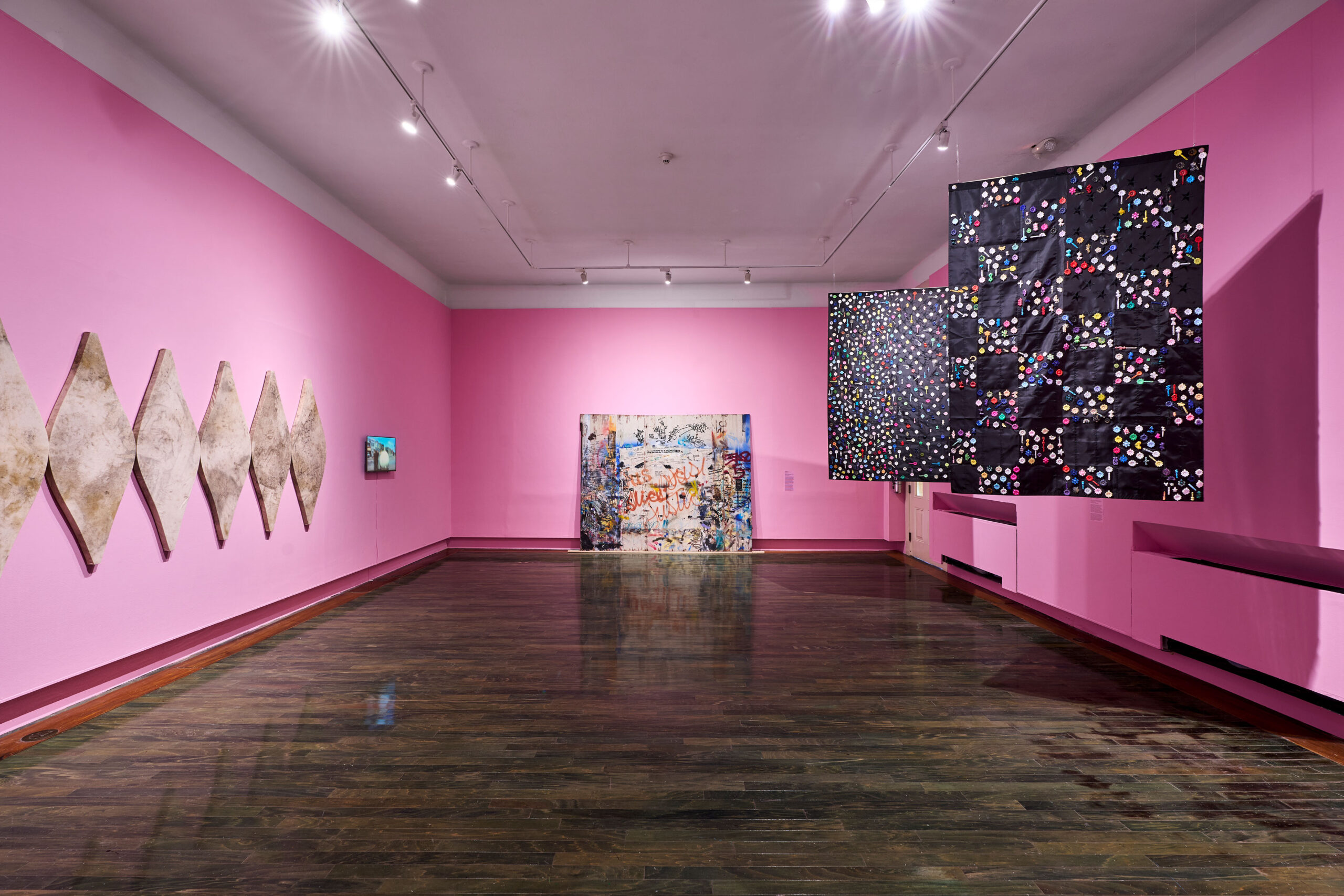
The first ecosystem invites viewers to think about the act of painting. It begins with the work of Olga Albizu, whose paintings appeared on several jazz and bossa nova album covers of the time. Her highly gestural, chromatic work enters into dialogue with that of Gisela Colón, whose practice centers on color without any intervention by the human hand. Colón’s work, in turn, dialogues with that of Fernando Colón, who creates paintings through a single gesture: these are not loose brushstrokes, but forms made with a single line. These three examples are very different from one another, but they all invite viewers to ask what motivates these artists to paint. That act, in turn, opens up a reflection on materiality—the second ecosystem. The choice of materials already produces meaning, because a work is informed by what it is made of and by the place it occupies in the gallery as an object in relation to other objects.
The next ecosystem considers the natural environment as a point of reference, and explores how landscape and observation inform each artist’s creative process. It brings together works that engage with climate, the environment, and, why not, the very tradition of landscape painting. These works may not be abstract in the strict sense of what we would typically expect abstraction to look like, but they do play with abstracting the “referent.”
For me, it is important that the exhibition, as a whole, also question abstraction itself as a category. In this sense, looking at the natural environment as a point of reference opens up a broader conversation about the ancestral. A number of works explore this idea, but not through a folklorized or self-contained vision of the past. Instead, the ancestral emerges as an aesthetic through which we can think about the present and the future. It has not been fossilized or confined to the past; it remains latent, continuing to inform and inspire new aesthetic languages.
We are not looking toward American Abstract Expressionism, but rather toward the body, the territory, and the pictographic imagery and markings found here—in the rocks and in the landscape we inhabit. This also raises questions about how the experience of abstraction is materialized, or whether it is materialized at all. That is why we decided to include sound works in the exhibition.
From there, we move toward cartography and more explicitly political conversations. This is where questions of race come in: identities shaped by the demographic landscape. This, in turn, leads us to the next ecosystem, the city. We ask how we inhabit the city and how that experience of inhabiting it accumulates, at times, in abstract gestures that seek to leave a trace of our passage through the cities we arrive in, as well as through those cities where, as migrants, no archive of our presence remains.
Another thematic thread focuses on embodiment, though not necessarily in an anatomical sense. It is an embodiment rooted in the realm of the sensuous: how the body serves as a vehicle for feeling, experiencing, and producing images, without necessarily referring back to a canonical notion of the body. There is also a group of works that engage with music, which makes another appearance here, but always in relation to the movement of the body. Around these musical practices, Colombian, Panamanian, and Dominican artists enter into dialogue with artists who identify as Puerto Rican. Finally, there is an ecosystem in which works concerned with geometry coexist with pieces that explore the ornamental, the architectural, and the domestic.
SOFÍA: It’s a conversation that crosses borders.
ABDIEL: Yes, and that leads into another thematic thread, one concerned with geometry and form, but above all with ornamentation and vernacular architecture. That is why the works are placed so close to one another: to break away from the formal conception of abstraction and the museographic conventions that condition how we read and relate to images we understand as abstract.
And those are all the ecosystems.
SOFÍA: These ecosystems function like a map: the exhibition route guides you from one point to the next, but each ecosystem contains others within it. One of the things that caught my attention most was the dialogue across generations. I particularly liked the placement of works by Awilda Sterling and Zilia Sánchez. They belong to an earlier generation, but their work remains active today, and it is placed alongside works that make you wonder, “How did these come together?” Could you tell us more about these intergenerational dialogues?
ABDIEL: Absolutely. This is not an exhibition that seeks to be historical in the conventional sense of art history. I am not narrating the history of Puerto Rican abstraction from beginning to end, nor am I trying to construct a linear narrative.
For me, this is a question of temporality, which is also a political construct, and I believe abstraction allows us to disrupt these ways of telling stories. I always envisioned the exhibition as an intergenerational dialogue. For example, Awilda is in close conversation with Paulina Pagán Picó, an artist under forty who will activate her piece through a vertical choreography within the gallery. Her work resonates deeply with Awilda’s, particularly with her project Blindfolded, in which she covers her eyes and listens to a selection of musical pieces she has studied over a long period of time. With her eyes closed, she leaves behind marks—a series of gestures and a choreography that she feels but cannot see. This is a deliberate dialogue between a young artist and a veteran who has spent many decades refining several bodies of work that bring together the choreographic and the pictorial. There are many poetic resonances that emerge from that initial formal layer, the one we all see, which is why it is important to me that the exhibition feel like an open invitation to further interpretations.
SOFÍA: Finally, what did it mean to bring together, for the first time in Puerto Rico, works from the collection of El Museo del Barrio in New York and private collections alongside the Museo de Arte de Puerto Rico (MAC) permanent collection? What does this dialogue reveal about the circuits through which Puerto Rican art circulates and gains legitimacy?
ABDIEL: I was very excited about bringing works from the collection of El Museo del Barrio to the archipelago for the first time, as a well-intentioned effort. This museum has spent a long time preserving and valuing a cultural heritage that generally exists separately from the collections held by art museums in Puerto Rico, which have focused more on constructing a narrative of Puerto Rican art from within the archipelago.
It is interesting to consider how this narrative is constructed. We know that Puerto Ricans move back and forth, and that this mobility is woven into the experience of Puerto Ricanness. Yet when it comes to narrating the development of art, there is a tendency toward a more linear account, one that generally leaves out artists based in the diaspora.
Bringing these collections together, then, is not merely a transaction; it is a way of asking who gets to decide what counts as Puerto Rican art and from where that story is told. If Puerto Ricanness is also articulated from New York or Madrid, then the map of artistic recognition must expand, just like the Caribbean itself. In this way, works from the diaspora cease to exist as a separate archive and become part of the same conversation as the MAC’s collection and works held in private collections.
SOFÍA: And before we wrap up, I’d like to ask how the exhibition connects with sound and music. I sensed a sonic dimension in some of the galleries that extends beyond abstraction. What contributions would you highlight, particularly in thinking about the diaspora and sound as a form of historical resistance in Puerto Rico?
ABDIEL: One of David Santamaría’s works seeks to unfold a selection of rhythms we know as salsa through abstract images. It opens up a conversation about the rhythmic, territorial, and musical diversity underlying the salsa project. For me, music was an easier way to explain the idea of the diasporic, because people have listened to far more salsa than they have encountered abstraction in public spaces. It was a happy coincidence that a Colombian artist, collector of Puerto Rican music, and friend of mine had developed a body of work that gave visual form to those rhythms through non-narrative images.
Santamaría designed a program, a kind of robot, that generates marks for each of the instruments played in these orchestras. He selects songs from his own collection and generates an array of stains through their playback. These stains resemble the iris of an eye; they do not directly reference the stories told in the songs, but are a literal imprint of the sound itself. This, in turn, reminds me of when a law on autochthonous music was passed here to encourage the hiring of groups that performed rhythms the institution considered indigenous to Puerto Rico, folkloric, and distinctly Puerto Rican. Salsa was excluded: cultural policies did not consider it sufficiently Puerto Rican, so it was ineligible for funding. And yet it is a rhythm with which Puerto Ricans deeply identify. You arrive in Puerto Rico, and even today, salsa is still playing. The same is true of reggaeton.
That is why this piece enters into dialogue with the work of Cisco Merel, a Panamanian artist. His work does not directly address rhythms, but music is an integral part of the installations he creates with la máquina del flow [the machine of flow]: abstractions derived from the decorations on diablos rojos [red devils], buses equipped with sound systems that often blast dancehall, the rhythmic foundation of reggaeton as well. Reggaeton is strongly associated with Puerto Rico, but it is not exclusively Puerto Rican. It is a Caribbean and deeply diasporic rhythm that, like salsa, speaks to patterns of migration within the Caribbean and from the Caribbean to the United States.
I do think there is an element of resistance, but it is neither exclusively national nor exclusively diasporic. It is a reclaiming of territory through these rhythms that circulate globally, rhythms that become spaces for the production of identities, affirmations, and forms of resistance that transcend Puerto Ricanness. This is one of the voices, one of the ingredients, within a chorus of subalternities: Afro-diasporic sounds emerging from different territories across the Caribbean and beyond.
From that perspective, it has been incredibly rewarding to see people’s surprise as they discover the work of artists they had not known about, despite their long careers. The poetic justice I hoped to bring to the work of some of the artists in the exhibition has come to fruition, and in a positive way. Visitors arrive with fresh, curious eyes, expecting a typical exhibition of Puerto Rican art or abstraction, only to discover that they are being invited to take part in an exercise in reinterpreting these concepts, as well as their own notions of Puerto Ricanness, abstraction, and the diasporic, and in considering how all of these are potentially interconnected—with how we experience who we are and how we relate to one another.
Abdiel D. Segarra Ríos at the opening of “Diasporican Abstraction: Identities Beyond Representation”, Museum of Contemporary Art of Puerto Rico. September 26, 2026. Photo: Adriana Vázquez.
A Conversation with Abdiel D. Segarra Ríos, Curator of Diasporican Abstraction: Identities Beyond Representation, an exhibition at the Museo de Arte Contemporáneo de Puerto Rico.
October 14, 2026
The history of abstraction has largely been constructed through the hegemonic narratives of the Global North. With Diasporican Abstraction: Identities Beyond Representation, curator Abdiel D. Segarra Ríos proposes a shift in perspective: to read abstraction through the diaspora, through the ongoing movement between Puerto Rico and other territories—a dynamic shaped not only by displacement, but also by cultural production and new forms of enunciation. Bringing together more than sixty artists across generations, the exhibition explores this space through a central question: What happens to Puerto Rican identity when it is no longer defined through representation?
I spoke with Abdiel amid internet outages, technological glitches, and inexplicable abstractions. Perhaps it was no coincidence: we were talking about what gets lost, what transforms, and what continues to be said in transit.
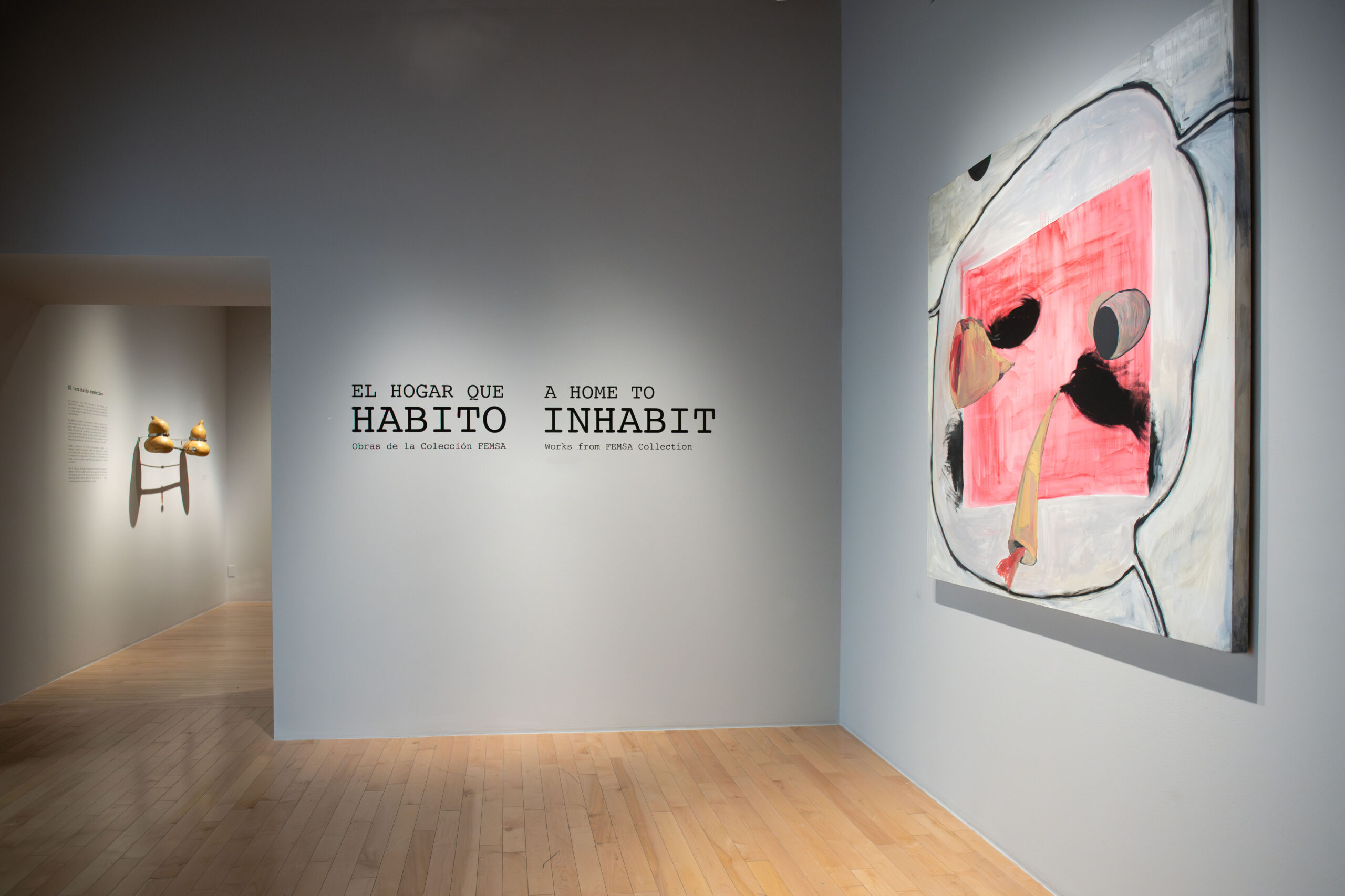
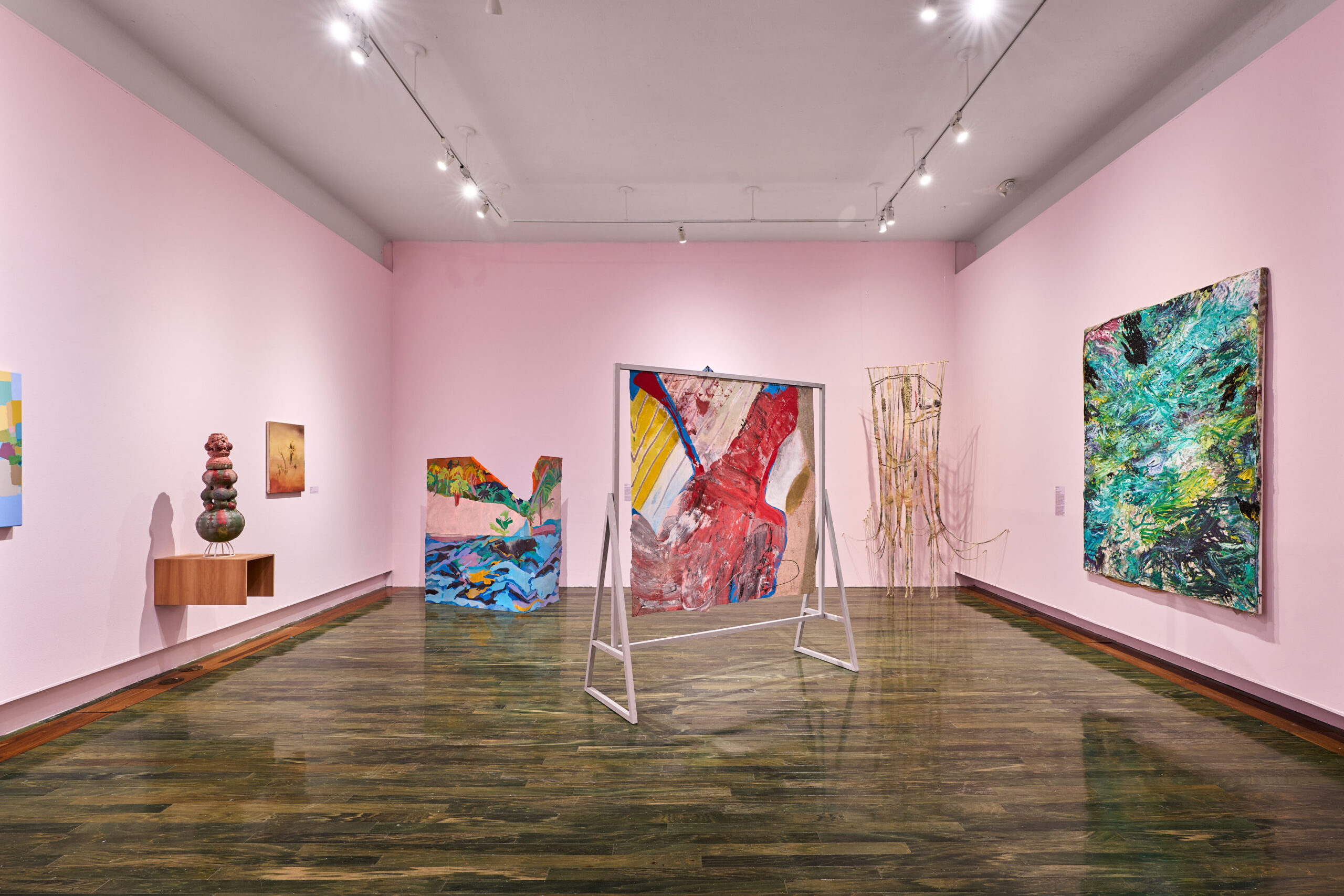
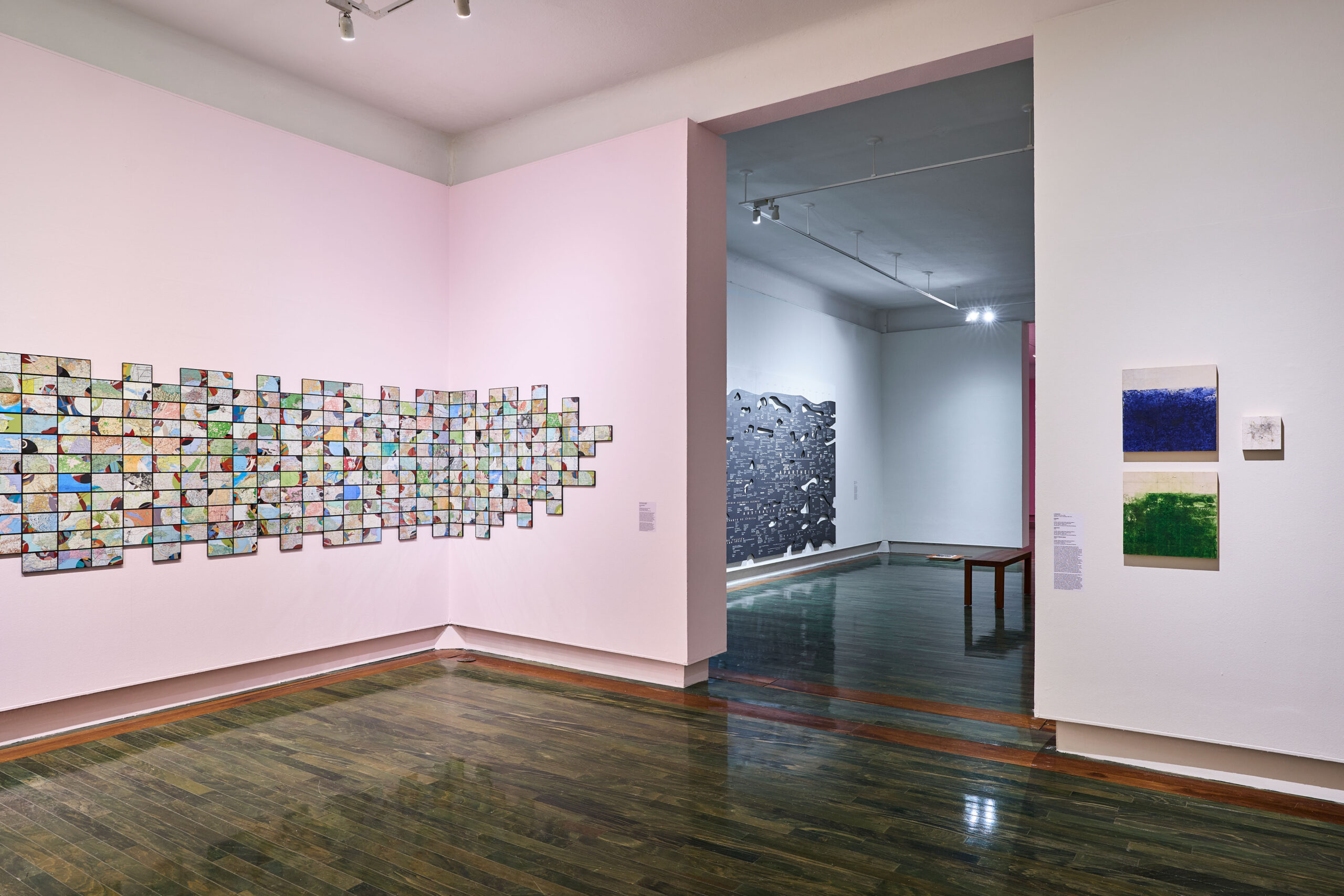
Gallery view of “Diasporican Abstraction: Identities Beyond Representation”, Museum of Contemporary Art of Puerto Rico. September 26, 2026. Photo: Pablo Serrano.
SOFÍA: What led you to approach the exhibition through the lens of the diaspora rather than positioning the island as its center?
ABDIEL: I lived outside Puerto Rico for eight years. I left with a one-way ticket to Madrid, thinking I would never return. As I lived through that migrant experience and became part of the diaspora, I realized how my own place of enunciation gradually shifted. You change in transit; you never entirely leave behind the place you came from, because that place travels with you, too. The journey shapes you, as you learn to understand yourself within the logic of another place.
Here’s an anecdote. While I was living in Spain, I worked as a nanny. The children’s mother would often say to me, “Oh, I see, you’re part of a diaspora!” At first, I would reply, “Well, I hadn’t realized that.” It was through her repeated remarks that I came to understand that most of the people I had studied with at university, or gone to school with, no longer lived in Puerto Rico—and neither did I. So I began to look more closely at the archipelago’s cultural, social, and political history over the previous six or seven decades.
That made me think about where my Puerto Ricanness is located. From where is it articulated? What other experiences shape the production of meaning around it? For me, it was revealing to realize that, while living abroad, I crossed paths with more Caribbean people from other territories than I had when I lived in the Caribbean itself. This led me to question where the idea of Puerto Ricanness is constructed from, and what imaginaries shape that project of identity. Who gets to take part in that conversation? While living in Spain, I made friends from the Dominican Republic, Colombia, Cuba, Honduras, Ecuador, and various African countries who, in different ways and without even realizing it, were participating in, extending, and broadening the conversation about the Caribbean. Perhaps more than I had been able to see while living in Puerto Rico.
I remember Cuban curator Gerardo Mosquera, who lives in Madrid, speaking about an expanded Caribbean—a notion that went beyond cartographic or geographical boundaries, extending across the Americas and even reaching other continents. This made me think about the sense of dislocation I was experiencing and led me to question the validity and limits of a national narrative that insists on articulating itself within geopolitical borders.
Puerto Rico is also home to people who have come from elsewhere, and we share these diasporic spaces with other communities: the Dominican diaspora, for instance, which we encounter in New York, as well as Cuban, Colombian, Venezuelan, and just about any other diaspora you can think of. Ultimately, the Caribbean is a place of movement, and it has been so since before colonization.
SOFÍA: If we understand the Puerto Rican experience beyond political borders and the geography of the archipelago, we must acknowledge that Puerto Rico lives under a colonial condition that has driven entire generations to migrate. How does abstraction engage with this reality? Can an “abstract” practice also be a form of resistance or critique?
ABDIEL: Ever since I was a child, Puerto Rico has been—and continues to be—a colony. As a result, we often speak from a position where the ideas of colonialism and nationhood are contested.
Perhaps this has to do with matters of political administration, with how this territory is governed. But it undoubtedly has repercussions for the construction of a collective identity and for the ways in which we discuss who we are and who we are not. Puerto Rico’s visual culture, shaped by a discursive modernity that took hold—more or less—with the establishment of the Commonwealth in the 1950s, emerged and consolidated itself within a figurative imaginary, constructed through a state-funded propaganda project.
This project was carried out through institutions such as the Division of Community Education and the Institute of Puerto Rican Culture. This entire network of cultural institutions also encompassed the University of Puerto Rico, which, although founded in 1903, opened itself up in the 1950s to the island’s new political status. As a result, a substantial body of work by artists from the 1940s was rendered invisible in the process of constructing that imaginary.
There was a need to affirm a sense of Puerto Ricanness through an image that reflected this discursive form of mestizaje, which the new political paradigm, together with its cultural institutions, used to declare: “Here, we are a mixture of Taíno, European, and African peoples; we are one big Puerto Rican family, the result of a happy and fortuitous process of racial and cultural mixing in which Castilian, or Spanish, is the fundamental vernacular language, the backbone of national identity.” The people invited to sit at this table played a very particular role: they did not choose it for themselves; rather, those who were already seated decided what it meant—and what it did not mean—to be Puerto Rican.
In the 1950s, abstraction was associated with the boom of American Abstract Expressionism, and was therefore understood in Puerto Rico as a market-driven trend. It was taken for granted that artists who practiced abstraction had been seduced by these aesthetics and were traitors to the national cause, because their images did not affirm the project of identity that needed to be defended against the wave of American cultural assimilation.
Abstraction has almost always been viewed in relation to its European and American counterparts, and this is by no means unique to Puerto Rico. With the exception of Neoconcretism and Venezuelan kinetic art, I think that in many other places where abstraction is practiced, it suffers a similar kind of erasure, because visual languages outside the Western canon are not taken into account. There is an impulse to question that national discourse, to make it more porous: these artists are not necessarily concerned with affirming those paradigms, but perhaps with inscribing a different kind of experience into a language that is ambiguous, ambivalent, and open-ended.
SOFÍA: If Puerto Ricanness was affirmed through a closed national narrative, the exhibition seems to propose the opposite: migration, memory, territories, bodies, and identities continually intersect and exist in tension. How did you develop the exhibition’s thematic framework?
ABDIEL: It was very important to me that the way the artworks were distributed throughout the museum’s galleries would not reproduce the logic of categorization. My argument is that the categories established by universal art history are insufficient, which is why I conceived the exhibition through the idea of an ecosystem: a kind of thematic ecosystem. The way the works are arranged allows audiences to play with the possibility that one work could be placed alongside another, and that a single work can belong to several ecosystems across the galleries. There is an intention behind this, an invitation to reflect on how the works are grouped.
The first ecosystem invites viewers to think about the act of painting. It begins with the work of Olga Albizu, whose paintings appeared on several jazz and bossa nova album covers of the time. Her highly gestural, chromatic work enters into dialogue with that of Gisela Colón, whose practice centers on color without any intervention by the human hand. Colón’s work, in turn, dialogues with that of Fernando Colón, who creates paintings through a single gesture: these are not loose brushstrokes, but forms made with a single line. These three examples are very different from one another, but they all invite viewers to ask what motivates these artists to paint. That act, in turn, opens up a reflection on materiality—the second ecosystem. The choice of materials already produces meaning, because a work is informed by what it is made of and by the place it occupies in the gallery as an object in relation to other objects.
Gallery view of “Diasporican Abstraction: Identities Beyond Representation”, Museum of Contemporary Art of Puerto Rico. September 26, 2026. Photo: Pablo Serrano.
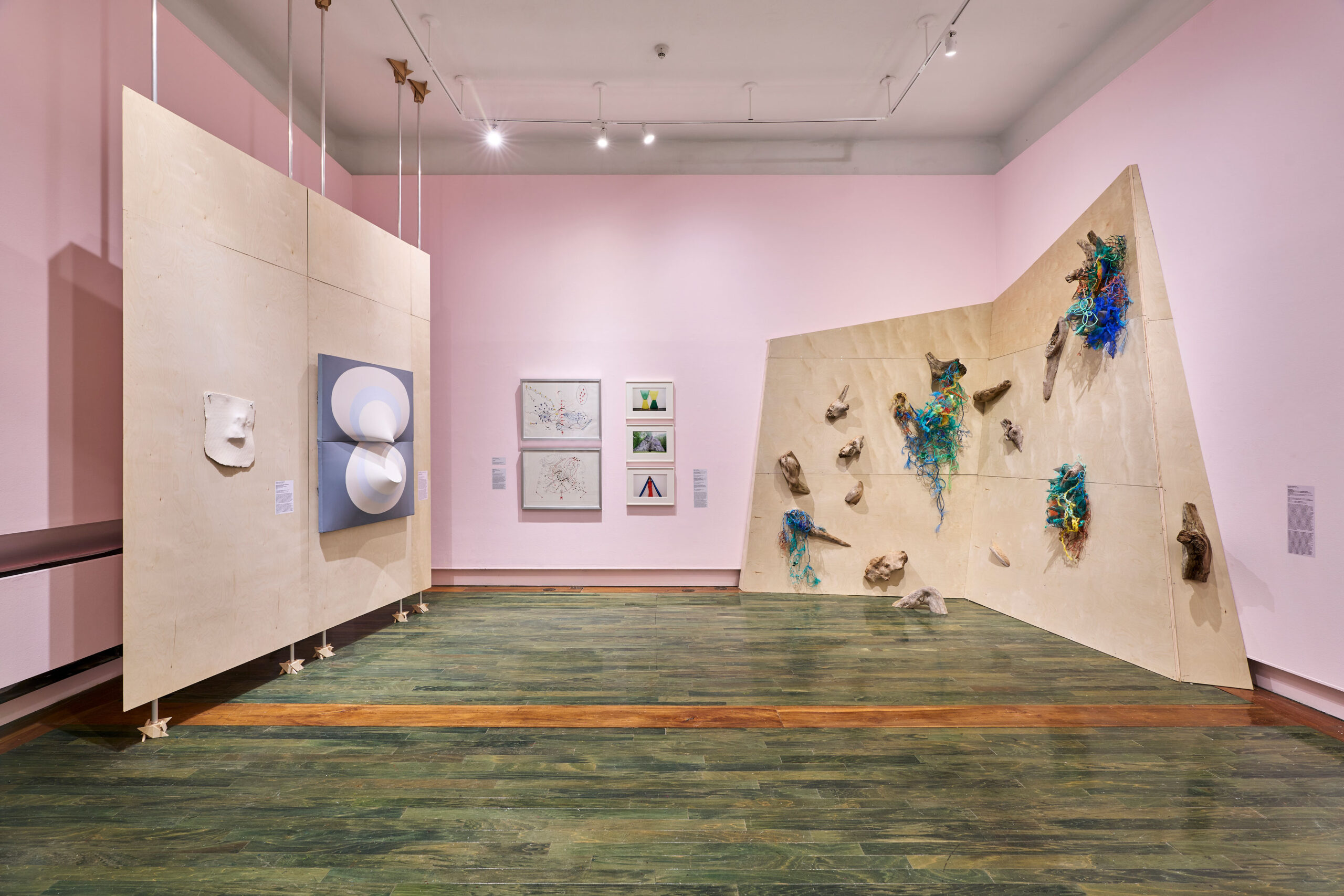
The next ecosystem considers the natural environment as a point of reference, and explores how landscape and observation inform each artist’s creative process. It brings together works that engage with climate, the environment, and, why not, the very tradition of landscape painting. These works may not be abstract in the strict sense of what we would typically expect abstraction to look like, but they do play with abstracting the “referent.”
For me, it is important that the exhibition, as a whole, also question abstraction itself as a category. In this sense, looking at the natural environment as a point of reference opens up a broader conversation about the ancestral. A number of works explore this idea, but not through a folklorized or self-contained vision of the past. Instead, the ancestral emerges as an aesthetic through which we can think about the present and the future. It has not been fossilized or confined to the past; it remains latent, continuing to inform and inspire new aesthetic languages.
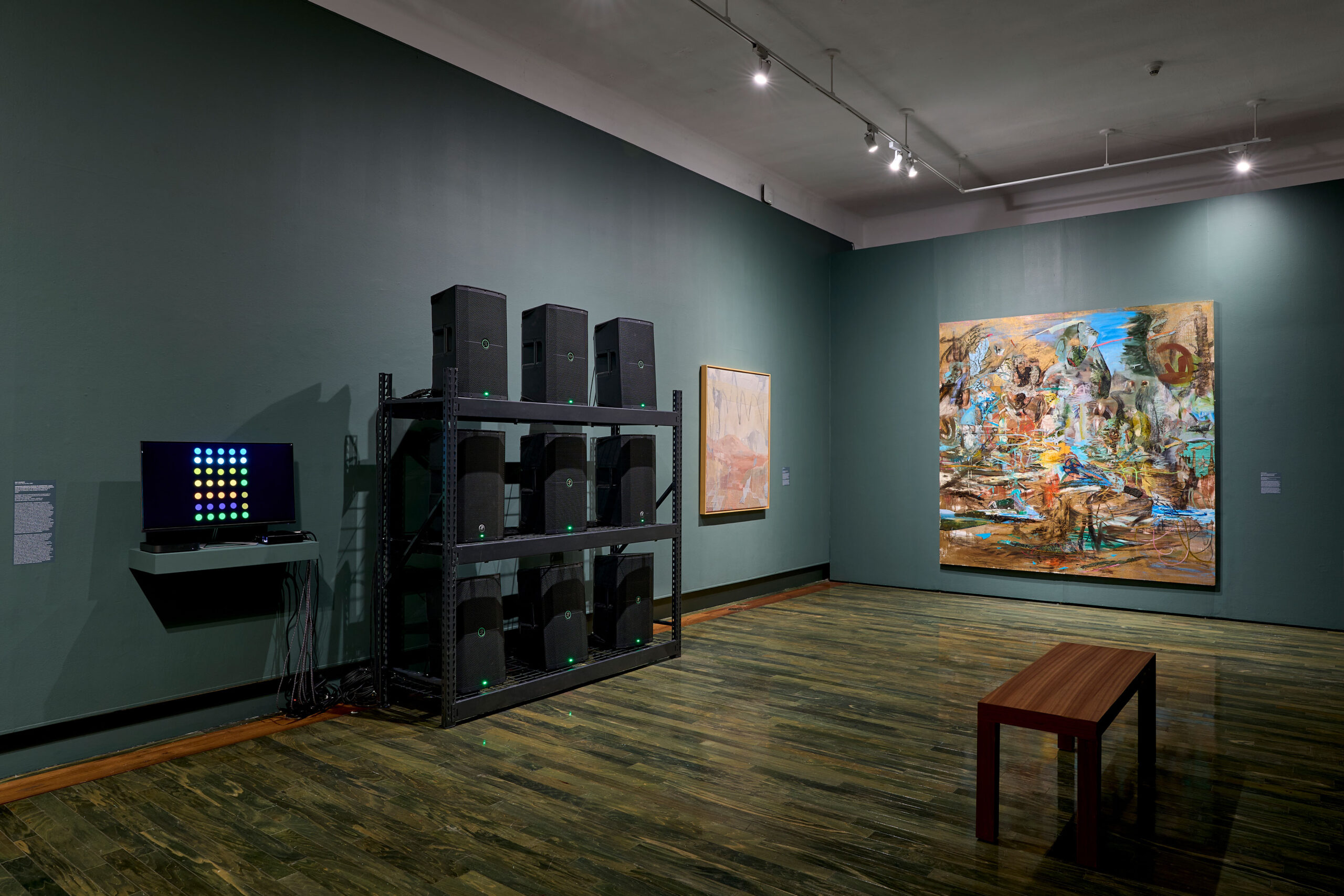
We are not looking toward American Abstract Expressionism, but rather toward the body, the territory, and the pictographic imagery and markings found here—in the rocks and in the landscape we inhabit. This also raises questions about how the experience of abstraction is materialized, or whether it is materialized at all. That is why we decided to include sound works in the exhibition.
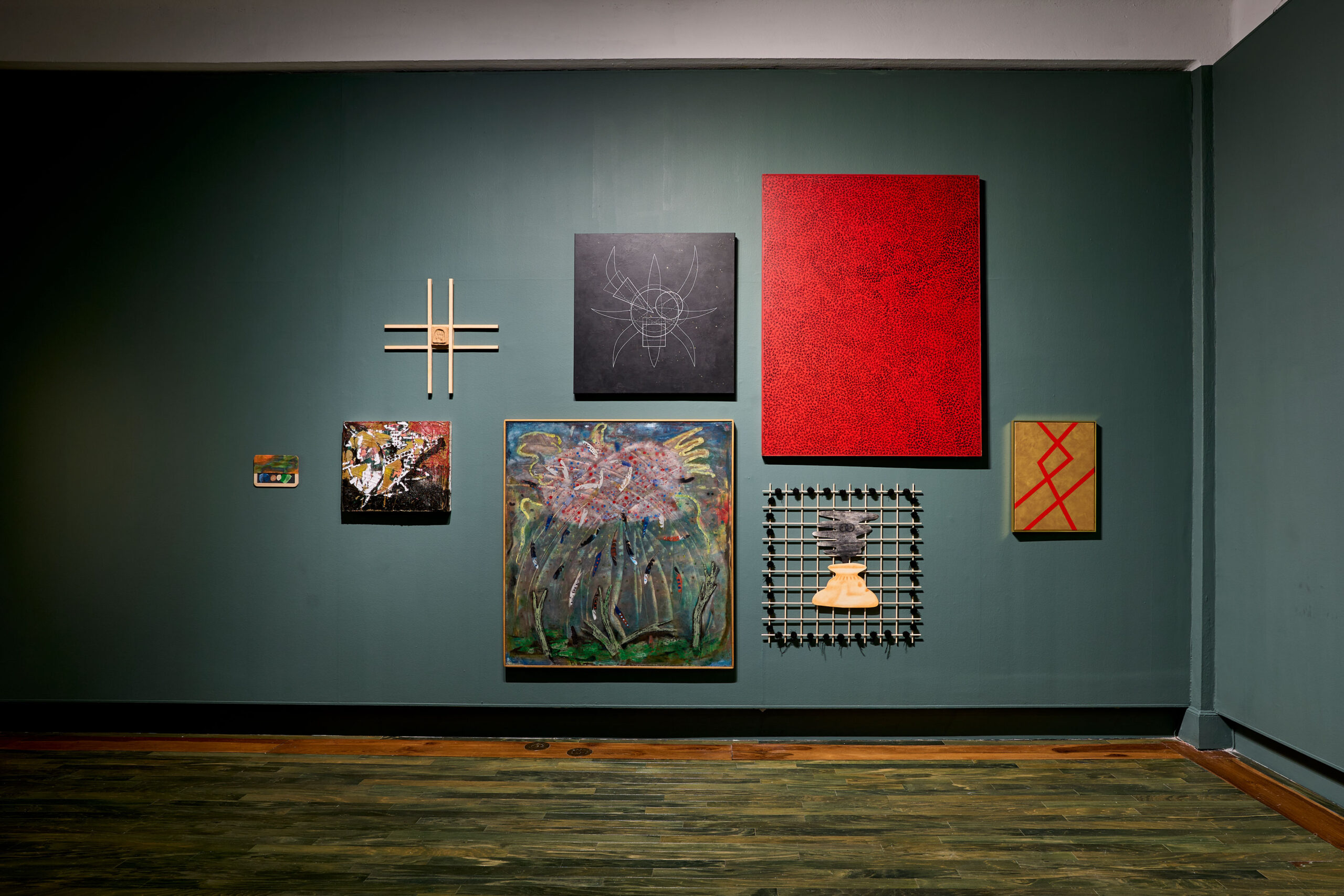
Gallery view of “Diasporican Abstraction: Identities Beyond Representation”, Museum of Contemporary Art of Puerto Rico. September 26, 2026. Photo: Pablo Serrano.
From there, we move toward cartography and more explicitly political conversations. This is where questions of race come in: identities shaped by the demographic landscape. This, in turn, leads us to the next ecosystem, the city. We ask how we inhabit the city and how that experience of inhabiting it accumulates, at times, in abstract gestures that seek to leave a trace of our passage through the cities we arrive in, as well as through those cities where, as migrants, no archive of our presence remains.
Gallery view of “Diasporican Abstraction: Identities Beyond Representation”, Museum of Contemporary Art of Puerto Rico. September 26, 2026. Photo: Pablo Serrano.
Another thematic thread focuses on embodiment, though not necessarily in an anatomical sense. It is an embodiment rooted in the realm of the sensuous: how the body serves as a vehicle for feeling, experiencing, and producing images, without necessarily referring back to a canonical notion of the body. There is also a group of works that engage with music, which makes another appearance here, but always in relation to the movement of the body. Around these musical practices, Colombian, Panamanian, and Dominican artists enter into dialogue with artists who identify as Puerto Rican. Finally, there is an ecosystem in which works concerned with geometry coexist with pieces that explore the ornamental, the architectural, and the domestic.
SOFÍA: It’s a conversation that crosses borders.
ABDIEL: Yes, and that leads into another thematic thread, one concerned with geometry and form, but above all with ornamentation and vernacular architecture. That is why the works are placed so close to one another: to break away from the formal conception of abstraction and the museographic conventions that condition how we read and relate to images we understand as abstract.
And those are all the ecosystems.
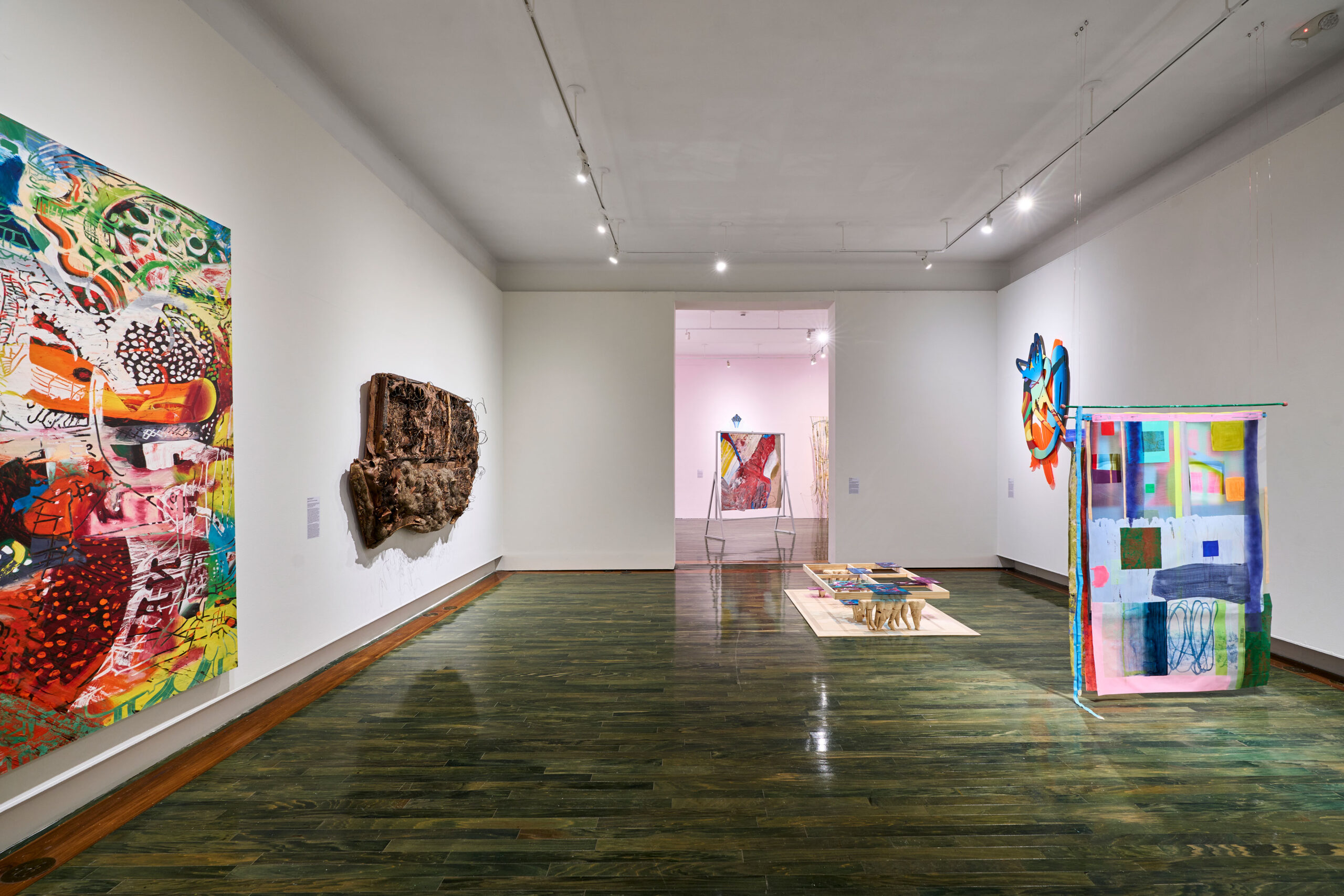
Gallery view of “Diasporican Abstraction: Identities Beyond Representation”, Museum of Contemporary Art of Puerto Rico. September 26, 2026. Photo: Pablo Serrano.
SOFÍA: These ecosystems function like a map: the exhibition route guides you from one point to the next, but each ecosystem contains others within it. One of the things that caught my attention most was the dialogue across generations. I particularly liked the placement of works by Awilda Sterling and Zilia Sánchez. They belong to an earlier generation, but their work remains active today, and it is placed alongside works that make you wonder, “How did these come together?” Could you tell us more about these intergenerational dialogues?
ABDIEL: Absolutely. This is not an exhibition that seeks to be historical in the conventional sense of art history. I am not narrating the history of Puerto Rican abstraction from beginning to end, nor am I trying to construct a linear narrative.
For me, this is a question of temporality, which is also a political construct, and I believe abstraction allows us to disrupt these ways of telling stories. I always envisioned the exhibition as an intergenerational dialogue. For example, Awilda is in close conversation with Paulina Pagán Picó, an artist under forty who will activate her piece through a vertical choreography within the gallery. Her work resonates deeply with Awilda’s, particularly with her project Blindfolded, in which she covers her eyes and listens to a selection of musical pieces she has studied over a long period of time. With her eyes closed, she leaves behind marks—a series of gestures and a choreography that she feels but cannot see. This is a deliberate dialogue between a young artist and a veteran who has spent many decades refining several bodies of work that bring together the choreographic and the pictorial. There are many poetic resonances that emerge from that initial formal layer, the one we all see, which is why it is important to me that the exhibition feel like an open invitation to further interpretations.
Gallery view of “Diasporican Abstraction: Identities Beyond Representation”, Museum of Contemporary Art of Puerto Rico. September 26, 2026. Photo: Pablo Serrano.
SOFÍA: Finally, what did it mean to bring together, for the first time in Puerto Rico, works from the collection of El Museo del Barrio in New York and private collections alongside the Museo de Arte de Puerto Rico (MAC) permanent collection? What does this dialogue reveal about the circuits through which Puerto Rican art circulates and gains legitimacy?
ABDIEL: I was very excited about bringing works from the collection of El Museo del Barrio to the archipelago for the first time, as a well-intentioned effort. This museum has spent a long time preserving and valuing a cultural heritage that generally exists separately from the collections held by art museums in Puerto Rico, which have focused more on constructing a narrative of Puerto Rican art from within the archipelago.
It is interesting to consider how this narrative is constructed. We know that Puerto Ricans move back and forth, and that this mobility is woven into the experience of Puerto Ricanness. Yet when it comes to narrating the development of art, there is a tendency toward a more linear account, one that generally leaves out artists based in the diaspora.
Bringing these collections together, then, is not merely a transaction; it is a way of asking who gets to decide what counts as Puerto Rican art and from where that story is told. If Puerto Ricanness is also articulated from New York or Madrid, then the map of artistic recognition must expand, just like the Caribbean itself. In this way, works from the diaspora cease to exist as a separate archive and become part of the same conversation as the MAC’s collection and works held in private collections.
SOFÍA: And before we wrap up, I’d like to ask how the exhibition connects with sound and music. I sensed a sonic dimension in some of the galleries that extends beyond abstraction. What contributions would you highlight, particularly in thinking about the diaspora and sound as a form of historical resistance in Puerto Rico?
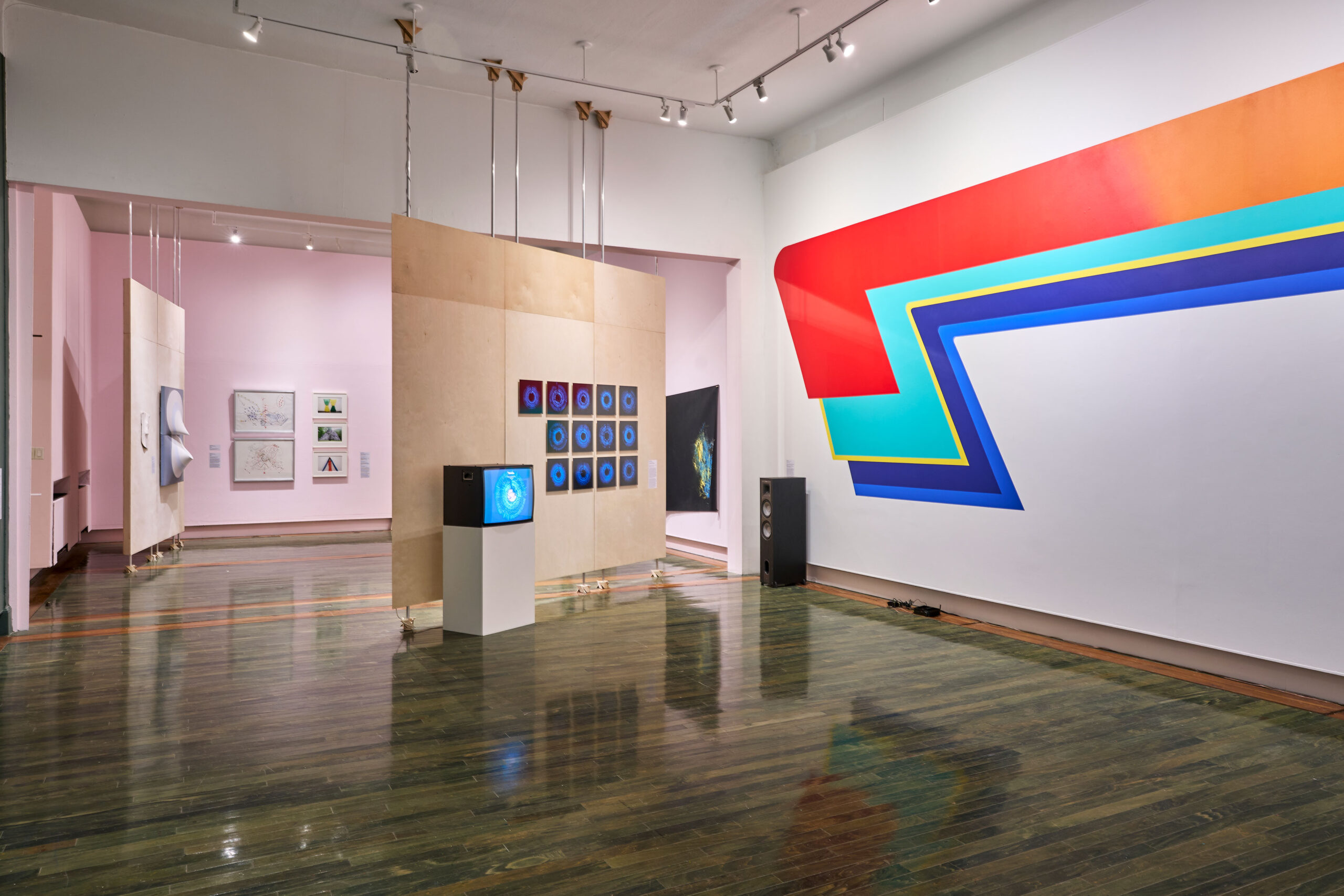
ABDIEL: One of David Santamaría’s works seeks to unfold a selection of rhythms we know as salsa through abstract images. It opens up a conversation about the rhythmic, territorial, and musical diversity underlying the salsa project. For me, music was an easier way to explain the idea of the diasporic, because people have listened to far more salsa than they have encountered abstraction in public spaces. It was a happy coincidence that a Colombian artist, collector of Puerto Rican music, and friend of mine had developed a body of work that gave visual form to those rhythms through non-narrative images.
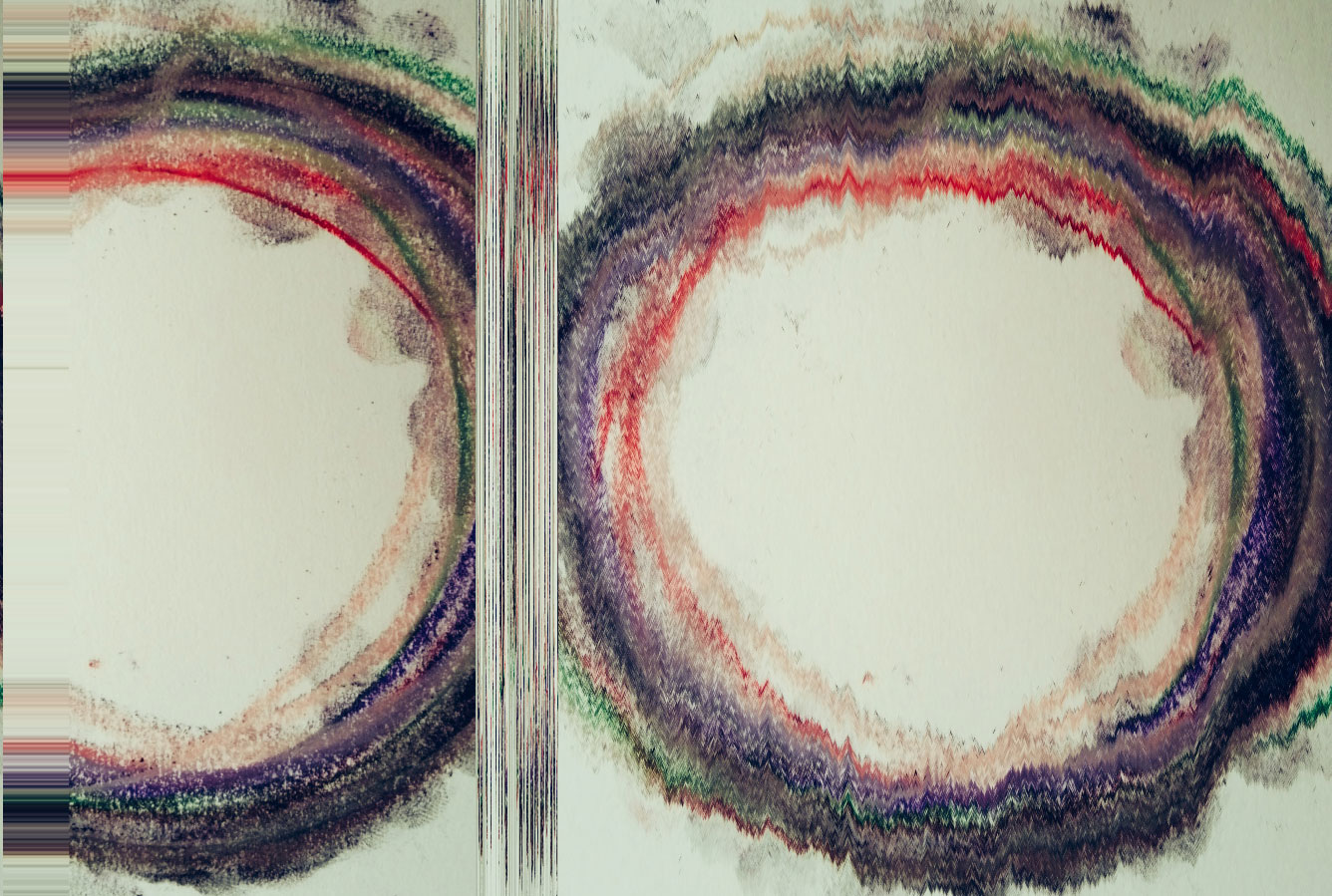
Santamaría designed a program, a kind of robot, that generates marks for each of the instruments played in these orchestras. He selects songs from his own collection and generates an array of stains through their playback. These stains resemble the iris of an eye; they do not directly reference the stories told in the songs, but are a literal imprint of the sound itself. This, in turn, reminds me of when a law on autochthonous music was passed here to encourage the hiring of groups that performed rhythms the institution considered indigenous to Puerto Rico, folkloric, and distinctly Puerto Rican. Salsa was excluded: cultural policies did not consider it sufficiently Puerto Rican, so it was ineligible for funding. And yet it is a rhythm with which Puerto Ricans deeply identify. You arrive in Puerto Rico, and even today, salsa is still playing. The same is true of reggaeton.
Gallery view of “Diasporican Abstraction: Identities Beyond Representation”, Museum of Contemporary Art of Puerto Rico. September 26, 2026. Photo: Pablo Serrano.
That is why this piece enters into dialogue with the work of Cisco Merel, a Panamanian artist. His work does not directly address rhythms, but music is an integral part of the installations he creates with la máquina del flow [the machine of flow]: abstractions derived from the decorations on diablos rojos [red devils], buses equipped with sound systems that often blast dancehall, the rhythmic foundation of reggaeton as well. Reggaeton is strongly associated with Puerto Rico, but it is not exclusively Puerto Rican. It is a Caribbean and deeply diasporic rhythm that, like salsa, speaks to patterns of migration within the Caribbean and from the Caribbean to the United States.
I do think there is an element of resistance, but it is neither exclusively national nor exclusively diasporic. It is a reclaiming of territory through these rhythms that circulate globally, rhythms that become spaces for the production of identities, affirmations, and forms of resistance that transcend Puerto Ricanness. This is one of the voices, one of the ingredients, within a chorus of subalternities: Afro-diasporic sounds emerging from different territories across the Caribbean and beyond.
From that perspective, it has been incredibly rewarding to see people’s surprise as they discover the work of artists they had not known about, despite their long careers. The poetic justice I hoped to bring to the work of some of the artists in the exhibition has come to fruition, and in a positive way. Visitors arrive with fresh, curious eyes, expecting a typical exhibition of Puerto Rican art or abstraction, only to discover that they are being invited to take part in an exercise in reinterpreting these concepts, as well as their own notions of Puerto Ricanness, abstraction, and the diasporic, and in considering how all of these are potentially interconnected—with how we experience who we are and how we relate to one another.
Gallery view of “Diasporican Abstraction: Identities Beyond Representation”, Museum of Contemporary Art of Puerto Rico. September 26, 2026. Photo: Pablo Serrano.