Kristi Kongi turns the Kumu Art Museum into a living organism: intense colors, acrylic balaclavas, and a community of gazes that pierce through the glass. Ana Gabriela García moves through the exhibition like an atmospheric drift, where territory, ecology, and politics intertwine without borders.
While passing through a thickness of clouds several meters above the ground, I had a vision I suspect is rather common, though no less unsettling. Inhabiting for a few minutes that fascinating space suspended between sky and earth; that brief gesture of looking up, down, and then up again, comes with a certain disorientation. Trying to find some solid ground, I remembered that in a certain place—one very far and yet very near—it is said that in the times when there was only sky, the earth emerged from the clouds and their drifting; that the caress of vaporous mists kneaded the earth, and with all that moisture, the mountains found their shapes. Amid the trembling rhythms of the heavy air, I could only ask myself: what is it, then, that the clouds have seen?
The question found an unexpected resonance after I touched the ground.
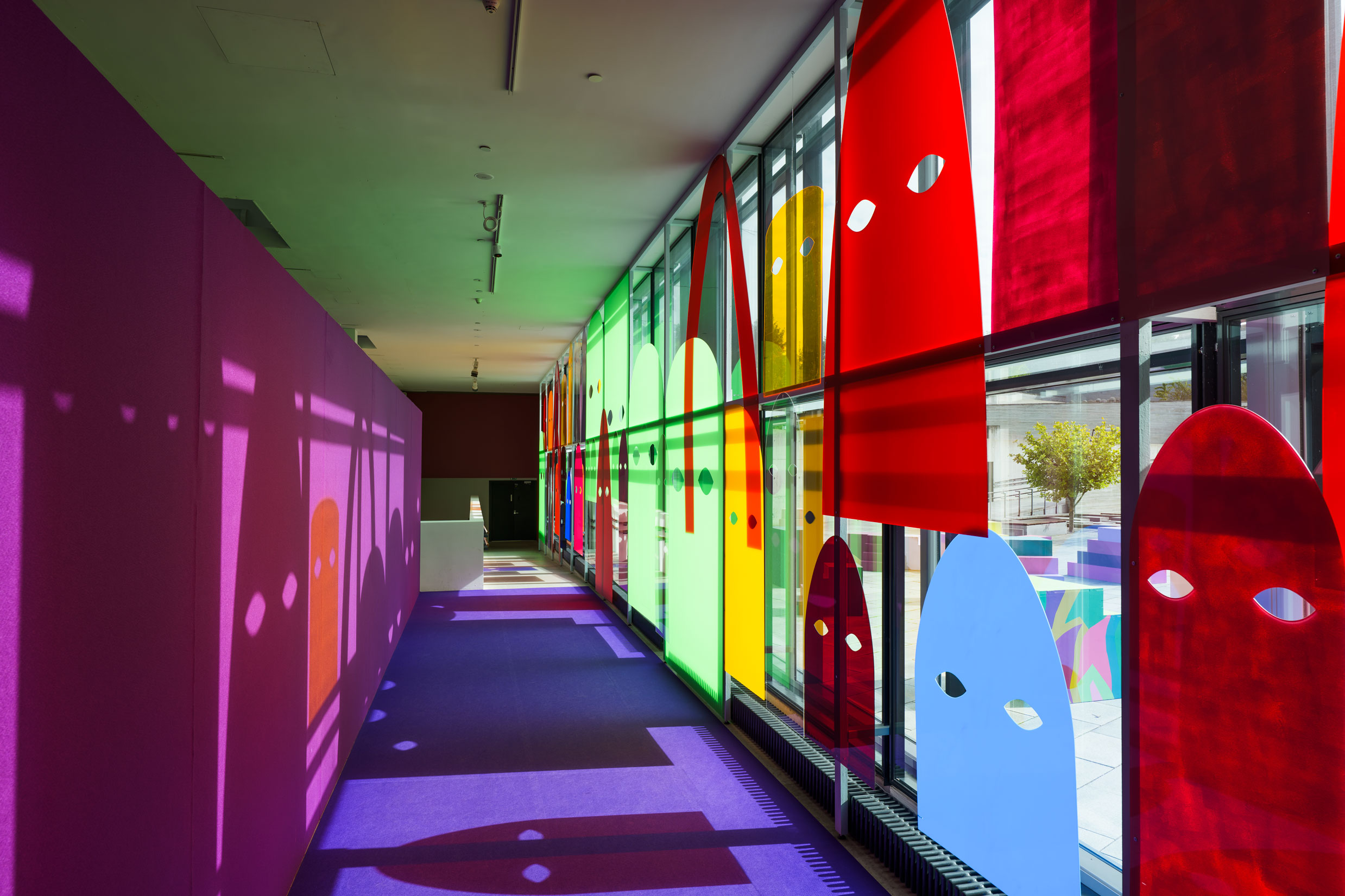
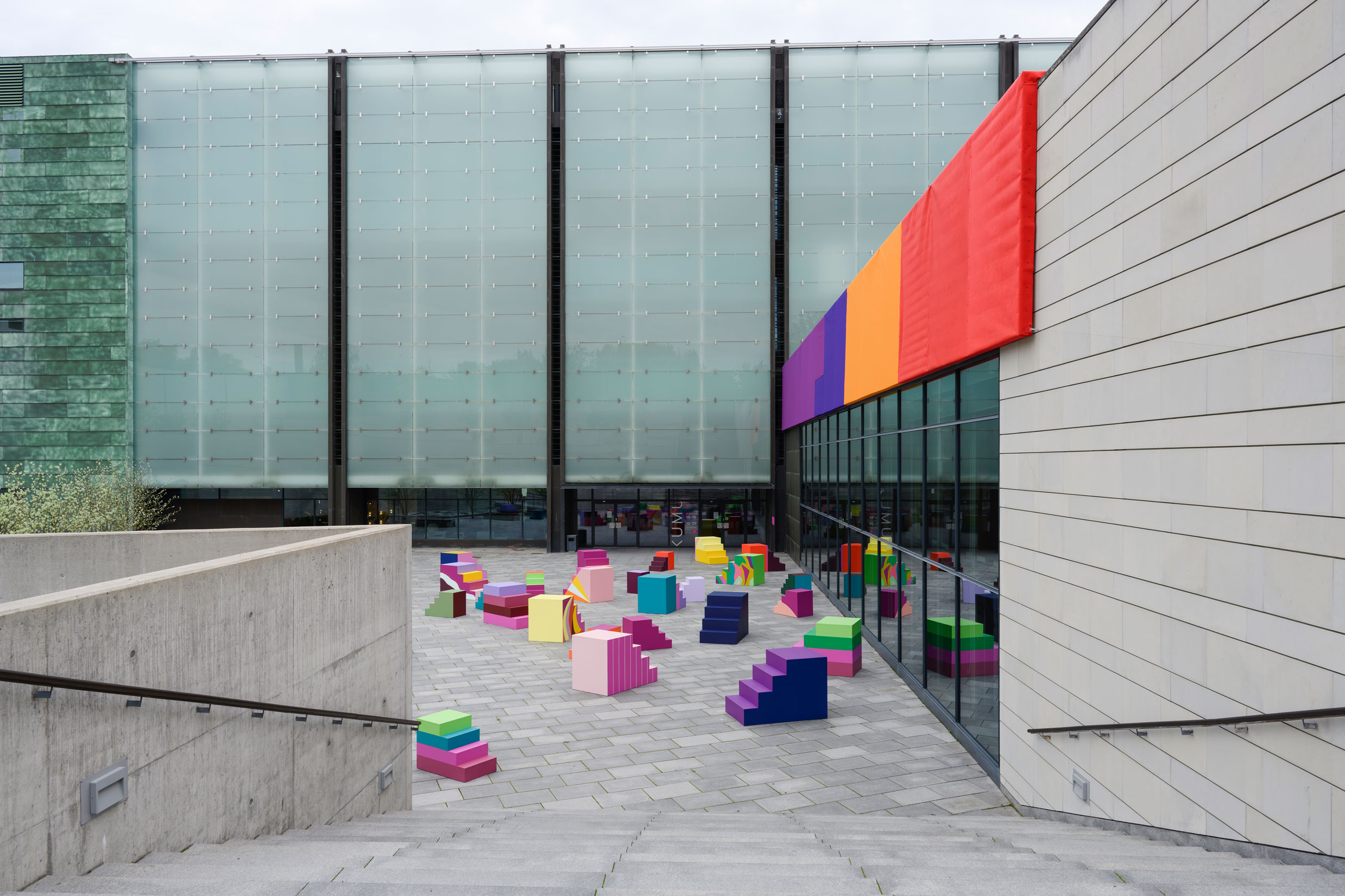
On the first floor of the Kumu Art Museum (Tallinn, Estonia)1, I stood before Chromatic Drift, the solo exhibition of Estonian artist Kristi Kongi,2 curated by Ann Mirjam Vaikla. What greets visitors is a large room whose surfaces, in intense magenta, reveal—just a few steps later—a contained clamor: The Cry of Silence. The piece presents itself to visitors as a community of acrylic figures on the window that, with a guerrilla gesture, filter the light and make color and shadow dance across the floor. Their faces sheltered under monochrome balaclavas reveal open eyes with which we look outward. There, like a dream, a cluster of stairs in every color appears. A preamble to the exhibition’s curatorial and museographic strategy: making the exhibition space a site in constant transformation, whose perception changes not only as we move through it, but is also affected by the movement of light itself, both interior and exterior.
Once past this scene, the space is revealed to us. There is an immediate reaction of the eye to color—how it takes hold of the space and how, in turn, it gradually reveals the pictorial and installation-based work.
In the realm of clouds3
There are colors we recognize before we can understand why: charged with a certain familiarity, their origin seems to slip through our fingers. After encountering the large- and small-format paintings, watercolors, ceramics, and installations that make up Chromatic Drift, one soon notices how color acts not only on the surface, but also gradually penetrates the spaces of memory.
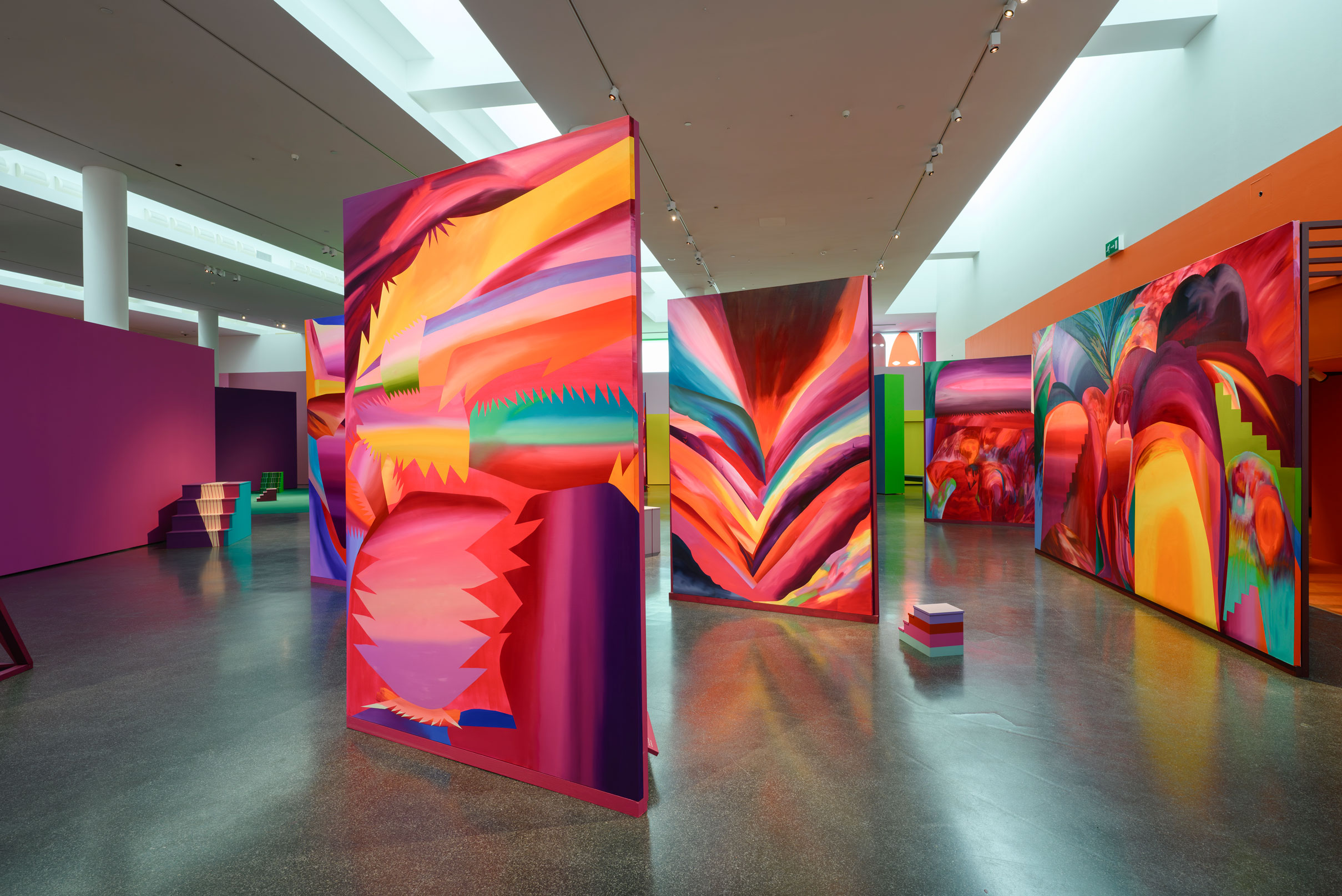
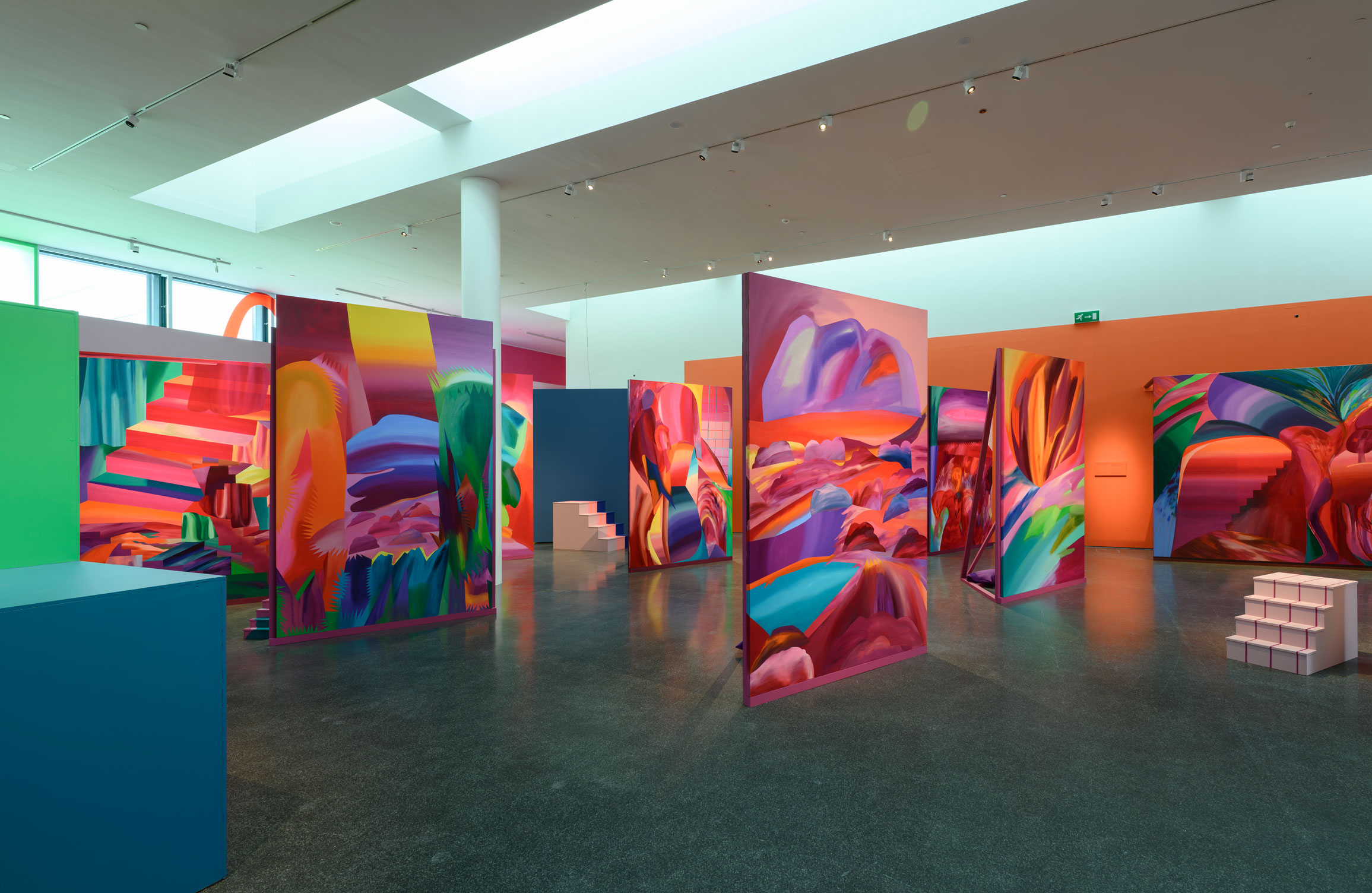
The exhibition thus reveals a body of work in which painting—both in its material condition and its aesthetic dimension—maps experiences, thoughts, and affective states through plays of color. Starting from a certain abstraction, blocks of magentas, oranges, reds, browns, and blues eventually suggest approaches to a vegetal and telluric world: round, undulating forms that evoke plants, stones, mountains, and caves. Among them slips in the occasional human figure, barely hinted at through the eyes with which they look at us, the hands with which they touch us. Others, sharper, evoke brush, dry vegetation, and at times the sun’s rays or even fire. With them, we move from the microscopic to the planetary, seeing from above—like a bird in flight—the valley, its mountain ranges, and its waters. Among these worlds, the rhythm of a couple of recurring forms also appears: something of clouds and something of stairs.
In these paintings and their color palette, I feel the temperatures, those warmths that embrace everything in a coastal region; the freshness and dampness of moss and rocks on a volcano’s slopes. I hear the insects hiding in every dark nook. I taste a juicy plum under the awning of the Sunday market. I see the intense magenta tones that wake me during the dry season, with its smog, in Mexico City. I recall the games of Mexican geometrism, or the characteristic color blocks of Barragán’s emotional architecture, whose construction of space relied on color as volume and vehicle to trigger meditative states. I think of the pictorial ceremony one sees in so-called popular arts and the noises of the streets. I think, too, of Mesoamerican pigments drawn from the earth, like the red of grana cochinilla [cochineal dye] or the ochres of cempasúchil [marigold]. Colors that are also there everytime I close my eyes. Having experienced color in the Baltic region for only a few days, I wonder how Kongi, across her years between Mexico and Estonia, has managed to weave these worlds together.
Thus, memory in these paintings does not seem contained in a single image, but scattered across space, time, and body. Memory moves with these paintings as something that comes from within us—perhaps not from the head, but from the gut. Perhaps it is precisely this impossibility of fully locating the origin of a sensation that makes Kongi’s paintings feel familiar even when they don’t depict any concrete figuration. We enter them as one enters a memory: without knowing exactly where we are, but with the strange certainty of having been there before.
Everything seems alive in the sky
There are memories we can hardly reconstruct as complete images: they persist, rather, as a temperature, a sound, a texture. Kongi has spoken of color as something capable of activating memories much like a scent does. But perhaps her painting takes this relationship a step further: color doesn’t just bring forth a memory, but can reconstruct the sensory space in which that memory once took place. Her chromatic fields envelop, expand, and alter our perception until they produce something akin to an atmosphere proper to the domains of memory or dream, but also beyond. It is not, then, a matter of recognizing a scene from the past, but of re-inhabiting—with a certain vulnerability—the conditions from which that scene might be remembered, and being carried, through color, to that instant of memory.
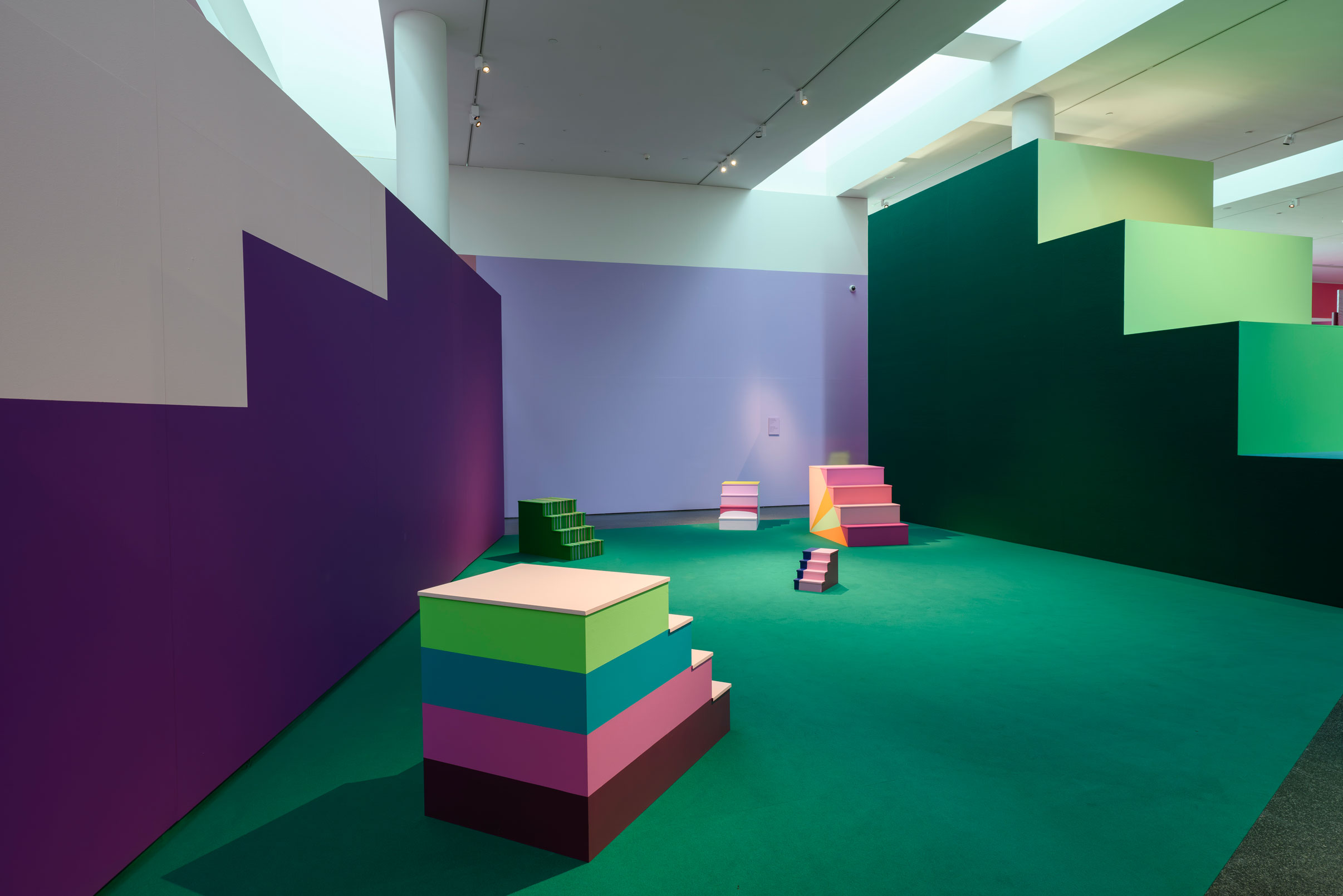
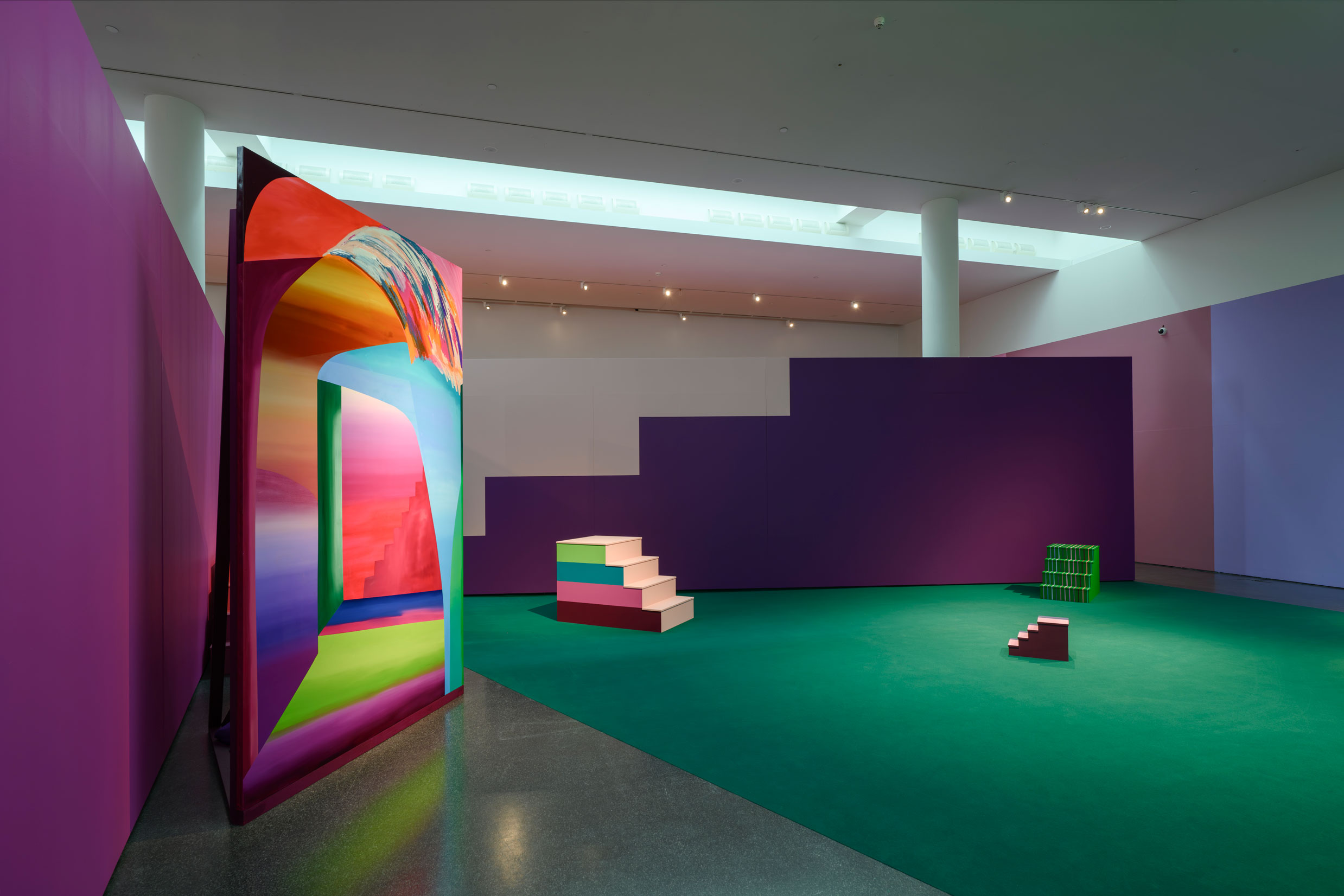
And yes, Kongi seems to use color as a carrier of memory, but that is only possible by exploring the spatial dimension of painting, just as much as the pictorial dimension of space. Throughout the show, light becomes an installation tool. Between natural and artificial light, color-filled structures transform the space, building atmospheres that take on the quality of dreamlike landscapes. Thus, we come across stairs of every size scattered inside and outside the museum. The repetition of this motif—as image in the painting, and as architecture in the space—suggests the staircase as a device for movement but also as a possibility for pause. One of the large-format immersive paintings, A View to Somewhere from Somewhere—whose color blocks suggest a threshold—activates an interesting gesture: placed near a staircase, it forms a portal. We quickly immerse ourselves in the painting to move toward the sculpture and then into the space; a passage that leads us to another place, off the field of view.
Other large-format paintings refuse to remain on the wall and instead ask us to move around them, to look at them not only from far or near, but also from behind and from the sides. The body thus enters into relation with the painting, which ceases to be a static surface and becomes something that moves and moves us with it. The exhibition plays, in this way, with a constant tension between looking at the painting and passing through it; between remaining in front of it and feeling the curiosity to seek it out from elsewhere.
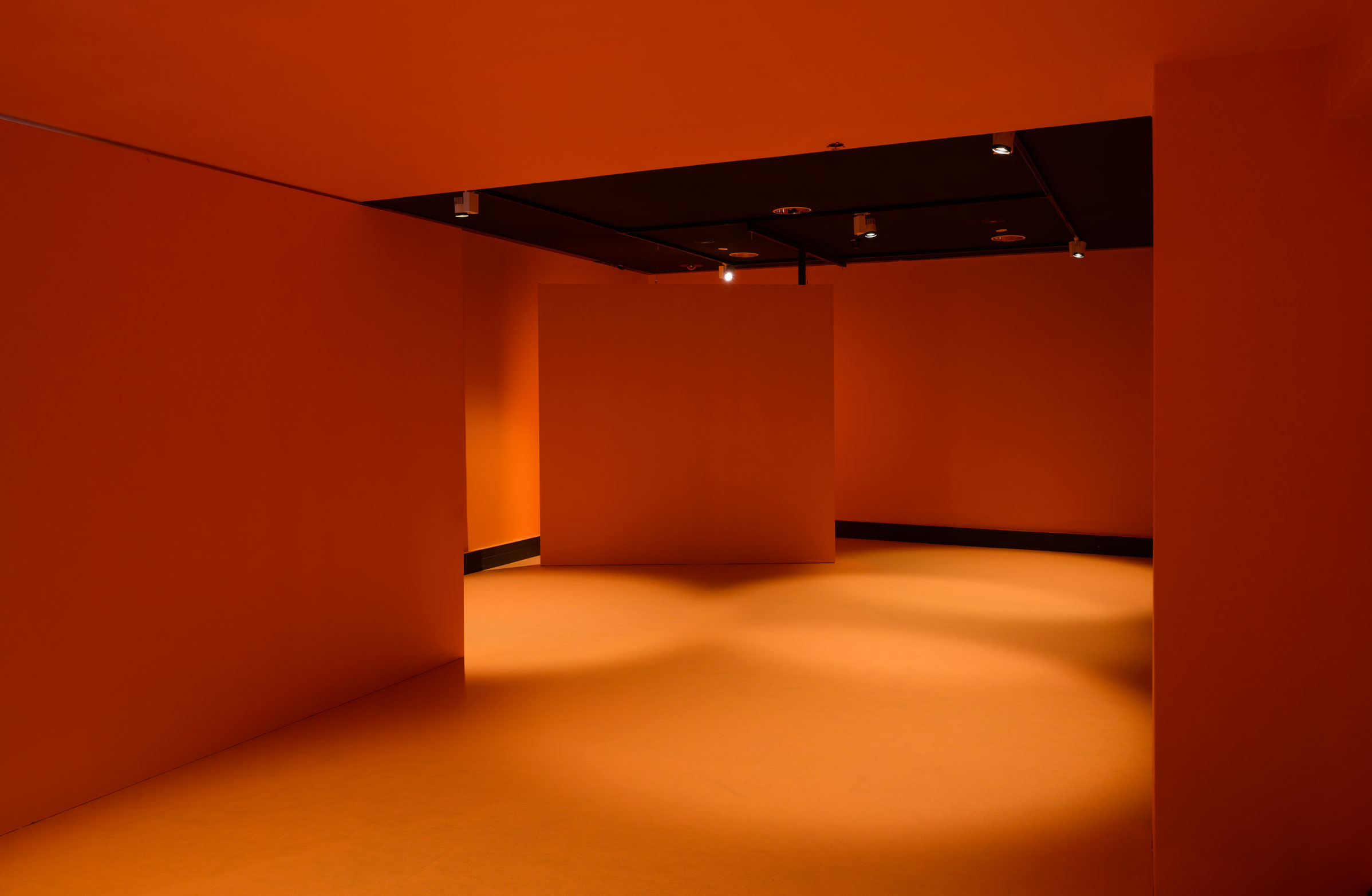
Entering the painting reaches its most literal form in the orange room hidden behind what is, perhaps, the largest-format painting in the exhibition: as one moves around the canvas, it opens onto an actual room, a place that is both painting and space at once. Dark, and crossed by other partially hidden paintings, it functions as a resting place for the body and the gaze. Something similar happens in the series of ceramic tiles made, in fact, at Cerámica Suro (Jalisco, Mexico), Empty Landscapes, whose abstraction and color palette hold the secrets of an unknown landscape. Amid paintings, ceramics, and seemingly empty landscapes, Kongi insists that emptiness is never truly vacant; there, layers of memory will always settle, along with the power to fabulate in order to unearth them.
Somewhat frightening clouds, and somewhat hopeful too
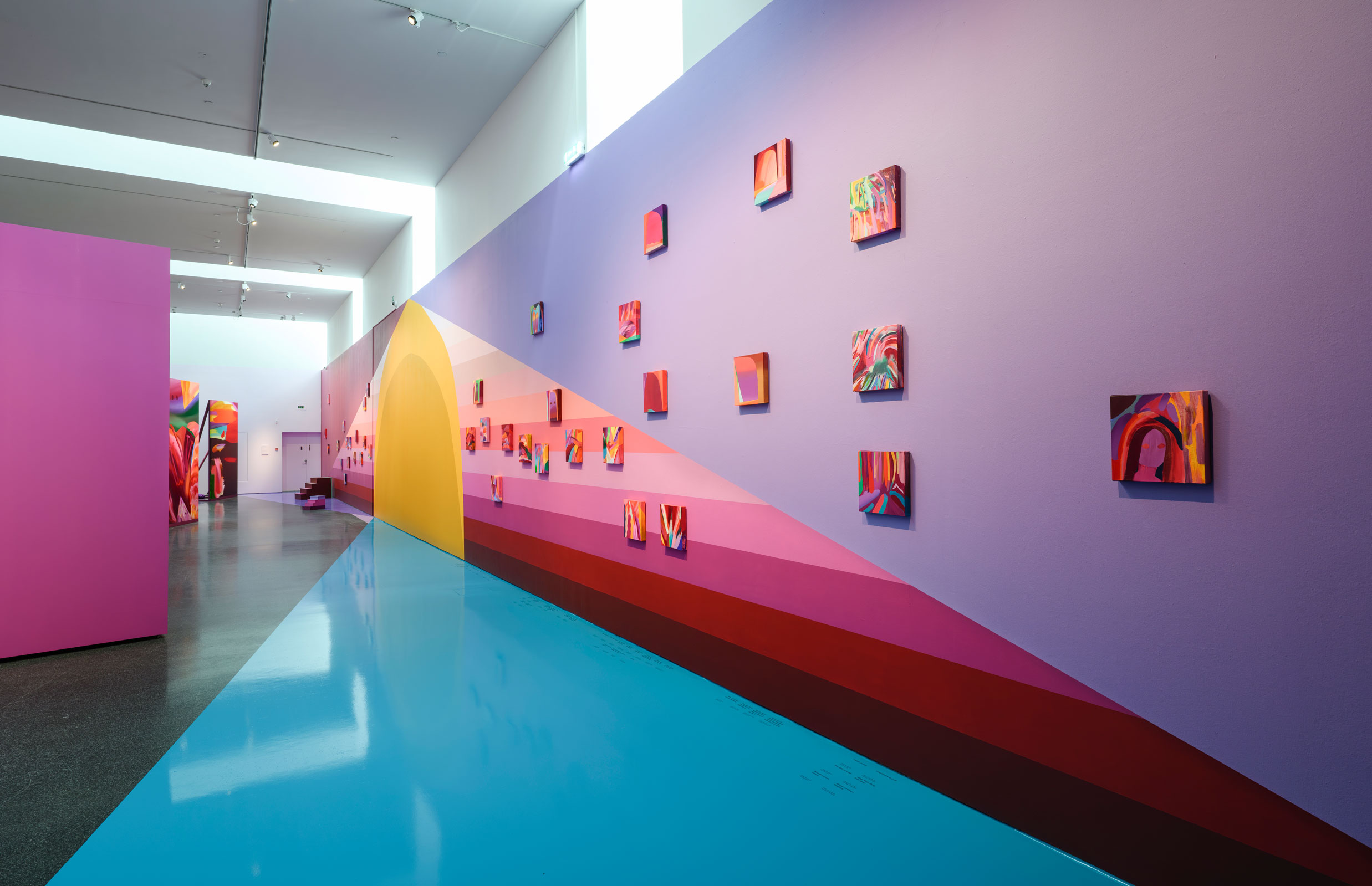
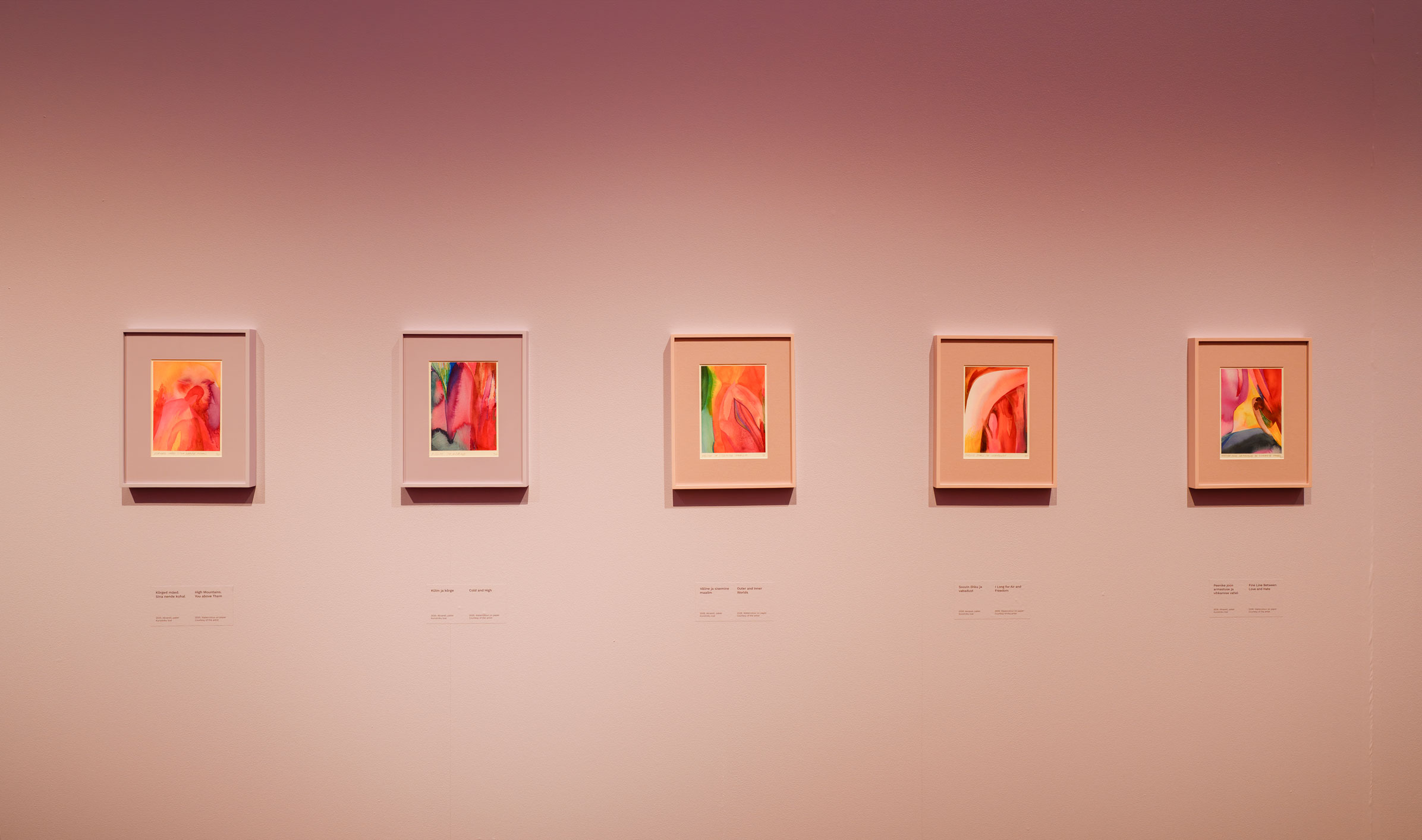
Whether on the back of the works or in their very titles, the artist inscribes a series of missives. Each piece thus has two faces: one pictorial, one textual—two parallel spaces that, upon meeting, produce something more. Small murmurs where text, as a carrier of stories, (de)encrypts what has been left in opacity: thoughts, feelings, conversations, references, and memories that account for an open process within the painting. This dimension becomes especially visible in the long pale-pink corridors that shelter the small watercolors at the far end of the route. In these works, color builds moods, records intimate moments, and turns the pictorial gesture into a kind of visual diary. But that diary is not isolated from the outside world: it is the textual dimension that unfolds a poetic exercise where the fear and anguish of these days emerge—an anguish that responds directly to the eco-geopolitics of a Europe in flames, both literally and figuratively.
Between the natural landscape and that of dreams, where exactly does the viewer stand when there is no firm ground? Kongi’s paintings complicate the position from which we participate in the landscape. The artist seems to feel out the light within the visible in order to try to glimpse what lies beyond the range of vision. In opposition to the colonial division of the human from its surroundings: it is not a matter of contemplating the earth, but of understanding ourselves as materially entangled with it. Painting thus becomes a place from which to look, but also a place that looks back at us.
I return, then, to those clouds and to what they carry—moist meteors that constitute and transform themselves in drift—to ask myself, this time from another place, what it is they have truly seen. I recall Kristi’s words imagining them as spaces of possibility. To me they seem atmospheric traces that move beyond the political limits of territory. Looking at them critically means recognizing that they carry with them ecological, political, and territorial histories, and that they make visible the interdependence of a world in transformation. I think of how other voices have considered this relationship between territory and expression. As philosopher Vinciane Despret notes, “each of these birds is the experience of a portion of a world, it embodies it: the song marked the territory, the territory marked the song […]; as if the song, the courtship, the colours, the postures, the acts that territorialise could be dissociated from the territory.”4 And so I imagine, among the clouds, what Kongi’s clouds have seen. In them, and in the color that gives them form, they seem to disorient the so-called landscape in order to find other ways of inhabiting this earth. Perhaps Chromatic Drift invites us to linger a little longer in that suspension: between earth and sky, between the visible and that which is only barely glimpsed. If we pay a little attention to color, its movement, and its light—what are the rhythms by which we shape a place?
While passing through a thickness of clouds several meters above the ground, I had a vision I suspect is rather common, though no less unsettling. Inhabiting for a few minutes that fascinating space suspended between sky and earth; that brief gesture of looking up, down, and then up again, comes with a certain disorientation. Trying to find some solid ground, I remembered that in a certain place—one very far and yet very near—it is said that in the times when there was only sky, the earth emerged from the clouds and their drifting; that the caress of vaporous mists kneaded the earth, and with all that moisture, the mountains found their shapes. Amid the trembling rhythms of the heavy air, I could only ask myself: what is it, then, that the clouds have seen?
The question found an unexpected resonance after I touched the ground.
On the first floor of the Kumu Art Museum (Tallinn, Estonia)1, I stood before Chromatic Drift, the solo exhibition of Estonian artist Kristi Kongi,2 curated by Ann Mirjam Vaikla. What greets visitors is a large room whose surfaces, in intense magenta, reveal—just a few steps later—a contained clamor: The Cry of Silence. The piece presents itself to visitors as a community of acrylic figures on the window that, with a guerrilla gesture, filter the light and make color and shadow dance across the floor. Their faces sheltered under monochrome balaclavas reveal open eyes with which we look outward. There, like a dream, a cluster of stairs in every color appears. A preamble to the exhibition’s curatorial and museographic strategy: making the exhibition space a site in constant transformation, whose perception changes not only as we move through it, but is also affected by the movement of light itself, both interior and exterior.
Once past this scene, the space is revealed to us. There is an immediate reaction of the eye to color—how it takes hold of the space and how, in turn, it gradually reveals the pictorial and installation-based work.
“Kristi Kongi: Chromatic Drift exhibition views”. 2026. Courtesy of the Art Museum of Estonia. Photograph: Stanislav Stepaško
“Kristi Kongi: Chromatic Drift exhibition views”. 2026. Courtesy of the Art Museum of Estonia. Photograph: Stanislav Stepaško
In the realm of clouds3
There are colors we recognize before we can understand why: charged with a certain familiarity, their origin seems to slip through our fingers. After encountering the large- and small-format paintings, watercolors, ceramics, and installations that make up Chromatic Drift, one soon notices how color acts not only on the surface, but also gradually penetrates the spaces of memory.
The exhibition thus reveals a body of work in which painting—both in its material condition and its aesthetic dimension—maps experiences, thoughts, and affective states through plays of color. Starting from a certain abstraction, blocks of magentas, oranges, reds, browns, and blues eventually suggest approaches to a vegetal and telluric world: round, undulating forms that evoke plants, stones, mountains, and caves. Among them slips in the occasional human figure, barely hinted at through the eyes with which they look at us, the hands with which they touch us. Others, sharper, evoke brush, dry vegetation, and at times the sun’s rays or even fire. With them, we move from the microscopic to the planetary, seeing from above—like a bird in flight—the valley, its mountain ranges, and its waters. Among these worlds, the rhythm of a couple of recurring forms also appears: something of clouds and something of stairs.
“Kristi Kongi: Chromatic Drift exhibition views”. 2026. Courtesy of the Art Museum of Estonia. Photograph: Stanislav Stepaško
“Kristi Kongi: Chromatic Drift exhibition views”. 2026. Courtesy of the Art Museum of Estonia. Photograph: Stanislav Stepaško
In these paintings and their color palette, I feel the temperatures, those warmths that embrace everything in a coastal region; the freshness and dampness of moss and rocks on a volcano’s slopes. I hear the insects hiding in every dark nook. I taste a juicy plum under the awning of the Sunday market. I see the intense magenta tones that wake me during the dry season, with its smog, in Mexico City. I recall the games of Mexican geometrism, or the characteristic color blocks of Barragán’s emotional architecture, whose construction of space relied on color as volume and vehicle to trigger meditative states. I think of the pictorial ceremony one sees in so-called popular arts and the noises of the streets. I think, too, of Mesoamerican pigments drawn from the earth, like the red of grana cochinilla [cochineal dye] or the ochres of cempasúchil [marigold]. Colors that are also there everytime I close my eyes. Having experienced color in the Baltic region for only a few days, I wonder how Kongi, across her years between Mexico and Estonia, has managed to weave these worlds together.
Thus, memory in these paintings does not seem contained in a single image, but scattered across space, time, and body. Memory moves with these paintings as something that comes from within us—perhaps not from the head, but from the gut. Perhaps it is precisely this impossibility of fully locating the origin of a sensation that makes Kongi’s paintings feel familiar even when they don’t depict any concrete figuration. We enter them as one enters a memory: without knowing exactly where we are, but with the strange certainty of having been there before.
Everything seems alive in the sky
There are memories we can hardly reconstruct as complete images: they persist, rather, as a temperature, a sound, a texture. Kongi has spoken of color as something capable of activating memories much like a scent does. But perhaps her painting takes this relationship a step further: color doesn’t just bring forth a memory, but can reconstruct the sensory space in which that memory once took place. Her chromatic fields envelop, expand, and alter our perception until they produce something akin to an atmosphere proper to the domains of memory or dream, but also beyond. It is not, then, a matter of recognizing a scene from the past, but of re-inhabiting—with a certain vulnerability—the conditions from which that scene might be remembered, and being carried, through color, to that instant of memory.
“Kristi Kongi: Chromatic Drift exhibition views”. 2026. Courtesy of the Art Museum of Estonia. Photograph: Stanislav Stepaško
And yes, Kongi seems to use color as a carrier of memory, but that is only possible by exploring the spatial dimension of painting, just as much as the pictorial dimension of space. Throughout the show, light becomes an installation tool. Between natural and artificial light, color-filled structures transform the space, building atmospheres that take on the quality of dreamlike landscapes. Thus, we come across stairs of every size scattered inside and outside the museum. The repetition of this motif—as image in the painting, and as architecture in the space—suggests the staircase as a device for movement but also as a possibility for pause. One of the large-format immersive paintings, A View to Somewhere from Somewhere—whose color blocks suggest a threshold—activates an interesting gesture: placed near a staircase, it forms a portal. We quickly immerse ourselves in the painting to move toward the sculpture and then into the space; a passage that leads us to another place, off the field of view.
“Kristi Kongi: Chromatic Drift exhibition views”. 2026. Courtesy of the Art Museum of Estonia. Photograph: Stanislav Stepaško
Other large-format paintings refuse to remain on the wall and instead ask us to move around them, to look at them not only from far or near, but also from behind and from the sides. The body thus enters into relation with the painting, which ceases to be a static surface and becomes something that moves and moves us with it. The exhibition plays, in this way, with a constant tension between looking at the painting and passing through it; between remaining in front of it and feeling the curiosity to seek it out from elsewhere.
Entering the painting reaches its most literal form in the orange room hidden behind what is, perhaps, the largest-format painting in the exhibition: as one moves around the canvas, it opens onto an actual room, a place that is both painting and space at once. Dark, and crossed by other partially hidden paintings, it functions as a resting place for the body and the gaze. Something similar happens in the series of ceramic tiles made, in fact, at Cerámica Suro (Jalisco, Mexico), Empty Landscapes, whose abstraction and color palette hold the secrets of an unknown landscape. Amid paintings, ceramics, and seemingly empty landscapes, Kongi insists that emptiness is never truly vacant; there, layers of memory will always settle, along with the power to fabulate in order to unearth them.
“Kristi Kongi: Chromatic Drift exhibition views”. 2026. Courtesy of the Art Museum of Estonia. Photograph: Stanislav Stepaško
“Kristi Kongi: Chromatic Drift exhibition views”. 2026. Courtesy of the Art Museum of Estonia. Photograph: Stanislav Stepaško
Somewhat frightening clouds, and somewhat hopeful too
Whether on the back of the works or in their very titles, the artist inscribes a series of missives. Each piece thus has two faces: one pictorial, one textual—two parallel spaces that, upon meeting, produce something more. Small murmurs where text, as a carrier of stories, (de)encrypts what has been left in opacity: thoughts, feelings, conversations, references, and memories that account for an open process within the painting. This dimension becomes especially visible in the long pale-pink corridors that shelter the small watercolors at the far end of the route. In these works, color builds moods, records intimate moments, and turns the pictorial gesture into a kind of visual diary. But that diary is not isolated from the outside world: it is the textual dimension that unfolds a poetic exercise where the fear and anguish of these days emerge—an anguish that responds directly to the eco-geopolitics of a Europe in flames, both literally and figuratively.
“Kristi Kongi: Chromatic Drift exhibition views”. 2026. Courtesy of the Art Museum of Estonia. Photograph: Stanislav Stepaško
Between the natural landscape and that of dreams, where exactly does the viewer stand when there is no firm ground? Kongi’s paintings complicate the position from which we participate in the landscape. The artist seems to feel out the light within the visible in order to try to glimpse what lies beyond the range of vision. In opposition to the colonial division of the human from its surroundings: it is not a matter of contemplating the earth, but of understanding ourselves as materially entangled with it. Painting thus becomes a place from which to look, but also a place that looks back at us.
I return, then, to those clouds and to what they carry—moist meteors that constitute and transform themselves in drift—to ask myself, this time from another place, what it is they have truly seen. I recall Kristi’s words imagining them as spaces of possibility. To me they seem atmospheric traces that move beyond the political limits of territory. Looking at them critically means recognizing that they carry with them ecological, political, and territorial histories, and that they make visible the interdependence of a world in transformation. I think of how other voices have considered this relationship between territory and expression. As philosopher Vinciane Despret notes, “each of these birds is the experience of a portion of a world, it embodies it: the song marked the territory, the territory marked the song […]; as if the song, the courtship, the colours, the postures, the acts that territorialise could be dissociated from the territory.”4 And so I imagine, among the clouds, what Kongi’s clouds have seen. In them, and in the color that gives them form, they seem to disorient the so-called landscape in order to find other ways of inhabiting this earth. Perhaps Chromatic Drift invites us to linger a little longer in that suspension: between earth and sky, between the visible and that which is only barely glimpsed. If we pay a little attention to color, its movement, and its light—what are the rhythms by which we shape a place?