Gustavo Torres Arma approaches the practice of Juan Arango Palacios through the intertwined lenses of migration, desire, and racialization as they are inscribed onto the body. Situated within the political climate of the United States, Arango’s painting is read as a monumental, earthy corporeality that destabilizes dominant models of gay masculinity. Voluminous bodies and ambiguous gestures place normative imaginaries under tension while opening a space where desire, fear, and memory coexist.
Under the mandate of Donald Trump, marked by the intensification of migration policies, the increase in Immigration and Customs Enforcement (ICE) raids, and an increasingly hostile climate toward racialized communities and sexual dissidents, the experience of the queer immigrant became shaped by multiple forms of vulnerability. The criminalization of the migrant body and the escalation of homophobic discourse operated as overlapping forces, producing a constant state of alert. Within the U.S. context, to exist and represent oneself as a queer Latino implies inhabiting a space of ongoing risk, where visibility functions both as affirmation and as exposure. Here, “Latino” does not designate a homogeneous identity or a stable national belonging, but rather a racialized category produced within the North American context—one that groups diverse trajectories under a single label.
Within this climate of structural hostility, artistic practices such as that of Juan Arango Palacios take on a particular urgency as symbolic territories of resistance, memory, and the rearticulation of identity. Born in 1997 in the coffee-growing region of Pereira, Juan Arango Palacios has moved across multiple geographies: a childhood between Colombia and rural Louisiana, adolescence in a suburb of Dallas, and adulthood in Chicago, where he graduated from the School of the Art Institute. After nearly a decade, the Windy City became a decisive component of his artistic identity. This fragmented biography does not follow an epic narrative of upward mobility, but rather reflects a trajectory shaped by displacement and ongoing negotiations with cultural, racial, and sexual systems that rarely offer stability to the queer immigrant subject. Through his narrative painting, Arango constructs fragments of his inner world, developing a symbolic structure that examines his relationship to heritage, culture, and queer experience from a position marked by migration and the search for belonging.
His universe emerges as an intimate response to structural conditions of exclusion—a space in which body, desire, and memory insist on becoming visible. Representation occupies a central role and is bound to the fear of inadequacy, of not fitting in as a queer immigrant within a Catholic family situated in a conservative environment. Painting thus becomes a form of self-affirmation.
This sense of individual dislocation translates into a broader structural experience or conflict, echoing what José Quiroga described as “the difficulty of simultaneously articulating sexuality, ethnicity, and cultural belonging within rigid identity frameworks.”
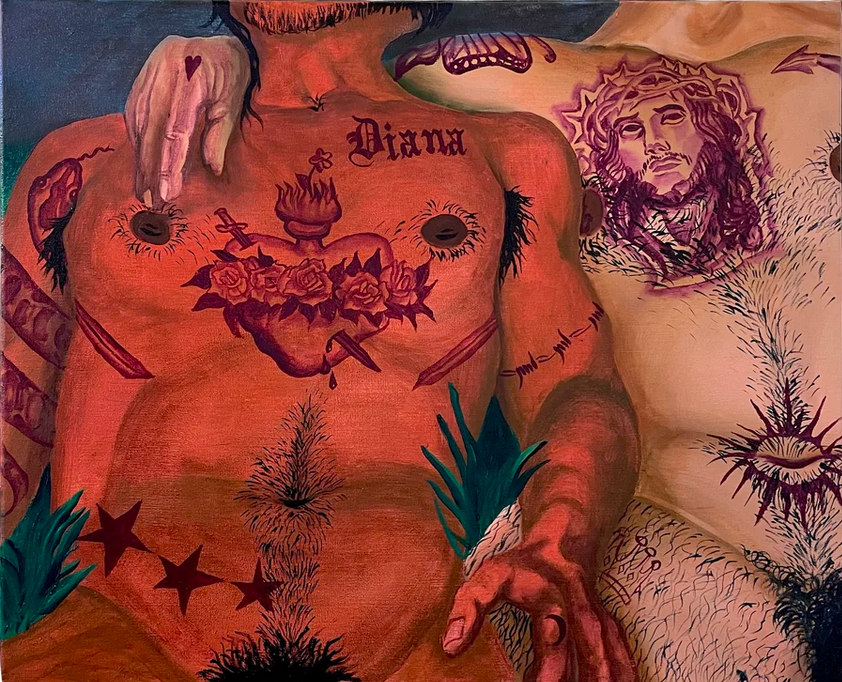
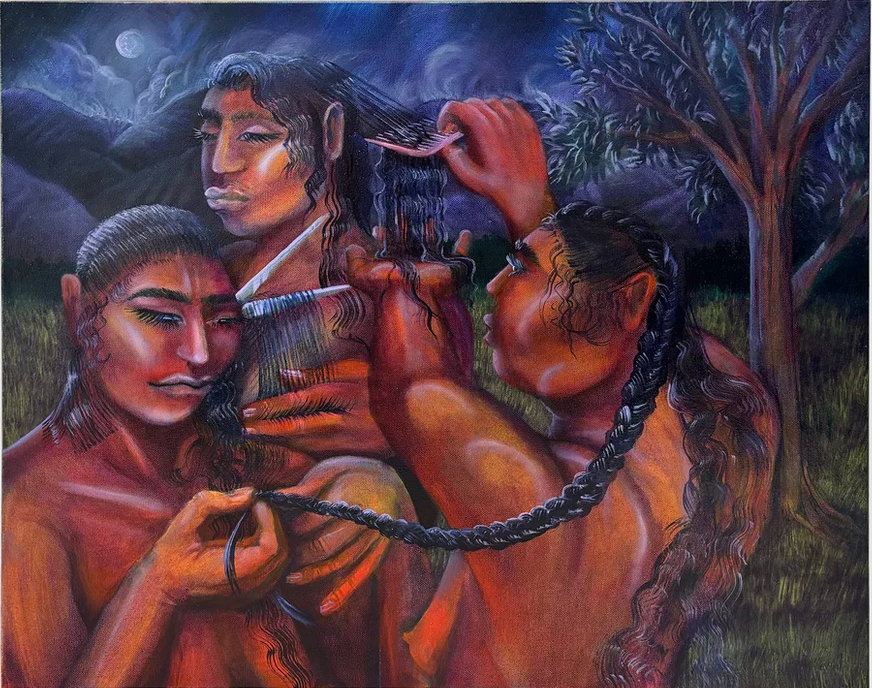
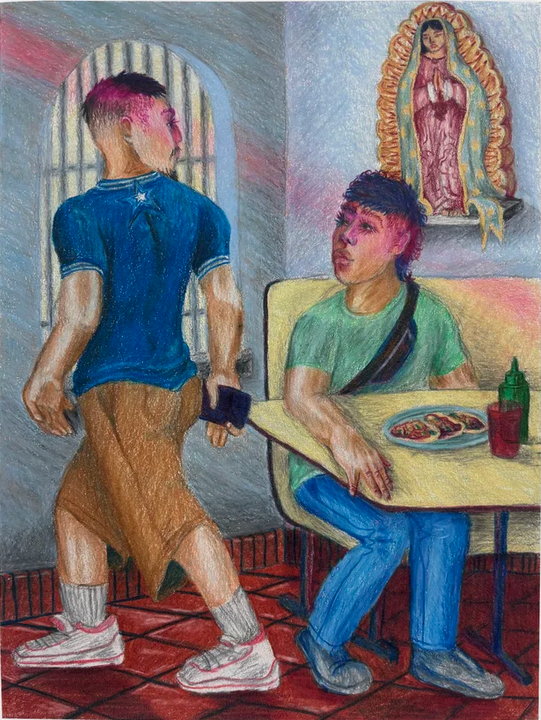
The use of color is fundamental in Arango’s work: lush, vibrant, expressive tones—drawing directly from the legacy of color in Latin American popular art—coalesce into a queer polychromy that resists aesthetic neutrality. The artist’s practice enters into dialogue with figures such as Débora Arango, Fernando Botero, and Paul Cadmus. If in Cadmus the bodies appear sculpted in marble, in Arango they take on the density of clay. Colossal and voluminous, they avoid slipping into fetishization and are deeply erotic in their earthy carnality, far removed from the hegemonic gay ideal: white, toned, and hairless, popularized by imaginaries such as that of Tom of Finland.
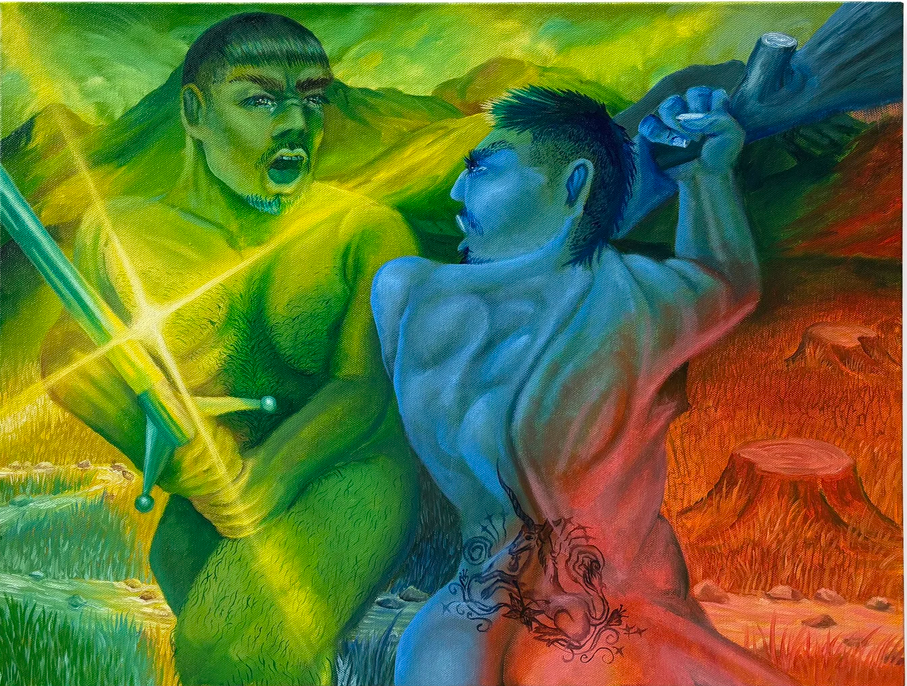
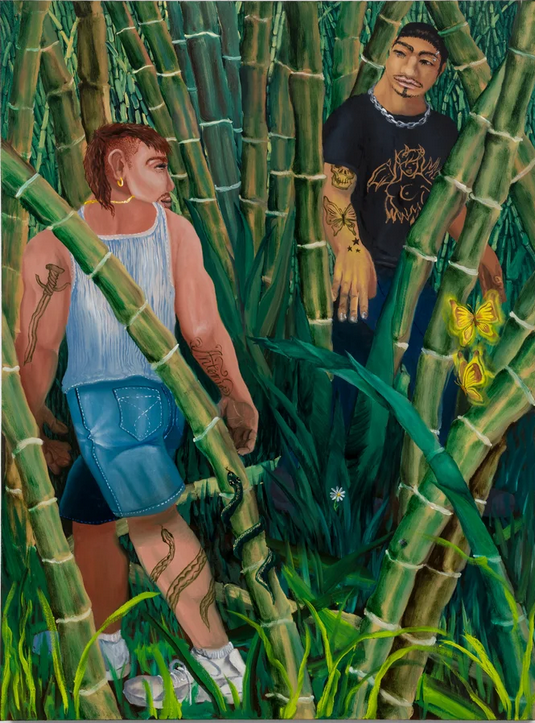
Monumentality constitutes one of the persistent features of his imaginary. Large, dense physiques appear through a caricatural exaggeration, yet charged with erotic force: oversized hands, firm legs, fleshy lips, powerful arms. The body incorporates signs associated with popular Latin masculinities—machetes, tattoos, abundant body hair. These elements introduce tension into the idea of masculinity and underscore its performative nature. This corporeality also unsettles the model of the idealized macho. Male figures, at times effeminate in their gestures or bodily expressiveness, sustain a deliberate ambiguity. They evoke archetypes recognizable within everyday Latin American life while simultaneously rising toward almost mythic registers.
The few female figures share the same voluminosity and muscularity. They belong to a continuum of bodies that destabilize binary readings of gender, allowing femininity and masculinity to bleed into one another. Raciality, marked as Indigenous, mestizo, or mixed, produces friction. The body becomes a territory where fear and trauma are inscribed alongside desire and tenderness. The wound, then, coexists with self-affirmation.
The narrative of his images privileges the instant, condensing intensity into fragments where something begins or fractures. A playful, almost illustrative curiosity emerges—one that alludes to youth, that time when emotions are experienced with heightened intensity, shaped by novelty and often by the forbidden. From this jovial impulse arises a palpable optimism that recovers the older meaning of the word gay as something joyful and vital. The emotional, the spiritual, and the carnal intertwine in an intimate world that aspires to resonate beyond its individual circumstance.
His imaginary oscillates between plausible representations and scenes of mythological resonance, where gay love takes on a spiritual dimension. The jungle appears as a sanctuary and refuge for the migrant, an accomplice to clandestine affections in the face of punitive systems. Nature becomes both hiding place and passage. Within this logic, cities such as Chicago can be read as concrete jungles associated with the possibility of a more open existence.
His visuality assumes that any affirmation of queer Latin American identity within hegemonic contexts carries inherent ambivalences and contradictions. The images inhabit that discomfort. Arango distances himself from the aesthetics of explicit activism and from the hypersexualization prevalent in certain mainstream visualities, proposing instead a politics of the everyday. His work resonates with Quiroga’s critique of identity politics, which, in their representational drive, tend to simplify lived experience.
Arango explores liminal identities that overflow fixed categories of gender, sexuality, race, or nationality. Being queer and being an immigrant emerge as mobile states. Non-belonging becomes a site of agency and a space for the critical selection of cultural references. In the absence of a consolidated queer Colombian community in his immediate environment, the artist finds affinity with Mexican and Puerto Rican communities, shaping a shared diasporic Latinidad—constructed from a common experience in the United States rather than from national origin.
Understanding his work entails recognizing that “Latinidad” and “queer” operate as communal dimensions shaped by tension. Various Latin American authors have pointed out how queer—a term emerging from the Global North—can function as an exported framework that tends to homogenize sexually dissident experiences under external logics. From this, the strategic emergence of cuir arises: a phonetic reappropriation that seeks to reinscribe these experiences within situated genealogies, while not constituting a stable or universal category.
In Arango’s case, the queer is activated through his inscription in the U.S. diaspora, where the term forms part of everyday political language and intersects with processes such as the migrant experience of racialized bodies.
In contexts where the communal holds a central place, sexual dissidence introduces painful fractures. Quiroga has noted that Latino communities offer relative degrees of protection that complicate an exclusively gay identification, placing subjects within a space of negotiation. Within the U.S. diaspora, queer Latino subjects may experience a double distance, both from certain Latino environments shaped by patriarchal legacies and from a dominant gay culture associated with whiteness and cisnormativity. Even within Latin micro-communities, internal hierarchies are reproduced, further complicating belonging. In response, Arango’s work suggests an affective pan-Americanism in which lateral bonds take on central importance. Identifications are constructed through resonances and affinities that destabilize rigid categories without dissolving them.
Although rooted in concrete experiences of migration and sexual dissidence, his work exceeds the autobiographical and projects itself toward a sensibility shared by gay and queer Latinx migrants in the United States. It speaks to emotions and tensions that are recognizable beyond specific coordinates: the fear of rejection, the search for community, and tenderness as a form of resistance remain constants within LGBT+ experiences.
¹
Under the mandate of Donald Trump, marked by the intensification of migration policies, the increase in Immigration and Customs Enforcement (ICE) raids, and an increasingly hostile climate toward racialized communities and sexual dissidents, the experience of the queer immigrant became shaped by multiple forms of vulnerability. The criminalization of the migrant body and the escalation of homophobic discourse operated as overlapping forces, producing a constant state of alert. Within the U.S. context, to exist and represent oneself as a queer Latino implies inhabiting a space of ongoing risk, where visibility functions both as affirmation and as exposure. Here, “Latino” does not designate a homogeneous identity or a stable national belonging, but rather a racialized category produced within the North American context—one that groups diverse trajectories under a single label.
Within this climate of structural hostility, artistic practices such as that of Juan Arango Palacios take on a particular urgency as symbolic territories of resistance, memory, and the rearticulation of identity. Born in 1997 in the coffee-growing region of Pereira, Juan Arango Palacios has moved across multiple geographies: a childhood between Colombia and rural Louisiana, adolescence in a suburb of Dallas, and adulthood in Chicago, where he graduated from the School of the Art Institute. After nearly a decade, the Windy City became a decisive component of his artistic identity. This fragmented biography does not follow an epic narrative of upward mobility, but rather reflects a trajectory shaped by displacement and ongoing negotiations with cultural, racial, and sexual systems that rarely offer stability to the queer immigrant subject. Through his narrative painting, Arango constructs fragments of his inner world, developing a symbolic structure that examines his relationship to heritage, culture, and queer experience from a position marked by migration and the search for belonging.
His universe emerges as an intimate response to structural conditions of exclusion—a space in which body, desire, and memory insist on becoming visible. Representation occupies a central role and is bound to the fear of inadequacy, of not fitting in as a queer immigrant within a Catholic family situated in a conservative environment. Painting thus becomes a form of self-affirmation.
This sense of individual dislocation translates into a broader structural experience or conflict, echoing what José Quiroga described as “the difficulty of simultaneously articulating sexuality, ethnicity, and cultural belonging within rigid identity frameworks.”
The use of color is fundamental in Arango’s work: lush, vibrant, expressive tones—drawing directly from the legacy of color in Latin American popular art—coalesce into a queer polychromy that resists aesthetic neutrality. The artist’s practice enters into dialogue with figures such as Débora Arango, Fernando Botero, and Paul Cadmus. If in Cadmus the bodies appear sculpted in marble, in Arango they take on the density of clay. Colossal and voluminous, they avoid slipping into fetishization and are deeply erotic in their earthy carnality, far removed from the hegemonic gay ideal: white, toned, and hairless, popularized by imaginaries such as that of Tom of Finland.
Monumentality constitutes one of the persistent features of his imaginary. Large, dense physiques appear through a caricatural exaggeration, yet charged with erotic force: oversized hands, firm legs, fleshy lips, powerful arms. The body incorporates signs associated with popular Latin masculinities—machetes, tattoos, abundant body hair. These elements introduce tension into the idea of masculinity and underscore its performative nature. This corporeality also unsettles the model of the idealized macho. Male figures, at times effeminate in their gestures or bodily expressiveness, sustain a deliberate ambiguity. They evoke archetypes recognizable within everyday Latin American life while simultaneously rising toward almost mythic registers.
The few female figures share the same voluminosity and muscularity. They belong to a continuum of bodies that destabilize binary readings of gender, allowing femininity and masculinity to bleed into one another. Raciality, marked as Indigenous, mestizo, or mixed, produces friction. The body becomes a territory where fear and trauma are inscribed alongside desire and tenderness. The wound, then, coexists with self-affirmation.
The narrative of his images privileges the instant, condensing intensity into fragments where something begins or fractures. A playful, almost illustrative curiosity emerges—one that alludes to youth, that time when emotions are experienced with heightened intensity, shaped by novelty and often by the forbidden. From this jovial impulse arises a palpable optimism that recovers the older meaning of the word gay as something joyful and vital. The emotional, the spiritual, and the carnal intertwine in an intimate world that aspires to resonate beyond its individual circumstance.
His imaginary oscillates between plausible representations and scenes of mythological resonance, where gay love takes on a spiritual dimension. The jungle appears as a sanctuary and refuge for the migrant, an accomplice to clandestine affections in the face of punitive systems. Nature becomes both hiding place and passage. Within this logic, cities such as Chicago can be read as concrete jungles associated with the possibility of a more open existence.
His visuality assumes that any affirmation of queer Latin American identity within hegemonic contexts carries inherent ambivalences and contradictions. The images inhabit that discomfort. Arango distances himself from the aesthetics of explicit activism and from the hypersexualization prevalent in certain mainstream visualities, proposing instead a politics of the everyday. His work resonates with Quiroga’s critique of identity politics, which, in their representational drive, tend to simplify lived experience.
Arango explores liminal identities that overflow fixed categories of gender, sexuality, race, or nationality. Being queer and being an immigrant emerge as mobile states. Non-belonging becomes a site of agency and a space for the critical selection of cultural references. In the absence of a consolidated queer Colombian community in his immediate environment, the artist finds affinity with Mexican and Puerto Rican communities, shaping a shared diasporic Latinidad—constructed from a common experience in the United States rather than from national origin.
Understanding his work entails recognizing that “Latinidad” and “queer” operate as communal dimensions shaped by tension. Various Latin American authors have pointed out how queer—a term emerging from the Global North—can function as an exported framework that tends to homogenize sexually dissident experiences under external logics. From this, the strategic emergence of cuir arises: a phonetic reappropriation that seeks to reinscribe these experiences within situated genealogies, while not constituting a stable or universal category.
In Arango’s case, the queer is activated through his inscription in the U.S. diaspora, where the term forms part of everyday political language and intersects with processes such as the migrant experience of racialized bodies.
In contexts where the communal holds a central place, sexual dissidence introduces painful fractures. Quiroga has noted that Latino communities offer relative degrees of protection that complicate an exclusively gay identification, placing subjects within a space of negotiation. Within the U.S. diaspora, queer Latino subjects may experience a double distance, both from certain Latino environments shaped by patriarchal legacies and from a dominant gay culture associated with whiteness and cisnormativity. Even within Latin micro-communities, internal hierarchies are reproduced, further complicating belonging. In response, Arango’s work suggests an affective pan-Americanism in which lateral bonds take on central importance. Identifications are constructed through resonances and affinities that destabilize rigid categories without dissolving them.
Although rooted in concrete experiences of migration and sexual dissidence, his work exceeds the autobiographical and projects itself toward a sensibility shared by gay and queer Latinx migrants in the United States. It speaks to emotions and tensions that are recognizable beyond specific coordinates: the fear of rejection, the search for community, and tenderness as a form of resistance remain constants within LGBT+ experiences.
¹