[:]
In the winter, when the shadow of the volcano Licancabur falls over the Kimal mountain, two mountain ranges, the Andes and the Domeyko, are united. At dawn, the sun appears above the volcano’s peak and its shadow projects all the way to the mountain, which harbors bodies of water beneath its surface. Although the landscape we are standing in is a desert, this relationship speaks of fertility; it is a sign of the agricultural year and the rebirth of the Earth. Beginning on August 1, Mother Earth awakens.
The human species has lived in the desert for thousands of years, and our survival is difficult to explain because the desert isn’t a habitat that invites an easy life. We have agriculture, but we rely on flood irrigation, which takes a great effort to achieve. One might wonder how we have survived for thousands of years in a desert. Eventually, one understands and deduces that, in order to gain an understanding of the land, human beings had to practice observation, achieving a total confluence of the four elements, the cardinal points, the cosmos, the underworld, the human, and the visible. But, besides what can be seen, the most important thing is to feel. It is when we understand these connections and allow this knowledge to flow together that we begin to generate ancestral science.
For the people of the Atacama, there exist in the desert three worlds: the world above, the human world—where we are—and the underworld, or the world below. While the Licancabur volcano has a connection with the world above, the Kimal mountain connects with the world below. At some point over the course of the year, we come to understand this relationship that exists here in the desert. The connection isn’t just spiritual; it is the real knowledge of a territory, where these worlds intertwine and act together.
Let us consider these three worlds. The world below has its own sun—what in the West we call magma. This internal sun is the reflection of the external sun, that of the cosmos; they are like mirror images of one another. What happens in one happens in the other. This underworld is an ecosystem fed by the internal sun.
The intermediary world is the human world, where all living beings reside. It is the world where everything we can see exists, where we developed the capacity to visualize. This world, the one where we live our day-to-day lives, is connected to the ecosystem below. For example, in the El Tatio geysers, we can see outbursts of this underworld.
Another example is the Salar de Atacama. It is here that our ancient waters gather in the surface waters of the endorheic basin. Here waters arrive from the northern Amazon and the coast, passing through the Domeyko, atmospheric rivers that come together on one day in summer in the Salar de Atacama. Thanks to the salt flats, our high-plain rains are generated, created in turn by microorganisms: oxygen-producing cyanobacteria whose work for this world is practically invisible. They’re like little microscopic trees, and thanks to them, we have rain. This is why the Salar de Atacama is so important, because it’s part of an entire ecosystem, of various systems, where everything flows together.
Currently, copper extraction impacts our entire territory. Our ancestors, however, were able to mine without deteriorating the ecosystem; that is ancestral science. Why do I say this? Because our ancestors extracted copper and bronze, and cast metal. Our ancestors were miners, but worked the copper using bacteria, without impacting the soil or the water and without using today’s chemicals, but in an ecological way. Why? Because here we have memory.
We have the Andes mountains, our volcanoes, and the internal sun. The volcanoes have this connection with the internal sun and they are the living reflection of that underworld—which is, in turn, a reflection of the sun above. They give us our understanding of the climate; they are connected to the temperature and waters. Volcanoes have a big impact on the climate, the temperature, and the waters, and when they forcefully express the activity of the internal sun, we pamper them, because they are very lonely beings. For the most part, we humans fear them, but when they feel tended to, they act harmoniously. This also forms part of our knowledge.
Licancabur, our guardian volcano, is part of a great planetary network of consciousness—because nature has its own intelligence, and that intelligence manifests through this great planetary network. It also forms part of an energetic network that connects our frequencies and vibrations, which is why we must remain in communication with it.
In this energetic context, the salt flat is connected with the surrounding volcanoes. The lithium in the salt flat is important not as something to be extracted for batteries, but rather because it conserves the planet’s memory. There lies information about the Earth’s formation, which is creating a whole system of microorganisms that can provide us with so many responses to the changes occurring today. There, the three worlds intertwine. They are interconnected ecosystems.
In our research on ancestral science, we have encountered ceremonies that refer to a glacial time. This shows us how important it is for a territory to retain its memory, because this memory holds knowledge about the many changes that can occur on Earth. Ceremonies mark for us the time when our ancestors lived on this planet. When we manage to discover these remains of human experience, we realize that our existence in the desert hasn’t lasted millions of years, but rather ten thousand to eleven thousand years. Thanks to this same planetary memory, our ancestors were able to evolve in the desert. Why didn’t human beings want to leave the desert? Wouldn’t it have been easier to try to occupy other territories, even if it meant having confrontations with other peoples over land?
Instead, humanity decided to remain in this territory because it was able to find its memory and use it to meet its own needs. That’s the importance of observation and connection with these worlds and memories.
Due to the intense solar radiation of the desert, when it rains it is possible to see the reflections the salt produces from very far away. The salt flat becomes a nest of stars. And in other places too, like the Valle de la Luna, one can see how nature shows us what we are as a species and the cosmos to which we belong. Here, our species can understand that the stars contain alcohol, and that is why we perform our ceremonies with alcohol—that’s the real reason. It’s a way of reaching out to the cosmos, to the stars that we honor so that they might continue in their transient life. The same is true of the iron that connects the internal sun and its magma to our bodies, and, in turn, the body to the territory.
Spirituality is science. The root of our culture, I always say, is spiritual. It is a planetary vision that relates to the cosmos, to the world below, to the underworld. It’s not only about our existence as living beings on Earth; it’s about all that information about the heavens and below, where, for thousands of years, the cosmic memories of the forging of the Earth have been guarded by the salt flats, our volcanoes, and our waters.
*Sonia Ramos Chocobar is a Atacameña-Lickanantay activist, advocate, and scientist.
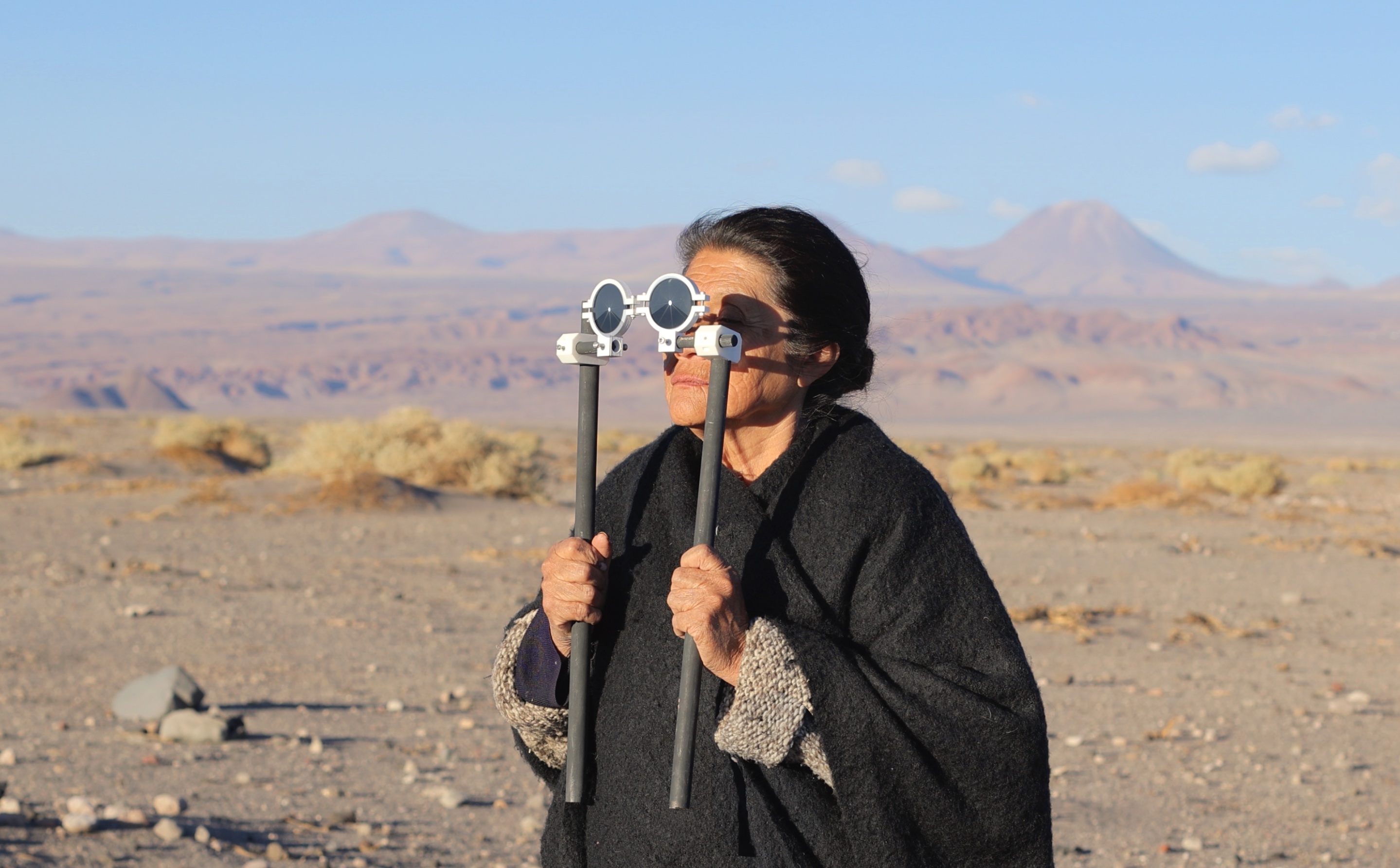
Oral story and stills recorded in the Salar de Atacama in August 2024 as part of the Infra project by artist and researcher Elisa Balmaceda.
In the winter, when the shadow of the volcano Licancabur falls over the Kimal mountain, two mountain ranges, the Andes and the Domeyko, are united. At dawn, the sun appears above the volcano’s peak and its shadow projects all the way to the mountain, which harbors bodies of water beneath its surface. Although the landscape we are standing in is a desert, this relationship speaks of fertility; it is a sign of the agricultural year and the rebirth of the Earth. Beginning on August 1, Mother Earth awakens.
The human species has lived in the desert for thousands of years, and our survival is difficult to explain because the desert isn’t a habitat that invites an easy life. We have agriculture, but we rely on flood irrigation, which takes a great effort to achieve. One might wonder how we have survived for thousands of years in a desert. Eventually, one understands and deduces that, in order to gain an understanding of the land, human beings had to practice observation, achieving a total confluence of the four elements, the cardinal points, the cosmos, the underworld, the human, and the visible. But, besides what can be seen, the most important thing is to feel. It is when we understand these connections and allow this knowledge to flow together that we begin to generate ancestral science.
For the people of the Atacama, there exist in the desert three worlds: the world above, the human world—where we are—and the underworld, or the world below. While the Licancabur volcano has a connection with the world above, the Kimal mountain connects with the world below. At some point over the course of the year, we come to understand this relationship that exists here in the desert. The connection isn’t just spiritual; it is the real knowledge of a territory, where these worlds intertwine and act together.
Let us consider these three worlds. The world below has its own sun—what in the West we call magma. This internal sun is the reflection of the external sun, that of the cosmos; they are like mirror images of one another. What happens in one happens in the other. This underworld is an ecosystem fed by the internal sun.
The intermediary world is the human world, where all living beings reside. It is the world where everything we can see exists, where we developed the capacity to visualize. This world, the one where we live our day-to-day lives, is connected to the ecosystem below. For example, in the El Tatio geysers, we can see outbursts of this underworld.
Another example is the Salar de Atacama. It is here that our ancient waters gather in the surface waters of the endorheic basin. Here waters arrive from the northern Amazon and the coast, passing through the Domeyko, atmospheric rivers that come together on one day in summer in the Salar de Atacama. Thanks to the salt flats, our high-plain rains are generated, created in turn by microorganisms: oxygen-producing cyanobacteria whose work for this world is practically invisible. They’re like little microscopic trees, and thanks to them, we have rain. This is why the Salar de Atacama is so important, because it’s part of an entire ecosystem, of various systems, where everything flows together.
Currently, copper extraction impacts our entire territory. Our ancestors, however, were able to mine without deteriorating the ecosystem; that is ancestral science. Why do I say this? Because our ancestors extracted copper and bronze, and cast metal. Our ancestors were miners, but worked the copper using bacteria, without impacting the soil or the water and without using today’s chemicals, but in an ecological way. Why? Because here we have memory.
We have the Andes mountains, our volcanoes, and the internal sun. The volcanoes have this connection with the internal sun and they are the living reflection of that underworld—which is, in turn, a reflection of the sun above. They give us our understanding of the climate; they are connected to the temperature and waters. Volcanoes have a big impact on the climate, the temperature, and the waters, and when they forcefully express the activity of the internal sun, we pamper them, because they are very lonely beings. For the most part, we humans fear them, but when they feel tended to, they act harmoniously. This also forms part of our knowledge.
Licancabur, our guardian volcano, is part of a great planetary network of consciousness—because nature has its own intelligence, and that intelligence manifests through this great planetary network. It also forms part of an energetic network that connects our frequencies and vibrations, which is why we must remain in communication with it.
In this energetic context, the salt flat is connected with the surrounding volcanoes. The lithium in the salt flat is important not as something to be extracted for batteries, but rather because it conserves the planet’s memory. There lies information about the Earth’s formation, which is creating a whole system of microorganisms that can provide us with so many responses to the changes occurring today. There, the three worlds intertwine. They are interconnected ecosystems.
In our research on ancestral science, we have encountered ceremonies that refer to a glacial time. This shows us how important it is for a territory to retain its memory, because this memory holds knowledge about the many changes that can occur on Earth. Ceremonies mark for us the time when our ancestors lived on this planet. When we manage to discover these remains of human experience, we realize that our existence in the desert hasn’t lasted millions of years, but rather ten thousand to eleven thousand years. Thanks to this same planetary memory, our ancestors were able to evolve in the desert. Why didn’t human beings want to leave the desert? Wouldn’t it have been easier to try to occupy other territories, even if it meant having confrontations with other peoples over land?
Instead, humanity decided to remain in this territory because it was able to find its memory and use it to meet its own needs. That’s the importance of observation and connection with these worlds and memories.
Due to the intense solar radiation of the desert, when it rains it is possible to see the reflections the salt produces from very far away. The salt flat becomes a nest of stars. And in other places too, like the Valle de la Luna, one can see how nature shows us what we are as a species and the cosmos to which we belong. Here, our species can understand that the stars contain alcohol, and that is why we perform our ceremonies with alcohol—that’s the real reason. It’s a way of reaching out to the cosmos, to the stars that we honor so that they might continue in their transient life. The same is true of the iron that connects the internal sun and its magma to our bodies, and, in turn, the body to the territory.
Spirituality is science. The root of our culture, I always say, is spiritual. It is a planetary vision that relates to the cosmos, to the world below, to the underworld. It’s not only about our existence as living beings on Earth; it’s about all that information about the heavens and below, where, for thousands of years, the cosmic memories of the forging of the Earth have been guarded by the salt flats, our volcanoes, and our waters.
*Sonia Ramos Chocobar is a Atacameña-Lickanantay activist, advocate, and scientist.
Oral story and stills recorded in the Salar de Atacama in August 2024 as part of the Infra project by artist and researcher Elisa Balmaceda.