Between futuristic deities, teosinte, and prieto maize, Uriel Vides Bautista reflects on “ŌME: Teōsinte,” a performative action that intervened in the heart of Mexico City, confronting the enduring racial and cultural hierarchies that shape the present.
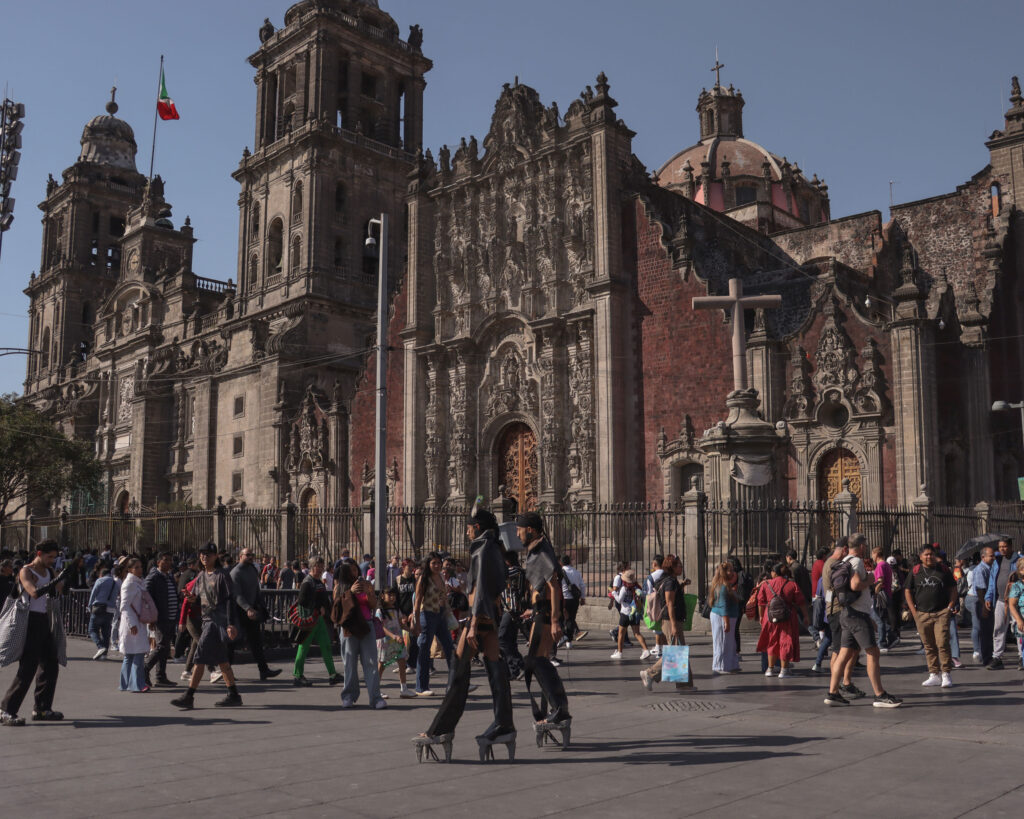
While a significant part of the city’s artistic activity is concentrated in institutional spaces and exhibition circuits, a walk took place in parallel to these dynamics. Crossing streets and avenues such as Madero, Juárez, Reforma, Bucareli, and General Prim, artists Óldo Erréve and Lechedevirgen began a journey of approximately three kilometers, from the Teocalli de la Guerra Sagrada in the Zócalo to the Juárez neighborhood. Conceived as a peaceful, slow, and silent action, the walk introduced a slowed-down temporality that contrasted with the dynamics of acceleration, circulation, and consumption that often shape much of the contemporary art experience.
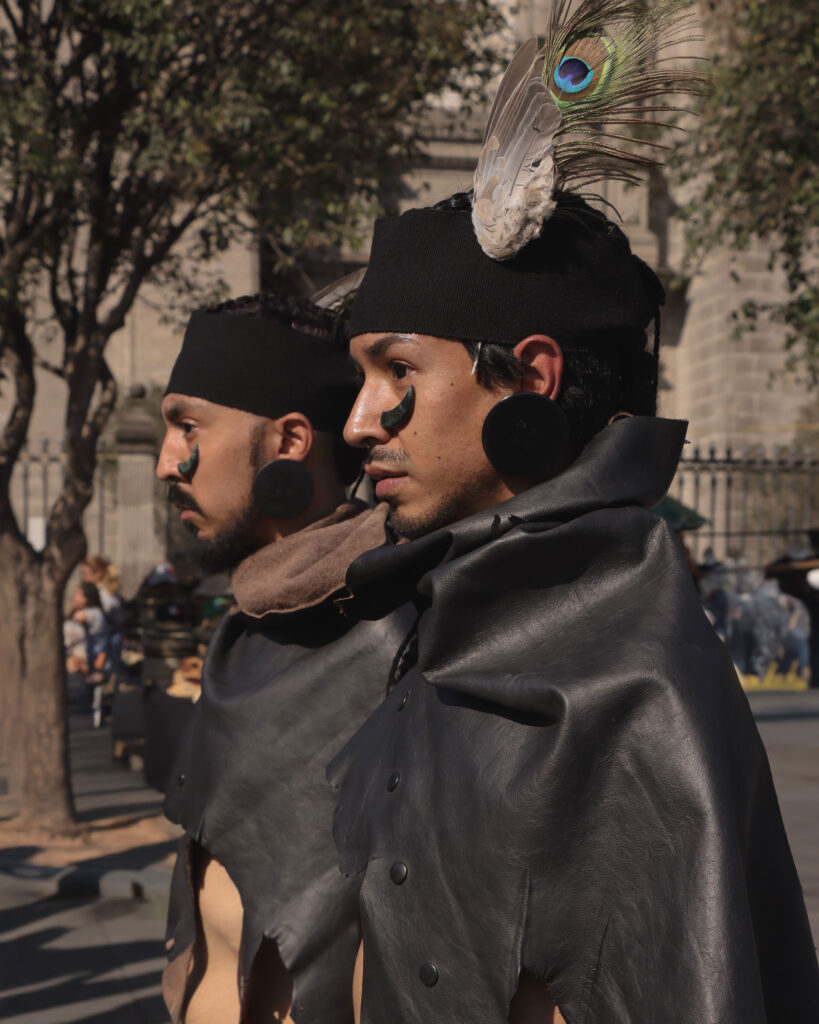
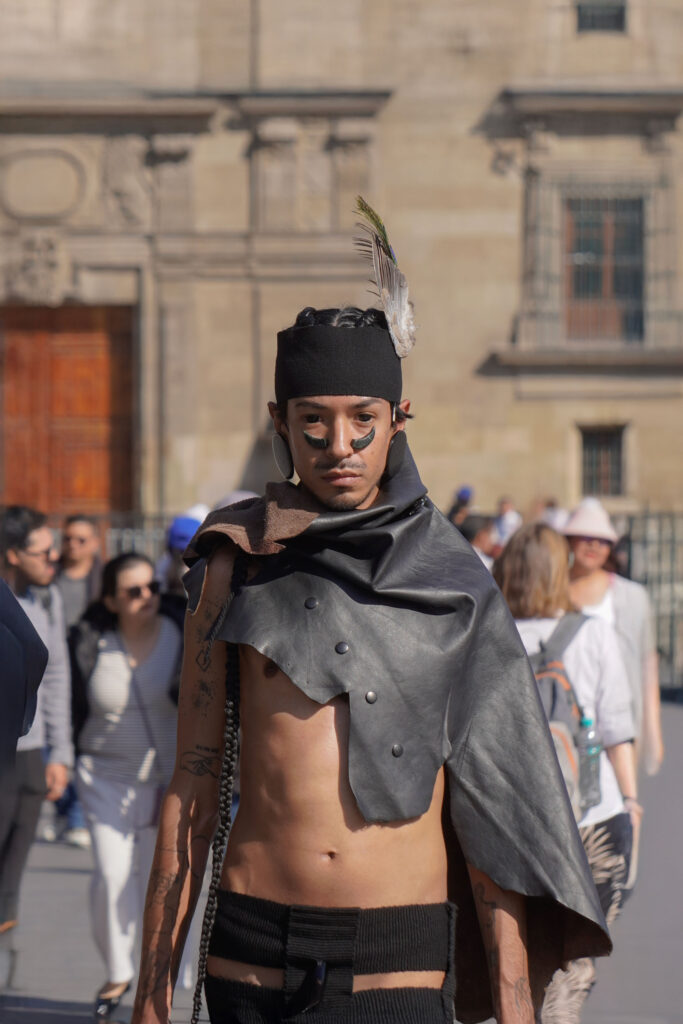
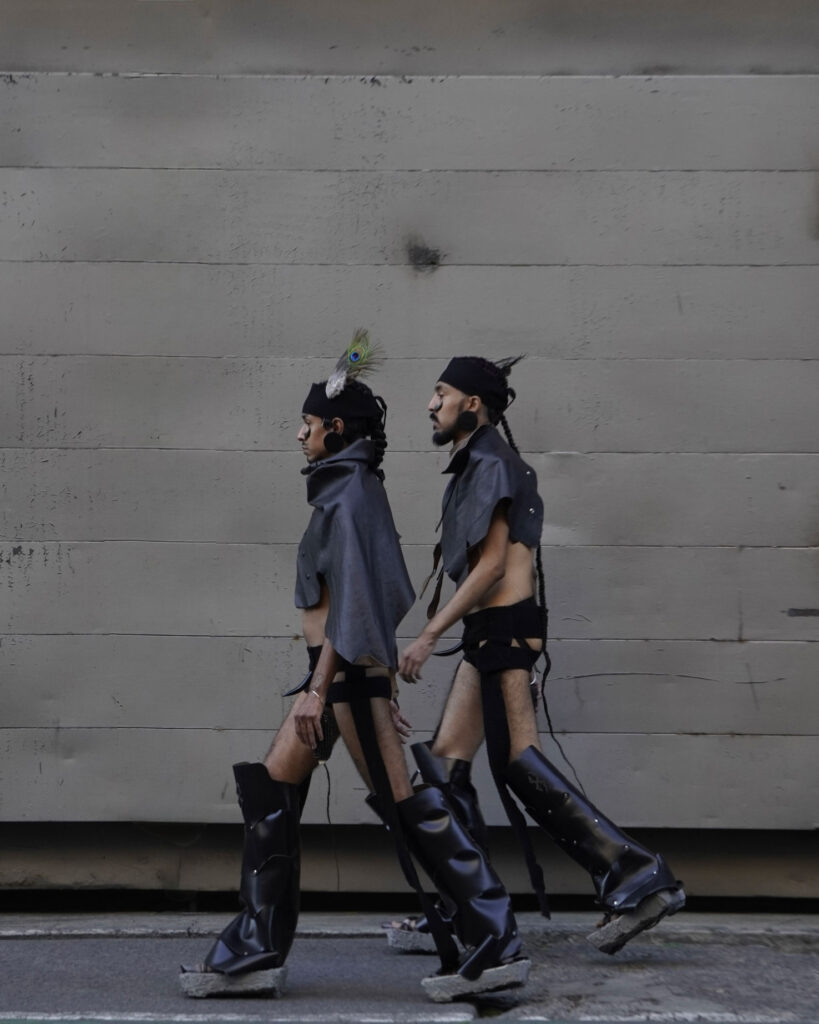
Through their bodies, the artists assumed two spectral figures of ambiguous temporality, whose garments functioned as bodily installations that extended physical presence beyond its anatomical limits. They wore loincloths made from textiles rooted in the Mazahua tradition, altered at the front with phallic obsidian pieces, alongside recycled leather chest pieces and leg warmers, as well as headdresses composed of pigeon wings and peacock feathers. Dark jade accessories and black contact lenses completed the ensemble. They walked atop high platform shoes shaped like metate-huaraches, produced through 3D printing using PLA polymers, granite, charcoal, and repurposed leather straps. These structures imposed a particular choreography, rendering each step slow, precarious, and ceremonial.
The walk moved through a space saturated with stimuli: flows of pedestrians, street vendors, motor traffic, odors, and constant noise. Amid favorable comments, reactions of rejection, and looks of curiosity or bewilderment, people made way for the artists as they advanced in synchrony. Along the route, they stopped at different points—the Zócalo and Madero, the esplanade of the Palacio de Bellas Artes, outside the Museo de Memoria y Tolerencia—where they performed sculptural bodily configurations. During these pauses, their bodies adopted minimal gestures that shifted between affectivity (intertwined hands) and defiance (raised fists), depending on the site in which they positioned themselves.
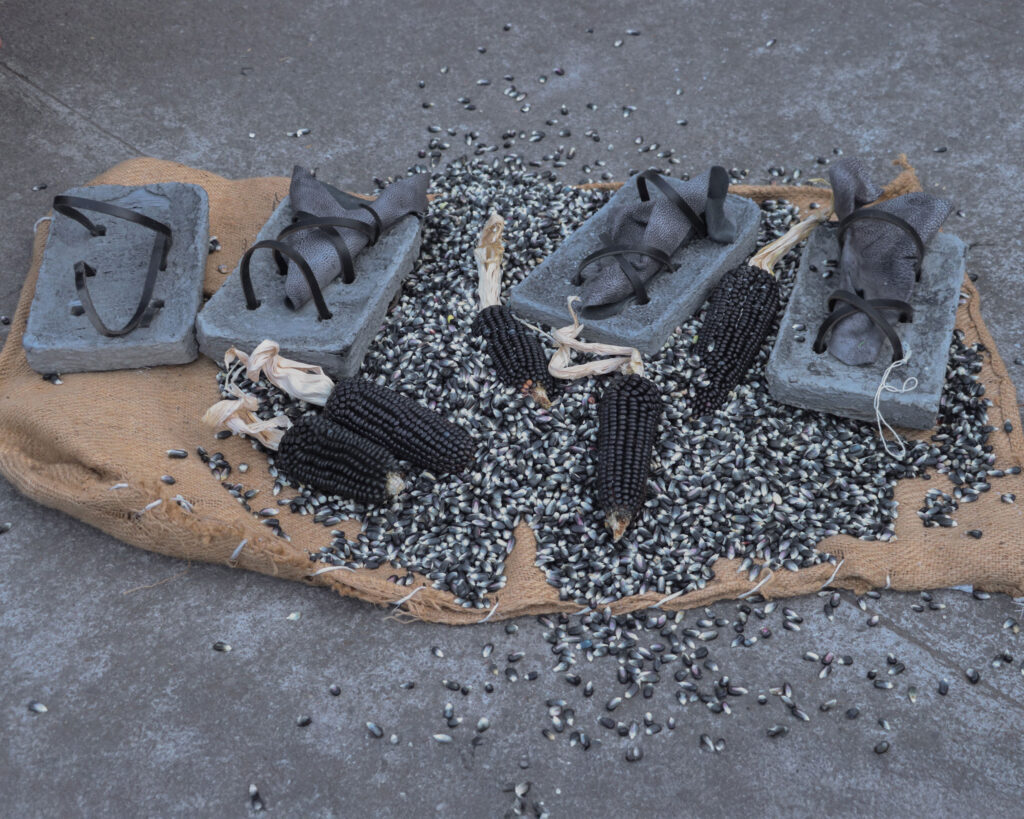
After nearly three hours, the procession arrived at General Prim Beside the line of visitors waiting to enter the art events, the duo carried out a final series of actions: they braided their long hair around an improvised altar on the sidewalk, scattered kernels of maíz prieto—a generic term used to designate dark varieties of corn, ranging from blue and purple to gray and black—across woven mats that they later crushed beneath their platforms, bringing the intervention to a close.
Disturbing Time and Space
In continuity with other projects by Óldo Erréve, ŌME: Teōsinte revisited the figure of the avatar as the conceptual axis of the intervention, shifting it from the realm of individual and multimedia-based practice toward a shared action with Lechedevirgen in public space. For Erréve, the term does not remain confined to its digital meaning as the image that represents a user in virtual worlds, but instead operates as a mediating figure between different planes: the human and the posthuman, the ancestral and the technological, the real and the speculative. Within the performance, this condition materialized in two bodies that exceeded their individual dimension in order to project themselves as transtemporal deities, immersed in a kind of trance.
The avatars seemed to move across different temporalities, combining futuristic imaginaries with visual references associated with Mesoamerican traditions. This convergence became evident in the garments and materials used in their construction—obsidian, jade, precious feathers, repurposed hides, and corn-derived polymers—while the title of the work alluded to the Mexica, whose vestiges persist beneath the ground of present-day Mexico City, through which the procession unfolded. In Nahuatl, ōme refers to the number two, but also to Ometéotl, the dual deity in Mexica cosmology associated with the origin of existence; meanwhile, teōcintli designates teosinte, the wild grass central to the processes of maize domestication in the region.
The intervention approached the past not as a distant and sterile ruin, but as a living force within the present. Under this logic, time ceased to be understood as a linear and progressive sequence, opening instead onto the coexistence of multiple temporalities, even if this was not always evident to those who involuntarily witnessed the action. In the same vein, ŌME: Teōsinte disrupted the habitual use of urban space, both through its occupation of the street and through the specific ways it unsettled everyday dynamics. The deliberate slowness of the steps and the ceremonial character of the garments altered an order governed by the constant circulation of pedestrians, commodities, and tourists, disturbing the attention of those moving through the area as it passed.
Symbolic Transvestism
The garments were among the most visible aspects of the performative intervention. As mentioned previously, some elements evoked repertoires associated with Mesoamerican traditions, while also incorporating codes drawn from contemporary design and even haute couture—an interdisciplinary intersection frequently present in Óldo Erréve’s artistic practice. The result was neither archaeological reproduction nor ethnographic record, but rather the hybridization of garments that, through the logic of the avatar, activated simultaneous associations between the ancestral, the technological, and the spectacular.
In Mexico, certain visual repertoires derived from Mesoamerican peoples have been folklorized or transformed into nationalist emblems as part of state cultural projects. For this reason, their use in contemporary practices raises questions that are difficult to evade. When artists who do not necessarily self-identify as Indigenous draw upon these repertoires, questions emerge regarding the boundaries between appropriation, reconfiguration, and symbolic displacement. In ŌME: Teōsinte, this tension was not immediately resolved; rather, it remained exposed as a paradox: that which is recognized as the cultural heritage of the nation continues to operate as a marker of ongoing social stratifications.
The notion of cultural transvestism, developed by Lechedevirgen, offers an alternative interpretive framework to the usual discussion surrounding cultural appropriation. Rather than conceiving identity as a stable essence that must be protected from external influences, this perspective proposes that cultural symbols are transformed through their circulation, thereby generating new symbolic assemblages shaped by historical tensions. In the artist’s words, appropriating symbols linked to an ancestral past and combining them with contemporary aesthetics or those of mass culture does not seek to restore a lost authenticity, but rather to reveal that cultural identities are historical constructions determined by relations of power.
From this perspective, the references present in ŌME: Teōsinte did not seek to speak on behalf of specific communities or particular cultural traditions, but rather to assert themselves through an experience shaped by prietud. Within this framework, the frictions the artists generated by appearing in certain settings can be understood as effects of that positioning. There, cultural transvestism ceased to function merely as an aesthetic device and instead acquired a critical dimension.
Embodying Memory
At different moments throughout the route, ŌME: Teōsinte staged more than a ritualized choreography within urban space, hinting instead at the persistence of racial structures that have shaped Mexican society throughout its history. In this sense, the inclusion of maíz prieto, along with metates—grinding stones fundamental to the traditional preparation of tortillas—acquired a particular symbolic weight. Their presence evoked both relationships to the land and food culture, as well as the social burdens the term prieto continues to carry in Mexico.
Prietud does not designate merely a skin tone, but rather a historically produced position within a system of racial hierarchies of colonial origin that continues to reorganize itself in the present, maíz prieto made a long-standing memory present within an environment oriented toward novelty, consumption, and cosmopolitan prestige. From this semantic charge, the corn alluded to processes of racialization that rarely occupy a central place within the hegemonic art circuit. That reading, however, required recognizing the sociohistorical implications of the term prieto—something difficult to verify among spectators in the moment of the action.
At that point, when the maíz prieto was scattered across a woven mat, the gesture provoked reactions of bewilderment among some attendees. For a moment, the scene ceased to be clearly perceived within the familiar framework of the artistic proposals presented there; indeed, there was no shortage of people who, attempting to decipher what was unfolding before their eyes, approached those of us witnessing the performance to ask in English: What’s going on here?
What proved most revealing about ŌME: Teōsinte was not the imagery it deployed, but the force of its gestures, capable of producing discomfort within the spaces it traversed. The intervention displaced the questions it raised back onto the very circuit it sought to address. In that movement, another contradiction became evident: the art system’s capacity to absorb even that which points to its own limits. Nevertheless, the reactions observed at the end of the procession suggest that such absorption does not occur without friction. The irruption of these bodies functioned—if only for a few minutes—as a reminder of the social and racial differences that continue to structure life in Mexico.
ŌME: Teōsinte
Credits
Concept: Óldo Erréve (@oldoerreve) in collaboration with Lechedevirgen (@lechedevirgen)
Coordination and support: Donahto A. Pastén (@donnahto)
Photography: Eduardo Gachuz (@eduardoogachuz), Fabián Mecate (@mecate_)
Video: Roy Alonso (@rrrrroyalonso)
Styling team: Sam Meniovich (@sam_phantommm), Monserrat Petlacalco (@monsmua_)
Costume design: Óldo Erréve in collaboration with Farid Rivera, República (@reepublica), Yvan Fiend (@yvanfiend)
Sistema de Apoyos a la Creación y Proyectos Culturales (SACPC/FONCA)
Video documentation: https://youtu.be/Vip5gRQgwfk
¹The garments were the result of a collective process involving the knowledge and expertise of multiple collaborators. Ididalia Chávez, originally from Hidalgo, contributed Mazahua textiles, which were later adapted into loincloths by Farid Rivera, designer at REPÚBLICA. The recycled leather leg warmers and chest pieces were designed by Óldo Erréve in collaboration with Yvan Fiend, while the metate-huaraches were created by Erréve, who has titled them Huarates. Together, these elements formed a neo-artisanal design ensemble, complemented by the styling of Monserrat Petlacalco and Sam Meniovich, who intervened directly upon the artists’ bodies.
² Lechedevirgen, “Travestismo espiritual” [“Spiritual Transvestism”], in Deshacer el arte y otras puñaladas [Undoing Art and Other Stabbings] (Mexico City: OnA Ediciones, 2025), 105–110, available at Lechedevirgen — Travestismo espiritual
³ Prietud refers not only to dark skin, but to a historically produced social position shaped by racialization and colonial hierarchies in Mexico and Latin America. The term has been reclaimed in recent critical and cultural discourse as a way of naming embodied experiences of racism, colorism, and structural inequality.
Fotografía: Eduardo Gachuz y Fabián Mecate
While a significant part of the city’s artistic activity is concentrated in institutional spaces and exhibition circuits, a walk took place in parallel to these dynamics. Crossing streets and avenues such as Madero, Juárez, Reforma, Bucareli, and General Prim, artists Óldo Erréve and Lechedevirgen began a journey of approximately three kilometers, from the Teocalli de la Guerra Sagrada in the Zócalo to the Juárez neighborhood. Conceived as a peaceful, slow, and silent action, the walk introduced a slowed-down temporality that contrasted with the dynamics of acceleration, circulation, and consumption that often shape much of the contemporary art experience.
Through their bodies, the artists assumed two spectral figures of ambiguous temporality, whose garments functioned as bodily installations that extended physical presence beyond its anatomical limits. They wore loincloths made from textiles rooted in the Mazahua tradition, altered at the front with phallic obsidian pieces, alongside recycled leather chest pieces and leg warmers, as well as headdresses composed of pigeon wings and peacock feathers. Dark jade accessories and black contact lenses completed the ensemble. They walked atop high platform shoes shaped like metate-huaraches, produced through 3D printing using PLA polymers, granite, charcoal, and repurposed leather straps. These structures imposed a particular choreography, rendering each step slow, precarious, and ceremonial.
The walk moved through a space saturated with stimuli: flows of pedestrians, street vendors, motor traffic, odors, and constant noise. Amid favorable comments, reactions of rejection, and looks of curiosity or bewilderment, people made way for the artists as they advanced in synchrony. Along the route, they stopped at different points—the Zócalo and Madero, the esplanade of the Palacio de Bellas Artes, outside the Museo de Memoria y Tolerencia—where they performed sculptural bodily configurations. During these pauses, their bodies adopted minimal gestures that shifted between affectivity (intertwined hands) and defiance (raised fists), depending on the site in which they positioned themselves.
After nearly three hours, the procession arrived at General Prim Beside the line of visitors waiting to enter the art events, the duo carried out a final series of actions: they braided their long hair around an improvised altar on the sidewalk, scattered kernels of maíz prieto—a generic term used to designate dark varieties of corn, ranging from blue and purple to gray and black—across woven mats that they later crushed beneath their platforms, bringing the intervention to a close.
Fotografía: Eduardo Gachuz y Fabián Mecate
Disturbing Time and Space
In continuity with other projects by Óldo Erréve, ŌME: Teōsinte revisited the figure of the avatar as the conceptual axis of the intervention, shifting it from the realm of individual and multimedia-based practice toward a shared action with Lechedevirgen in public space. For Erréve, the term does not remain confined to its digital meaning as the image that represents a user in virtual worlds, but instead operates as a mediating figure between different planes: the human and the posthuman, the ancestral and the technological, the real and the speculative. Within the performance, this condition materialized in two bodies that exceeded their individual dimension in order to project themselves as transtemporal deities, immersed in a kind of trance.
The avatars seemed to move across different temporalities, combining futuristic imaginaries with visual references associated with Mesoamerican traditions. This convergence became evident in the garments and materials used in their construction—obsidian, jade, precious feathers, repurposed hides, and corn-derived polymers—while the title of the work alluded to the Mexica, whose vestiges persist beneath the ground of present-day Mexico City, through which the procession unfolded. In Nahuatl, ōme refers to the number two, but also to Ometéotl, the dual deity in Mexica cosmology associated with the origin of existence; meanwhile, teōcintli designates teosinte, the wild grass central to the processes of maize domestication in the region.
The intervention approached the past not as a distant and sterile ruin, but as a living force within the present. Under this logic, time ceased to be understood as a linear and progressive sequence, opening instead onto the coexistence of multiple temporalities, even if this was not always evident to those who involuntarily witnessed the action. In the same vein, ŌME: Teōsinte disrupted the habitual use of urban space, both through its occupation of the street and through the specific ways it unsettled everyday dynamics. The deliberate slowness of the steps and the ceremonial character of the garments altered an order governed by the constant circulation of pedestrians, commodities, and tourists, disturbing the attention of those moving through the area as it passed.
Fotografía: Eduardo Gachuz y Fabián Mecate
Symbolic Transvestism
The garments were among the most visible aspects of the performative intervention. As mentioned previously, some elements evoked repertoires associated with Mesoamerican traditions, while also incorporating codes drawn from contemporary design and even haute couture—an interdisciplinary intersection frequently present in Óldo Erréve’s artistic practice. The result was neither archaeological reproduction nor ethnographic record, but rather the hybridization of garments that, through the logic of the avatar, activated simultaneous associations between the ancestral, the technological, and the spectacular.
In Mexico, certain visual repertoires derived from Mesoamerican peoples have been folklorized or transformed into nationalist emblems as part of state cultural projects. For this reason, their use in contemporary practices raises questions that are difficult to evade. When artists who do not necessarily self-identify as Indigenous draw upon these repertoires, questions emerge regarding the boundaries between appropriation, reconfiguration, and symbolic displacement. In ŌME: Teōsinte, this tension was not immediately resolved; rather, it remained exposed as a paradox: that which is recognized as the cultural heritage of the nation continues to operate as a marker of ongoing social stratifications.
The notion of cultural transvestism, developed by Lechedevirgen, offers an alternative interpretive framework to the usual discussion surrounding cultural appropriation. Rather than conceiving identity as a stable essence that must be protected from external influences, this perspective proposes that cultural symbols are transformed through their circulation, thereby generating new symbolic assemblages shaped by historical tensions. In the artist’s words, appropriating symbols linked to an ancestral past and combining them with contemporary aesthetics or those of mass culture does not seek to restore a lost authenticity, but rather to reveal that cultural identities are historical constructions determined by relations of power.
From this perspective, the references present in ŌME: Teōsinte did not seek to speak on behalf of specific communities or particular cultural traditions, but rather to assert themselves through an experience shaped by prietud. Within this framework, the frictions the artists generated by appearing in certain settings can be understood as effects of that positioning. There, cultural transvestism ceased to function merely as an aesthetic device and instead acquired a critical dimension.
Fotografía: Eduardo Gachuz y Fabián Mecate
Embodying Memory
At different moments throughout the route, ŌME: Teōsinte staged more than a ritualized choreography within urban space, hinting instead at the persistence of racial structures that have shaped Mexican society throughout its history. In this sense, the inclusion of maíz prieto, along with metates—grinding stones fundamental to the traditional preparation of tortillas—acquired a particular symbolic weight. Their presence evoked both relationships to the land and food culture, as well as the social burdens the term prieto continues to carry in Mexico.
Prietud does not designate merely a skin tone, but rather a historically produced position within a system of racial hierarchies of colonial origin that continues to reorganize itself in the present, maíz prieto made a long-standing memory present within an environment oriented toward novelty, consumption, and cosmopolitan prestige. From this semantic charge, the corn alluded to processes of racialization that rarely occupy a central place within the hegemonic art circuit. That reading, however, required recognizing the sociohistorical implications of the term prieto—something difficult to verify among spectators in the moment of the action.
At that point, when the maíz prieto was scattered across a woven mat, the gesture provoked reactions of bewilderment among some attendees. For a moment, the scene ceased to be clearly perceived within the familiar framework of the artistic proposals presented there; indeed, there was no shortage of people who, attempting to decipher what was unfolding before their eyes, approached those of us witnessing the performance to ask in English: What’s going on here?
What proved most revealing about ŌME: Teōsinte was not the imagery it deployed, but the force of its gestures, capable of producing discomfort within the spaces it traversed. The intervention displaced the questions it raised back onto the very circuit it sought to address. In that movement, another contradiction became evident: the art system’s capacity to absorb even that which points to its own limits. Nevertheless, the reactions observed at the end of the procession suggest that such absorption does not occur without friction. The irruption of these bodies functioned—if only for a few minutes—as a reminder of the social and racial differences that continue to structure life in Mexico.
ŌME: Teōsinte
Fotografía: Eduardo Gachuz y Fabián Mecate
Credits
Concept: Óldo Erréve (@oldoerreve) in collaboration with Lechedevirgen (@lechedevirgen)
Coordination and support: Donahto A. Pastén (@donnahto)
Photography: Eduardo Gachuz (@eduardoogachuz), Fabián Mecate (@mecate_)
Video: Roy Alonso (@rrrrroyalonso)
Styling team: Sam Meniovich (@sam_phantommm), Monserrat Petlacalco (@monsmua_)
Costume design: Óldo Erréve in collaboration with Farid Rivera, República (@reepublica), Yvan Fiend (@yvanfiend)
Sistema de Apoyos a la Creación y Proyectos Culturales (SACPC/FONCA)
Video documentation: https://youtu.be/Vip5gRQgwfk
¹The garments were the result of a collective process involving the knowledge and expertise of multiple collaborators. Ididalia Chávez, originally from Hidalgo, contributed Mazahua textiles, which were later adapted into loincloths by Farid Rivera, designer at REPÚBLICA. The recycled leather leg warmers and chest pieces were designed by Óldo Erréve in collaboration with Yvan Fiend, while the metate-huaraches were created by Erréve, who has titled them Huarates. Together, these elements formed a neo-artisanal design ensemble, complemented by the styling of Monserrat Petlacalco and Sam Meniovich, who intervened directly upon the artists’ bodies.
² Lechedevirgen, “Travestismo espiritual” [“Spiritual Transvestism”], in Deshacer el arte y otras puñaladas [Undoing Art and Other Stabbings] (Mexico City: OnA Ediciones, 2025), 105–110, available at Lechedevirgen — Travestismo espiritual
³ Prietud refers not only to dark skin, but to a historically produced social position shaped by racialization and colonial hierarchies in Mexico and Latin America. The term has been reclaimed in recent critical and cultural discourse as a way of naming embodied experiences of racism, colorism, and structural inequality.