A conversation with Beto Díaz Suárez and Sara Medina on "Rutas metabólicas"
Rutas metabólicas is a program of culinary residencies and artistic projects organized by the FEMSA Collection, at Museo MARCO in Monterrey. The project seeks to displace the exhibition into the museum’s restaurant, activating the kitchen as a site of research and knowledge production.
Through temporary menus developed with artists, cooks, and researchers, the project approaches food as a living archive—one in which histories of territory, violence, migration, and resistance are inscribed. From there, ingredients, recipes, and processes open up everyday life as a space deeply traversed by the political.
This conversation addresses food as a field of tensions: between vernacular knowledge and institutional structures, collective practices and authorship, sensory experience and the museum’s regimes of visibility. Rutas metabólicas unfolds through doubt, experimentation, and ongoing negotiation. In that process, food appears as a site of thinking—and thinking itself as a metabolic process: a practice in which historical and political relations are inscribed in the body.
Terremoto: Rutas metabólicas proposes to move the logics of exhibition into other spaces. How did that impulse emerge, and what does it mean to think the museum from that position?
Beto Díaz Suárez: Rutas metabólicas begins with the desire to take the exhibition out of the galleries and see what unfolds when curatorial thinking is activated elsewhere—in this case, in the restaurant.
That shift also raises questions about the museum itself: its uses, codes, and the ways we learn within it. There’s something about the institutional framework of the museum that still imposes certain rules—you’re not always sure whether you can speak, sit, how close you can get, or what can be touched. It’s a set of norms that aren’t always explicit. As an institution, we have to work within that, but also push against it.
The project tries to overflow the exhibition into other areas. We were interested in the idea that learning doesn’t happen only through the head, but through the body. Visual arts tend to privilege sight—looking, reading—but we started asking what would happen if learning also passed through the mouth, the tongue, taste.
We invited Sara Medina, Margarita Beristáin, Juan Escalona, and Colectivo Amasijo, whose practices engage with different axes of the exhibition. Rather than producing “works,” the idea was to open a space for experimentation through the kitchen, understood as a site of mediation and encounter. It has been a highly experimental process, especially because it involves working with the restaurant and its team, and navigating the negotiations that unfold between operational and curatorial logics.
T: In that sense, how do you think about food within the project? I’m interested in its role as a curatorial device, but also as a political archive—especially as a form of knowledge historically excluded from museum narratives.
BDS: As a curatorial device, we imagined the restaurant as another exhibition space. We even created a wall text for it, integrating it into the identity of the show. At the same time, we thought about the kitchen as a space of digestion, in parallel with thought itself.
From the beginning, there was a question: were we working with dishes or with artworks? That ambiguity became central. We also wanted to accompany the experience with texts, instructions, and materials developed with Sara.
In that sense, the kitchen and the restaurant become a place of encounter and meaning-making, where the sensory and the bodily activate other forms of conversation. To inhabit the restaurant also implies thinking about audiences differently: the museum is not only a place to see exhibitions, but to inhabit, to work, to talk, to eat.
Sara Medina: We’ve been interested in thinking about food as a device for a long time. For me, it’s both an artistic device and a device of experience.
Food cuts across all the systems we inhabit—political, economic, social, historical, physical—whether we notice it or not. There’s something powerful in that: only three things from the outside world enter our bodies and become us—air, water, and food. That’s why they’re deeply political.
That process is natural and daily, but also strange, almost alien. I’m interested in working from there. I think of thought itself as a digestive process—we “chew on” ideas, we “digest” experiences. It’s already embedded in language.
Working with the restaurant has been interesting because it follows different logics. What has emerged is a hybrid between restaurant and exhibition, between artwork and dish. And that opens up another type of experience. Working with food activates the body, not just the gaze. At a moment when passive experience dominates, involving the body is, in itself, a political gesture.
T: There has been a renewed interest in the milpa and other systems tied to communal and ancestral knowledge. How does Rutas metabólicas engage with these forms of knowledge without extracting or decontextualizing them? What happens when they are brought into an institutional space?
BDS: To answer that, I go back to the project’s title. Rutas metabólicas draws from the book Mundos mutuos: la cocina como taller [Mutual Worlds: The Kitchen as Studio], by Cristina Consuegra and Carlos Alfonso. Food allows us to read our historiography—as individuals, as societies, as territories.
From the beginning, we chose to work with cooks or with practices that emerge from the kitchen, rather than with chefs. We were interested in questioning that hierarchy of knowledge. The work with the restaurant has been an ongoing conversation. It’s not about bringing in fixed recipes, but about building something together—through ingredients, processes, and dialogue as they unfold.
For instance, Margarita Beristáin works from what she learned from her ancestors. These are forms of knowledge embedded in the body, transmitted orally. I think of Elvira Espejo’s idea of oralitura as a way of resisting colonial forms of knowledge. Margarita doesn’t “present” a recipe, but opens a conversation with the restaurant. Juan Escalona, on the other hand, works with pulque in Nuevo León through alchemy, fermentation, and biology. All different approaches, yet in all cases the project is built through exchange, not appropriation.
T: Even within collaborative processes, how do the power structures of the kitchen—often shaped by hierarchy and gender—play out in the project?
BDS: It’s something we’re constantly thinking about: how to give credit, who appears, and how. These power structures inevitably surface—very marked hierarchies, specific forms of organization. We can’t simply avoid them, but we can make them visible and try to shift them, even slightly.
This also intersects with mediation or educational practices, which often fall into a kind of limbo—they’re not fully recognized as artworks, but they’re not acknowledged in the same way either. We wanted Rutas metabólicas to be understood as part of the exhibition, not as a public program.
SM: This is central to my practice. Territory is not a single thing—it’s complex, contradictory, shaped by historical, political, and social processes. The milpa, for example, is not native to northern Mexico; it comes from the center and south. That creates tensions in how we think about identity. Rather than treating these issues carefully, I think they need to be approached honestly. We don’t have answers—we’re asking questions.
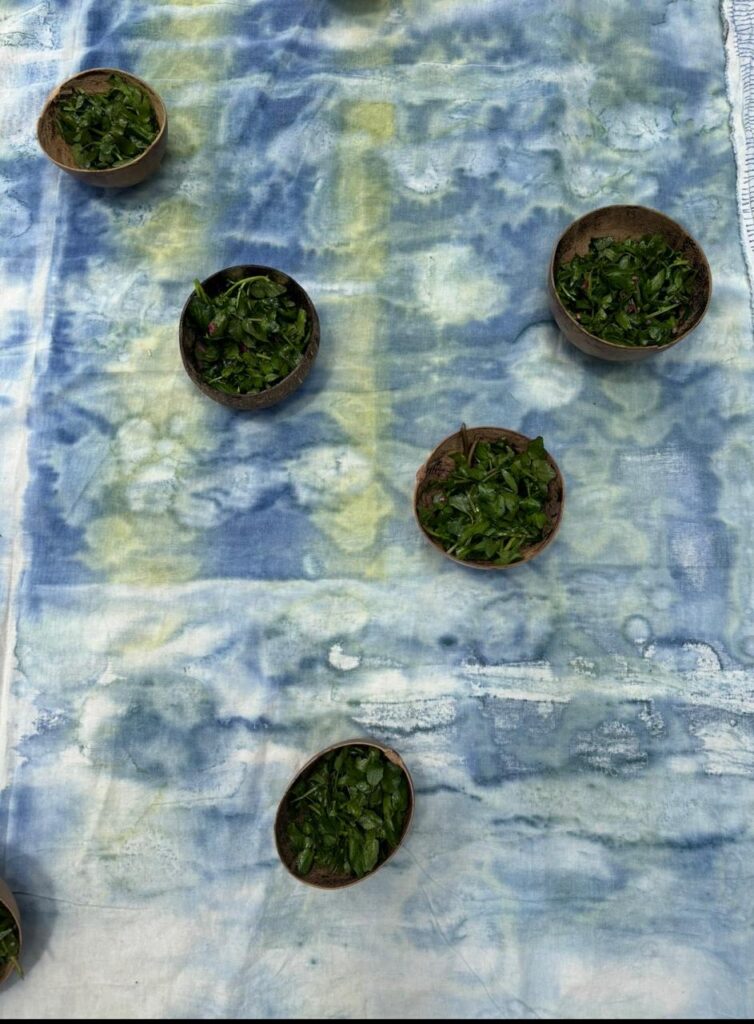
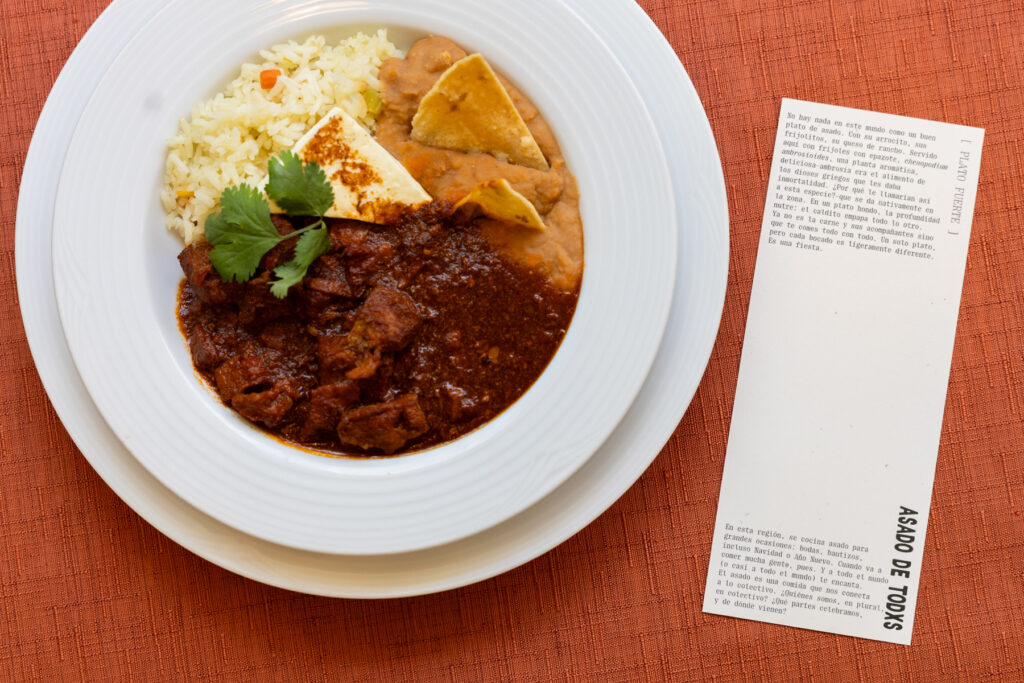
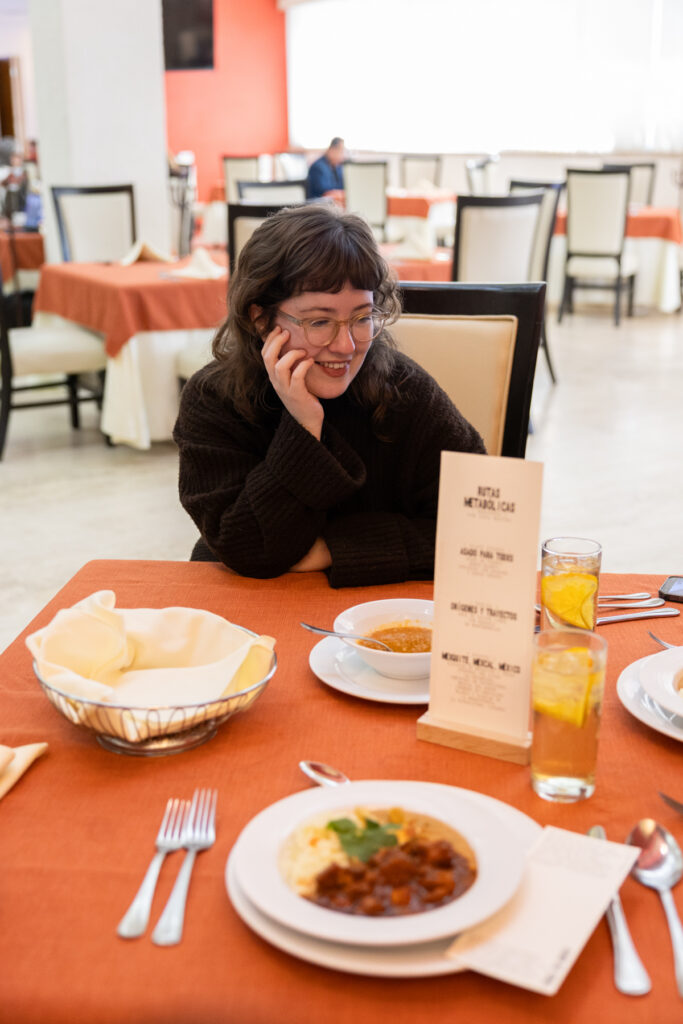
The menu is structured in three parts: a main dish, a drink, and a dessert. The main dish is an asado; the drink, a lemongrass infusion with citrus; the dessert, a mesquite flour cake with glorias, thyme, orange, and mezcal produced in Nuevo León.
Each dish is accompanied by texts and questions that open conversation: where do these ingredients come from? What histories do they carry?
For example, citrus fruits from Montemorelos are not native—they arrive through colonization and expand with the railway. So talking about an orange is also talking about colonial, industrial, and capitalist history. That’s the kind of conversation we want to activate.
T: We live in a system where food is deeply shaped by industrial and capitalist logics. How does the project position itself in relation to that?
BDS: I think it has to do with making those structures visible. Through food, we can narrate our history. We eat territory, knowledge, and forms of knowledge transmission. The point is not to provide answers, but to open questions: what are we eating?
Many recipes historically attributed to nuns were actually developed by enslaved women living in convents. That sociopolitical history is embedded in food: the erasure of gendered labor, but also the broader power structures that organize everyday life.
In that sense, Juan’s work—through alchemy and fermentation—also connects to the idea that Monterrey is a region of agaves, with a pulque history that is not always acknowledged. And with Colectivo Amasijo, we’re working on a closing moment that revisits the nomadic histories of the northeast.
SM: From the perspective of art, there’s an urgent question about how to position oneself within a world in crisis. And the question of food—also shaped by those crises—is not separate from that; it’s another way of asking the same thing.
What sustains the project, or at least what activates it, is the idea that art doesn’t need to offer answers, but rather to open spaces for imagination and conversation—symbolic, but also social. It’s also about activating the body as a site of experience; creating a space where the body doesn’t just receive, but participates in the production of meaning.
T: What does it mean for a company like FEMSA—linked to the food industry—to support a project that critically reflects on food and territory?
BDS: Part of our responsibility is to ask what can be done from within this position. Being in that tension is not comfortable, but it does open up a space for action. A central concern has been how to sustain projects like this without precarizing those involved. That means thinking about support, remuneration, but also visibility and legitimacy—especially for practices that are often excluded from those circuits.
T: For you, where does doubt live within this project?
BDS: There are many uncertainties. It’s a project that depends on multiple variables, especially because working with the restaurant brings in entirely different logics. The process begins long before the dish itself—at the level of the idea, the ingredients, the coordination. And once the restaurant takes it on, it also becomes theirs—they are the ones who ultimately execute it. So the project has been a constant adjustment between what is planned and what actually happens.
SM: There are frictions, but also a kind of flow. Many of the decisions we make on a daily basis—things that might seem minor—actually contain larger structures.
Unexpected questions have also emerged. For instance, in the documentation: at first we thought about photographing people eating or the kitchen in action, but we ended up making still lifes of the dishes. Images that sit somewhere between artwork documentation and product photography, without fully belonging to either.
The collaboration with the restaurant has been another key point. It’s a space with its own rules: timing, costs, very clear hierarchies. And for me, entering from the outside has meant constant negotiation. There are moments where you adapt, and others where you try to push certain dynamics.
So the conflict is not singular. Some things are accepted, others are contested, others are pushed. And it’s precisely in that back-and-forth that the project takes shape.
T: How do you understand the idea of residency within Rutas metabólicas, considering that it unfolds across different times, spaces, and forms of work?
BDS: Each person has had their own route. In some cases, like Sara’s, the invitation was about continuing processes already underway; in others, like Margarita Beristáin or Juan Escalona, the residency opens up a line of inquiry that develops through being in Monterrey—inhabiting the city, the restaurant, and seeing what emerges from that.
Rather than thinking of them as commissions, we were interested in sustaining the idea of residency as a way of inhabiting: inhabiting the restaurant, inhabiting the exhibition. The residency doesn’t begin when someone arrives—it starts earlier, in the conversations—and it doesn’t necessarily end in a fixed timeframe.
In that sense, working with the residents has also meant opening the exhibition to their readings. The show operates through a logic of constellations, and each person builds their own relation to it. The project moves outward—to the restaurant—but also returns to the galleries. It overflows, but maintains certain links.
SM: For me, residency has to do with creating conditions for immersion: being there, listening, sustaining a relationship over time. In my case, even though I already live in Monterrey, the project allowed me to inhabit the museum differently—to return to the exhibition, to the conversations, to the ideas.
More than producing a specific outcome, it’s been about presence. And I think that runs through the project as a whole: there isn’t a single way of “residing,” but different ways of entering, engaging, and building from there.
BDS: And in that process, the unexpected also appears. There may be an initial intention, but the project transforms along the way. In the end, Rutas metabólicas is precisely that: a set of open processes that test other ways of activating an exhibition—of seeing what happens when it’s not only looked at, but also devoured.
Rutas metabólicas is a program of culinary residencies and artistic projects organized by the FEMSA Collection, at Museo MARCO in Monterrey. The project seeks to displace the exhibition into the museum’s restaurant, activating the kitchen as a site of research and knowledge production.
Through temporary menus developed with artists, cooks, and researchers, the project approaches food as a living archive—one in which histories of territory, violence, migration, and resistance are inscribed. From there, ingredients, recipes, and processes open up everyday life as a space deeply traversed by the political.
This conversation addresses food as a field of tensions: between vernacular knowledge and institutional structures, collective practices and authorship, sensory experience and the museum’s regimes of visibility. Rutas metabólicas unfolds through doubt, experimentation, and ongoing negotiation. In that process, food appears as a site of thinking—and thinking itself as a metabolic process: a practice in which historical and political relations are inscribed in the body.
Terremoto: Rutas metabólicas proposes to move the logics of exhibition into other spaces. How did that impulse emerge, and what does it mean to think the museum from that position?
Beto Díaz Suárez: Rutas metabólicas begins with the desire to take the exhibition out of the galleries and see what unfolds when curatorial thinking is activated elsewhere—in this case, in the restaurant.
That shift also raises questions about the museum itself: its uses, codes, and the ways we learn within it. There’s something about the institutional framework of the museum that still imposes certain rules—you’re not always sure whether you can speak, sit, how close you can get, or what can be touched. It’s a set of norms that aren’t always explicit. As an institution, we have to work within that, but also push against it.
The project tries to overflow the exhibition into other areas. We were interested in the idea that learning doesn’t happen only through the head, but through the body. Visual arts tend to privilege sight—looking, reading—but we started asking what would happen if learning also passed through the mouth, the tongue, taste.
We invited Sara Medina, Margarita Beristáin, Juan Escalona, and Colectivo Amasijo, whose practices engage with different axes of the exhibition. Rather than producing “works,” the idea was to open a space for experimentation through the kitchen, understood as a site of mediation and encounter. It has been a highly experimental process, especially because it involves working with the restaurant and its team, and navigating the negotiations that unfold between operational and curatorial logics.
T: In that sense, how do you think about food within the project? I’m interested in its role as a curatorial device, but also as a political archive—especially as a form of knowledge historically excluded from museum narratives.
BDS: As a curatorial device, we imagined the restaurant as another exhibition space. We even created a wall text for it, integrating it into the identity of the show. At the same time, we thought about the kitchen as a space of digestion, in parallel with thought itself.
From the beginning, there was a question: were we working with dishes or with artworks? That ambiguity became central. We also wanted to accompany the experience with texts, instructions, and materials developed with Sara.
In that sense, the kitchen and the restaurant become a place of encounter and meaning-making, where the sensory and the bodily activate other forms of conversation. To inhabit the restaurant also implies thinking about audiences differently: the museum is not only a place to see exhibitions, but to inhabit, to work, to talk, to eat.
Sara Medina: We’ve been interested in thinking about food as a device for a long time. For me, it’s both an artistic device and a device of experience.
Food cuts across all the systems we inhabit—political, economic, social, historical, physical—whether we notice it or not. There’s something powerful in that: only three things from the outside world enter our bodies and become us—air, water, and food. That’s why they’re deeply political.
That process is natural and daily, but also strange, almost alien. I’m interested in working from there. I think of thought itself as a digestive process—we “chew on” ideas, we “digest” experiences. It’s already embedded in language.
Working with the restaurant has been interesting because it follows different logics. What has emerged is a hybrid between restaurant and exhibition, between artwork and dish. And that opens up another type of experience. Working with food activates the body, not just the gaze. At a moment when passive experience dominates, involving the body is, in itself, a political gesture.
T: There has been a renewed interest in the milpa and other systems tied to communal and ancestral knowledge. How does Rutas metabólicas engage with these forms of knowledge without extracting or decontextualizing them? What happens when they are brought into an institutional space?
BDS: To answer that, I go back to the project’s title. Rutas metabólicas draws from the book Mundos mutuos: la cocina como taller [Mutual Worlds: The Kitchen as Studio], by Cristina Consuegra and Carlos Alfonso. Food allows us to read our historiography—as individuals, as societies, as territories.
From the beginning, we chose to work with cooks or with practices that emerge from the kitchen, rather than with chefs. We were interested in questioning that hierarchy of knowledge. The work with the restaurant has been an ongoing conversation. It’s not about bringing in fixed recipes, but about building something together—through ingredients, processes, and dialogue as they unfold.
For instance, Margarita Beristáin works from what she learned from her ancestors. These are forms of knowledge embedded in the body, transmitted orally. I think of Elvira Espejo’s idea of oralitura as a way of resisting colonial forms of knowledge. Margarita doesn’t “present” a recipe, but opens a conversation with the restaurant. Juan Escalona, on the other hand, works with pulque in Nuevo León through alchemy, fermentation, and biology. All different approaches, yet in all cases the project is built through exchange, not appropriation.
T: Even within collaborative processes, how do the power structures of the kitchen—often shaped by hierarchy and gender—play out in the project?
BDS: It’s something we’re constantly thinking about: how to give credit, who appears, and how. These power structures inevitably surface—very marked hierarchies, specific forms of organization. We can’t simply avoid them, but we can make them visible and try to shift them, even slightly.
This also intersects with mediation or educational practices, which often fall into a kind of limbo—they’re not fully recognized as artworks, but they’re not acknowledged in the same way either. We wanted Rutas metabólicas to be understood as part of the exhibition, not as a public program.
SM: This is central to my practice. Territory is not a single thing—it’s complex, contradictory, shaped by historical, political, and social processes. The milpa, for example, is not native to northern Mexico; it comes from the center and south. That creates tensions in how we think about identity. Rather than treating these issues carefully, I think they need to be approached honestly. We don’t have answers—we’re asking questions.
The menu is structured in three parts: a main dish, a drink, and a dessert. The main dish is an asado; the drink, a lemongrass infusion with citrus; the dessert, a mesquite flour cake with glorias, thyme, orange, and mezcal produced in Nuevo León.
Each dish is accompanied by texts and questions that open conversation: where do these ingredients come from? What histories do they carry?
For example, citrus fruits from Montemorelos are not native—they arrive through colonization and expand with the railway. So talking about an orange is also talking about colonial, industrial, and capitalist history. That’s the kind of conversation we want to activate.
T: We live in a system where food is deeply shaped by industrial and capitalist logics. How does the project position itself in relation to that?
BDS: I think it has to do with making those structures visible. Through food, we can narrate our history. We eat territory, knowledge, and forms of knowledge transmission. The point is not to provide answers, but to open questions: what are we eating?
Many recipes historically attributed to nuns were actually developed by enslaved women living in convents. That sociopolitical history is embedded in food: the erasure of gendered labor, but also the broader power structures that organize everyday life.
In that sense, Juan’s work—through alchemy and fermentation—also connects to the idea that Monterrey is a region of agaves, with a pulque history that is not always acknowledged. And with Colectivo Amasijo, we’re working on a closing moment that revisits the nomadic histories of the northeast.
SM: From the perspective of art, there’s an urgent question about how to position oneself within a world in crisis. And the question of food—also shaped by those crises—is not separate from that; it’s another way of asking the same thing.
What sustains the project, or at least what activates it, is the idea that art doesn’t need to offer answers, but rather to open spaces for imagination and conversation—symbolic, but also social. It’s also about activating the body as a site of experience; creating a space where the body doesn’t just receive, but participates in the production of meaning.
T: What does it mean for a company like FEMSA—linked to the food industry—to support a project that critically reflects on food and territory?
BDS: Part of our responsibility is to ask what can be done from within this position. Being in that tension is not comfortable, but it does open up a space for action. A central concern has been how to sustain projects like this without precarizing those involved. That means thinking about support, remuneration, but also visibility and legitimacy—especially for practices that are often excluded from those circuits.
T: For you, where does doubt live within this project?
BDS: There are many uncertainties. It’s a project that depends on multiple variables, especially because working with the restaurant brings in entirely different logics. The process begins long before the dish itself—at the level of the idea, the ingredients, the coordination. And once the restaurant takes it on, it also becomes theirs—they are the ones who ultimately execute it. So the project has been a constant adjustment between what is planned and what actually happens.
SM: There are frictions, but also a kind of flow. Many of the decisions we make on a daily basis—things that might seem minor—actually contain larger structures.
Unexpected questions have also emerged. For instance, in the documentation: at first we thought about photographing people eating or the kitchen in action, but we ended up making still lifes of the dishes. Images that sit somewhere between artwork documentation and product photography, without fully belonging to either.
The collaboration with the restaurant has been another key point. It’s a space with its own rules: timing, costs, very clear hierarchies. And for me, entering from the outside has meant constant negotiation. There are moments where you adapt, and others where you try to push certain dynamics.
So the conflict is not singular. Some things are accepted, others are contested, others are pushed. And it’s precisely in that back-and-forth that the project takes shape.
T: How do you understand the idea of residency within Rutas metabólicas, considering that it unfolds across different times, spaces, and forms of work?
BDS: Each person has had their own route. In some cases, like Sara’s, the invitation was about continuing processes already underway; in others, like Margarita Beristáin or Juan Escalona, the residency opens up a line of inquiry that develops through being in Monterrey—inhabiting the city, the restaurant, and seeing what emerges from that.
Rather than thinking of them as commissions, we were interested in sustaining the idea of residency as a way of inhabiting: inhabiting the restaurant, inhabiting the exhibition. The residency doesn’t begin when someone arrives—it starts earlier, in the conversations—and it doesn’t necessarily end in a fixed timeframe.
In that sense, working with the residents has also meant opening the exhibition to their readings. The show operates through a logic of constellations, and each person builds their own relation to it. The project moves outward—to the restaurant—but also returns to the galleries. It overflows, but maintains certain links.
SM: For me, residency has to do with creating conditions for immersion: being there, listening, sustaining a relationship over time. In my case, even though I already live in Monterrey, the project allowed me to inhabit the museum differently—to return to the exhibition, to the conversations, to the ideas.
More than producing a specific outcome, it’s been about presence. And I think that runs through the project as a whole: there isn’t a single way of “residing,” but different ways of entering, engaging, and building from there.
BDS: And in that process, the unexpected also appears. There may be an initial intention, but the project transforms along the way. In the end, Rutas metabólicas is precisely that: a set of open processes that test other ways of activating an exhibition—of seeing what happens when it’s not only looked at, but also devoured.