El pozo de agua (The Water Well) by Oscar Murillo, at kurimanzutto gallery, departs from the idea of the traditional exhibition by proposing a field of shared energy. The constellation of works resembles a device in which painting, installation, and archive intertwine to explore a notion that may seem radical today: art and collectivity are not separate spheres, but manifestations of the same living force. Ana Paola Rodríguez reflects on this evocative exhibition.
El pozo de agua is a generator of life; it gathers different imprints of existence. It is painting, installation, memory, performance, collectivity, experiment, companionship, canvas, history, and drawing.
There are exhibitions where viewers connect through the conceptual frameworks proposed by artists or curators. Yet Oscar Murillo’s work does not dwell entirely in words; they are not the primary point of entry for understanding it. His practice unfolds instead in memory, community, and both collective and individual lived experience. For this reason, we met the artist at the exhibition’s opening, hoping he might offer us the Rosetta Stone for his work—something that could help decipher what lies behind these abstract canvases.
Oscar Murillo’s proposal emerges as a project of social mapping, nourished by a social performative gesture. His work proposes a monist theory between collectivity and art. That is, art cannot exist without collectivity, and collectivity has no meaning without art; they are not two separate things, but two dimensions of the same reality.
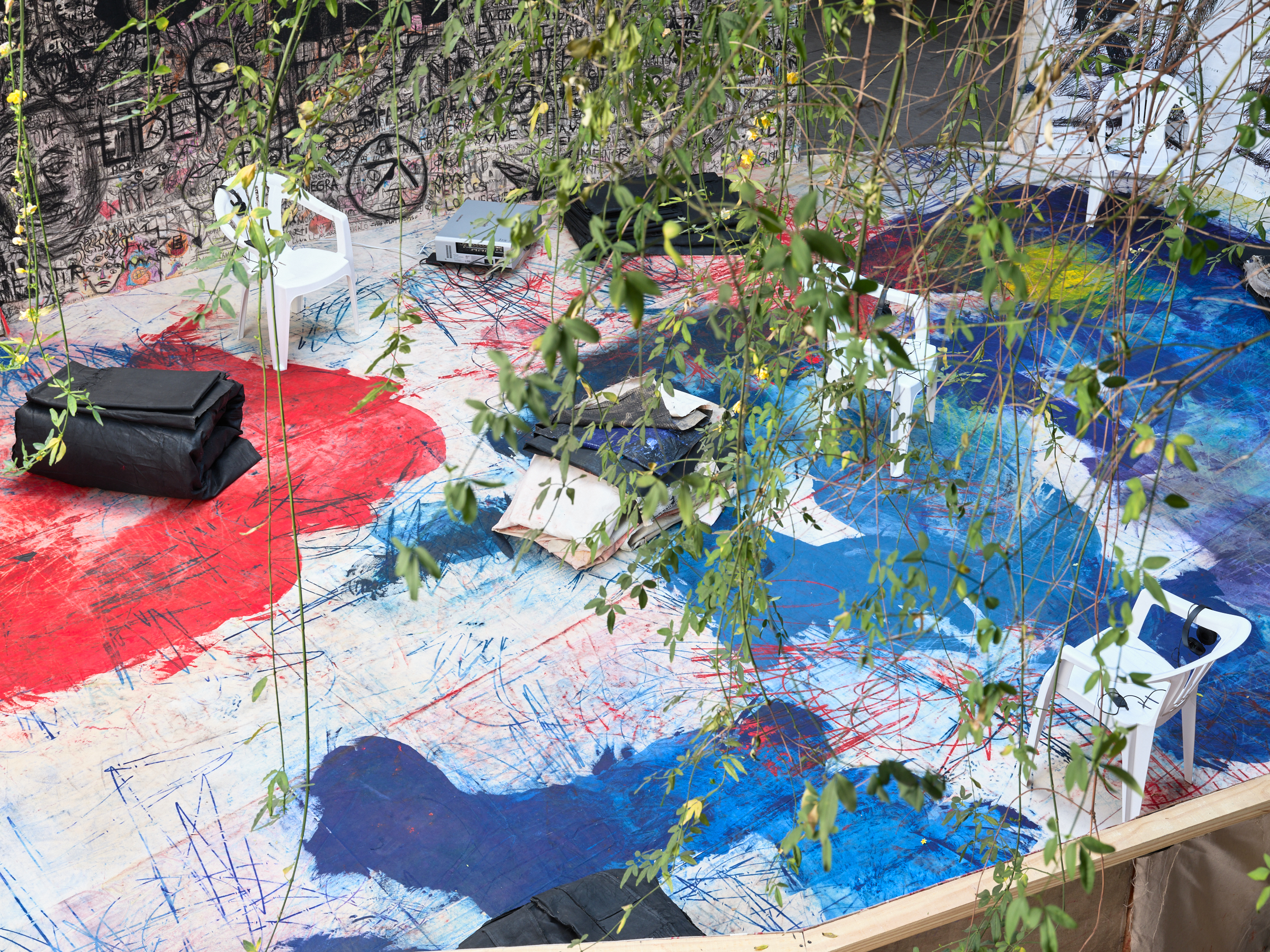
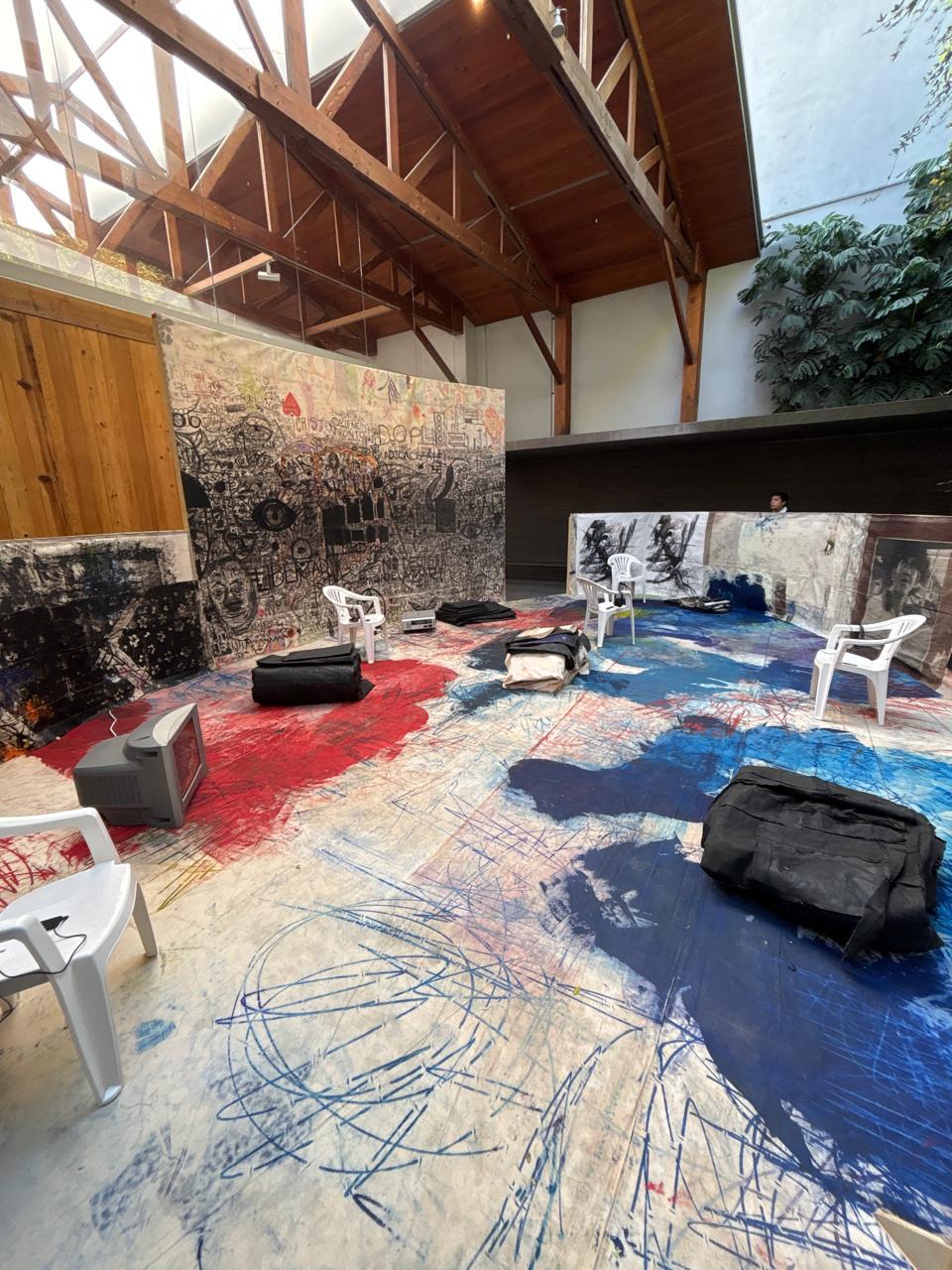
He identifies El pozo de agua as the installation that welcomes visitors at the beginning of the exhibition: a large-scale structure with a circular floor surrounded by panels, all made of canvas covered with drawing, oil paint, and graffiti. And like Alice, upon entering the well, you feel suddenly small, stepping—or rather, navigating—through the artist’s work and life.
The elements Murillo chose to shape the exhibition are not accidental; each was curatorially selected to embody this sense of community and collective space. Some emerge from the community itself, while others stem from the artist’s individual experiences which, by sharing them, he releases and transforms into a collective experience where the “I” merges with the “we.” However, this does not mean that the concepts that make up the exhibition follow a linear or logical chronology. Listening to the artist speak about his pieces, the ideas bounce and exist within a free space.
A material expression of this is the well itself.
We entered the well with Oscar Murillo (Valle del Cauca, Colombia). As we walked through it, he introduced the characters that inhabit it—whether the well or the artist himself. The chairs that move through the well are plastic monobloc chairs, the most widely produced and distributed in the world; anyone who sees them can link them to memories of family gatherings, parties, neighborhood events, workshops, or markets. In this way—from the very first encounter with the well—Murillo makes it feel as though it belongs to everyone.
The floor—which at first might appear to be nothing more than paint stains and scribbles—contains the first steps of his creative process: the “stains” on the canvas result from a process of folding and unfolding, through which the paint transforms, spreads, and multiplies.
It is here that Murillo points to the vitality of the well. “It’s not just painting; it’s a channel for energy,” the artist says during the walkthrough. Inside, paint unfolds in all its stages; the well preserves the original patterns and their negatives like a seal, generating a far more complex visual field that moves beyond two-dimensional painting and asserts its three-dimensional presence—perhaps an ode to collective complexity.
In one corner of the well rests a cathode-ray tube television (CRT), another symbol of collective rituals. The CRT once served as the symbolic nucleus of the home; living-room furniture was arranged around the television. Before the era of individual screens, entire families gathered in the same space to watch the same program, helping shape the collective imagination of generations. The CRT that moves through the well does more than evoke this symbolism: it also broadcasts one of the most iconic projects in Murillo’s career—and one that most strongly engages the collective dimension of his practice—frequencies. Over the past thirteen years, Murillo has placed blank canvases on students’ desks for periods of six months without instructions, allowing collective creativity to unfold freely. From the drawings produced, he began building a digital archive.
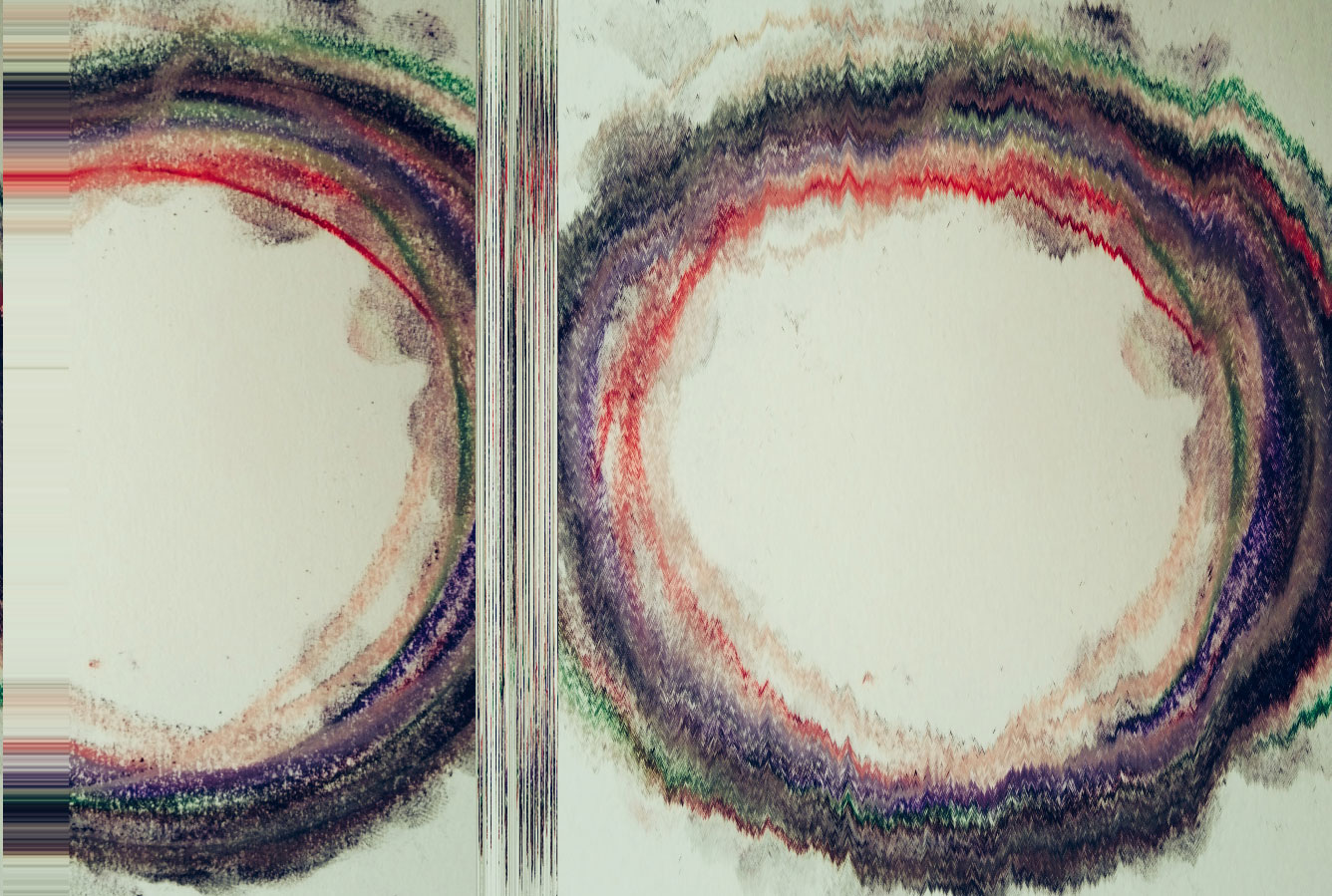
The video projected on the CRT consists of digitized images that were fed into artificial intelligence to generate new visual patterns. In this part of the exhibition, one begins to wonder whether, in handing this collective archive over to artificial intelligence so that it might evolve, Murillo considers AI to be part of the community—whether it can participate in, or even understand, the collective feeling evoked by the CRT or the plastic garden chairs—and, ultimately, whether one agrees with that proposition.
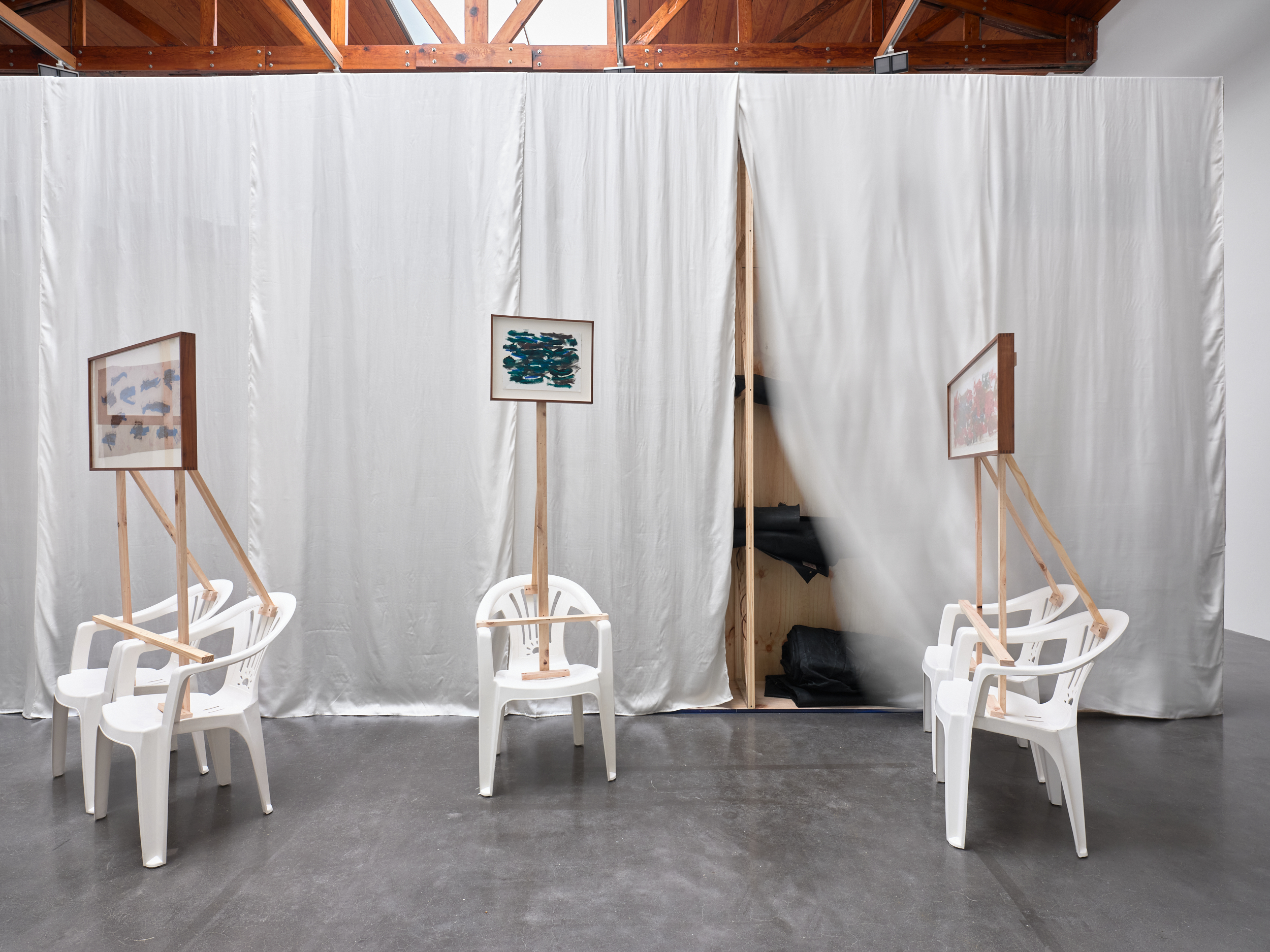
Behind the installation, we encounter what Oscar Murillo calls “the first formal reference to the well”: a framed painting, supported by a rather precarious wooden base and resting on a monobloc chair. It is a study of the well’s swell.
Reinforcing the idea that paintings are energetic discharges, Murillo places greater importance on the act of release than on the final result of the work itself. He finds inspiration in Monet—not in what he painted, but in his lived experience; he is particularly moved by the making of art under precarious economic conditions and by the altered perception of color and form Monet experienced as a result of cataracts at the end of his life. For Murillo, the work that stands behind the installation is a nostalgic discharge drawn from the immigrant life of a Colombian in London.
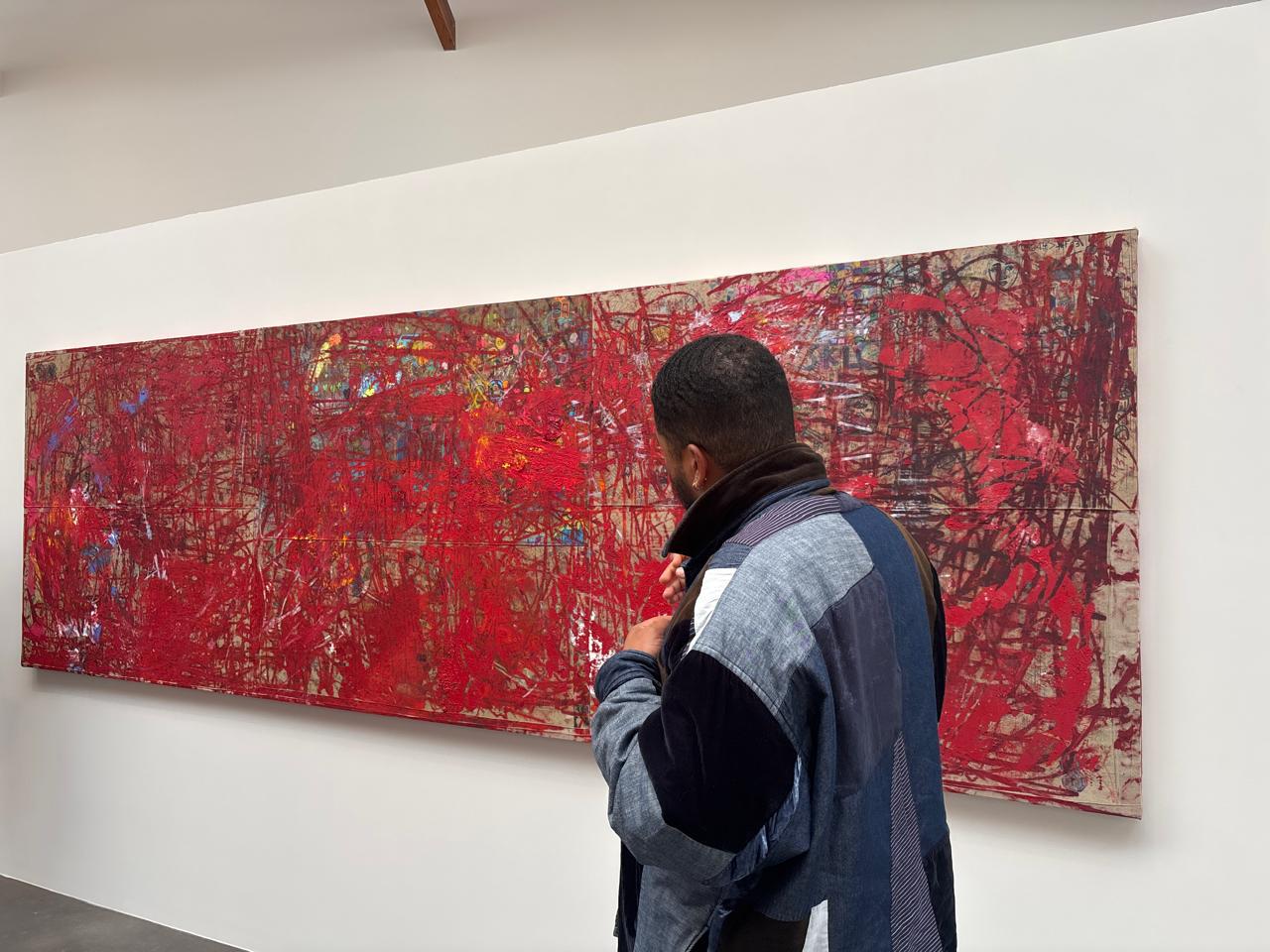
Upon entering the gallery, the large-scale paintings unfold. The raw materials of the works take center stage: drawings in their most rudimentary form serve as the foundation, gradually traversed by energetic discharges that materialize in layers of oil paint, intensified by linseed oil.
Murillo explains that his work is not made on a stretcher; his canvases are laid out—just as in the well—and from above (the artist) to below (the canvas), the discharges spill out. When there is a surplus of energy, he places another canvas on top so that the impression transfers onto a new work, generating an exchange between the paintings. It is, without a doubt, a “field full of spirits.”
The color red, the recycling of paint, and the use of carbon paper function as a response to the economic constraints of making art. Murillo explains that his practice is also rooted in his history as a student—an artist who created with limited resources and who continued to do so as a form of protest, demonstrating that art should not be bound to purchasing power.
When asked whether these energetic discharges originate from an individual or a collective source, Murillo explained that:
The work emerges from an urban context.
The work is ambiguous, open to interpretation.
The work lives beyond the artist himself.
Monet’s cataracts allude to a form of social blindness. The piece was first created with phrases of protest, love, sadness, desolation, and happiness, which gradually dissolved into the paint until they formed a pattern of striking beauty.
Murillo explains that the importance of the social dimension in his work does not stem from a benevolent impulse; rather, it is embedded in his life as a migrant. His engagement with society does not arise from a moral concern in itself, but from a deep sense of nostalgia.
In this final work, the artist seems to understand where he stands today. When speaking about it, he refers to the aesthetics of the superficial; perhaps this work does not possess the same depth as the others. It is striking that, while walking through the exhibition, Murillo speaks of life, energetic discharges, history, community, memory, and nostalgia—finding great depth in the more “violent” works—yet speaks of blindness and superficiality when referring to the most aesthetic and harmonious work in the exhibition.
El pozo de agua is a reminder that, when living a reality as complex as collective human experience, disorder can sometimes be the only territory that truly feels like one’s own.
Oscar Murillo: El pozo de agua, Kurimanzutto, Mexico City, 2026
El pozo de agua is a generator of life; it gathers different imprints of existence. It is painting, installation, memory, performance, collectivity, experiment, companionship, canvas, history, and drawing.
There are exhibitions where viewers connect through the conceptual frameworks proposed by artists or curators. Yet Oscar Murillo’s work does not dwell entirely in words; they are not the primary point of entry for understanding it. His practice unfolds instead in memory, community, and both collective and individual lived experience. For this reason, we met the artist at the exhibition’s opening, hoping he might offer us the Rosetta Stone for his work—something that could help decipher what lies behind these abstract canvases.
Oscar Murillo’s proposal emerges as a project of social mapping, nourished by a social performative gesture. His work proposes a monist theory between collectivity and art. That is, art cannot exist without collectivity, and collectivity has no meaning without art; they are not two separate things, but two dimensions of the same reality.
He identifies El pozo de agua as the installation that welcomes visitors at the beginning of the exhibition: a large-scale structure with a circular floor surrounded by panels, all made of canvas covered with drawing, oil paint, and graffiti. And like Alice, upon entering the well, you feel suddenly small, stepping—or rather, navigating—through the artist’s work and life.
The elements Murillo chose to shape the exhibition are not accidental; each was curatorially selected to embody this sense of community and collective space. Some emerge from the community itself, while others stem from the artist’s individual experiences which, by sharing them, he releases and transforms into a collective experience where the “I” merges with the “we.” However, this does not mean that the concepts that make up the exhibition follow a linear or logical chronology. Listening to the artist speak about his pieces, the ideas bounce and exist within a free space.
Oscar Murillo: El pozo de agua, Kurimanzutto, Mexico City, 2026
A material expression of this is the well itself.
We entered the well with Oscar Murillo (Valle del Cauca, Colombia). As we walked through it, he introduced the characters that inhabit it—whether the well or the artist himself. The chairs that move through the well are plastic monobloc chairs, the most widely produced and distributed in the world; anyone who sees them can link them to memories of family gatherings, parties, neighborhood events, workshops, or markets. In this way—from the very first encounter with the well—Murillo makes it feel as though it belongs to everyone.
The floor—which at first might appear to be nothing more than paint stains and scribbles—contains the first steps of his creative process: the “stains” on the canvas result from a process of folding and unfolding, through which the paint transforms, spreads, and multiplies.
It is here that Murillo points to the vitality of the well. “It’s not just painting; it’s a channel for energy,” the artist says during the walkthrough. Inside, paint unfolds in all its stages; the well preserves the original patterns and their negatives like a seal, generating a far more complex visual field that moves beyond two-dimensional painting and asserts its three-dimensional presence—perhaps an ode to collective complexity.
In one corner of the well rests a cathode-ray tube television (CRT), another symbol of collective rituals. The CRT once served as the symbolic nucleus of the home; living-room furniture was arranged around the television. Before the era of individual screens, entire families gathered in the same space to watch the same program, helping shape the collective imagination of generations. The CRT that moves through the well does more than evoke this symbolism: it also broadcasts one of the most iconic projects in Murillo’s career—and one that most strongly engages the collective dimension of his practice—frequencies. Over the past thirteen years, Murillo has placed blank canvases on students’ desks for periods of six months without instructions, allowing collective creativity to unfold freely. From the drawings produced, he began building a digital archive.
The video projected on the CRT consists of digitized images that were fed into artificial intelligence to generate new visual patterns. In this part of the exhibition, one begins to wonder whether, in handing this collective archive over to artificial intelligence so that it might evolve, Murillo considers AI to be part of the community—whether it can participate in, or even understand, the collective feeling evoked by the CRT or the plastic garden chairs—and, ultimately, whether one agrees with that proposition.
Behind the installation, we encounter what Oscar Murillo calls “the first formal reference to the well”: a framed painting, supported by a rather precarious wooden base and resting on a monobloc chair. It is a study of the well’s swell.
Reinforcing the idea that paintings are energetic discharges, Murillo places greater importance on the act of release than on the final result of the work itself. He finds inspiration in Monet—not in what he painted, but in his lived experience; he is particularly moved by the making of art under precarious economic conditions and by the altered perception of color and form Monet experienced as a result of cataracts at the end of his life. For Murillo, the work that stands behind the installation is a nostalgic discharge drawn from the immigrant life of a Colombian in London.
Upon entering the gallery, the large-scale paintings unfold. The raw materials of the works take center stage: drawings in their most rudimentary form serve as the foundation, gradually traversed by energetic discharges that materialize in layers of oil paint, intensified by linseed oil.
Murillo explains that his work is not made on a stretcher; his canvases are laid out—just as in the well—and from above (the artist) to below (the canvas), the discharges spill out. When there is a surplus of energy, he places another canvas on top so that the impression transfers onto a new work, generating an exchange between the paintings. It is, without a doubt, a “field full of spirits.”
The color red, the recycling of paint, and the use of carbon paper function as a response to the economic constraints of making art. Murillo explains that his practice is also rooted in his history as a student—an artist who created with limited resources and who continued to do so as a form of protest, demonstrating that art should not be bound to purchasing power.
When asked whether these energetic discharges originate from an individual or a collective source, Murillo explained that:
The work emerges from an urban context.
The work is ambiguous, open to interpretation.
The work lives beyond the artist himself.
Monet’s cataracts allude to a form of social blindness. The piece was first created with phrases of protest, love, sadness, desolation, and happiness, which gradually dissolved into the paint until they formed a pattern of striking beauty.
Murillo explains that the importance of the social dimension in his work does not stem from a benevolent impulse; rather, it is embedded in his life as a migrant. His engagement with society does not arise from a moral concern in itself, but from a deep sense of nostalgia.
In this final work, the artist seems to understand where he stands today. When speaking about it, he refers to the aesthetics of the superficial; perhaps this work does not possess the same depth as the others. It is striking that, while walking through the exhibition, Murillo speaks of life, energetic discharges, history, community, memory, and nostalgia—finding great depth in the more “violent” works—yet speaks of blindness and superficiality when referring to the most aesthetic and harmonious work in the exhibition.
El pozo de agua is a reminder that, when living a reality as complex as collective human experience, disorder can sometimes be the only territory that truly feels like one’s own.