What if the self-portrait were not an affirmation of the self, but a strategy for disappearance? Samuel Figueroa’s text proposes reading Marta Palau through the figure of the Nahualli: not as a decorative metaphor, but as a key for thinking art as material, ritual, and political transformation. Between fibers, knots, and roots, her work does not represent—it operates. It does not illustrate the spiritual—it embodies it in the everyday. From exile to textile, from the body to the land, Palau displaces the center: from the individual to the community, from form to relation, from object to bond. Her works do not ask for passive contemplation; they demand proximity, discomfort, even contact.
Marta Palau: The Artist Who Hid Within Her Self-Portrait
“…here I remain devoted to all those willing to pause for a moment and look at the weavings, ropes, roots, spaces, the knots that both bind me and free me from myself…” — Marta Palau 1
It is said that the Nahualli is a sorceress with the ability to transform herself into a wild animal, into fire or rain, or even disappear completely.2 The mechanisms or logic underlying this mutation remain unknown. Thought that eludes Western rationality often converges in the realms of the ancestral and the magical. In this sense, there are those whose sensitivity allows them to harness the possibilities of matter, giving it form and imbuing objects with the earthly manifestation of their intentions, desires, and spells. Depending on the context, they may be called Nahualli—or artists.
In 1972, speaking about the art of Marta Palau, Raquel Tibol wrote: “…it is a magical ritual in which the final result is what matters; one is merely the medium, the intermediary.”3 It was precisely through the recognition of art’s magical potential that Palau spent her life as an intermediary—exploring the composition and recomposition of diverse materials emerging from her surroundings—in search of recovering the bond that contemporary society has lost with the living world. Drawn to artistic expression from a very early age, she trained as a painter and printmaker at the Escuela Nacional de Pintura y Escultura de la Secretaría de Educación Pública and at the printmaking workshop of the Instituto Nacional de Bellas Artes in La Ciudadela. By the 1960s, she began producing work in Tijuana, where she came into contact with artistic circles on both sides of the border. There, thanks to the textile art of Sheila Hicks, she became aware of the possibilities and expressive potential of this medium.4 In 1968, carried by the disruptive spirit and the collaborative, experimental nature characteristic of the Salón Independiente, Marta participated in exhibitions taking place outside the boundaries of academic and pictorial orthodoxy.5 This series of events planted the seed of a rebellious character that, into the following decade, would find an outlet through Josep Grau-Garriga.
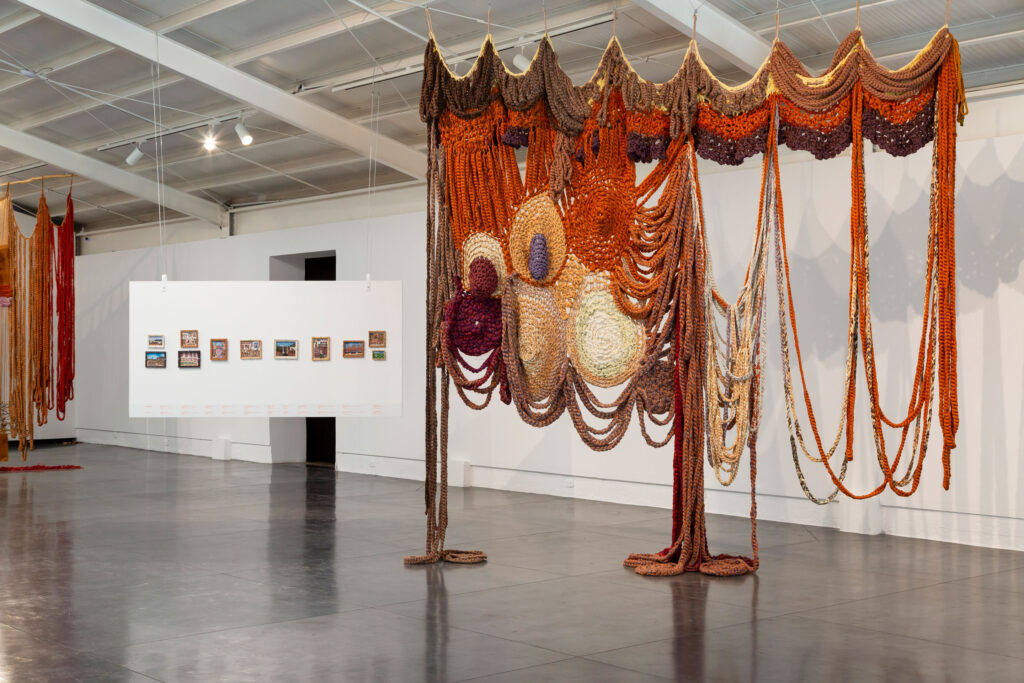
In Catalonia, she frequented Garriga’s workshop, where she learned from one of the leading figures of contemporary tapestry about the medium’s versatility in bringing together organic and inorganic elements. Jute, cotton, linen, plastic fibers, and found materials acquired, before Palau’s eyes, an unexpected beauty—a texture infused with life and connected to its surroundings—which transformed tapestry into the preferred medium for her artistic discourse. Her return to Spain at the end of the 1960s marked a significant moment in the artist’s life, not only because her time with Garriga allowed her to undergo a process of liberation in her understanding of textile art, but also because this journey represented a reunion with her roots. Born in the small town of Albesa, Lleida, in 1934, she was forced at the age of six to emigrate and settle in the Mexico of Lázaro Cárdenas.6 The way she emotionally situated herself in relation to her hometown is evident in the body of work Ilerda (1973)—the Latin name for Lleida—in which, using jute and cotton, and through symbolic allusions to the vaginal opening, she gives organic form and presence to the affection she held for a place of childhood that also witnessed her departure.
This insistence on biomorphic forms and sensorially alluring folds finds its fullest expression in Cascada [Cascade] (1978). As the only large-scale work she produced using synthetic fiber, this enormous installation—composed of a horizontal torrent of translucent tubes and small velvety nodules—occupies an important place in the history of her production due to the “soft monumentality”7 that unfolds before the viewer. What she described as a “river of spermatozoa”8 hardly does justice to the sensual and intimate poetics that emerge through the artificial and artistic replication of this natural phenomenon. The exhibition space itself is intervened: a delicate tidal wave of nylon folds and cavities invades the area of contemplation and invites the viewer to step beyond passive observation. Like a wall of white stockings, Cascada asserts itself through the elegance of the night and through the intense privacy we maintain with the textile elements of our clothing, establishing a material and intimate relationship with the viewer. Whether or not one wears stockings, the piece is constituted through the familiarity and everyday nature of clothing in general. While it may be interpreted as an expression of female desire,9 it’s incorporeal force deserves further nuance: one must consider its ability to speak from a specific gaze without the need for a specific body—a feminine gaze without substance, or perhaps the absolute body of the feminine gaze itself.
By “absolute,” I do not mean the realm of the pure and immaterial. Rather, as Imma Prieto notes in relation to the title of the exhibition Mis caminos son terrestres [My Paths Are Earthly], Palau’s work—composed of materials of a transient nature—moves toward a spirituality that organizes a “more here,” of which we all form part, as opposed to the traditional and relatively elitist notion of the “hereafter.”10 Thus, many of her works, such as Naualli Mano poderosa [Powerfull Naualli Hand](2005), which represent or symbolically employ bodily elements, operate according to the logic of an experience of the spiritual situated within everyday life. Branches, woven mats, and natural fibers give form to the human need to include the ephemeral as a fundamental part of physical reality. The hands of the Naualli shape the object and alter matter according to a ritual that materializes within the ordinary. The reminiscence of a time that coexisted with and knew how to navigate the hidden dimension—a condition of which Marta was deeply aware—resulted in esoteric practices and tools of diverse forms throughout her work. In this way, the stapled envelope in Recetario de Naualli: Legítimo polvo doblegado a mis pies[Naualli’s Recipe Book: Legitimate Dust Bent at My Feet ](1991)—marked by traces of a female body—reveals the evident bond between spirituality and popular practical ritual. The daily use of this particular powder promises that “he (the bewitched one) will always remain humbled at your feet.” On the one hand, to remain perpetually “subdued” unfolds as the ultimate act of humiliation and domination; on the other, “at my feet” invokes the base of the body that the West, in its obsessive civilizing mission, has sought to conceal: the lower realm shared by all bodies, hidden twice over. Let us remove the stockings and allow ourselves to be surprised by the “most intimate and personal area of our body”;11 thus, as in the novel Sobre los huesos de los muertos [Drive Your Plow Over the Bones of the Dead], where the literature professor glimpses the secret hidden within the feet and confesses that:
“everything there is to know about the human being is there [in the feet], where the body concentrates its deepest meaning and reveals who we truly are and how we relate to the earth. In the way we touch the ground, in the point where the earth joins the body, lies the mystery: it reminds us that we are made of matter and at the same time estranged from it, separated from it. Feet are our instruments for making contact.”12
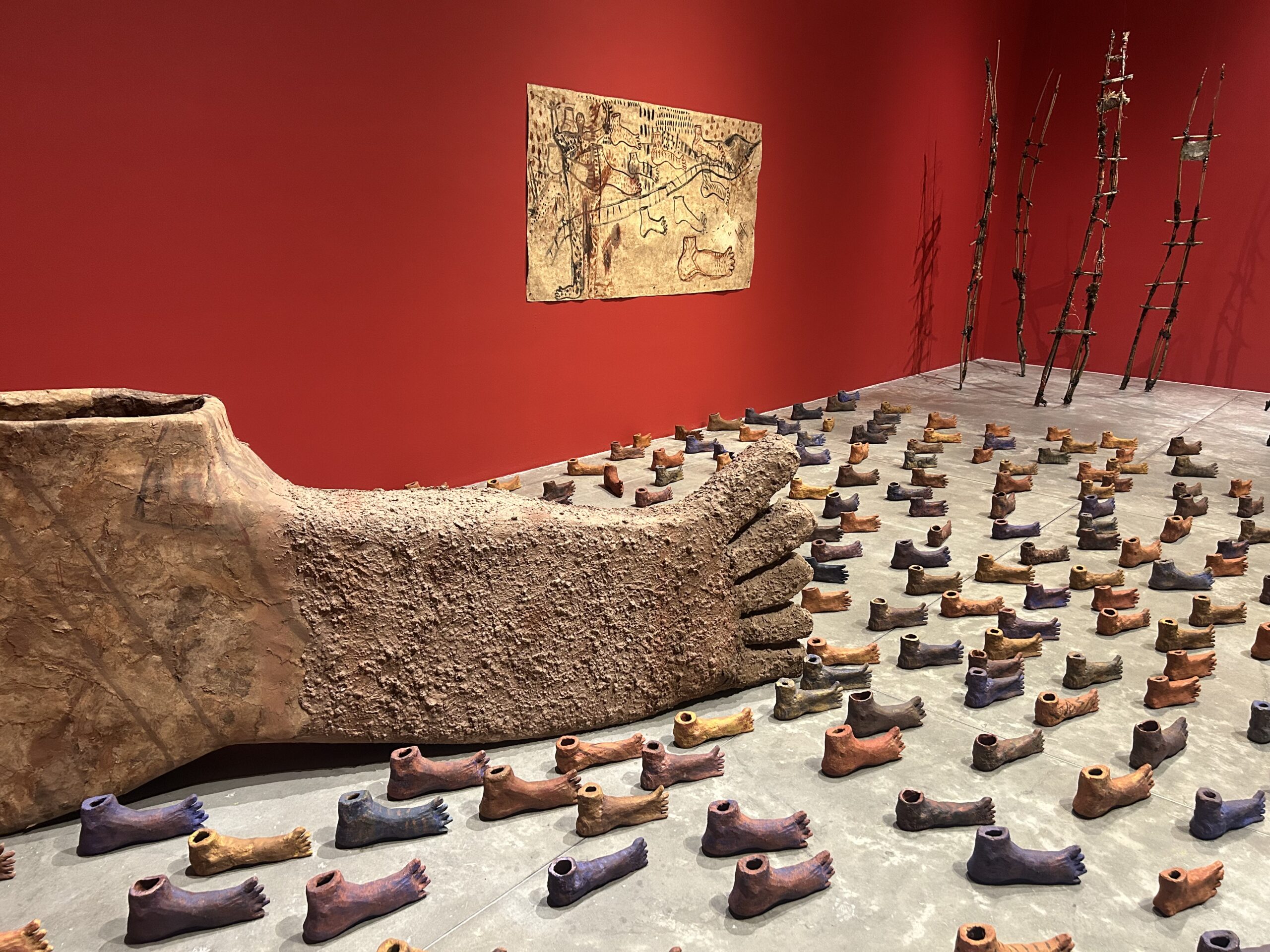
In walking, we believe we distinguish ourselves from other species. We tend to see it as the inevitable triumph of human verticality over the horizontality of the earth, as the fortunate beginning of the separation between humankind and nature. Yet feet signify nothing other than a direct and intimate encounter with the world—a relationship sustained through touch and continuously reworked, with every step, through the difficult task of maintaining balance. Thus, any understanding of the earth would depend on the care taken in knowing it, in walking it. It is necessary to feel and physically assimilate the precise balance required to traverse different surfaces; it is necessary to wander and, through falling, to musically memorize the underlying space. Although movement is a shared condition, not everyone is heading toward the same place, nor do they move with the same intentions. Without forgetting the political dimension of Palau’s production, Nomadismo II [Nomadism II] explores the condition of the migrant—the wanderer par excellence—and, through hundreds of resin and clay feet, reactivates the historical phenomenon of human displacement. Arranged across the floor in a delirium of directions, Marta understands the personal and symbolic force of the foot and seeks to restore sensitivity to a standardized representation of the migrant. Having herself experienced displacement and exile, she attempts to transform the visual ecosystem surrounding an event of extreme violence against bodies. She does not question the urgency of the issue itself, but rather the way in which the question is posed.
Situated within the Latin American landscape, the apparent simplicity of her work seems capable of rendering a global problem visible to a global community. The one who walks creates their own path; from afar, differences dissolve, and the route risks disappearing once it is no longer traveled. Devoid of a fixed destination, this multitude of extremities forms a metaphor for the wandering collective and materializes the shared drift that intertwines body, land, and identity. Small lost feet wandering within the forced becoming of migration, duality emerges as a condition of existence itself: death in stasis, or life in the dynamism of what is yet to come.
Influenced by the ancestral tradition of transhumance,13 Palau understood this form of pastoralism—which, through continuous movement, adapts itself to zones of shifting productivity—as a possible model for contemporary society. Unlike nomadism, transhumance involves seasonal settlements and a fixed central nucleus from which the community practicing it originates.14 To recover transhumance as a horizon of meaning, therefore, implies entering into dialogue with nature: adapting processes of production to its demands, understanding its temporality, moving according to its rhythm. In an interview with Cristina Pacheco, Palau remarked, “all my work is related to the earth,” and later, speaking about the ephemeral and precarious nature of her materials, stated: “a branch may disappear soon, but a branch never truly disappears.”15 In many ways, Palau’s entire body of work moves through these two lines of thought: on the one hand, understanding the earth as the sustenance of life and therefore as a fundamental tangible bond; and on the other, perceiving within the fragility of nature the transcendental becoming of physical reality. It seems that her entire investigation into matter attempts to examine our temporal condition; her inquiry revolves around finitude. Since she never separates spirituality from the earthly, the soil, branches, and natural fibers that intrinsically compose her work possess materially eternal qualities. In this way, she establishes a holistic understanding of the world grounded in an organic becoming deeply rooted in the perishable processes of nature. This is why, in her notes, we encounter a spiral pointing toward circular movement as the engine of a non-linear conception of time. To perish—the beyond configured and reconfigured from a “more here,” a total and universal experience of matter; a radically egalitarian perspective on all living things. Where, then, does the Self remain?
Community, in its modern sense, is not merely an accumulation of individualities. For Jean-Luc Nancy, it is “the spacing of the experience of the outside, of being outside oneself.”16 Thus, Cristina Rivera Garza identifies that the composition of community through finite beings (singularities), together with the emphasis on communication as an intra-subjective social bond, inevitably leads to what she recovers from Nancy as “the appearance of the between as such: you and I (the between-us), a formula in which the I does not function as juxtaposition but as exposition.” Parallel to the material fragility present in Palau’s work, Cristina concludes: “The experience of community is, therefore, an experience of finitude.”17 In her own way, this between-us clearly emerges as a central motif in Palau’s practice when she writes of her desire to forget words and concepts in order to engage the viewer through “a language of knots, ropes, spaces, and forms.”18 The “harsh clamor of the broken, knotted, twisted, braided rope…,” as she would later describe it, symbolizes the weaving together of singularities that become community through the experience of the limits of being—an experience that takes place precisely in being-braided-with-others.19
The indispensable presence of weaving as a symbolic apparatus of community finds its complement in the identity-forming and spiritual dimension embedded in the earth. Cristina Rivera Garza recognizes the importance of understanding that “the portion of the Earth occupied by the community to which I belong [is the condition of possibility] for me to be myself.”20 In a similar way, Floriberto Díaz conceives the reconstruction of community as a physical space in which “people carry out acts of recreation and transformation of nature, insofar as the primary relationship is that between the land and the people, through labor.”21 Palau is no exception, and in Naualli-Gestación [Naualli-Gestation] (1991) we encounter a series of adobe indentations that symbolize the earth’s potential as a vital furrow.22 Through its direct simplicity, the installation reveals the shift that Díaz understands as the movement from community to communality: where the relationship to the land is not one of ownership, but of mutual belonging. The adobe furrow thus becomes the vessel of life itself—a form of living that is collectively constructed.23
In Diario de un fracaso [Diary of a failure] (1985), Marta Palau states that magic, or the spiritual, had always been present in her work, though she herself was not yet conscious of it. I believe she offered another clue regarding the reasons that moved her through art when, in Retrato de Marta Palau [Portrait of Marta Palau] (n.d.), she delicately wrote: “I hid behind my self-portrait, and only my legs peek out … it is because I am shy.” It is no coincidence that behind the large fabric face, the only visible elements are her legs—the most intimate and anonymous part of our beautiful organic matter. Nor is it accidental that the earliest works in the exhibition are self-portraits, for they reveal that her earliest concerns never truly disappeared. The medium may have changed, through a metamorphosis from brush to textile and from color to tapestry, but the impulse remained. The mechanism of portraying oneself, so deeply self-referential, shifted in parallel with Marta’s gradual loss of individuality: she forgot the Self and discovered collective transcendence within the “branching” language of nature. The self-portrait, which she continued to produce throughout her artistic career, ultimately became a method for escaping herself—for fleeing singularity and unfolding into earthly infinitude. Mis caminos son terrestres ultimately represents the definitive divorce from any notion of a hereafter and the full emergence into the truth of “being-in-common.”24 It signifies a complete immersion into the magical dialogue of being braided together within the world.