Between territory, coloniality, abstraction, alchemy, and identity, the exhibition transforms the collection into a living space: an archive in motion where the works do not illustrate a linear history, but instead propose new ways of looking at the present
What is an art collection? How does a collection inhabit and evolve over time? On the occasion of its 50th anniversary, FEMSA explores these questions in the exhibition Constelaciones y Derivas: Arte de América Latina desde la colección FEMSA (Constellations And Currents: Latin American Art From the FEMSA collection), featuring a selection of 174 works by more than 100 artists. This exhibition reflects the legacy of a corporate collection that now comprises over 1,300 modern and contemporary artworks. Through evocative thematic lines and a museography that oscillates between texture and intimacy, the exhibition grants agency to its works, enabling the paintings, installations, sculptures, and gestures at the Museo de Arte Contemporáneo de Monterrey (MARCO) to articulate their own voices.
The curatorial team of the FEMSA Collection—composed of Paulina Bravo, Beto Díaz Suárez, and Eugenia Braniff—together with independent curator Adriana Melchor, drew on the model developed by Mari Carmen Ramírez and Héctor Olea to group the expressions of a broad and diverse Latin America into constellations or associations, rather than following a chronological or strictly geographic route: “Constellations are permeable; they are not fixed boxes or closed theoretical or thematic categories, but instead establish transnational and transgenerational relationships that unfold within specific times and spaces,” said Paulina Bravo, Chief Curator of the collection, in an interview. “Rather than presenting a single notion of what Latin American art is within our holdings, we are interested in opening up windows onto relationships between artists,” Bravo added during the press walkthrough.
Through this lens—shaped by close attention to each work’s materiality and repeated visits to the collection’s storage, and informed by Aby Warburg’s associative approach in Atlas Mnemosyne—the exhibition brings the works into a dialogue that feels both cohesive and open-ended. This configuration is anchored in five thematic cores: Territories, Colonial Structures, Debating Abstraction: Geometry and Form in Latin America, and Alchemy and Identities, which together outline a reinterpretation of the collection. Many of the works are being exhibited for the first time, while others are returning to public view after a long period away from the public eye.
Glimpses into the history behind a collection
Every collection carries a history shaped by the tastes, preferences, and interests of those behind it. This exhibition is no exception; that dimension accompanies it. Although the FEMSA Collection is now a well-established corporate collection, its beginnings—like those of many private collections—stemmed from curiosity and, however cliché it may sound, from a “love of art.” At the same time, its history is tied to pioneering spaces such as the Museo de Monterrey (1977–2000), where its first core holdings were formed. Despite the museum’s closure, the collection continued to grow and even traveled through itinerant exhibitions. In parallel, the Bienal FEMSA—now spanning more than thirty years—has played a key role in the acquisition of contemporary works by younger and emerging artists.
Echoing this trajectory, the exhibition positions itself as a key moment in the ongoing evolution of the FEMSA Collection. In the words of Paulina Bravo, the exhibition’s axes “reflect the curatorial lines guiding the collection’s growth” into the future, also shaped through more than three years of work that included seminars with a range of specialists.
Grand opening: the first work in the collection
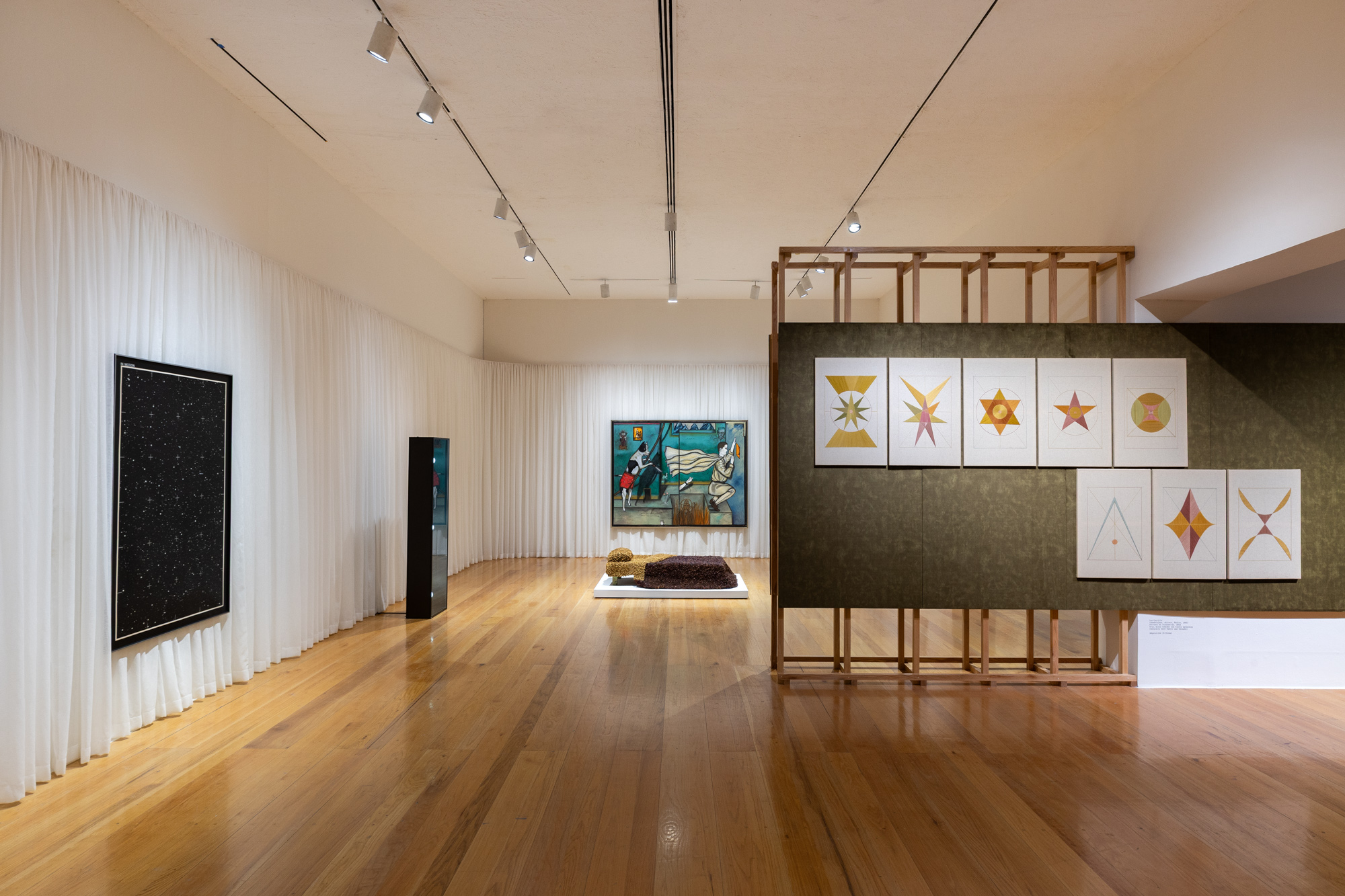
Fifty years is no small milestone, and while one might expect a grand commemoration—especially for a corporate collection—the exhibition, as a whole, does celebrate, yet places greater emphasis on reflection. The history behind the collection is revealed in a subtle yet powerful way through the oil painting El maizal (The Cornfiel) (1955), by Gerardo Murillo (Mexico, 1875–1964). This piece, donated by Rosario Garza Sada de Zambrano, is the first in the FEMSA Collection. Behind it, a white curtain—both scenographic and tactile, as well as sensory—sets the tone for the exhibition’s museography and narrative, opening onto key works in art-historical terms that engage in an open dialogue with those of emerging artists. “We sought for the museography to accompany the works, also focusing on the specificity of each piece,” Paulina Bravo shared in an interview, adding that the museographic process was highly detailed and aimed to foreground not only the overall narrative, but each individual work as well.
Territories, beyond geography
In this first node, Territories—understood as space, landscape, memory, body, and critique—questions notions of center and periphery while addressing social issues of a geopolitical nature. A broader understanding of inhabiting emerges in the installation Objetos de mi jardín (Objects of My Garden) (2024), by Miguel Fernández de Castro (Mexico, 1986), which includes metal plates, barbed wire, and glass bottles: traces of stories marked by abandonment, loss, abuse, and inequality in the pursuit of a better life across the border. Similarly, on the opposite wall, the photographs (San Francisco Javier (Saint Francisco Javier), from the series Tierra Arrasada (Scorched Earth), 2009) by Óscar Farfán (Guatemala, 1973) register the marks of violence and oppression—stories that are further narrated through texts displayed within the gallery space.
Metaphor also finds its place within this space. At the back of the gallery, Mujer dormida (La primavera) (Sleeping Woman (Spring)) (1947), by David Alfaro Siqueiros, a seminal work in the collection, articulates the landscape as a female body that is both mountain and fertile land. From other artistic approaches and concerns, this dimension also emerges in the photograph Untitled (1978), from the series Siluetas (Silhouettes), by Ana Mendieta (Cuba, 1948–USA, 1985), as an ephemeral yet enduring ritual gesture. While the pairing of Siqueiros and Mendieta might initially seem incompatible—given the differences in their artistic production and the strong symbolic weight associated with their names—I would argue that within the exhibition, through specific works, this dialogue not only holds, but also opens up new questions.
This section also explores the social and political conception of territory, exemplified by the work Espacio social del arte (The Social Space of Art) (1977), by Anna Bella Geiger (Brazil, 1933). Other projects address the chaos of urban life and its traces, as seen in Bara bara (Divisor Pirata Naranja) (Bargain (Divider Orange Pirate) (2017) by Pía Camil (Mexico, 1980)—presented to the public for the first time. The installation is composed of second-hand T-shirts sourced from city street markets, filling the gallery as a reflection of collective activation. Inspired by the work of Brazilian artist Lygia Pape, Camil deconstructs the garments and then reassembles them into a large textile mosaic that captures shifting reflections of light. The remnants of urban life—here in the form of waste—are also documented in Cityscape III (2008), a series of photographs by Donna Conlon (United States, 1966; based in Panama), part of her long-standing practice of depicting what we discard, yet which continues to persist.
On Colonial Structures: questions and explorations
Conquest, struggle, violence—all of this resonates in the Colonial Structures section. Upon entering, there are no curtains, but rather a kind of material deconstruction of painterly technique and its most visceral expressivity. The central work, Uno muere muchas veces (One Dies Many Times) (2023), by Paloma Contreras (Mexico, 1991), and recently acquired, unfolds a dense saturation of symbols and motifs rendered in graphite, charcoal, pastel, and oil. These elements evoke the darker layers of Mexico’s history, as well as those embedded within us. This piece enters into a direct dialogue with the painting La conquista (The Conquest) (ca. 1942), by José Clemente Orozco (Mexico, 1883–1949), shown to the public for the first time, in which violence and pain take on a bodily form.
I think that, in order to access the subtleties of some of its components, this is the section that demands a broader art-historical understanding. Here, eighteenth-century casta paintings on loan are presented alongside modern and contemporary works that open up and challenge stereotypes, labels, and affiliations. Among them, the painting Mujer de Bali (Woman of Bali) (1930), by Miguel Covarrubias (Mexico, 1904–1957), stands out. In it, Covarrubias sketches constructions of an “exotic” America and of other latitudes. In this sense, the creation of an imaginary not only exceeds—but at times even connects—borders.
Alchemical manifestations
In a material sense—though also philosophical and existential—the galleries devoted to alchemy expand the formal and conceptual range of surrealist-inflected practices. Here, the curtains once again underscore the key role of two works: a painting by Leonora Carrington (England, 1917–Mexico, 2001), and one of the great jewels of the collection, Papilla estelar (Star Maker) (1958), by Remedios Varo (Spain, 1908–Mexico, 1963), which on its own seems to resonate throughout the expansive space that surrounds it.
In keeping with the tone of the exhibition, this section brings together compositions by established artists such as Juan O’Gorman (Mexico, 1905–1982) and Isa Carrillo (Mexico, 1982). The former is represented by paintings such as Los mitos (The Myths) (1944), saturated with psychological intensity, while the latter presents the series Patrones de resonancia (Resonance Patterns) (2024). In this series, through threads woven with natural dyes, Carrillo constructs minimalist geometric configurations—interlinked yet imbued with a spiritual dimension that also serves as a transition into the next section, focused on abstraction.
I believe one of the works that best captures the spirit of this section is Sobre el tiempo (About Time) (2015), by Tania Candiani(Mexico, 1974), composed of 288 white clocks arranged on wooden shelves. This kinetic configuration functions both as a geometric abstraction and as a philosophical reflection on the passage of time: that time which slips away from us, and the constant ticking that orders, defines, and binds us.
Debating abstraction: geometry and form
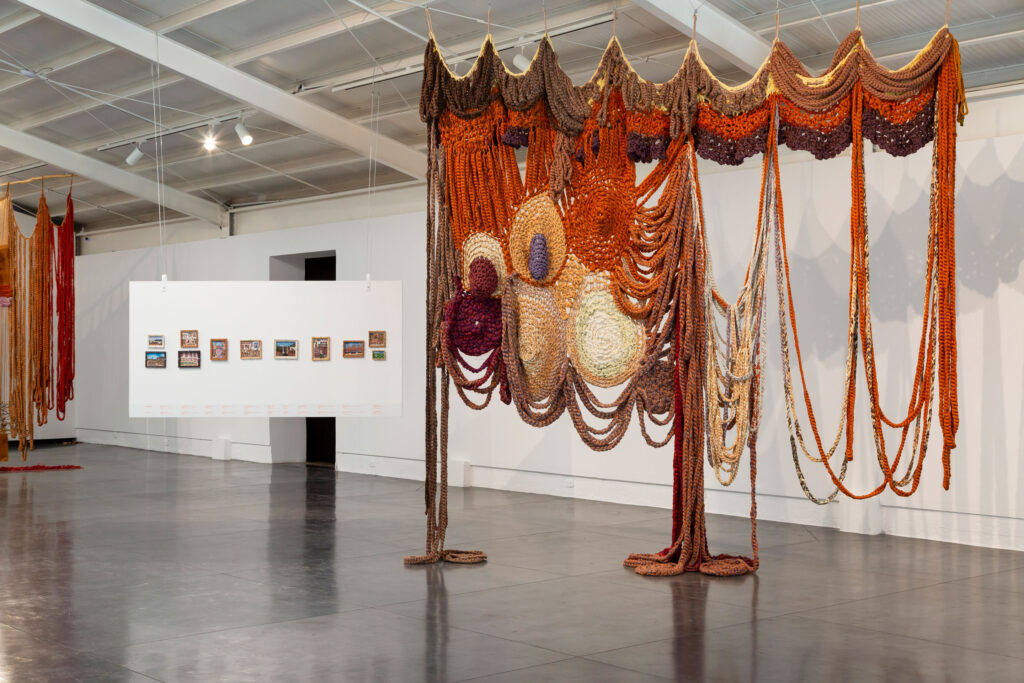
Although it belongs to another abstract-oriented section, the installation of suspended canvases by Vivian Suter (Argentina, 1949) also embodies this sense of transformation through a display shaped by exposure. The artist allows her works to exist outdoors, outside her remote studio in Guatemala, revealing the passage of time and the uncertainty that becomes part of her process—an admirable act of relinquishing control. Within this section, key works can also be discerned by figures such as Diego Rivera (Mexico, 1886–1957), particularly in his Cubist explorations, alongside those of Manuel Felguérez (Mexico, 1928–2020), a central figure of abstract art and part of the so-called Generación de la Ruptura (Rupture Generation), which broke away from muralism. Also present are works by Helen Escobedo (Mexico, 1934–2010), where movement, time, and line are inscribed into space, as well as those by Gego (Germany, 1912–Venezuela, 1994). Across these practices, abstraction unfolds not as a closed language, but as a spatial and temporal inquiry—one that activates line, structure, and rhythm as living elements within the exhibition.
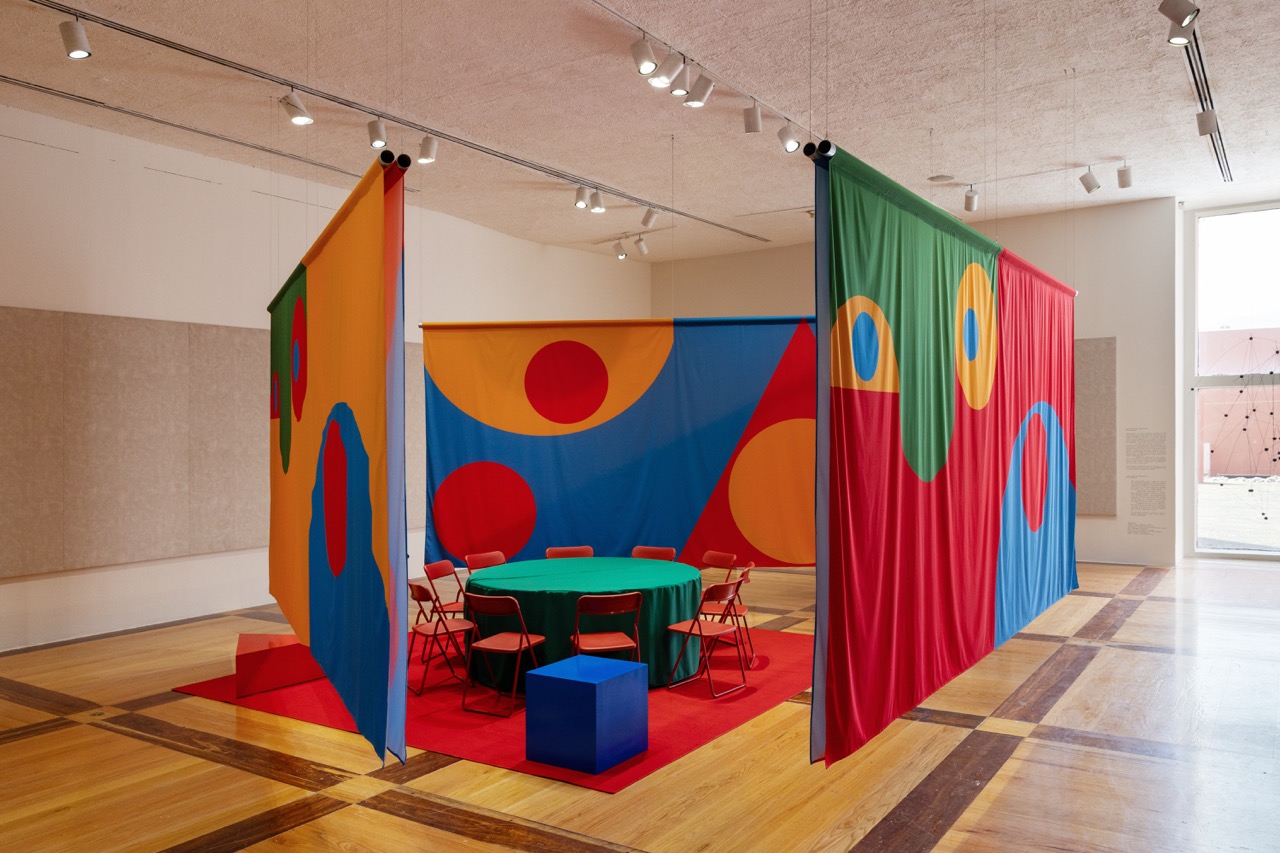
Within this section is a newly commissioned work by Argentine artist Ad Minoliti (Argentina, 1980), Club de collage especulativo (Speculative Collage Club). Through an immersive geometric environment, Minoliti turns to collage as a tool to explore the construction of identities from a queer feminist perspective. In this case, collage is not limited to a two-dimensional operation but unfolds into space: it becomes inhabitable, navigable, almost scenographic, and will be activated through activities in the exhibition’s public program. The work also signals a new phase for the FEMSA Collection, in which, alongside acquisitions—such as those made through the Bienal FEMSA—new commissions will also be undertaken.
Redefining identities
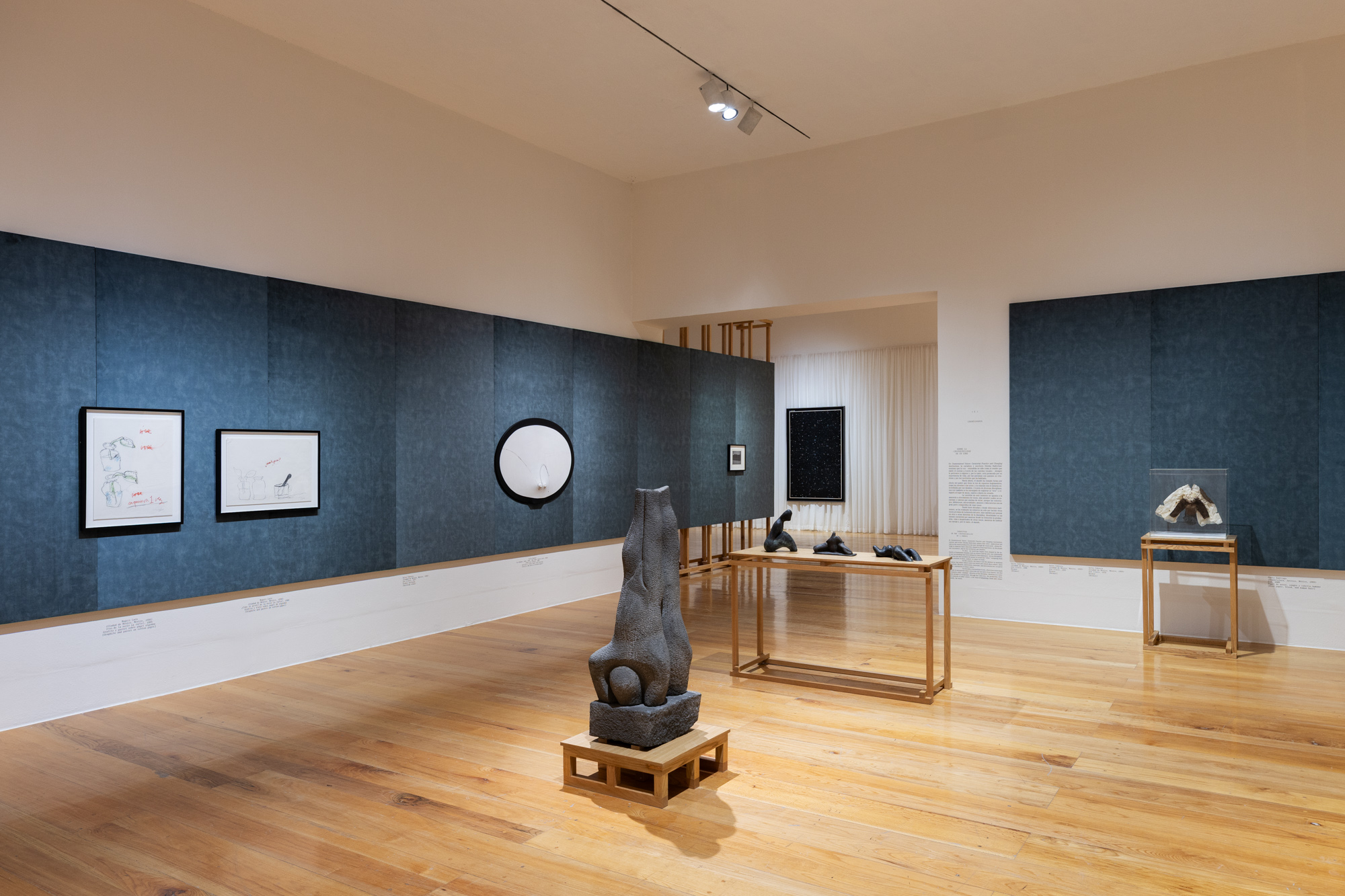
The Identities section is the most intimate in character and, at the same time, one of the most critical, questioning the expectations and roles that are constantly being placed under tension. It includes sculptures by Geles Cabrera (Mexico, 1926), who challenged the role of women artists in her time by proposing a sculptural language in which the body and movement take form in stone and bronze. An approach to the female body—yet in its most visceral expression of pain—also emerges in the drawing Estudio del Zócalo del Duelo (Study of the Zócalo of Mourning) (2018), by Beatriz González (Colombia, 1932–2026), where loss is embodied in the expressions on a woman’s face.
At this point, the room dedicated to the project Estudio para la restauración II (Study for Restoration II), by Ana Gallardo (Argentina, 1958), deconstructs and reinterprets the still lifes of Carmen Gómez Raba (1927–1965), the artist’s mother, who was unable to pursue a professional career in art due to the constraints of her time. Elements from her mother’s oil paintings—displayed outside the room—are transformed into an intimate space populated by large graphite drawings created by Gallardo’s hand, impressions of her mother’s work. This space, also inhabited by ceramic pieces by Rocío Gallardo, the artist’s daughter, offers a sense of pause. Here, the power of lineage passed from woman to woman becomes tangible—a force charged with vulnerability, transmitted from will to will, and from hand to hand.
The section culminates in perhaps its most evocative moment, which also brings the exhibition’s narrative to a close. One work draws all attention: Tres futbolistas con boina (Three soccer Players with Berets) (1921), by Ángel Zárraga (Mexico, 1886–1946), where gestures and physical proximity in this portrait of soccer players suggest a connection and sensuality unthinkable for the time in which it was painted. Facing this work, pieces by younger artists, such as Ángel Cammen (Mexico, 1997), reflect a more intimate, free, and everyday form of love. There is a trace of critique, of questioning—and, yes, of confrontation. This room is perhaps the most openly critical, as it also engages a desire to unfold and challenge exclusionary narratives through an exploration of the collection itself, leaving open questions that are as urgent as they are necessary.
Although it may fall outside the curators’ explicit intentions, to me the exhibition stems from a meticulous and well-articulated reflection that also engages a philosophical and existential dimension. This is what allows it not only to honor the trajectory of the FEMSA Collection, but also the people who have been part of it, resonating beyond itself. All of this conveys a freshness not often found in a museum context: a balance between materiality, the work itself, and the concept. Here, line, gesture, and nuance come into play, as do the questions each work and thematic core opens up. On a sensory level, this revisiting of the collection opens onto something more: a desire to return to those gestures, voices, spaces, and tonalities that lend intimacy to the works and allow them simply to exist.
Subsequently, the exhibition will travel to the Museo Amparo, where its “constellations and currents” will take on a new form.
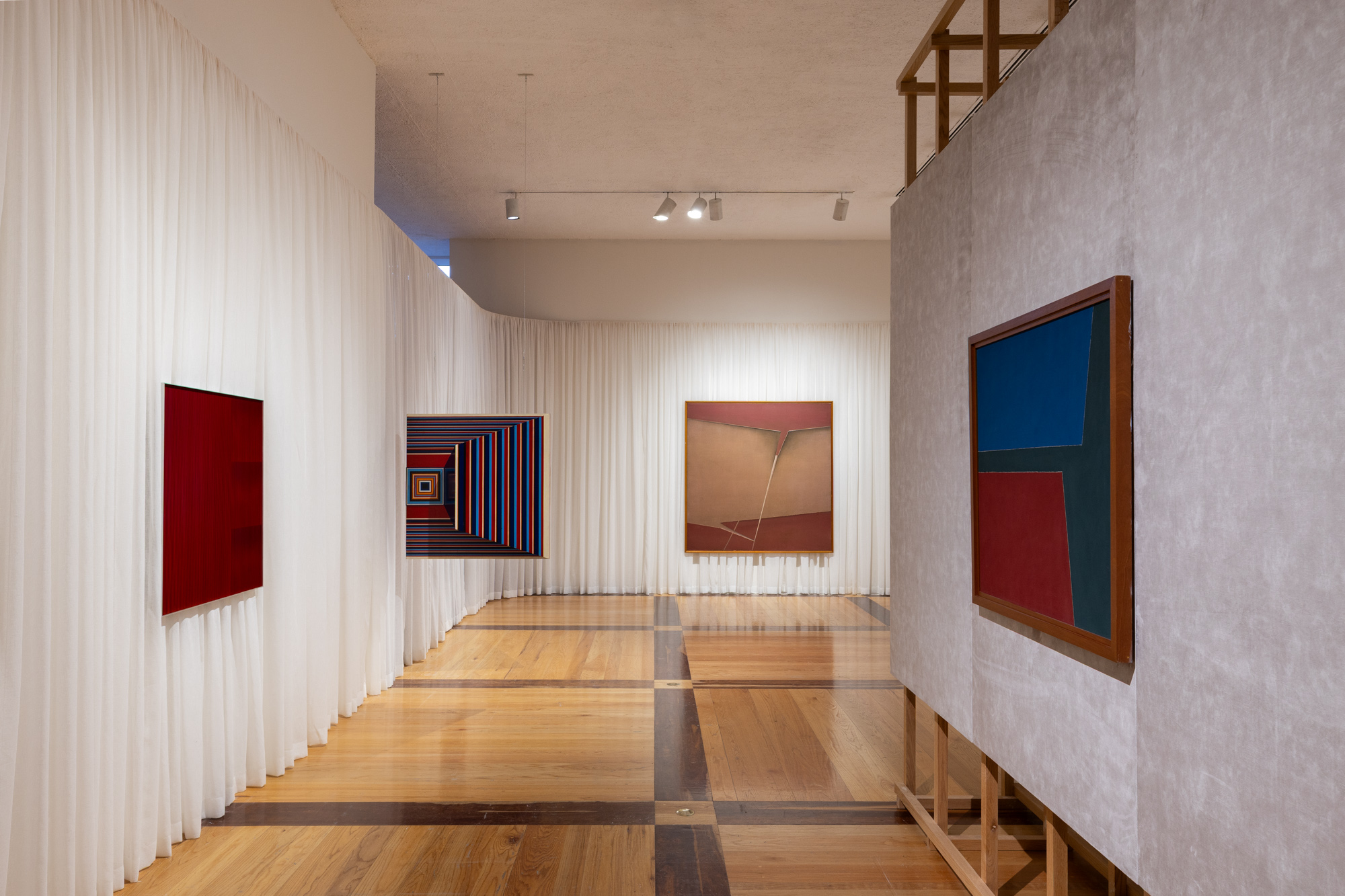
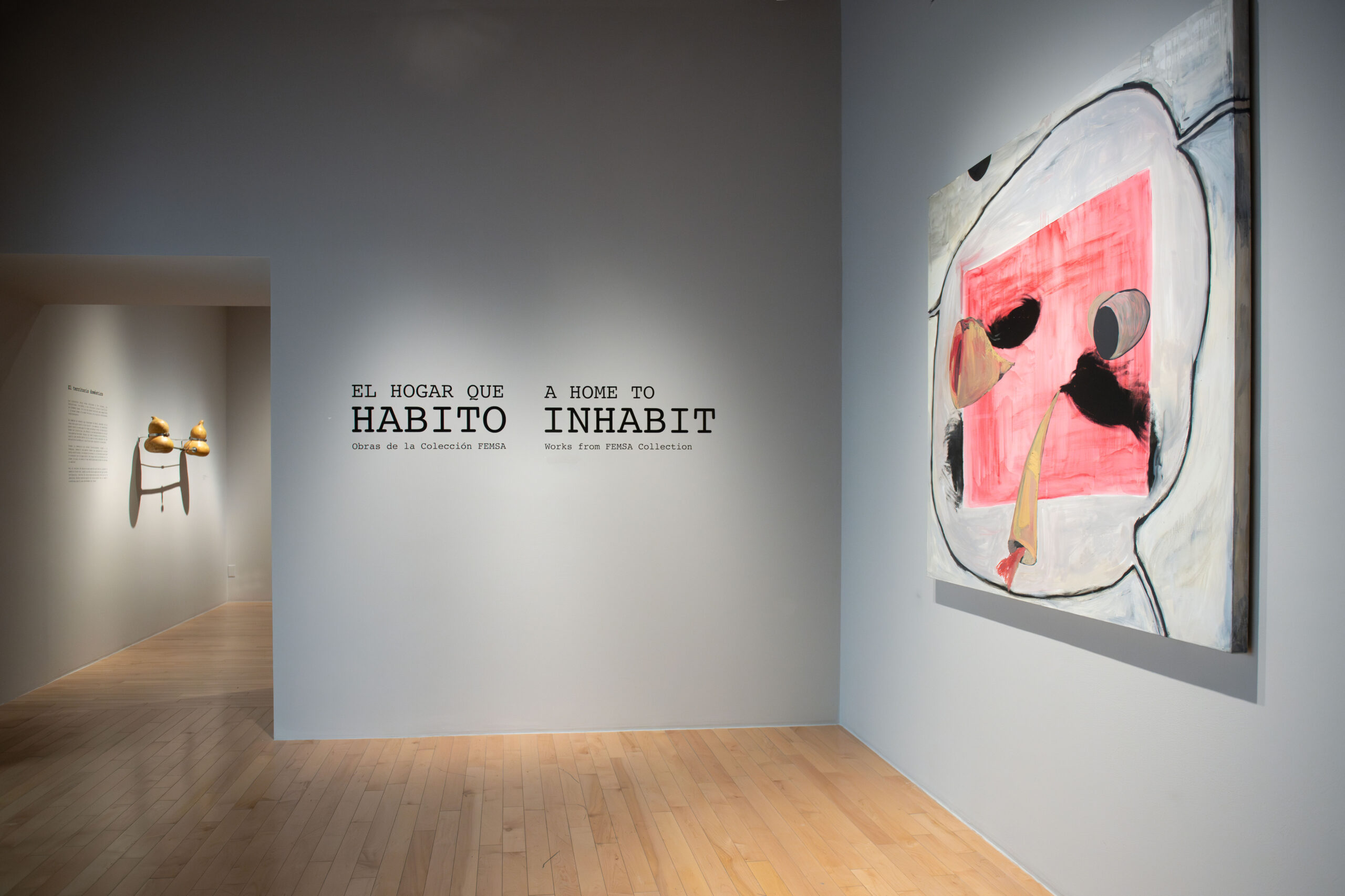
Vista de la exposición, cortesía de la autora.
What is an art collection? How does a collection inhabit and evolve over time? On the occasion of its 50th anniversary, FEMSA explores these questions in the exhibition Constelaciones y Derivas: Arte de América Latina desde la colección FEMSA (Constellations And Currents: Latin American Art From the FEMSA collection), featuring a selection of 174 works by more than 100 artists. This exhibition reflects the legacy of a corporate collection that now comprises over 1,300 modern and contemporary artworks. Through evocative thematic lines and a museography that oscillates between texture and intimacy, the exhibition grants agency to its works, enabling the paintings, installations, sculptures, and gestures at the Museo de Arte Contemporáneo de Monterrey (MARCO) to articulate their own voices.
The curatorial team of the FEMSA Collection—composed of Paulina Bravo, Beto Díaz Suárez, and Eugenia Braniff—together with independent curator Adriana Melchor, drew on the model developed by Mari Carmen Ramírez and Héctor Olea to group the expressions of a broad and diverse Latin America into constellations or associations, rather than following a chronological or strictly geographic route: “Constellations are permeable; they are not fixed boxes or closed theoretical or thematic categories, but instead establish transnational and transgenerational relationships that unfold within specific times and spaces,” said Paulina Bravo, Chief Curator of the collection, in an interview. “Rather than presenting a single notion of what Latin American art is within our holdings, we are interested in opening up windows onto relationships between artists,” Bravo added during the press walkthrough.
Through this lens—shaped by close attention to each work’s materiality and repeated visits to the collection’s storage, and informed by Aby Warburg’s associative approach in Atlas Mnemosyne—the exhibition brings the works into a dialogue that feels both cohesive and open-ended. This configuration is anchored in five thematic cores: Territories, Colonial Structures, Debating Abstraction: Geometry and Form in Latin America, and Alchemy and Identities, which together outline a reinterpretation of the collection. Many of the works are being exhibited for the first time, while others are returning to public view after a long period away from the public eye.
Glimpses into the history behind a collection
Every collection carries a history shaped by the tastes, preferences, and interests of those behind it. This exhibition is no exception; that dimension accompanies it. Although the FEMSA Collection is now a well-established corporate collection, its beginnings—like those of many private collections—stemmed from curiosity and, however cliché it may sound, from a “love of art.” At the same time, its history is tied to pioneering spaces such as the Museo de Monterrey (1977–2000), where its first core holdings were formed. Despite the museum’s closure, the collection continued to grow and even traveled through itinerant exhibitions. In parallel, the Bienal FEMSA—now spanning more than thirty years—has played a key role in the acquisition of contemporary works by younger and emerging artists.
Echoing this trajectory, the exhibition positions itself as a key moment in the ongoing evolution of the FEMSA Collection. In the words of Paulina Bravo, the exhibition’s axes “reflect the curatorial lines guiding the collection’s growth” into the future, also shaped through more than three years of work that included seminars with a range of specialists.
Grand opening: the first work in the collection
Fifty years is no small milestone, and while one might expect a grand commemoration—especially for a corporate collection—the exhibition, as a whole, does celebrate, yet places greater emphasis on reflection. The history behind the collection is revealed in a subtle yet powerful way through the oil painting El maizal (The Cornfiel) (1955), by Gerardo Murillo (Mexico, 1875–1964). This piece, donated by Rosario Garza Sada de Zambrano, is the first in the FEMSA Collection. Behind it, a white curtain—both scenographic and tactile, as well as sensory—sets the tone for the exhibition’s museography and narrative, opening onto key works in art-historical terms that engage in an open dialogue with those of emerging artists. “We sought for the museography to accompany the works, also focusing on the specificity of each piece,” Paulina Bravo shared in an interview, adding that the museographic process was highly detailed and aimed to foreground not only the overall narrative, but each individual work as well.
Territories, beyond geography
In this first node, Territories—understood as space, landscape, memory, body, and critique—questions notions of center and periphery while addressing social issues of a geopolitical nature. A broader understanding of inhabiting emerges in the installation Objetos de mi jardín (Objects of My Garden) (2024), by Miguel Fernández de Castro (Mexico, 1986), which includes metal plates, barbed wire, and glass bottles: traces of stories marked by abandonment, loss, abuse, and inequality in the pursuit of a better life across the border. Similarly, on the opposite wall, the photographs (San Francisco Javier (Saint Francisco Javier), from the series Tierra Arrasada (Scorched Earth), 2009) by Óscar Farfán (Guatemala, 1973) register the marks of violence and oppression—stories that are further narrated through texts displayed within the gallery space.
Metaphor also finds its place within this space. At the back of the gallery, Mujer dormida (La primavera) (Sleeping Woman (Spring)) (1947), by David Alfaro Siqueiros, a seminal work in the collection, articulates the landscape as a female body that is both mountain and fertile land. From other artistic approaches and concerns, this dimension also emerges in the photograph Untitled (1978), from the series Siluetas (Silhouettes), by Ana Mendieta (Cuba, 1948–USA, 1985), as an ephemeral yet enduring ritual gesture. While the pairing of Siqueiros and Mendieta might initially seem incompatible—given the differences in their artistic production and the strong symbolic weight associated with their names—I would argue that within the exhibition, through specific works, this dialogue not only holds, but also opens up new questions.
This section also explores the social and political conception of territory, exemplified by the work Espacio social del arte (The Social Space of Art) (1977), by Anna Bella Geiger (Brazil, 1933). Other projects address the chaos of urban life and its traces, as seen in Bara bara (Divisor Pirata Naranja) (Bargain (Divider Orange Pirate) (2017) by Pía Camil (Mexico, 1980)—presented to the public for the first time. The installation is composed of second-hand T-shirts sourced from city street markets, filling the gallery as a reflection of collective activation. Inspired by the work of Brazilian artist Lygia Pape, Camil deconstructs the garments and then reassembles them into a large textile mosaic that captures shifting reflections of light. The remnants of urban life—here in the form of waste—are also documented in Cityscape III (2008), a series of photographs by Donna Conlon (United States, 1966; based in Panama), part of her long-standing practice of depicting what we discard, yet which continues to persist.
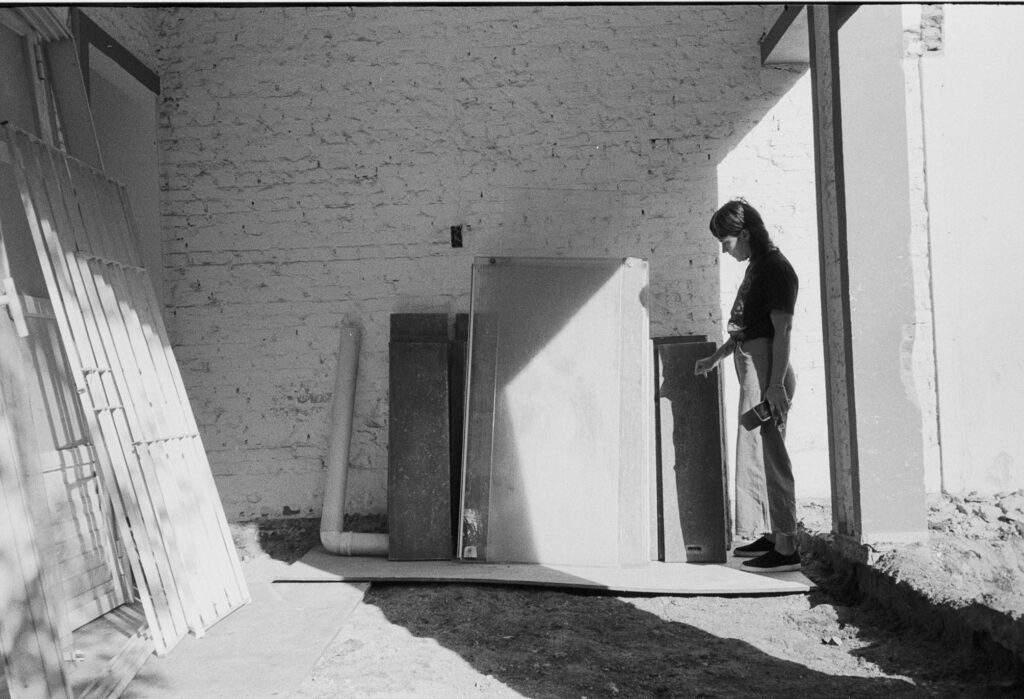
Vista de la exposición, cortesía de la autora.
On Colonial Structures: questions and explorations
Conquest, struggle, violence—all of this resonates in the Colonial Structures section. Upon entering, there are no curtains, but rather a kind of material deconstruction of painterly technique and its most visceral expressivity. The central work, Uno muere muchas veces (One Dies Many Times) (2023), by Paloma Contreras (Mexico, 1991), and recently acquired, unfolds a dense saturation of symbols and motifs rendered in graphite, charcoal, pastel, and oil. These elements evoke the darker layers of Mexico’s history, as well as those embedded within us. This piece enters into a direct dialogue with the painting La conquista (The Conquest) (ca. 1942), by José Clemente Orozco (Mexico, 1883–1949), shown to the public for the first time, in which violence and pain take on a bodily form.
I think that, in order to access the subtleties of some of its components, this is the section that demands a broader art-historical understanding. Here, eighteenth-century casta paintings on loan are presented alongside modern and contemporary works that open up and challenge stereotypes, labels, and affiliations. Among them, the painting Mujer de Bali (Woman of Bali) (1930), by Miguel Covarrubias (Mexico, 1904–1957), stands out. In it, Covarrubias sketches constructions of an “exotic” America and of other latitudes. In this sense, the creation of an imaginary not only exceeds—but at times even connects—borders.
Alchemical manifestations
In a material sense—though also philosophical and existential—the galleries devoted to alchemy expand the formal and conceptual range of surrealist-inflected practices. Here, the curtains once again underscore the key role of two works: a painting by Leonora Carrington (England, 1917–Mexico, 2001), and one of the great jewels of the collection, Papilla estelar (Star Maker) (1958), by Remedios Varo (Spain, 1908–Mexico, 1963), which on its own seems to resonate throughout the expansive space that surrounds it.
In keeping with the tone of the exhibition, this section brings together compositions by established artists such as Juan O’Gorman (Mexico, 1905–1982) and Isa Carrillo (Mexico, 1982). The former is represented by paintings such as Los mitos (The Myths) (1944), saturated with psychological intensity, while the latter presents the series Patrones de resonancia (Resonance Patterns) (2024). In this series, through threads woven with natural dyes, Carrillo constructs minimalist geometric configurations—interlinked yet imbued with a spiritual dimension that also serves as a transition into the next section, focused on abstraction.
I believe one of the works that best captures the spirit of this section is Sobre el tiempo (About Time) (2015), by Tania Candiani(Mexico, 1974), composed of 288 white clocks arranged on wooden shelves. This kinetic configuration functions both as a geometric abstraction and as a philosophical reflection on the passage of time: that time which slips away from us, and the constant ticking that orders, defines, and binds us.
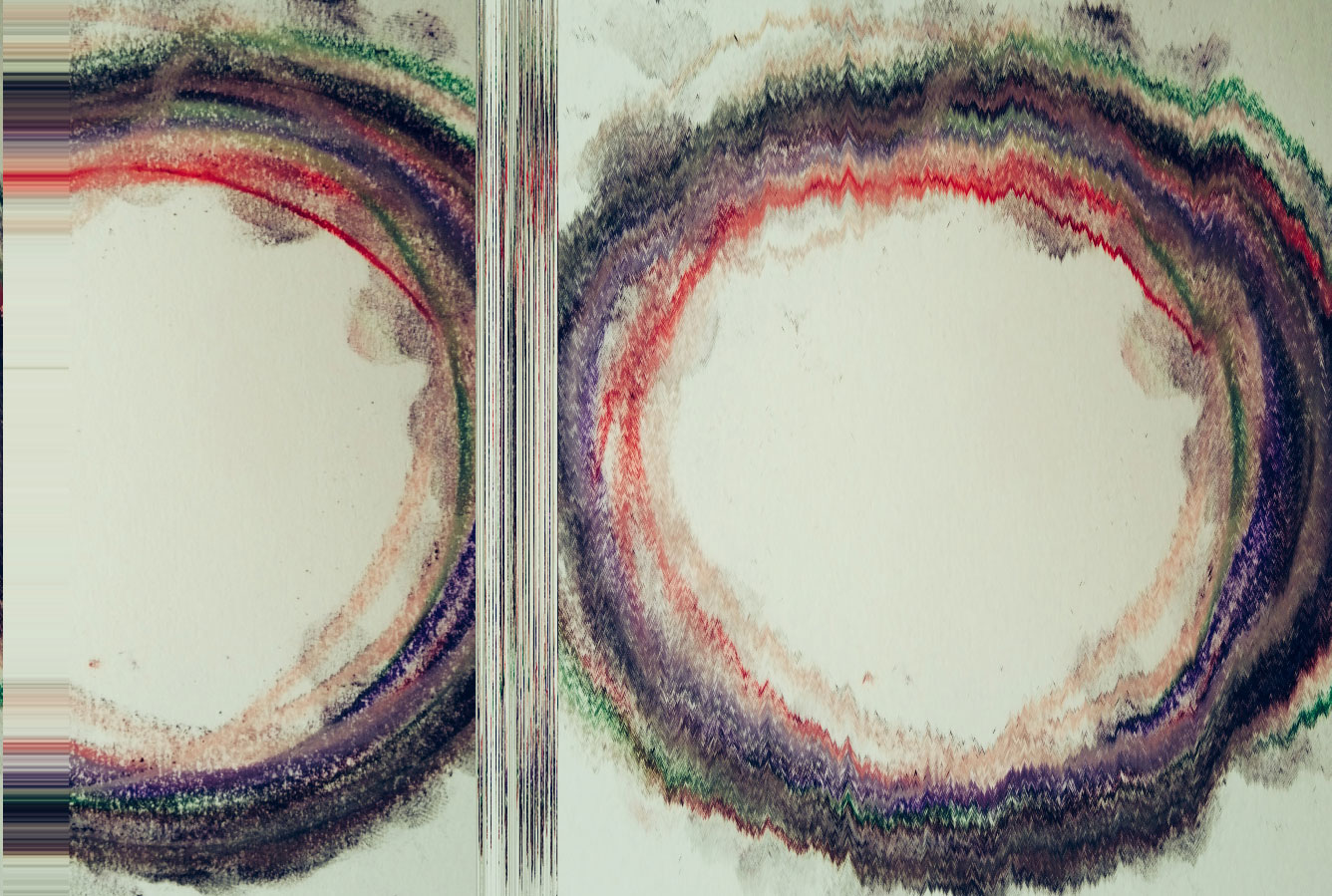
Vista de la exposición, cortesía de la autora.
Debating abstraction: geometry and form
Although it belongs to another abstract-oriented section, the installation of suspended canvases by Vivian Suter (Argentina, 1949) also embodies this sense of transformation through a display shaped by exposure. The artist allows her works to exist outdoors, outside her remote studio in Guatemala, revealing the passage of time and the uncertainty that becomes part of her process—an admirable act of relinquishing control. Within this section, key works can also be discerned by figures such as Diego Rivera (Mexico, 1886–1957), particularly in his Cubist explorations, alongside those of Manuel Felguérez (Mexico, 1928–2020), a central figure of abstract art and part of the so-called Generación de la Ruptura (Rupture Generation), which broke away from muralism. Also present are works by Helen Escobedo (Mexico, 1934–2010), where movement, time, and line are inscribed into space, as well as those by Gego (Germany, 1912–Venezuela, 1994). Across these practices, abstraction unfolds not as a closed language, but as a spatial and temporal inquiry—one that activates line, structure, and rhythm as living elements within the exhibition.
Within this section is a newly commissioned work by Argentine artist Ad Minoliti (Argentina, 1980), Club de collage especulativo (Speculative Collage Club). Through an immersive geometric environment, Minoliti turns to collage as a tool to explore the construction of identities from a queer feminist perspective. In this case, collage is not limited to a two-dimensional operation but unfolds into space: it becomes inhabitable, navigable, almost scenographic, and will be activated through activities in the exhibition’s public program. The work also signals a new phase for the FEMSA Collection, in which, alongside acquisitions—such as those made through the Bienal FEMSA—new commissions will also be undertaken.
Redefining identities
The Identities section is the most intimate in character and, at the same time, one of the most critical, questioning the expectations and roles that are constantly being placed under tension. It includes sculptures by Geles Cabrera (Mexico, 1926), who challenged the role of women artists in her time by proposing a sculptural language in which the body and movement take form in stone and bronze. An approach to the female body—yet in its most visceral expression of pain—also emerges in the drawing Estudio del Zócalo del Duelo (Study of the Zócalo of Mourning) (2018), by Beatriz González (Colombia, 1932–2026), where loss is embodied in the expressions on a woman’s face.
At this point, the room dedicated to the project Estudio para la restauración II (Study for Restoration II), by Ana Gallardo (Argentina, 1958), deconstructs and reinterprets the still lifes of Carmen Gómez Raba (1927–1965), the artist’s mother, who was unable to pursue a professional career in art due to the constraints of her time. Elements from her mother’s oil paintings—displayed outside the room—are transformed into an intimate space populated by large graphite drawings created by Gallardo’s hand, impressions of her mother’s work. This space, also inhabited by ceramic pieces by Rocío Gallardo, the artist’s daughter, offers a sense of pause. Here, the power of lineage passed from woman to woman becomes tangible—a force charged with vulnerability, transmitted from will to will, and from hand to hand.
The section culminates in perhaps its most evocative moment, which also brings the exhibition’s narrative to a close. One work draws all attention: Tres futbolistas con boina (Three soccer Players with Berets) (1921), by Ángel Zárraga (Mexico, 1886–1946), where gestures and physical proximity in this portrait of soccer players suggest a connection and sensuality unthinkable for the time in which it was painted. Facing this work, pieces by younger artists, such as Ángel Cammen (Mexico, 1997), reflect a more intimate, free, and everyday form of love. There is a trace of critique, of questioning—and, yes, of confrontation. This room is perhaps the most openly critical, as it also engages a desire to unfold and challenge exclusionary narratives through an exploration of the collection itself, leaving open questions that are as urgent as they are necessary.
Although it may fall outside the curators’ explicit intentions, to me the exhibition stems from a meticulous and well-articulated reflection that also engages a philosophical and existential dimension. This is what allows it not only to honor the trajectory of the FEMSA Collection, but also the people who have been part of it, resonating beyond itself. All of this conveys a freshness not often found in a museum context: a balance between materiality, the work itself, and the concept. Here, line, gesture, and nuance come into play, as do the questions each work and thematic core opens up. On a sensory level, this revisiting of the collection opens onto something more: a desire to return to those gestures, voices, spaces, and tonalities that lend intimacy to the works and allow them simply to exist.
Subsequently, the exhibition will travel to the Museo Amparo, where its “constellations and currents” will take on a new form.
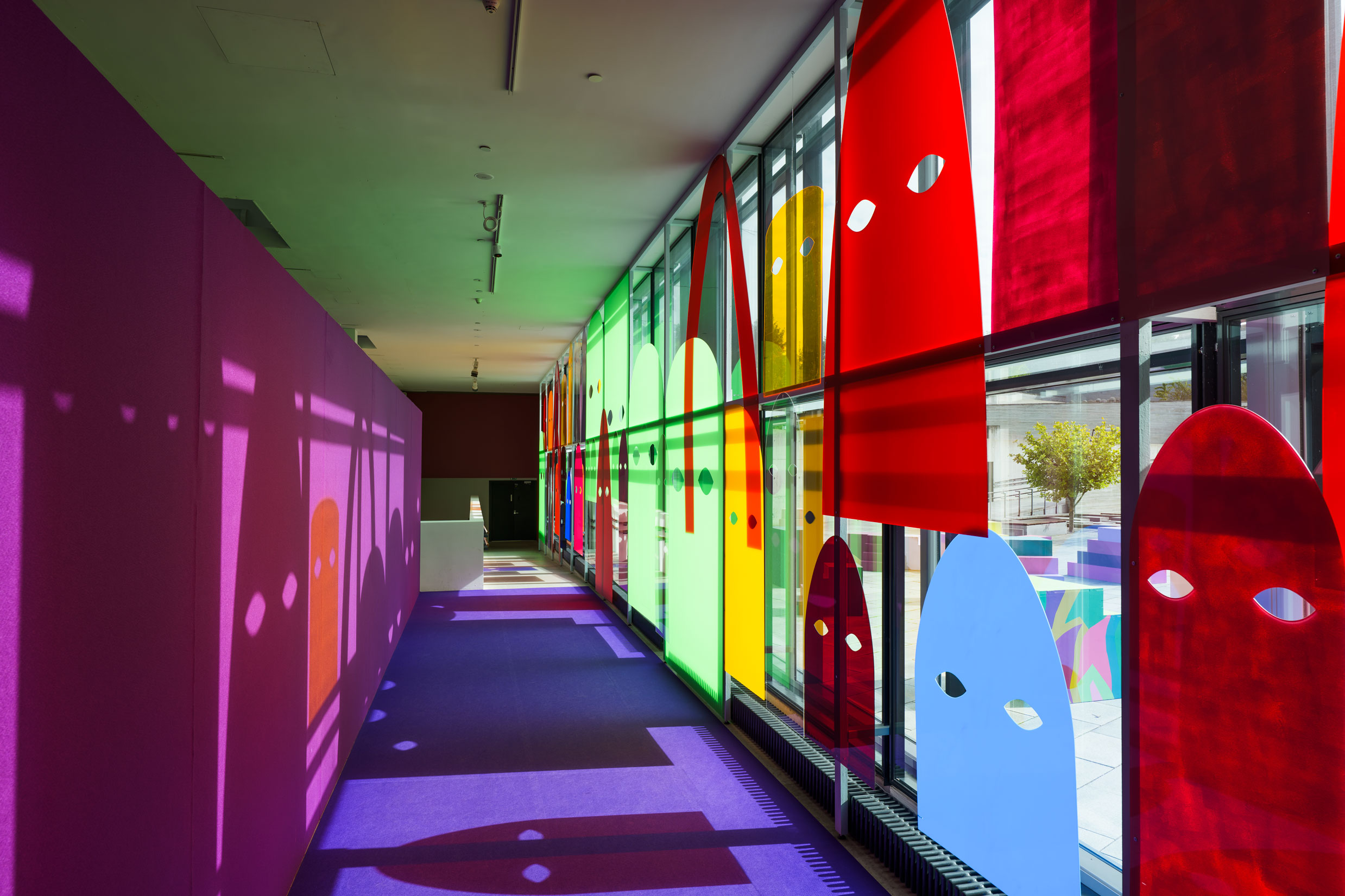
Vista de la exposición, cortesía de la autora.