In São Paulo, Julia Feldens opened her home to artists to share workspaces and everyday life. Beatriz Ferro visits Casa Líquida, a project sustained by affection, trust, and an economy that seeks not to produce more money, but to make other bonds possible. Between shared life and silence, the house becomes a space where creating also means experimenting with other ways of inhabiting the world and being together.
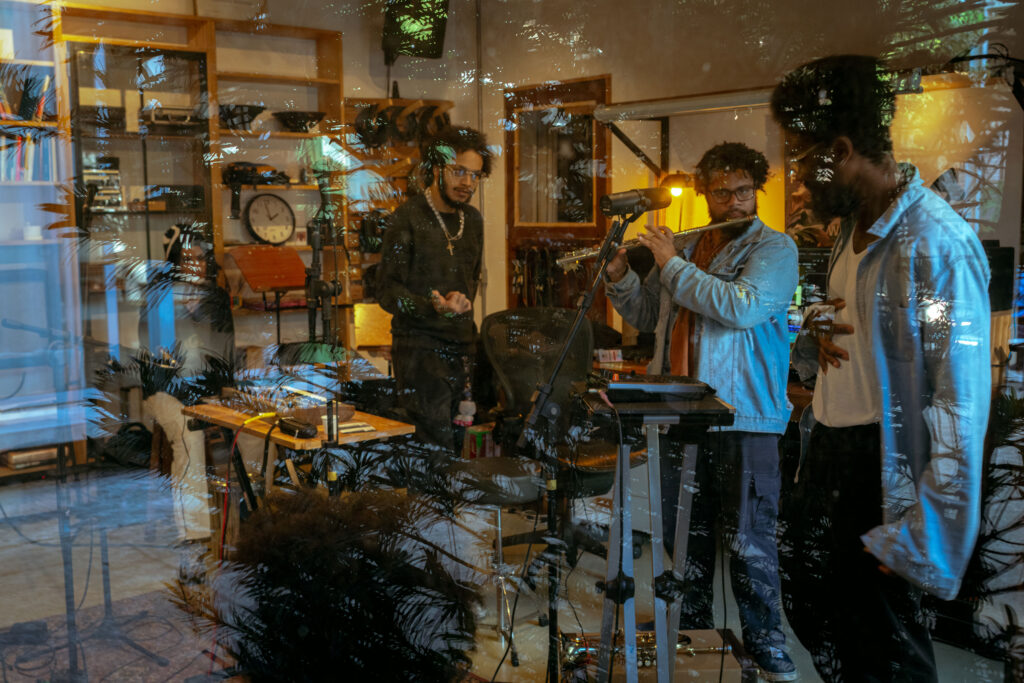
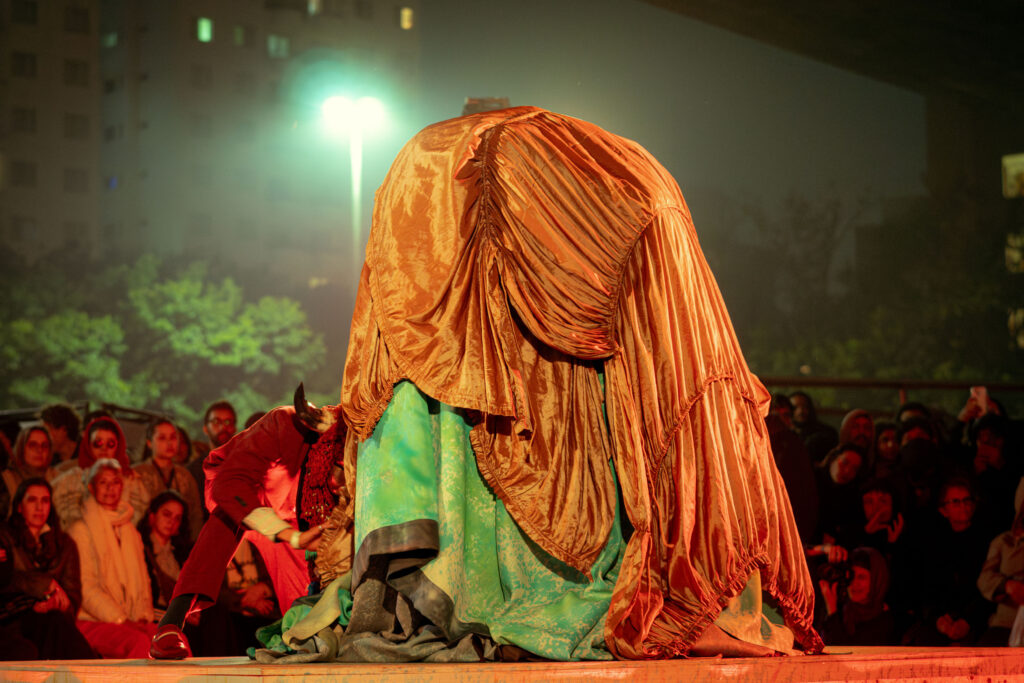
Silence is rare at Casa Líquida. On that rainy Thursday morning you could hear the jingle of keys from a performance by Novíssimo Edgar, rehearsing in the garden ahead of a show in MASP’s open-air space; the percussion of O Cheiro do Queijo, a scenic-musical group from Ceará, echoing out of the back studio; residents’ coffee cups clinking against the kitchen table; the steady rush of a shower running somewhere in the house. “No day here is like another,” says Julia Feldens when I ask about the house’s routine. Together with her sons Heitor and Antônio, the artist and founder of the project gave up solitude to surrender herself to the unpredictability of encounters: her own home became a space of coexistence and transit for artists, hosting residency programs, studio work, and research, along with free lodging for cultural professionals.
In Brazil, Julia Feldens is a familiar face, especially to those who follow the country’s television dramas. After a career in theatre, she made her television debut and became one of the stars of Manoel Carlos’s classic telenovela Laços de família [Family Ties], which aired in the early 2000s. Over time, however, fame made her aware of how difficult it was to form spontaneous connections when people were constantly recognizing her. “The image took on a dimension in my life far greater than my work as an actress,” she explains.
Julia consciously stepped away from the spotlight to devote herself to motherhood. In 2015, more than a decade later, the obstacle that had kept her from connecting and forming meaningful bonds with others would resonate in her research for the performance Casa Líquida [Liquid House]—also the name of the house where she lives—rooted in the gesture of offering space for artists working across different disciplines to develop their projects and share everyday life with her family. “I understood performance as an action with a body at its center that brought about a certain transformation around it. That inspired me to create an action in which I open my home to collective use, where the central bodies were mine, those of my two children, and that of the house itself,” she adds.
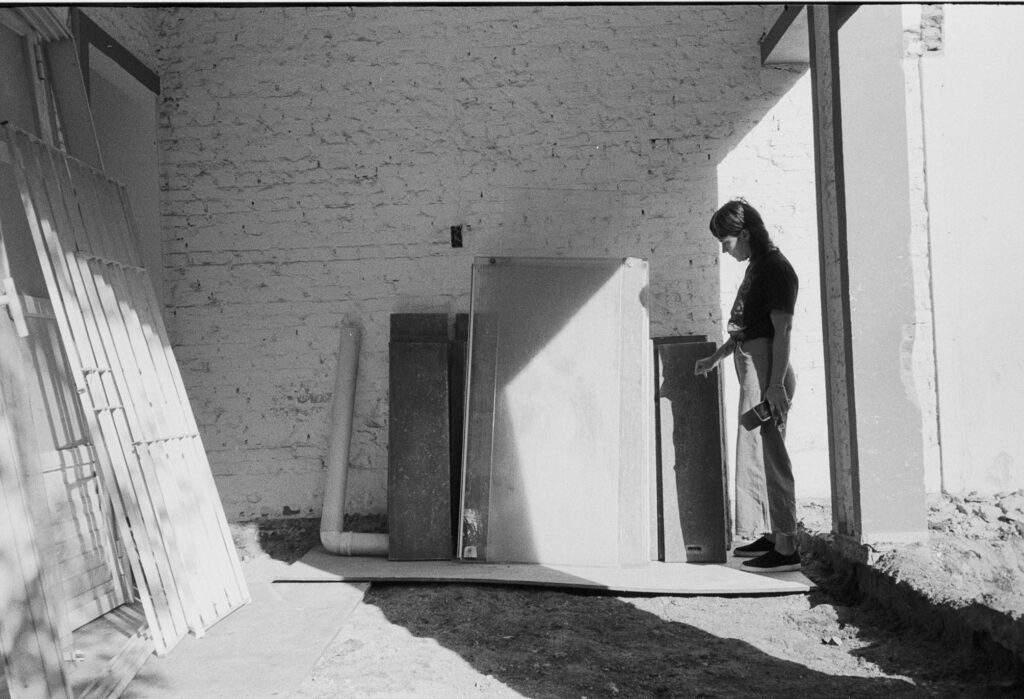
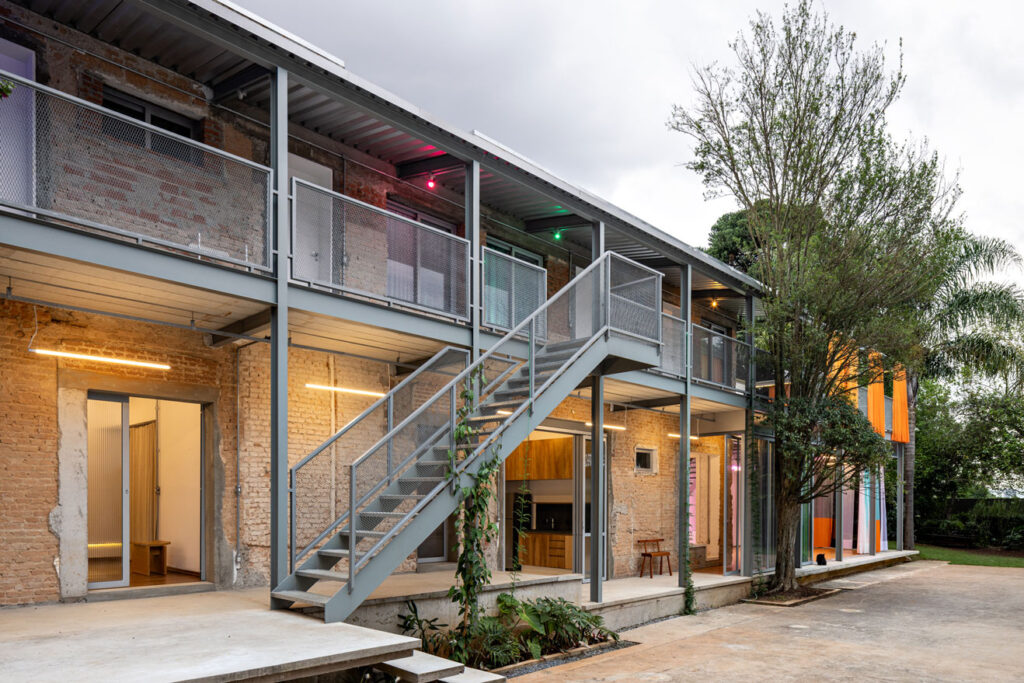
Located on the west side of São Paulo, the roughly 700-square-meter house remains hidden behind a wall shrouded in trees, in contrast to the large real estate developments and buildings slowly consuming the older homes of this upper-middle-class neighborhood. The walk there is tortuous, through construction dust and noise. Julia says the neighborhood itself regards what happens there as something akin to an obscene act: given its configuration and the constant flow of people, it does not recognize her house as a home in conventional terms—if such a thing exists. “In this geopolitical place, it is neither understood nor welcome.”
Despite the carceral urbanism of the area’s private fortresses, with their high walls and surveillance cameras powered by Zionist military technologies, the door to the House was open. I crossed the gate and entered the central courtyard, where I sensed another dynamic at work: a kind of machine producing not only art but also vitality.
It is evident how the works created there are oxygenated by everyday exchanges and experiences—a premise that also underpins Julia’s undergraduate thesis in Communication of the Body Arts at PUC-SP. “I tried to understand how being a house and a domestic space could influence people’s creative processes. I came to understand that this produced a certain intimacy that could inspire freedom and the courage to take risks. The home, everyday life, and routine are very important to the creative process, especially through the experience of living with the differences of others,” she remarks.
She came to the house at the end of her marriage. As part of the divorce settlement, she received the property to live in with her children, with all maintenance costs covered for ten years. This arrangement gave her the autonomy she needed to devote herself fully to research, running the space, and raising her children, who were just ten and six when they arrived.
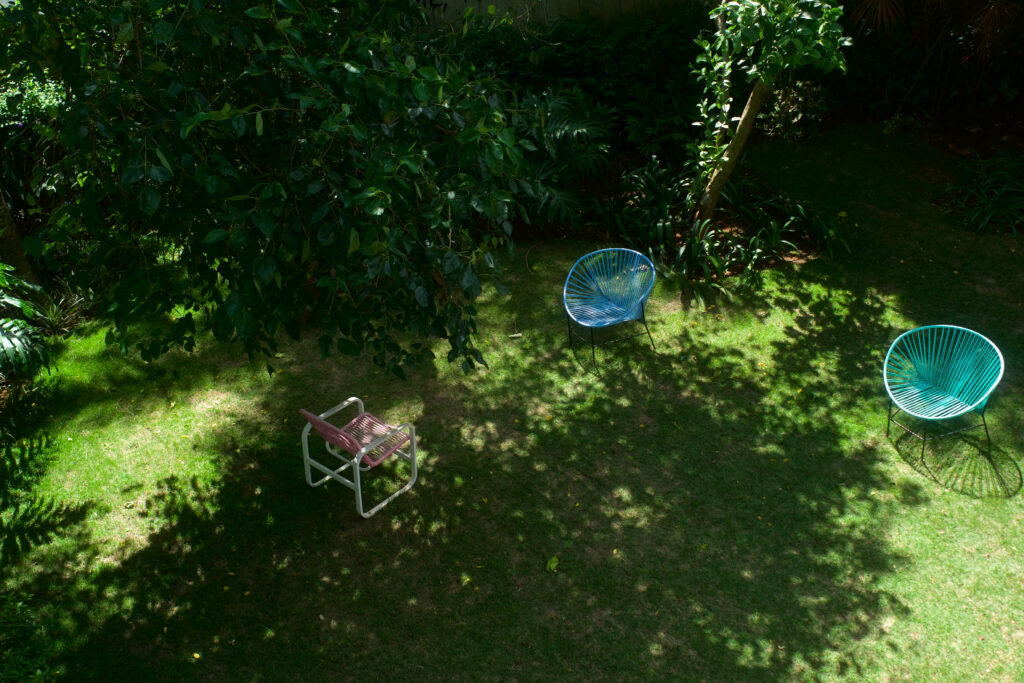
It all began when a friend asked to use the glass-walled room overlooking the garden to rehearse a play with a group of women and stayed for three months. Little by little, word spread. More and more artists began seeking out this place that offered space to work and live, free of charge.
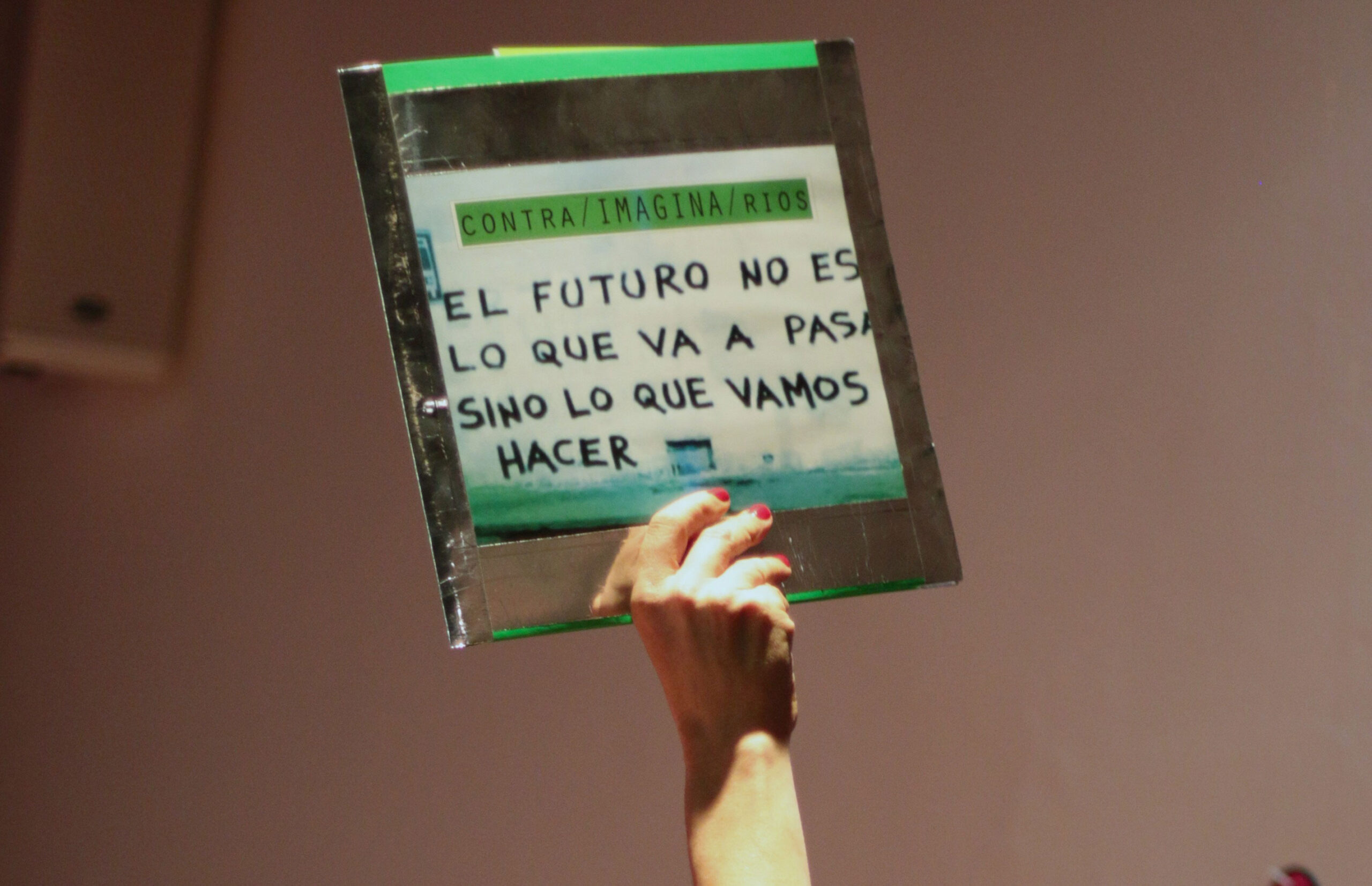
At first, Julia organized a weekly schedule, allocating time slots to the groups that quickly began to occupy the space. Dancers, actors, filmmakers, photographers, writers, and musicians: entirely different people moved through her practice of observation and analysis. She then began posting photographs on Facebook of her children holding signs with phrases such as “We want to meet people!”
“They would say to me, ‘So I’m going to rehearse in your house for six months and give you nothing in return?’ No, you’re already giving so much. These are contributions that already exist and go unnoticed, while others resonate in a time that is not linear.”
Julia believes that economic exchange limits the possibilities for establishing other kinds of relationships; this is why Casa Líquida charges no fees and requires no financial contribution in return. Residents are not required to submit proposals or present outcomes either. This is not an artist’s residency in the traditional sense; what Julia built was a network sustained by affection, shared life, and bonds—a destabilizing condition for an economic system based on capital.
And she asks: “But what kind of economy is that? An economy of circulating and amplifying capital. From the beginning, I thought about how to use capital to allow intensities to emerge rather than to produce more money. I could have material assets or invested the money, but I wanted to create this possibility. It is not exactly a direct exchange, but one you make with the whole surrounding environment, which comes back to you in other forms.”
The value she placed on collective experience also shaped her decision not to establish fixed rules—or at least not to write them down and stick them on the wall like irreversible decrees. The founder recalls conflicts with some residents, who on several occasions suggested introducing rules for living together. She stood firm: “I don’t want signs. I want you to talk to one another!”
“For the boys, all that movement in the house was important, but I wanted to see our routine become even more contaminated by these people,” she says. That was when Julia began inviting artists to live with them. To date, she, Heitor, and Antônio have shared their home with more than 110 people, for varying lengths of time.
And Julia remembers them all: the longest-staying resident, with whom she shared six years of daily life; the Syrian artist Yara Ktaisch, who lived with the family during the year the House remained closed because of the pandemic and who, without speaking Portuguese, spent hours playing video games with Antônio; the period when they hosted members of the riverside community of Boa Esperança in Teresina, in the country’s northeast, which has spent years resisting the dispossession of families to make way for tourist complexes and the advance of real estate speculation; the gatherings of students from SenseLab Montreal, a laboratory at Concordia University in Canada dedicated to studying the intersections of art and activism; and the Scottish political arts organization Arika, which brought Palestinian artist Ayreen Anastas and Iranian artist Rene Gabri. The stories accumulate like successive layers of paint on a wall.
The arrival of SenseLab Montreal also led to an institutional collaboration with Casa Líquida to host Immediations in São Paulo, a project comprising study groups and artist residencies with Concordia students in various parts of the world. Exchange between institutions became one of the House’s strands, particularly through initiatives offering time, space, and the conditions for creative processes to artists affiliated with other institutions and residency programs.
Novíssimo Edgar and his performance Hipnagógico, presented in MASP’s open space, are among the most recent examples, alongside Davi Pontes’s work while producing his commission for the 38th edition of the Panorama of Brazilian Art at MAM São Paulo, and that of Angolan artist Helena Uambembe, a participant in the 36th São Paulo Biennial.
The House’s physical expansion also marks a significant moment in Julia’s trajectory. In 2019, she discovered that the neighboring property, which had been abandoned for two years, belonged to the father of her children, who authorized its use through a fifteen-year usufruct agreement. In a symbolic gesture, the wall separating the two properties was torn down, giving rise to the House’s current configuration.
The two properties then began to function as a small village, making it possible to build new workspaces, studios, and suites for residents. “Today I know that a fortress is, in fact, a house without walls,” Julia writes in her thesis.
Built in the 1950s, the annex underwent an extensive renovation designed by her colleague, architect Luiz Pataro. Weaving together the modern and the contemporary, Pataro carefully planned the addition of a steel structure to the original house—a solution that not only connects the spaces but also affirms Casa Líquida’s own natural, fluid organization.
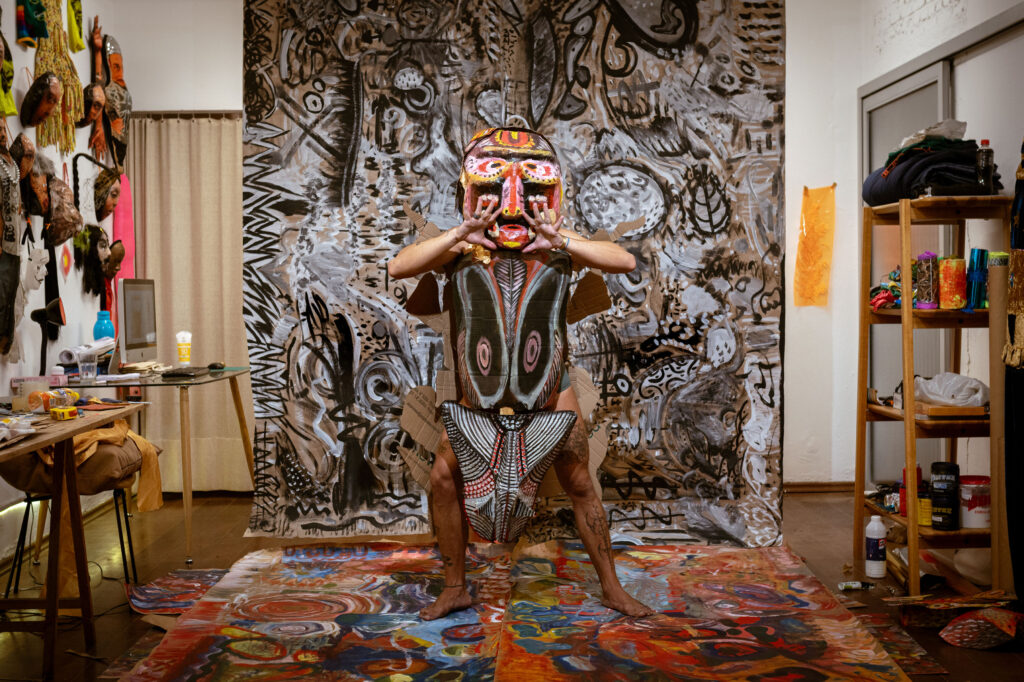
The house holds traces in every corner, like a living archive of those who have passed through it. I see the remnants of the poem inscribed on an exterior wall by the Syrian performance artist; the phrase graffitied on the back wall—“There is no solid ground, everything moves”; the swing hanging from a tree for Valentim, Julia’s nephew, barely a year old, who also lives there; and posters scattered throughout the rooms, including an image of the statue of Borba Gato in flames and slogans such as “End the six-days-on, one-day-off workweek!”1
In all, some three thousand people have left their mark on Casa Líquida and been transformed by it as a workspace. Although the performance ended last year, Julia found a way to continue the research by establishing Instituto Casa Líquida in August 2024.
The house then began to operate as one of the institute’s cultural devices, and all the projects that had already existed organically acquired a structure and a name. Cruza is a three-month artist residency program with two formats: accommodation and use of the space. The music studio became Estúdio Sem Piscina [Studio Without a Pool], which also offers residencies for use of the space and music production, coordinated by producer, sound engineer, and Julia’s partner, Eduardo Magliano.
This new phase also gave rise to new initiatives, such as the Audiovisual Production Program, which runs across the House’s activities, and Flutuantes [Floaters], an educational program for artists aged nineteen to twenty-three transitioning from their training into professional life.
The first edition, held through an open call, brought together twenty-two young people, including Heitor, now twenty-one, a multidisciplinary artist who moves between music, dance, and photography; and Antônio, seventeen, who is passionate about gastronomy but, according to his mother, increasingly in touch with his creative side. Both took part in the residency and in developing the project. “Now our experience is with Tintin, another artist in the family,” Julia says, referring to her nephew Valentim, who was born in the house and was eating lunch at the kitchen table as we spoke.
The consolidation of the institute, a milestone marking eleven years of research, also meant slowing the frenetic—and at times overwhelming—pace that characterized Casa Líquida in its earlier stages, Julia remarks. As both she and the project matured, she came to recognize the need to preserve certain spaces of intimacy: the possibility of waking up in the morning and having a coffee in silence, or simply sharing private moments with her children, now grown.
“That never happens; it’s difficult to have moments of solitude, let’s say, which are necessary […]. We’re moving toward a dynamic with fewer people coming and going and greater depth in the processes. I think that’s what I need for myself, really.” Conversation is the starting point, but silence, too, forms part of the fabric of creation. “In this situation, I’m coming to understand the importance of silences in the House. Now that we have residency programs and artists who come to create, and not necessarily to live here, they often need solitude and silence.”
The transformations are natural, but the pact of trust with the other remains unchanged: an agreement grounded in freedom and gentleness as ways of living together. Perhaps that is why Julia has already lost count of how many copies of the house keys she has had made over the years.
1. Editor’s note: The slogan “Fim da escala 6x1” (“End the six-days-on, one-day-off workweek”) is a labor demand that gained widespread visibility in Brazil in 2023 and 2024, driven primarily by workers in retail, services, supermarkets, call centers, and other low-wage sectors. The 6×1 schedule means working six consecutive days and having one day off. In practice, many people work Monday through Saturday and rest on Sunday, though the days may vary by sector. This typically entails a 44-hour workweek, the maximum permitted under Brazilian labor law.

Silence is rare at Casa Líquida. On that rainy Thursday morning you could hear the jingle of keys from a performance by Novíssimo Edgar, rehearsing in the garden ahead of a show in MASP’s open-air space; the percussion of O Cheiro do Queijo, a scenic-musical group from Ceará, echoing out of the back studio; residents’ coffee cups clinking against the kitchen table; the steady rush of a shower running somewhere in the house. “No day here is like another,” says Julia Feldens when I ask about the house’s routine. Together with her sons Heitor and Antônio, the artist and founder of the project gave up solitude to surrender herself to the unpredictability of encounters: her own home became a space of coexistence and transit for artists, hosting residency programs, studio work, and research, along with free lodging for cultural professionals.
In Brazil, Julia Feldens is a familiar face, especially to those who follow the country’s television dramas. After a career in theatre, she made her television debut and became one of the stars of Manoel Carlos’s classic telenovela Laços de família [Family Ties], which aired in the early 2000s. Over time, however, fame made her aware of how difficult it was to form spontaneous connections when people were constantly recognizing her. “The image took on a dimension in my life far greater than my work as an actress,” she explains.
Julia consciously stepped away from the spotlight to devote herself to motherhood. In 2015, more than a decade later, the obstacle that had kept her from connecting and forming meaningful bonds with others would resonate in her research for the performance Casa Líquida [Liquid House]—also the name of the house where she lives—rooted in the gesture of offering space for artists working across different disciplines to develop their projects and share everyday life with her family. “I understood performance as an action with a body at its center that brought about a certain transformation around it. That inspired me to create an action in which I open my home to collective use, where the central bodies were mine, those of my two children, and that of the house itself,” she adds.
Located on the west side of São Paulo, the roughly 700-square-meter house remains hidden behind a wall shrouded in trees, in contrast to the large real estate developments and buildings slowly consuming the older homes of this upper-middle-class neighborhood. The walk there is tortuous, through construction dust and noise. Julia says the neighborhood itself regards what happens there as something akin to an obscene act: given its configuration and the constant flow of people, it does not recognize her house as a home in conventional terms—if such a thing exists. “In this geopolitical place, it is neither understood nor welcome.”
Despite the carceral urbanism of the area’s private fortresses, with their high walls and surveillance cameras powered by Zionist military technologies, the door to the House was open. I crossed the gate and entered the central courtyard, where I sensed another dynamic at work: a kind of machine producing not only art but also vitality.
It is evident how the works created there are oxygenated by everyday exchanges and experiences—a premise that also underpins Julia’s undergraduate thesis in Communication of the Body Arts at PUC-SP. “I tried to understand how being a house and a domestic space could influence people’s creative processes. I came to understand that this produced a certain intimacy that could inspire freedom and the courage to take risks. The home, everyday life, and routine are very important to the creative process, especially through the experience of living with the differences of others,” she remarks.
She came to the house at the end of her marriage. As part of the divorce settlement, she received the property to live in with her children, with all maintenance costs covered for ten years. This arrangement gave her the autonomy she needed to devote herself fully to research, running the space, and raising her children, who were just ten and six when they arrived.
It all began when a friend asked to use the glass-walled room overlooking the garden to rehearse a play with a group of women and stayed for three months. Little by little, word spread. More and more artists began seeking out this place that offered space to work and live, free of charge.
At first, Julia organized a weekly schedule, allocating time slots to the groups that quickly began to occupy the space. Dancers, actors, filmmakers, photographers, writers, and musicians: entirely different people moved through her practice of observation and analysis. She then began posting photographs on Facebook of her children holding signs with phrases such as “We want to meet people!”
“They would say to me, ‘So I’m going to rehearse in your house for six months and give you nothing in return?’ No, you’re already giving so much. These are contributions that already exist and go unnoticed, while others resonate in a time that is not linear.”
Julia believes that economic exchange limits the possibilities for establishing other kinds of relationships; this is why Casa Líquida charges no fees and requires no financial contribution in return. Residents are not required to submit proposals or present outcomes either. This is not an artist’s residency in the traditional sense; what Julia built was a network sustained by affection, shared life, and bonds—a destabilizing condition for an economic system based on capital.
And she asks: “But what kind of economy is that? An economy of circulating and amplifying capital. From the beginning, I thought about how to use capital to allow intensities to emerge rather than to produce more money. I could have material assets or invested the money, but I wanted to create this possibility. It is not exactly a direct exchange, but one you make with the whole surrounding environment, which comes back to you in other forms.”
The value she placed on collective experience also shaped her decision not to establish fixed rules—or at least not to write them down and stick them on the wall like irreversible decrees. The founder recalls conflicts with some residents, who on several occasions suggested introducing rules for living together. She stood firm: “I don’t want signs. I want you to talk to one another!”
“For the boys, all that movement in the house was important, but I wanted to see our routine become even more contaminated by these people,” she says. That was when Julia began inviting artists to live with them. To date, she, Heitor, and Antônio have shared their home with more than 110 people, for varying lengths of time.
And Julia remembers them all: the longest-staying resident, with whom she shared six years of daily life; the Syrian artist Yara Ktaisch, who lived with the family during the year the House remained closed because of the pandemic and who, without speaking Portuguese, spent hours playing video games with Antônio; the period when they hosted members of the riverside community of Boa Esperança in Teresina, in the country’s northeast, which has spent years resisting the dispossession of families to make way for tourist complexes and the advance of real estate speculation; the gatherings of students from SenseLab Montreal, a laboratory at Concordia University in Canada dedicated to studying the intersections of art and activism; and the Scottish political arts organization Arika, which brought Palestinian artist Ayreen Anastas and Iranian artist Rene Gabri. The stories accumulate like successive layers of paint on a wall.
The arrival of SenseLab Montreal also led to an institutional collaboration with Casa Líquida to host Immediations in São Paulo, a project comprising study groups and artist residencies with Concordia students in various parts of the world. Exchange between institutions became one of the House’s strands, particularly through initiatives offering time, space, and the conditions for creative processes to artists affiliated with other institutions and residency programs.
Novíssimo Edgar and his performance Hipnagógico, presented in MASP’s open space, are among the most recent examples, alongside Davi Pontes’s work while producing his commission for the 38th edition of the Panorama of Brazilian Art at MAM São Paulo, and that of Angolan artist Helena Uambembe, a participant in the 36th São Paulo Biennial.
The House’s physical expansion also marks a significant moment in Julia’s trajectory. In 2019, she discovered that the neighboring property, which had been abandoned for two years, belonged to the father of her children, who authorized its use through a fifteen-year usufruct agreement. In a symbolic gesture, the wall separating the two properties was torn down, giving rise to the House’s current configuration.
The two properties then began to function as a small village, making it possible to build new workspaces, studios, and suites for residents. “Today I know that a fortress is, in fact, a house without walls,” Julia writes in her thesis.
Built in the 1950s, the annex underwent an extensive renovation designed by her colleague, architect Luiz Pataro. Weaving together the modern and the contemporary, Pataro carefully planned the addition of a steel structure to the original house—a solution that not only connects the spaces but also affirms Casa Líquida’s own natural, fluid organization.
The house holds traces in every corner, like a living archive of those who have passed through it. I see the remnants of the poem inscribed on an exterior wall by the Syrian performance artist; the phrase graffitied on the back wall—“There is no solid ground, everything moves”; the swing hanging from a tree for Valentim, Julia’s nephew, barely a year old, who also lives there; and posters scattered throughout the rooms, including an image of the statue of Borba Gato in flames and slogans such as “End the six-days-on, one-day-off workweek!”1
In all, some three thousand people have left their mark on Casa Líquida and been transformed by it as a workspace. Although the performance ended last year, Julia found a way to continue the research by establishing Instituto Casa Líquida in August 2024.
The house then began to operate as one of the institute’s cultural devices, and all the projects that had already existed organically acquired a structure and a name. Cruza is a three-month artist residency program with two formats: accommodation and use of the space. The music studio became Estúdio Sem Piscina [Studio Without a Pool], which also offers residencies for use of the space and music production, coordinated by producer, sound engineer, and Julia’s partner, Eduardo Magliano.
This new phase also gave rise to new initiatives, such as the Audiovisual Production Program, which runs across the House’s activities, and Flutuantes [Floaters], an educational program for artists aged nineteen to twenty-three transitioning from their training into professional life.
The first edition, held through an open call, brought together twenty-two young people, including Heitor, now twenty-one, a multidisciplinary artist who moves between music, dance, and photography; and Antônio, seventeen, who is passionate about gastronomy but, according to his mother, increasingly in touch with his creative side. Both took part in the residency and in developing the project. “Now our experience is with Tintin, another artist in the family,” Julia says, referring to her nephew Valentim, who was born in the house and was eating lunch at the kitchen table as we spoke.
The consolidation of the institute, a milestone marking eleven years of research, also meant slowing the frenetic—and at times overwhelming—pace that characterized Casa Líquida in its earlier stages, Julia remarks. As both she and the project matured, she came to recognize the need to preserve certain spaces of intimacy: the possibility of waking up in the morning and having a coffee in silence, or simply sharing private moments with her children, now grown.
“That never happens; it’s difficult to have moments of solitude, let’s say, which are necessary […]. We’re moving toward a dynamic with fewer people coming and going and greater depth in the processes. I think that’s what I need for myself, really.” Conversation is the starting point, but silence, too, forms part of the fabric of creation. “In this situation, I’m coming to understand the importance of silences in the House. Now that we have residency programs and artists who come to create, and not necessarily to live here, they often need solitude and silence.”
The transformations are natural, but the pact of trust with the other remains unchanged: an agreement grounded in freedom and gentleness as ways of living together. Perhaps that is why Julia has already lost count of how many copies of the house keys she has had made over the years.
1. Editor’s note: The slogan “Fim da escala 6x1” (“End the six-days-on, one-day-off workweek”) is a labor demand that gained widespread visibility in Brazil in 2023 and 2024, driven primarily by workers in retail, services, supermarkets, call centers, and other low-wage sectors. The 6×1 schedule means working six consecutive days and having one day off. In practice, many people work Monday through Saturday and rest on Sunday, though the days may vary by sector. This typically entails a 44-hour workweek, the maximum permitted under Brazilian labor law.