Gladys Turner Bosso explores this exhibition presented in Panama to question the boundaries between archive and fiction, authorship and appropriation, word and image.
The exhibition Rapsodias [Rhapsodies] by Carlos Amorales (Mexico), curated by Leonardo González (Honduras), unfolds as a space where different forms of language — visual, textual, and corporeal — intertwine, contaminate one another, and mutually transform.The term rhapsody is particularly fitting here; much like in the musical or literary tradition, the exhibition is structured as a sequence of fragments that, while belonging to the same artistic universe, acquire new nuances through their juxtaposition.
At the center of this apparatus lies Archivo líquido [Liquid Archive], a visual system initiated by the artist in the late 1990s that operates as a reservoir of signs, images, and figures in constant mutation. This archive does not function as a static repository, but rather as a generative mechanism that allows elements to be recombined and new visual narratives to emerge. The works presented in the exhibition—installations, animations, and pictograms—can be understood as episodes within this ongoing process. Yet beyond the formal diversity, the exhibition as a whole raises a series of deeper questions: what happens when language becomes unstable? And what happens when images, once released, begin to circulate beyond the control of their author?
The Archive as a Living Organism
The concept of the archive is often associated with the preservation of the past: a space where documents and images are arranged in order to guarantee their permanence. In Carlos Amorales’s work, however, the archive operates differently. The Archivo líquido is not an immovable repository, but rather a dynamic system that continuously reorganizes its own components. Its elements—butterflies, masks, animals, pictograms, human silhouettes—function as visual units that can be transformed, reconfigured, or translated across different media.
In this sense, the archive behaves like a living organism, in constant mutation. Its signs move across disciplines and mediums: from drawing to book, from book to animation, from installation to performance or sound. This mobility generates a form of media contamination in which the boundaries between artistic languages become porous. A pictogram can become a letter, a letter a choreography, a silhouette a digital form.
This logic recalls, to some extent, historian Aby Warburg’s project and his Mnemosyne Atlas, in which images were organized into constellations that revealed their displacements throughout cultural history. Rather than a static inventory, the atlas proposed understanding the archive as a “field of forces” where images migrate, survive, and acquire new meanings according to the context in which they reappear.
That same logic, that of the archive as a “field of forces,” underlies the Archivo líquido proposed by Carlos Amorales and may be understood as the logical consequence of what Warburg intuited, though reformulated in an era in which technology has shifted the archive toward the realm of the immaterial and the digital circulation of images. This discourse of mutation also entails a political dimension. Archiving is never a neutral gesture, since it implies selecting, classifying, and assigning value to certain images while others remain excluded. By developing his own visual system, Amorales constructs an alternative symbolic field from which the ways in which codes of representation can be conceived and articulated are reconsidered.
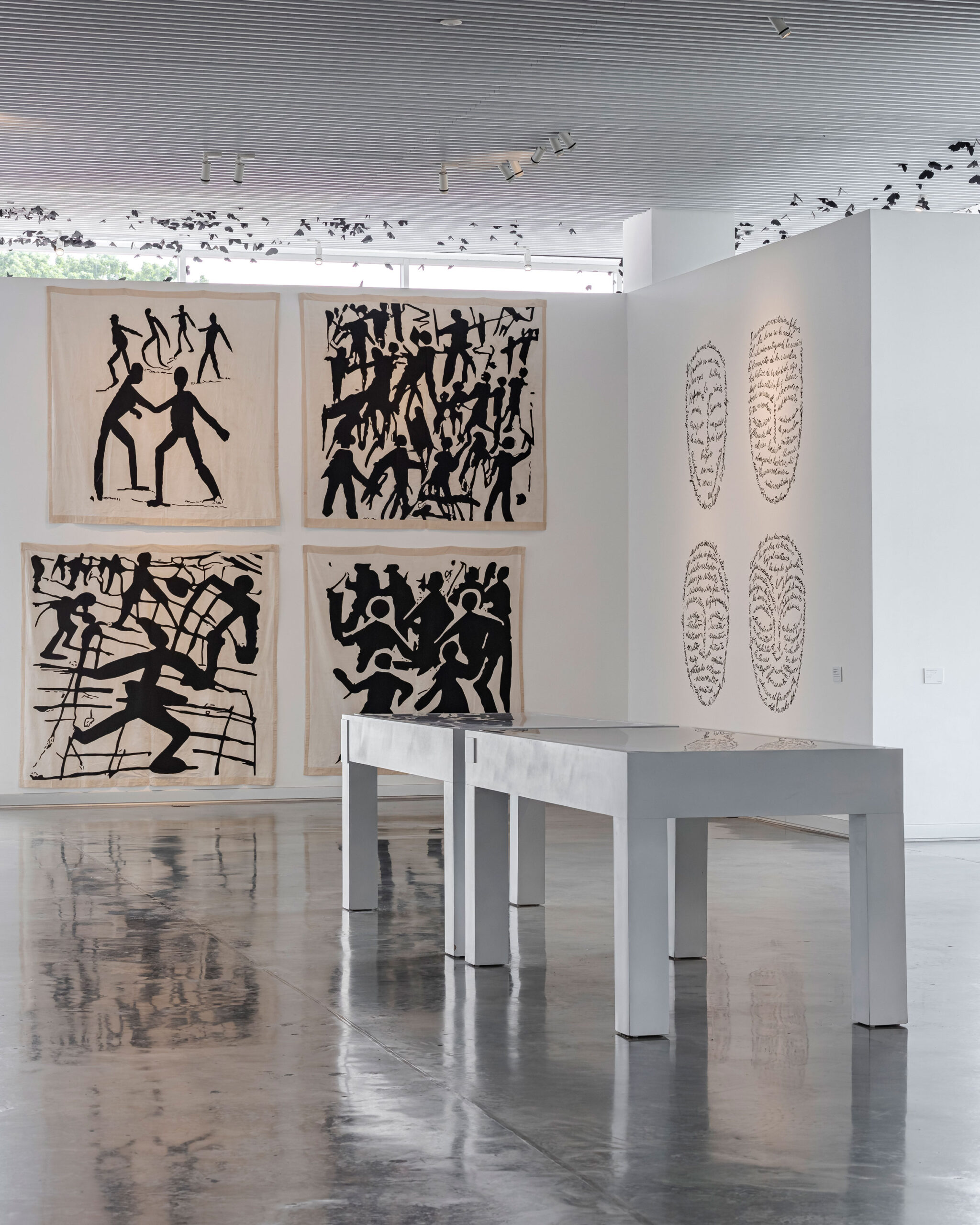
Several works in the exhibition make this tension evident. In Vagabundo en Francia y Bélgica [Vagabond in France and Belgium] (2011), the archive’s pictograms are organized as an editorial alphabet oscillating between image and writing. The viewer is confronted with signs that appear familiar yet simultaneously resist immediate legibility. Similarly, in La lengua de los muertos [The Language of the Dead] (2012), photographs of drug violence are integrated into an illegible narrative, akin to the aesthetic of the photo novel, in which the texts have been replaced by an invented graphic system.
In both cases, the artist does not seek to stabilize language, but rather to expose its fragility, since each recombination of signs introduces the possibility of a different reading, as though the archive were a territory in constant negotiation. Thus, rather than organizing the past, the Archivo líquido operates as a platform from which new ways of thinking about the present are produced.
Illegible Language and the Crisis of Meaning
One of the most visible constants in Carlos Amorales’s work is the creation of writing systems that challenge legibility. In this exhibition, pictograms, invented alphabets, and abstract calligraphies appear as attempts to expand—or even sabotage—the conventions of language. Far from being merely a formal gesture, illegibility functions as a critical strategy that exposes the insufficiency of existing systems of representation. When language fails, images begin to occupy its place; when images become ambiguous, meaning itself is suspended. Yet the works also pose a challenge to the symbolic imagination, as human beings attempt to fill the absence of meaning through their own experiences, personal codes of representation, and imaginaries.
This phenomenon becomes particularly evident in La lengua de los muertos, where a narrative constructed from photographs of drug violence is presented through an indecipherable alphabet. The viewer recognizes the presence of a narrative, yet cannot fully access it. The story remains concealed behind a surface of signs that allude to language without ever fully constituting it, while the viewer attempts to organize and interpret them through their own symbolic experience.
The operation is unsettling: violence appears, yet its symbolic translation becomes impossible. Rather than explaining or illustrating the brutality of the images, the artist introduces a linguistic barrier that prevents their immediate consumption. Illegibility thus functions as the artist’s maneuver against the media normalization of violence.
A similar operation takes place in Caligramas [Calligrams] (2026), where poetic texts are progressively transformed into gestural forms. As the text unfolds through space, its grammatical structure dissolves until it becomes a visual figure. Language ceases to function as an instrument of communication and instead becomes visual matter.
This displacement reveals a broader crisis: the contemporary difficulty of constructing stable meanings within an environment saturated with images and discourse. In a world where information circulates at great speed, the proliferation of signs does not necessarily guarantee greater understanding. On the contrary, it can generate a sensation of noise or semantic overload.
Before Carlos Amorales’s works, the viewer is confronted with a system of signs that resembles language while simultaneously resisting it. In this context, illegibility acquires an almost poetic dimension. By preventing immediate reading, it compels the viewer to remain longer before the work, to navigate it through intuition and imagination—which is, precisely, the great triumph of this body of work. In this way, the crisis of language is not presented as a failure, but rather articulated as an opportunity to imagine new forms of visual communication through the possibilities afforded by art. To some extent, the experience of moving through the exhibition recalls the linguistic games of Lewis Carroll in Through the Looking-Glass, where words shift in meaning and language becomes an unstable terrain that challenges ordinary rules of interpretation. Meaning is no longer passively received; it must be constructed through experience.
This tension between word and image also resonates with certain investigations of conceptual art, particularly with the work of Barbara Kruger, who demonstrated how language can radically alter the meaning of an image and expose the ideological structures that organize its reading. In Carlos Amorales’s case, this relationship becomes further radicalized: language ceases to function as a transparent system of communication and instead transforms into visual matter, into gesture, into a sign open to multiple interpretations.
Mourning, Copy, and Circulation
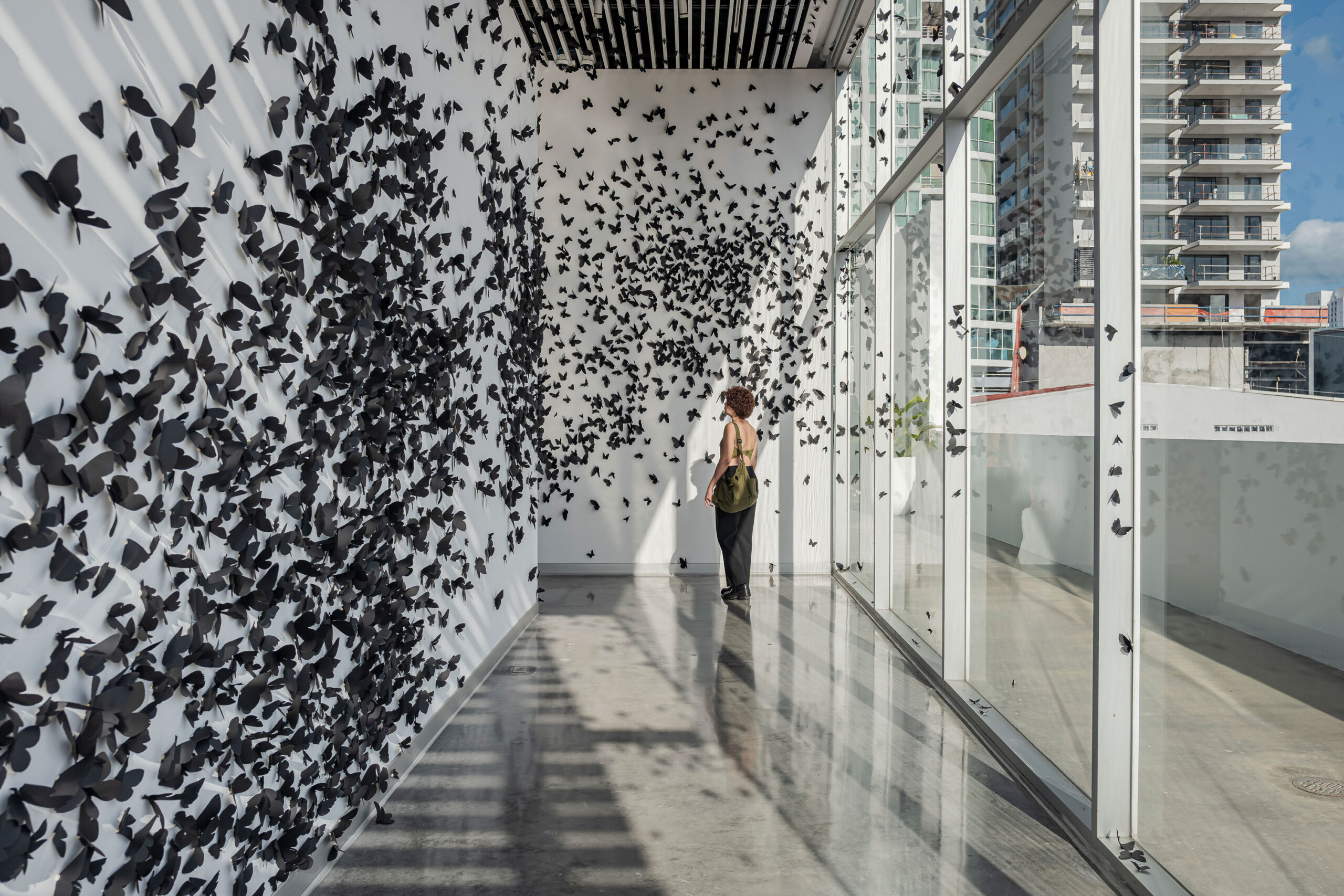
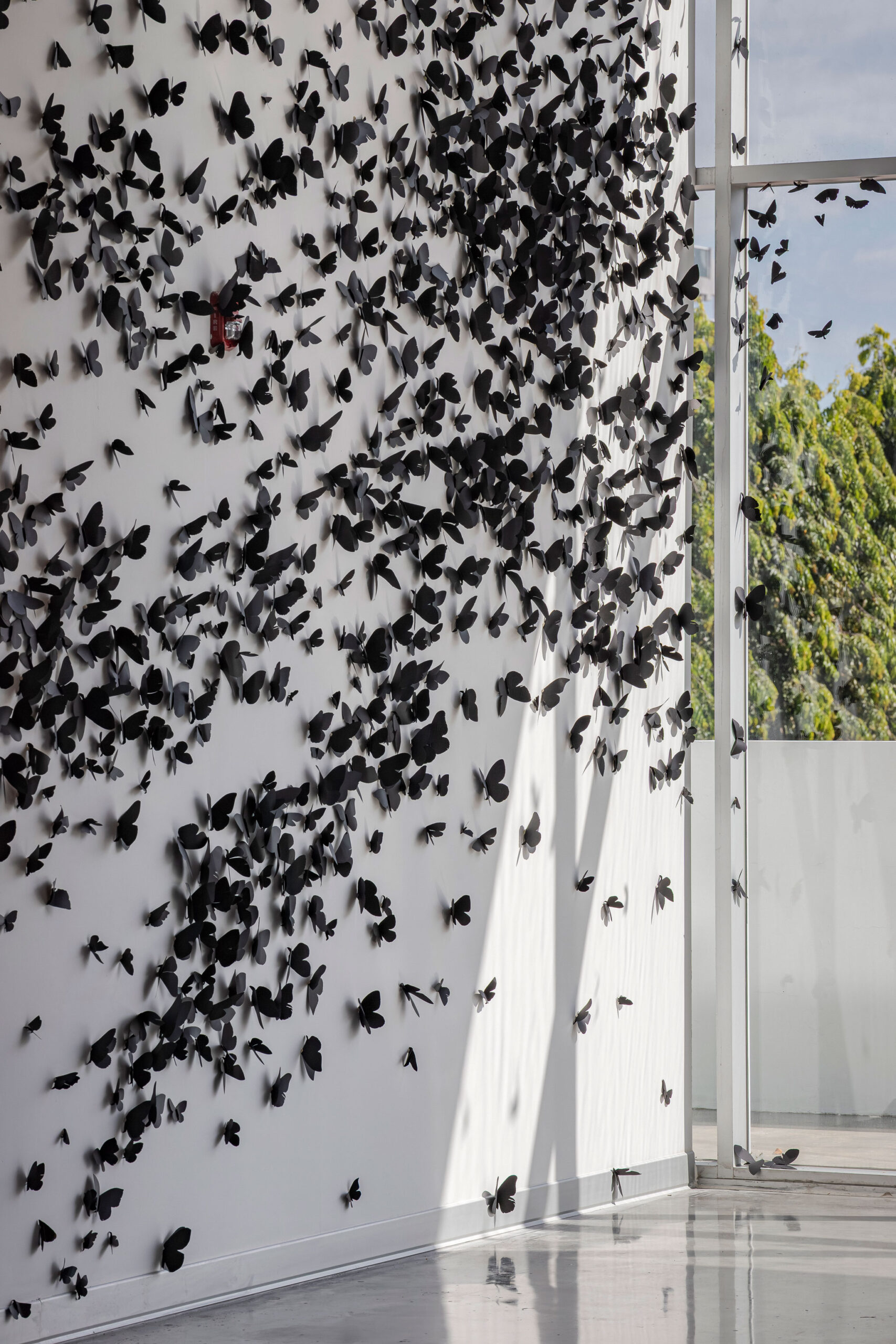
Among Carlos Amorales’s most emblematic works is Black Cloud (2007), an installation composed of thousands of black paper butterflies that invade the exhibition space as though they were a migration suspended in time. Although its presence is visually striking, the origin of the piece lies in the intimate gesture of a symbolic farewell dedicated to the artist’s grandmother.
Mourning thus becomes the point of departure for a work that, paradoxically, would eventually acquire an unexpected public life. Over time, the image of the butterflies began to be reproduced across different contexts: fashion designs, magazines, decorative objects, and other cultural products that reinterpreted or replicated the installation’s aesthetic. This process of dissemination raises a fundamental question about the nature of contemporary images: what happens when a work no longer belongs exclusively to its author and instead becomes part of the collective imaginary?
The circulation of Black Cloud reveals how images can detach themselves from their original context and acquire different meanings as they are replicated. What initially emerged as a reflection on memory and migration is transformed, in certain cases, into an ornamental motif or a reusable visual resource. Far from ignoring this phenomenon, the artist himself documents it in Black Cloud (Aftermath) (2007–2016), an editorial project that reconstructs the trajectory of the work and examines the multiple appropriations it has undergone, ranging from initial sketches to examples of its reproduction across different cultural contexts. Rather than denouncing these copies as mere acts of plagiarism, Carlos Amorales incorporates them into the very history of the work itself. Reproduction thus becomes yet another chapter in the creative process, where the distribution, circulation, and appropriation of images come to shape the life of the work. In this sense, the trajectory of Black Cloud may be read in light of Arthur Danto’s reflections in The Transfiguration of the Commonplace, where he argues that what distinguishes a work of art from an ordinary object is not its visible form, but the interpretive framework that surrounds it. When Carlos Amorales’s butterflies migrate from the exhibition space into other cultural circuits, their meaning is reconfigured, revealing how context actively participates in the construction of the work’s significance.
This gesture reveals a particular understanding of authorship within contemporary culture. At this point, Carlos Amorales’s work enters into dialogue with certain intuitions of John Baldessari, who demonstrated that the meaning of an image does not reside solely in its origin, but also in the contexts in which it reappears and is reinterpreted. In an era marked by the digital circulation of images, absolute control over the work becomes virtually impossible. Images travel, transform themselves, and acquire new functions as they pass through different contexts.
In this sense, Black Cloud may be understood as a metaphor for this constant movement. The butterflies that invade the museum’s architecture evoke not only biological migration, but also the migration of images within cultural space. The initial mourning does not disappear, but rather dissolves into a broader process of symbolic circulation. The work ceases to be solely a personal expression and instead becomes a collective phenomenon, open to multiple interpretations and appropriations.
Liquid Archive and Generative Systems
The idea of an archive capable of generating new combinations of signs acquires an additional dimension when placed in relation to contemporary image-generation technologies. In recent works such as Riots on the Moon (2025–2026), Carlos Amorales incorporates artificial intelligence tools that expand the possibilities of the Archivo líquido.
At first glance, this integration could be interpreted as a simple technical resource. However, there is a deeper conceptual affinity between the two systems. Both the artist’s archive and generative algorithms operate through processes of recombination: they take existing elements and reorganize them in order to produce unprecedented configurations.
The Archivo líquido anticipates, in some way, the logic of these systems. From its very inception, it has operated as a visual catalogue capable of being reused across diverse contexts. Each pictogram or silhouette can be transformed, duplicated, or mutated according to the needs of a specific work. Within this process, artificial intelligence introduces a new layer. By delegating part of the generation of images to algorithmic systems, Carlos Amorales expands the archive’s field of possibilities, allowing it to grow beyond direct human decisions.
Nevertheless, this relationship also raises critical questions. If the archive already functions as a generative system, what changes when machines intervene? Is this a natural continuity or a radical displacement of authorship? Rather than offering definitive answers, Carlos Amorales’s work keeps these questions open. The Archivo líquido thus reveals itself as an apparatus capable of entering into dialogue with new systems of visual production, demonstrating that the mutation of artistic language remains in constant process. At this point, Amorales’s work also resonates with contemporary reflections such as those proposed by Hito Steyerl, who has argued that within digital culture images become increasingly difficult to contain within a single framework of control or interpretation. The exhibition Rapsodias may be understood as yet another instance of this process: a space where fragments of the archive are recombined and where visual language continues to expand in new directions.
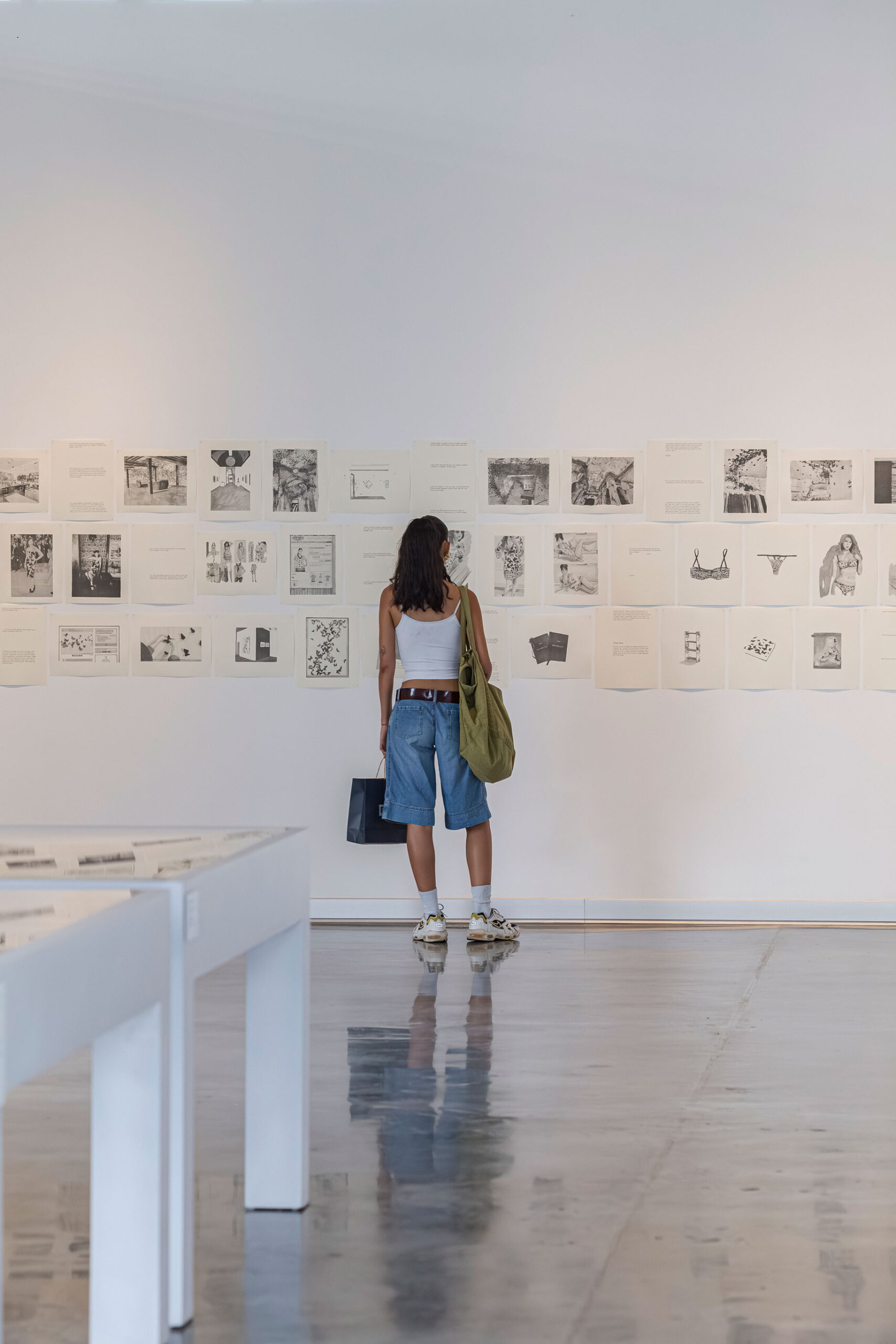
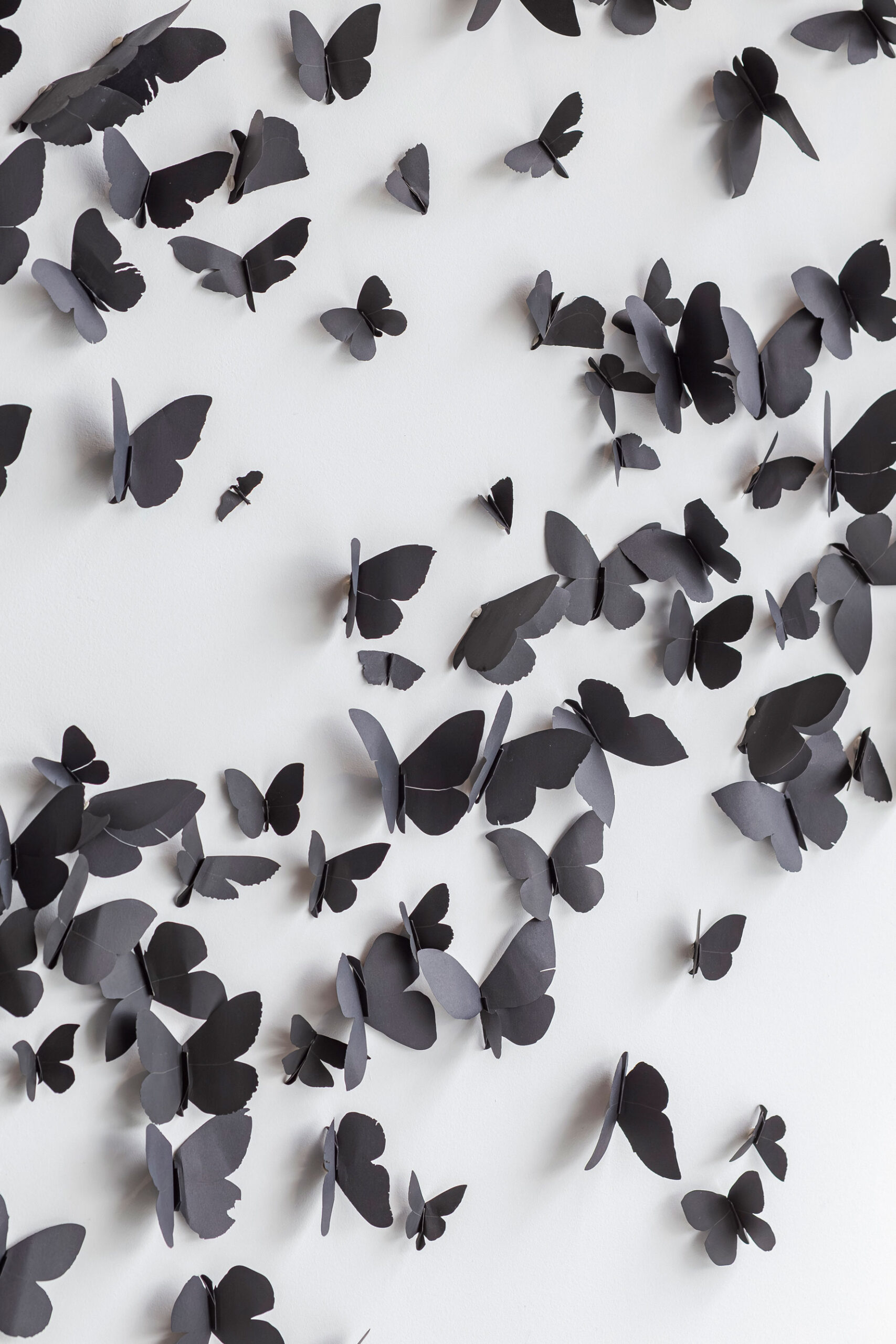
Vista de la exposición, fotografía Alfredo J. Martiz, cortesía de Centro Espacio Arte, 2026. / Exhibition view, photograph by Alfredo J. Martiz, courtesy of Centro Espacio Arte, 2026.
The exhibition Rapsodias [Rhapsodies] by Carlos Amorales (Mexico), curated by Leonardo González (Honduras), unfolds as a space where different forms of language — visual, textual, and corporeal — intertwine, contaminate one another, and mutually transform.The term rhapsody is particularly fitting here; much like in the musical or literary tradition, the exhibition is structured as a sequence of fragments that, while belonging to the same artistic universe, acquire new nuances through their juxtaposition.
At the center of this apparatus lies Archivo líquido [Liquid Archive], a visual system initiated by the artist in the late 1990s that operates as a reservoir of signs, images, and figures in constant mutation. This archive does not function as a static repository, but rather as a generative mechanism that allows elements to be recombined and new visual narratives to emerge. The works presented in the exhibition—installations, animations, and pictograms—can be understood as episodes within this ongoing process. Yet beyond the formal diversity, the exhibition as a whole raises a series of deeper questions: what happens when language becomes unstable? And what happens when images, once released, begin to circulate beyond the control of their author?
The Archive as a Living Organism
The concept of the archive is often associated with the preservation of the past: a space where documents and images are arranged in order to guarantee their permanence. In Carlos Amorales’s work, however, the archive operates differently. The Archivo líquido is not an immovable repository, but rather a dynamic system that continuously reorganizes its own components. Its elements—butterflies, masks, animals, pictograms, human silhouettes—function as visual units that can be transformed, reconfigured, or translated across different media.
In this sense, the archive behaves like a living organism, in constant mutation. Its signs move across disciplines and mediums: from drawing to book, from book to animation, from installation to performance or sound. This mobility generates a form of media contamination in which the boundaries between artistic languages become porous. A pictogram can become a letter, a letter a choreography, a silhouette a digital form.
This logic recalls, to some extent, historian Aby Warburg’s project and his Mnemosyne Atlas, in which images were organized into constellations that revealed their displacements throughout cultural history. Rather than a static inventory, the atlas proposed understanding the archive as a “field of forces” where images migrate, survive, and acquire new meanings according to the context in which they reappear.
Vista de la exposición, fotografía Alfredo J. Martiz, cortesía de Centro Espacio Arte, 2026. / Exhibition view, photograph by Alfredo J. Martiz, courtesy of Centro Espacio Arte, 2026.
That same logic, that of the archive as a “field of forces,” underlies the Archivo líquido proposed by Carlos Amorales and may be understood as the logical consequence of what Warburg intuited, though reformulated in an era in which technology has shifted the archive toward the realm of the immaterial and the digital circulation of images. This discourse of mutation also entails a political dimension. Archiving is never a neutral gesture, since it implies selecting, classifying, and assigning value to certain images while others remain excluded. By developing his own visual system, Amorales constructs an alternative symbolic field from which the ways in which codes of representation can be conceived and articulated are reconsidered.
Several works in the exhibition make this tension evident. In Vagabundo en Francia y Bélgica [Vagabond in France and Belgium] (2011), the archive’s pictograms are organized as an editorial alphabet oscillating between image and writing. The viewer is confronted with signs that appear familiar yet simultaneously resist immediate legibility. Similarly, in La lengua de los muertos [The Language of the Dead] (2012), photographs of drug violence are integrated into an illegible narrative, akin to the aesthetic of the photo novel, in which the texts have been replaced by an invented graphic system.
In both cases, the artist does not seek to stabilize language, but rather to expose its fragility, since each recombination of signs introduces the possibility of a different reading, as though the archive were a territory in constant negotiation. Thus, rather than organizing the past, the Archivo líquido operates as a platform from which new ways of thinking about the present are produced.
Illegible Language and the Crisis of Meaning
One of the most visible constants in Carlos Amorales’s work is the creation of writing systems that challenge legibility. In this exhibition, pictograms, invented alphabets, and abstract calligraphies appear as attempts to expand—or even sabotage—the conventions of language. Far from being merely a formal gesture, illegibility functions as a critical strategy that exposes the insufficiency of existing systems of representation. When language fails, images begin to occupy its place; when images become ambiguous, meaning itself is suspended. Yet the works also pose a challenge to the symbolic imagination, as human beings attempt to fill the absence of meaning through their own experiences, personal codes of representation, and imaginaries.
This phenomenon becomes particularly evident in La lengua de los muertos, where a narrative constructed from photographs of drug violence is presented through an indecipherable alphabet. The viewer recognizes the presence of a narrative, yet cannot fully access it. The story remains concealed behind a surface of signs that allude to language without ever fully constituting it, while the viewer attempts to organize and interpret them through their own symbolic experience.
The operation is unsettling: violence appears, yet its symbolic translation becomes impossible. Rather than explaining or illustrating the brutality of the images, the artist introduces a linguistic barrier that prevents their immediate consumption. Illegibility thus functions as the artist’s maneuver against the media normalization of violence.
A similar operation takes place in Caligramas [Calligrams] (2026), where poetic texts are progressively transformed into gestural forms. As the text unfolds through space, its grammatical structure dissolves until it becomes a visual figure. Language ceases to function as an instrument of communication and instead becomes visual matter.
Vista de la exposición, fotografía Alfredo J. Martiz, cortesía de Centro Espacio Arte, 2026.
This displacement reveals a broader crisis: the contemporary difficulty of constructing stable meanings within an environment saturated with images and discourse. In a world where information circulates at great speed, the proliferation of signs does not necessarily guarantee greater understanding. On the contrary, it can generate a sensation of noise or semantic overload.
Before Carlos Amorales’s works, the viewer is confronted with a system of signs that resembles language while simultaneously resisting it. In this context, illegibility acquires an almost poetic dimension. By preventing immediate reading, it compels the viewer to remain longer before the work, to navigate it through intuition and imagination—which is, precisely, the great triumph of this body of work. In this way, the crisis of language is not presented as a failure, but rather articulated as an opportunity to imagine new forms of visual communication through the possibilities afforded by art. To some extent, the experience of moving through the exhibition recalls the linguistic games of Lewis Carroll in Through the Looking-Glass, where words shift in meaning and language becomes an unstable terrain that challenges ordinary rules of interpretation. Meaning is no longer passively received; it must be constructed through experience.
This tension between word and image also resonates with certain investigations of conceptual art, particularly with the work of Barbara Kruger, who demonstrated how language can radically alter the meaning of an image and expose the ideological structures that organize its reading. In Carlos Amorales’s case, this relationship becomes further radicalized: language ceases to function as a transparent system of communication and instead transforms into visual matter, into gesture, into a sign open to multiple interpretations.
Mourning, Copy, and Circulation
Among Carlos Amorales’s most emblematic works is Black Cloud (2007), an installation composed of thousands of black paper butterflies that invade the exhibition space as though they were a migration suspended in time. Although its presence is visually striking, the origin of the piece lies in the intimate gesture of a symbolic farewell dedicated to the artist’s grandmother.
Mourning thus becomes the point of departure for a work that, paradoxically, would eventually acquire an unexpected public life. Over time, the image of the butterflies began to be reproduced across different contexts: fashion designs, magazines, decorative objects, and other cultural products that reinterpreted or replicated the installation’s aesthetic. This process of dissemination raises a fundamental question about the nature of contemporary images: what happens when a work no longer belongs exclusively to its author and instead becomes part of the collective imaginary?
The circulation of Black Cloud reveals how images can detach themselves from their original context and acquire different meanings as they are replicated. What initially emerged as a reflection on memory and migration is transformed, in certain cases, into an ornamental motif or a reusable visual resource. Far from ignoring this phenomenon, the artist himself documents it in Black Cloud (Aftermath) (2007–2016), an editorial project that reconstructs the trajectory of the work and examines the multiple appropriations it has undergone, ranging from initial sketches to examples of its reproduction across different cultural contexts. Rather than denouncing these copies as mere acts of plagiarism, Carlos Amorales incorporates them into the very history of the work itself. Reproduction thus becomes yet another chapter in the creative process, where the distribution, circulation, and appropriation of images come to shape the life of the work. In this sense, the trajectory of Black Cloud may be read in light of Arthur Danto’s reflections in The Transfiguration of the Commonplace, where he argues that what distinguishes a work of art from an ordinary object is not its visible form, but the interpretive framework that surrounds it. When Carlos Amorales’s butterflies migrate from the exhibition space into other cultural circuits, their meaning is reconfigured, revealing how context actively participates in the construction of the work’s significance.
Vista de la exposición, fotografía Alfredo J. Martiz, cortesía de Centro Espacio Arte, 2026. / Exhibition view, photograph by Alfredo J. Martiz, courtesy of Centro Espacio Arte, 2026.
This gesture reveals a particular understanding of authorship within contemporary culture. At this point, Carlos Amorales’s work enters into dialogue with certain intuitions of John Baldessari, who demonstrated that the meaning of an image does not reside solely in its origin, but also in the contexts in which it reappears and is reinterpreted. In an era marked by the digital circulation of images, absolute control over the work becomes virtually impossible. Images travel, transform themselves, and acquire new functions as they pass through different contexts.
In this sense, Black Cloud may be understood as a metaphor for this constant movement. The butterflies that invade the museum’s architecture evoke not only biological migration, but also the migration of images within cultural space. The initial mourning does not disappear, but rather dissolves into a broader process of symbolic circulation. The work ceases to be solely a personal expression and instead becomes a collective phenomenon, open to multiple interpretations and appropriations.
Liquid Archive and Generative Systems
The idea of an archive capable of generating new combinations of signs acquires an additional dimension when placed in relation to contemporary image-generation technologies. In recent works such as Riots on the Moon (2025–2026), Carlos Amorales incorporates artificial intelligence tools that expand the possibilities of the Archivo líquido.
At first glance, this integration could be interpreted as a simple technical resource. However, there is a deeper conceptual affinity between the two systems. Both the artist’s archive and generative algorithms operate through processes of recombination: they take existing elements and reorganize them in order to produce unprecedented configurations.
The Archivo líquido anticipates, in some way, the logic of these systems. From its very inception, it has operated as a visual catalogue capable of being reused across diverse contexts. Each pictogram or silhouette can be transformed, duplicated, or mutated according to the needs of a specific work. Within this process, artificial intelligence introduces a new layer. By delegating part of the generation of images to algorithmic systems, Carlos Amorales expands the archive’s field of possibilities, allowing it to grow beyond direct human decisions.
Nevertheless, this relationship also raises critical questions. If the archive already functions as a generative system, what changes when machines intervene? Is this a natural continuity or a radical displacement of authorship? Rather than offering definitive answers, Carlos Amorales’s work keeps these questions open. The Archivo líquido thus reveals itself as an apparatus capable of entering into dialogue with new systems of visual production, demonstrating that the mutation of artistic language remains in constant process. At this point, Amorales’s work also resonates with contemporary reflections such as those proposed by Hito Steyerl, who has argued that within digital culture images become increasingly difficult to contain within a single framework of control or interpretation. The exhibition Rapsodias may be understood as yet another instance of this process: a space where fragments of the archive are recombined and where visual language continues to expand in new directions.
Vista de la exposición, fotografía Alfredo J. Martiz, cortesía de Centro Espacio Arte, 2026. / Exhibition view, photograph by Alfredo J. Martiz, courtesy of Centro Espacio Arte, 2026.