What does it mean today to conjugate the idea of humanity? The 36th São Paulo Biennial sought to articulate this question through beauty, ritual, music, and architecture, but also through frictions, ambiguities, and conceptual disputes. Art critic Tatiane de Assis proposes a profound exercise in reflection amid the banalization of criticism, the commodification of opinion, and identity performance.
If you spend some time at the 36th edition of the São Paulo Biennial, you may feel that the exhibition is trying to draw you in from the very first moment. Acting as masters of ceremony, the artworks by Precious Okoyomon and Gê Viana take you by the hand in a surprising movement—through trees, collages, and music. By the end of this opening act, you might feel an unexpected sensation: a blend of welcome, enchantment, and a hint of melancholy.
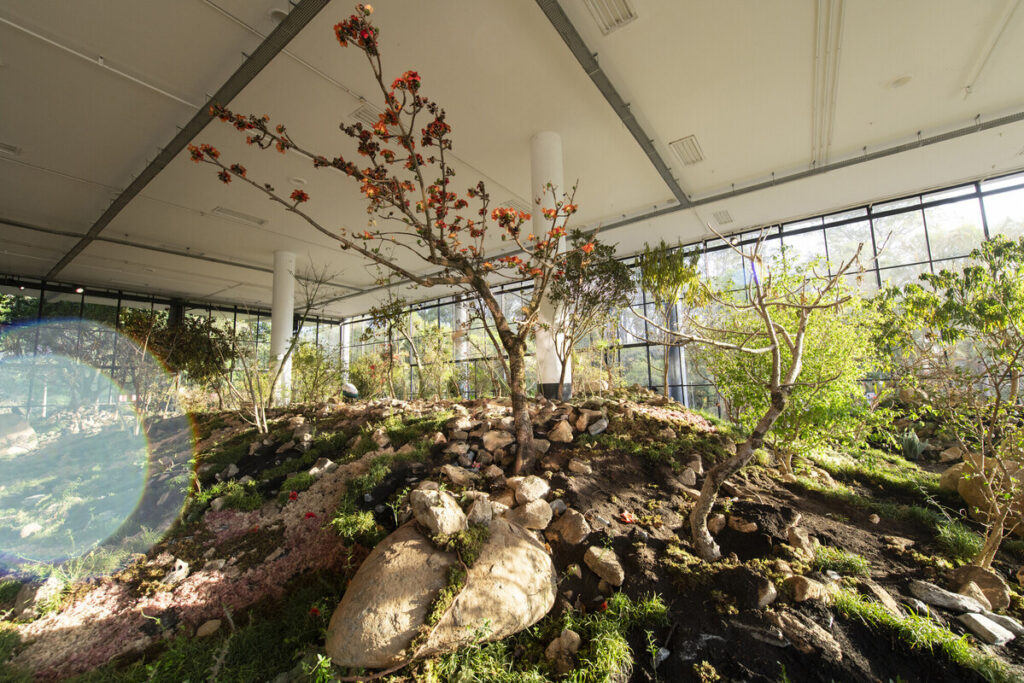
According to the curatorial text, Sun of Consciousness. God Blow Thru Me – Love Break Me (2025), Okoyomon’s installation, engages in a dialogue with the Brazilian biome known as the Cerrado by evoking its symbiotic and unpredictable relations born from multiple encounters. The artwork also invites us to imagine collective spaces for rest, and to sense how such gestures might shape the audience’s experience within the exhibition.
The list of curatorial intentions is not fully achieved. Okoyomon’s installation remains ambiguous. On the one hand, it certainly establishes a new rhythm for walking and contemplation. At the end of the path, one might sense a certain serenity. In fact, during one of my visits, a little girl bent down and gazed into the water. I wondered what she was thinking, or what she saw.
Other feelings, however, also emerge. The installation may feel a bit strange. Although there is soil (but not the red kind, native to the Cerrado), mango and Surinam cherry trees, and a small lake, the glass windows of the building surrounding the installation, overlooking the real trees in Ibirapuera Park, convey a sense of detachment from nature. With its vapor jets, the work resembles an alien island, or a displaced garden, transplanted inside the Biennial pavilion. This encounter between modern architect and the Cerrado may even evoke Brasília, the federal capital imposed upon the Planalto Central’s nature and people. And if one allows another association, the same thought comes to mind when we see, on the same level, an adobe curved wall—part of the installation by the group Sertão Negro—contrasting with the modernist volume that shapes the Biennial building.
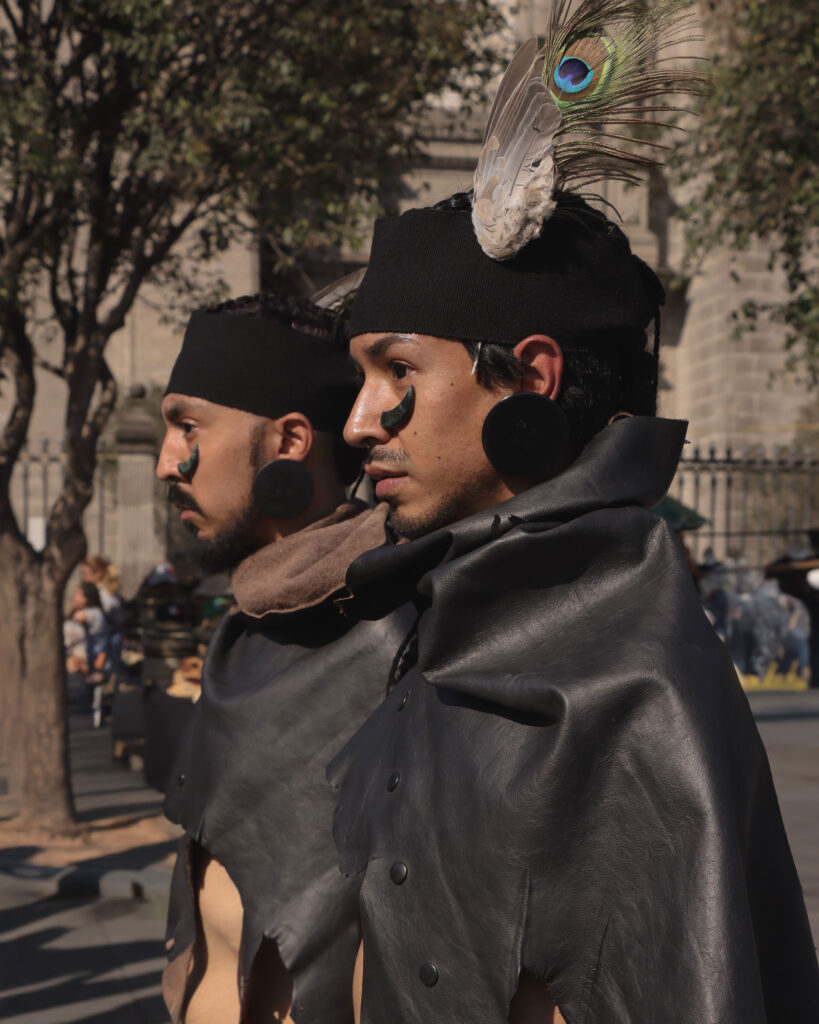
Still within the exhibition’s opening gesture, it is worth discussing Battle of Cam by Gê Viana. The music from the sound system enveloped people, while the collages drew on news reports about the prohibition of reggae maranhense, a musical style born of the African diaspora, and the tambores do terreiro, a cultural manifestation rooted in the traditions of enslaved Black people. A flow that begins in blood and death, yet turns into music, art, architecture, and adornment—as recalled by thinkers Paul Gilroy and Anne Lafont. And if the conjunction of resistance and celebration seems strange, one can turn to the exhibition’s chief curator, the Berlin-based Cameroonian Bonaventure Soh Bejeng Ndikung, who, in his book The Delusions of Care, writes: “To counterattack is to have hope, and to have hope is to be capable of reacting.”
It’s curious that Viana’s work also evokes an altar composed of small lights reminiscent of candles—a space marked between the front-stage sculpture and the sound system, made for a ceremony that is, in this case, dancing. The motto of this terreiro is written in small letters between the sound speakers. Few people noticed it, since it’s written in Fon, the language used in ceremonies of Tambor de Mina, an Afro-Brazilian religion. But if you ask the artist, she’ll tell you it reads as: “When the sound comes to kiss the sea.”
After the last decade of intense debate in Brazil about race in the visual arts, it seems abrupt that the curatorial team chose “conjugating humanity” as a guide for the collective show, because the term “humanity” has frequently served to justify universalism, among other purposes.
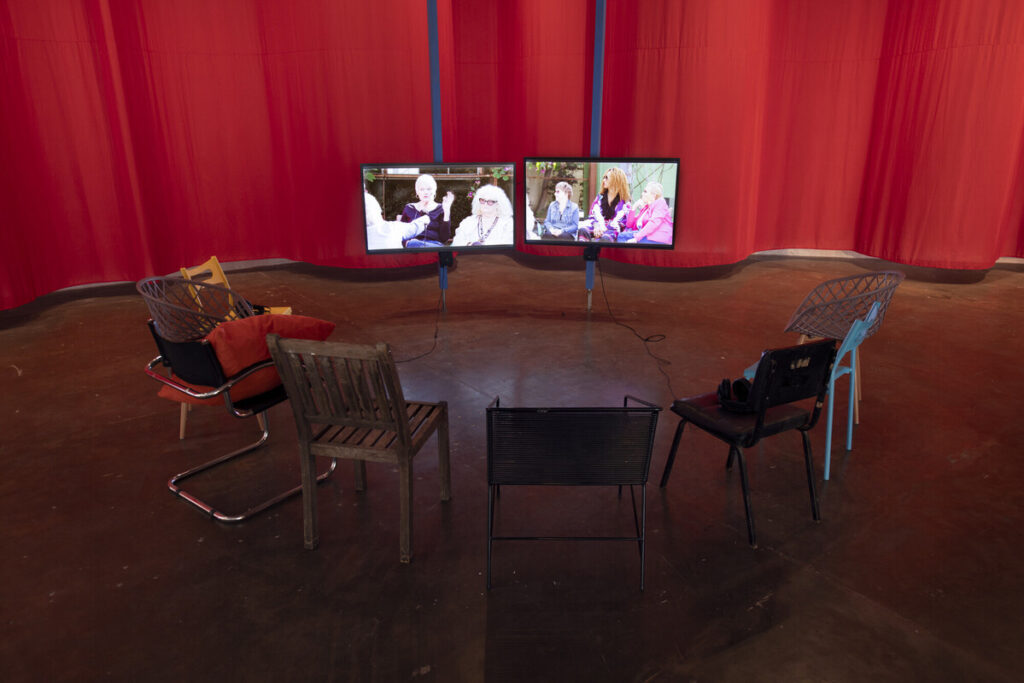
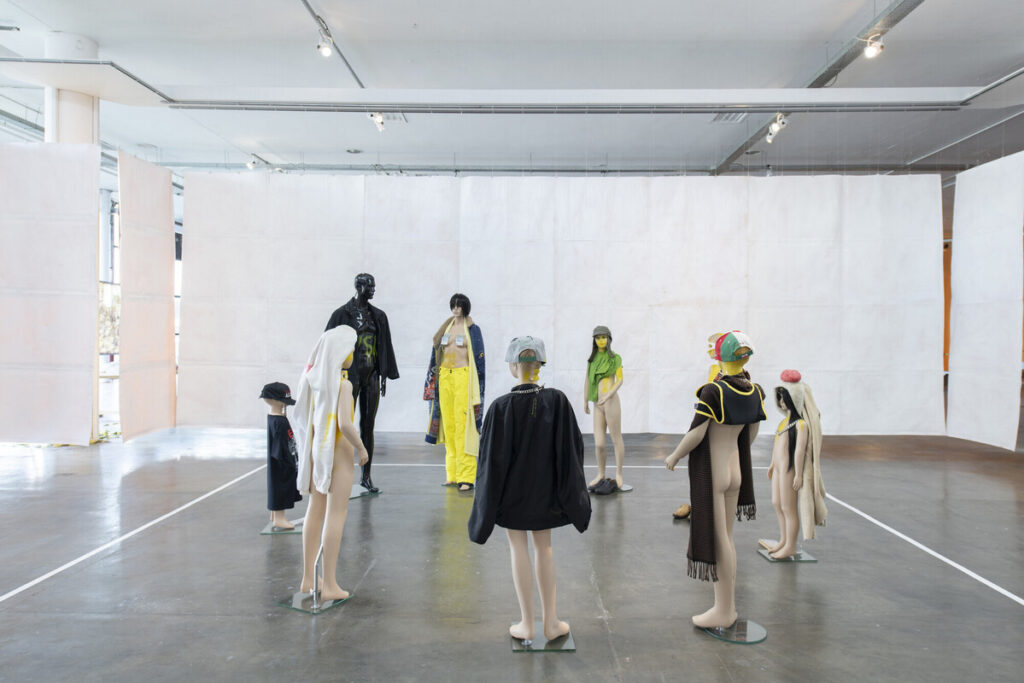
The closest I’ve come to understanding this proposal is through an extraordinary series of videos titled Richerche by Sharon Heyes, in which the stereotypes are dismantled as a network of shared feelings emerges, thus shuffling the social markers.
Heyes’s works, like Frank Bowling’s, appear at various points in the exhibition, forming a kind of recurring movement in a musical composition. That they evoke both the question of humanity and the discussions arising from decoloniality is a way of not giving in to a universalization of humanity, restricted to white Western experience.
Another hypothesis to help discuss the curatorial proposal is that, while detractors—such as the art market or even sympathetic critics—expected Black figurative painting to dominate both the last and the current biennials, Black curators have chosen, through both will and strategy, to follow other paths instead. Although these curators have not made this explicit, to me this is one of the driving forces behind the shift: an effort to alter the terms by which Black artists are recognized and claimed, and thus, to engage with the very question of humanity itself. Why is it that some can be multiple, and others cannot?
It is therefore striking that this edition takes “beauty” as its fundamental principle—a statement the chief curator makes in the sixth and final chapter of the exhibition: beauty as resistance and as a tool to discuss and bring people together around the themes addressed in the exhibition.
Accordingly, the audience may not fully grasp the meaning of the gameleira tree in Afro-Brazilian religions, and yet they are drawn to its form made of strands of yellow beads cascading softly. They may also overlook the significance of the gourd, but they can sense the weight of this golden object—and the quiet care with which it is passed from bird-woman to bird-woman in Nádia Taquary’s work. Interestingly, the sculptures here play a similar role to controversial monuments that tell stories, except for this time it’s not about Western hegemony but Yoruba culture.
Laurie Provost’s flower evokes a similar feeling by showing that beauty and wonder can be tools of connection, a way to start a conversation. The first reaction is an “ohh,” followed by the questions: “What are those spheres inside?” and “Are they real plants?” At this point, both the fabric and the flower’s movement matter, but so does its scale—a strategy Ndikung also used to interact with Oscar Niemeyer’s intimidating architecture. In this edition, a logic of vertical occupation of the pavilion seems to have been used: it can also be seen in the works of Ana Raylander Mártir dos Anjos, Tanka Fonta (on the column wrapped around the ramp), and Otobong Nkanga, who marks each level with her tapestries.
A group of three works located on the second floor could also be added to this discussion of beauty, even though the chapter there is titled “Flows of Care and Plural Cosmologies.”
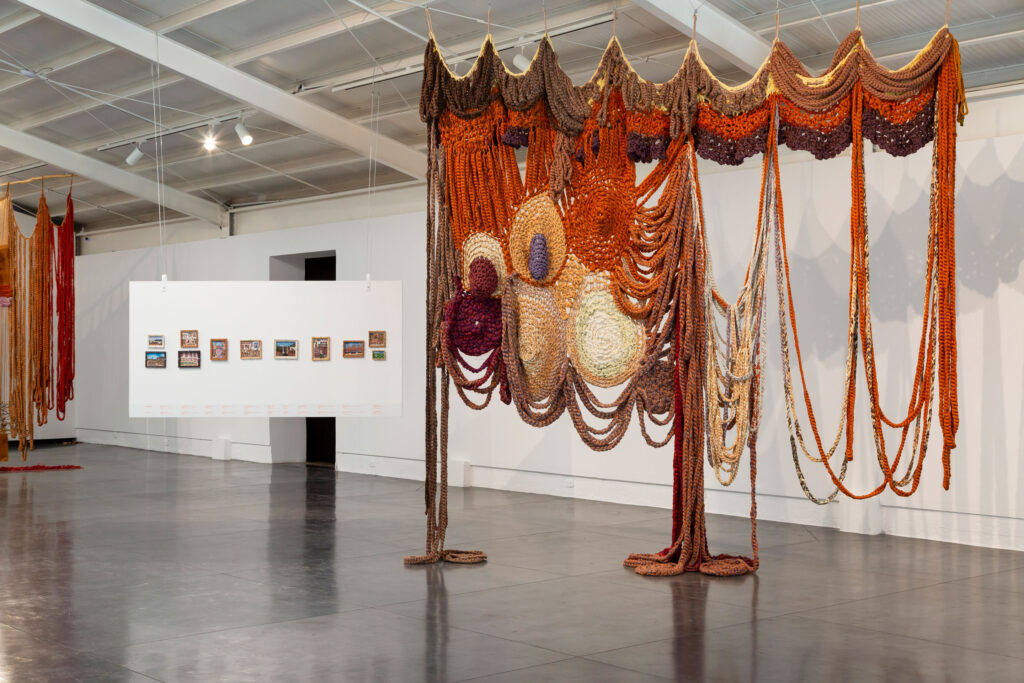
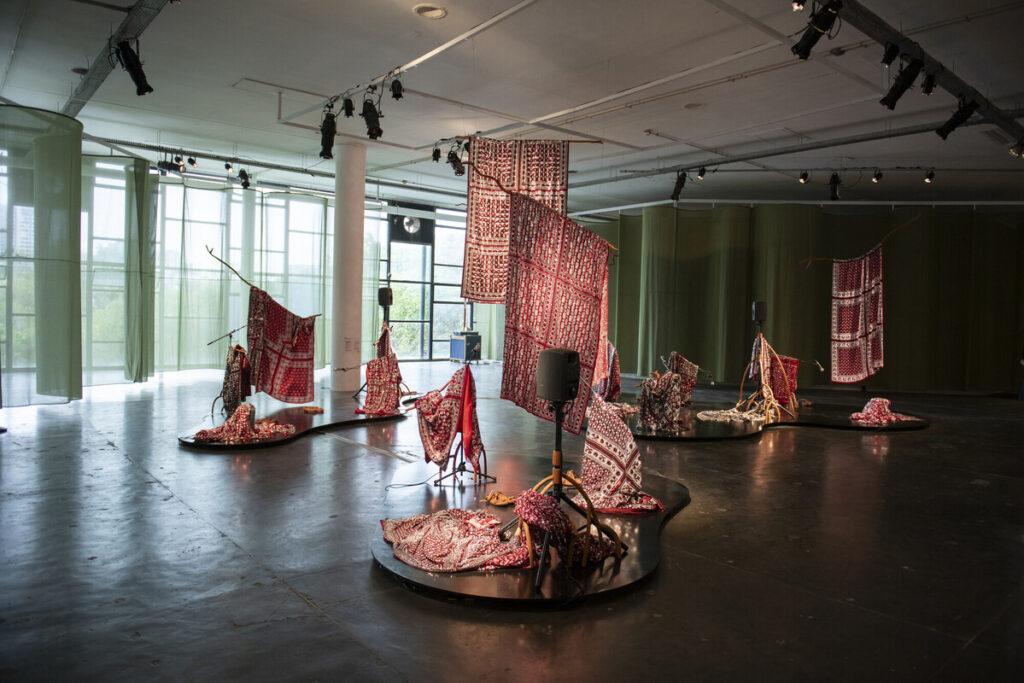
A decade ago, Miriam Omar Awad’s installation, The Smell of Earth After Fire and the Promise of Breaths: For the Obsession With Resonance Spreading Tenderly Our Skin/ Our Bodies O/ From the Incandescent Warmth of the Ashes, might have appeared in an anthropological group exhibition, given the fact that shiromani, traditional Comorian textiles, are ritualistic objects. But Awad subverts this interpretation of non-white art by constructing a complex in which beauty and brilliance are fundamental. Before you can form any mental connection, the shiny pieces hanging from the ceiling captivate you visually with their exuberant geometric compositions. Then, microphones are activated, and you realize there’s a conversation going on: through the fabrics, voices, and spatial arrangement, Awad reconstructs a kind of scene that alludes to Debe, a ritual tradition performed by women to resolve conflicts in the Comoros Islands, off the east coast of the African continent.
Along with Awad’s installation, Juliana dos Santos’s work deserves to be displayed in a larger space or one that allows the ensemble to be viewed more openly. The same applies to Lídia Lisboa’s work, which is located nearby.
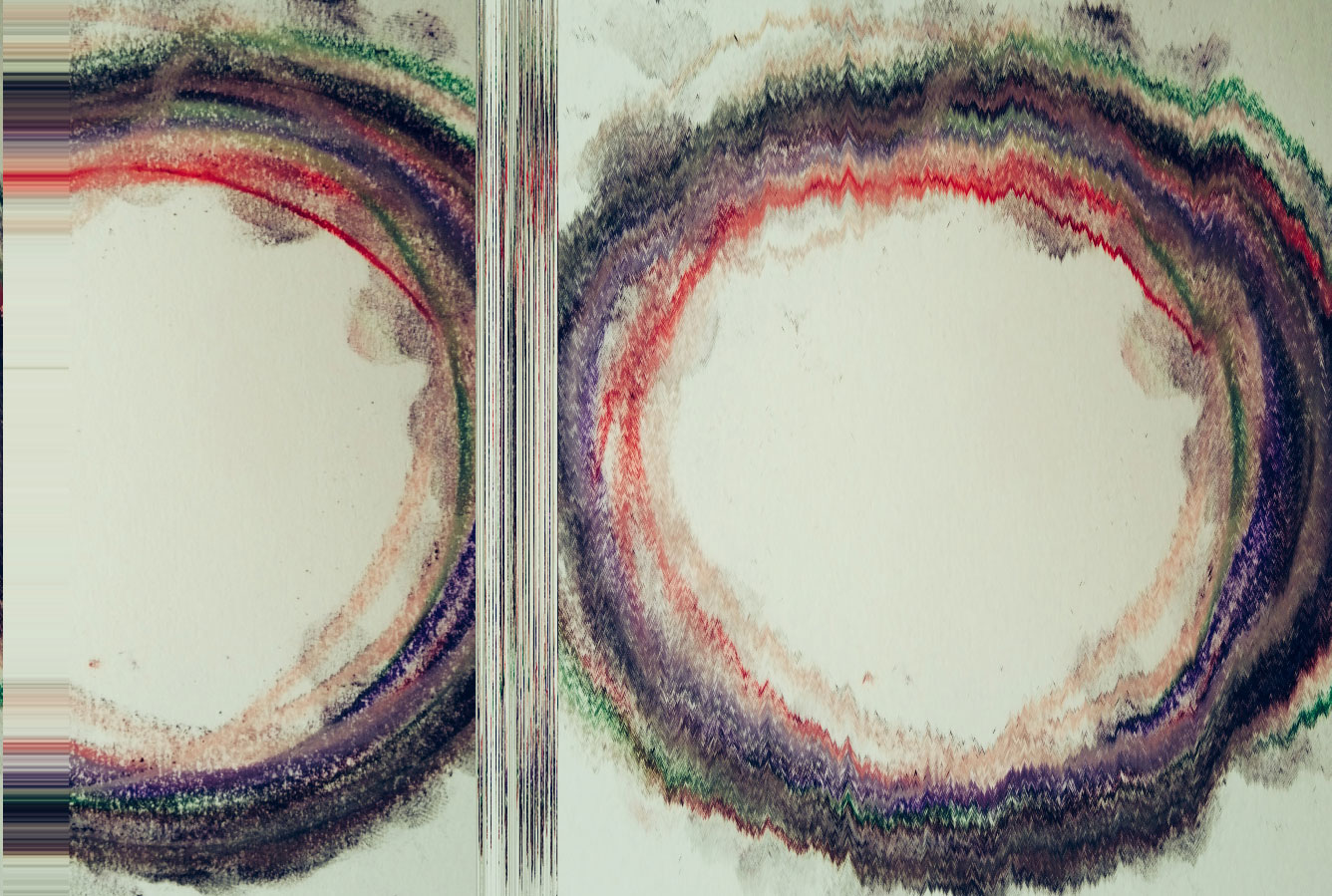
Despite the boom in figurative art, Dos Santos remains committed to her artistic research, which began with an exploration of the color blue in a solo show at Paço das Artes, titled “Entre o azul e o que não me deixo/deixam esquecer” and later evolved through her work with the Clitoria ternatea flower, a plant her grandmother once cultivated—and with which the artist has grown intimately close.
When she involves her grandmother—and later we learn that her mother also participates in the making of the work—we have an important element to understand Dos Santos’s practice, which is related to collective gestures and educational experiences. In her large-sized watercolors, the unpredictable flow created by the gesture of brushing the canvas and blowing the pigment drawn from the flower—without knowing how far the color will travel—forms spiral-like landscapes that captivate both from a distance and up close. In this sense, beauty connects to care, turning the artist’s large watercolor panels into a kind of meditation.
Lidia Lisboa’s works, by contrast, are the opposite. Beauty arises from the juxtaposition of colors, perforated points, and the extensions of her sculptures—which she calls tetas [breasts]. And, once again, through beauty, the notion of art is expanded.
Beyond the works themselves, there was intense discussion surrounding the labels in the exhibition design, which were not placed immediately close to the artworks.
I understand this gesture, which recurs in Ndikung’s exhibitions in Germany. However, in the Brazilian context, it felt more like noise—perhaps because many of the artists on display are not widely known to the Brazilian audience and also because in recent years, Brazilian museums have introduced explanatory labels. However, I do not see it as an authoritarian gesture, only an experimental one, which approaches curating like a jam session, seeking a coexistence of sounds and artworks without too many directions. Later, the labels have been placed near the works.
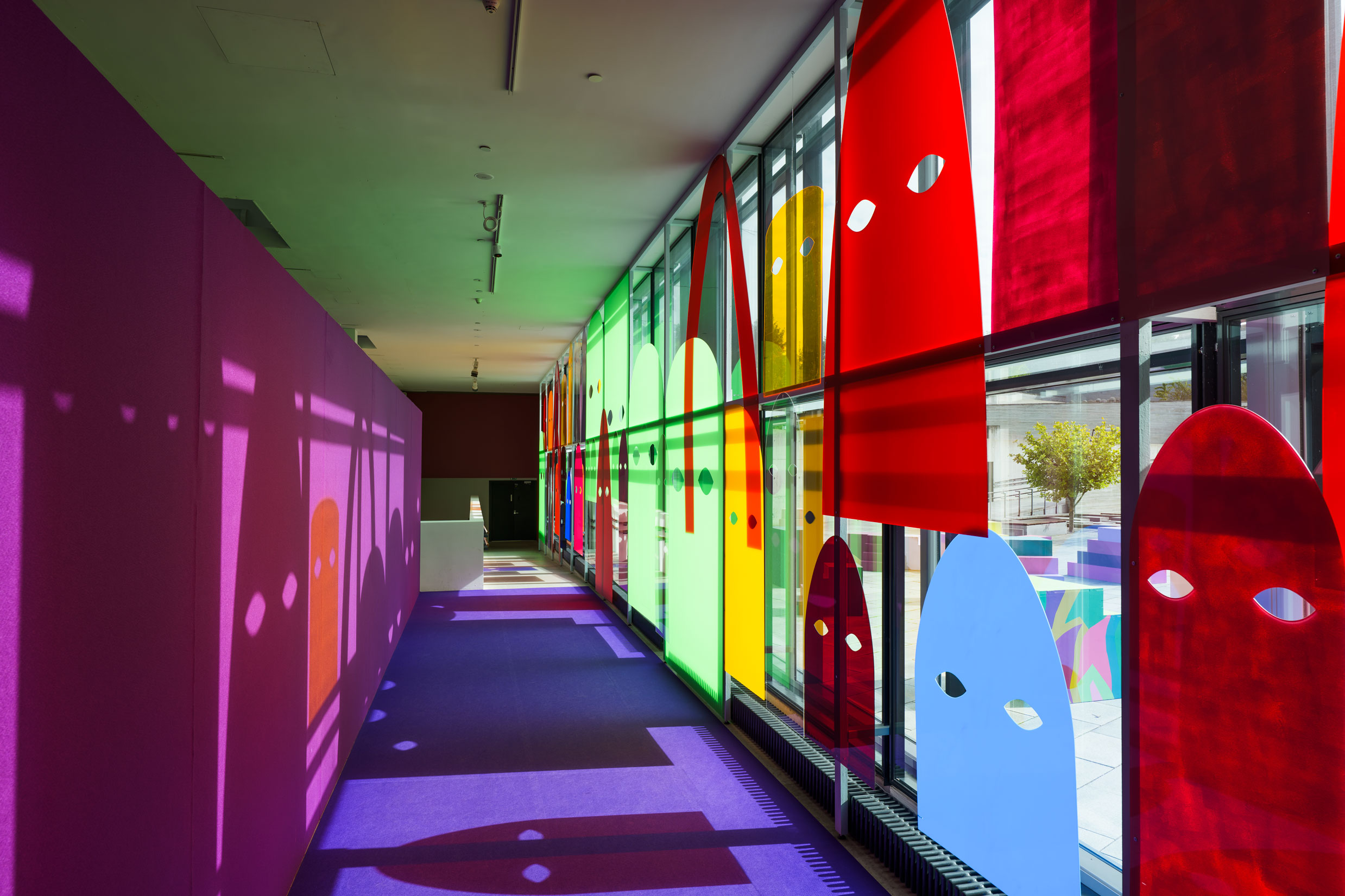
Regarding the colors used in the exhibition layout, it may sound controversial, but the strategy works even alongside the striking paintings of Márcia Falcão. Yet, when considering Rebeca Carapiá’s sculptures unfold with their shadows, reaching in every direction, unfortunately the mustard curtain almost conceals the pieces. The same does not occur with the diaphanous green fabric, which only hints at the Gervane de Paula’s creatures.
It is also worth noting that the public program gives the exhibition a different character. In one of my visits, there was a congada, and a crowd moved among the works, activating them in new ways. In this sense, it seems that the collective show is conceived as an event that goes beyond the mere exhibition of the artworks, which is why it functions differently when filled with people.
Finally, an unexpected encounter between the works of Maxwell Alexandre and Isa Genkhen closes this analysis (ok, Genkhen took part in the São Paulo Biennial with a similar set of works, yet I still appreciate this gesture).
Placing the two artists side by side becomes a provocation on multiple levels. Even though Alexandre’s works are made on brown paper, they possess a certain elegance even when the artist criticizes the white cube. Genkhen’s work goes in the opposite direction of Alexandre’s: it creates aversion. You look at it and think, “I can’t believe she did that.” She does not operate with the idea of beauty, charm, or the notion of “well-made.” She challenges it.
And so, with a laugh of disbelief and the sense that there are countless ways to subvert conventions—especially when it comes to underrepresented groups still too often read monolithically—this 36th Biennial will stick with me.
If you spend some time at the 36th edition of the São Paulo Biennial, you may feel that the exhibition is trying to draw you in from the very first moment. Acting as masters of ceremony, the artworks by Precious Okoyomon and Gê Viana take you by the hand in a surprising movement—through trees, collages, and music. By the end of this opening act, you might feel an unexpected sensation: a blend of welcome, enchantment, and a hint of melancholy.
According to the curatorial text, Sun of Consciousness. God Blow Thru Me – Love Break Me (2025), Okoyomon’s installation, engages in a dialogue with the Brazilian biome known as the Cerrado by evoking its symbiotic and unpredictable relations born from multiple encounters. The artwork also invites us to imagine collective spaces for rest, and to sense how such gestures might shape the audience’s experience within the exhibition.
The list of curatorial intentions is not fully achieved. Okoyomon’s installation remains ambiguous. On the one hand, it certainly establishes a new rhythm for walking and contemplation. At the end of the path, one might sense a certain serenity. In fact, during one of my visits, a little girl bent down and gazed into the water. I wondered what she was thinking, or what she saw.
Other feelings, however, also emerge. The installation may feel a bit strange. Although there is soil (but not the red kind, native to the Cerrado), mango and Surinam cherry trees, and a small lake, the glass windows of the building surrounding the installation, overlooking the real trees in Ibirapuera Park, convey a sense of detachment from nature. With its vapor jets, the work resembles an alien island, or a displaced garden, transplanted inside the Biennial pavilion. This encounter between modern architect and the Cerrado may even evoke Brasília, the federal capital imposed upon the Planalto Central’s nature and people. And if one allows another association, the same thought comes to mind when we see, on the same level, an adobe curved wall—part of the installation by the group Sertão Negro—contrasting with the modernist volume that shapes the Biennial building.
Still within the exhibition’s opening gesture, it is worth discussing Battle of Cam by Gê Viana. The music from the sound system enveloped people, while the collages drew on news reports about the prohibition of reggae maranhense, a musical style born of the African diaspora, and the tambores do terreiro, a cultural manifestation rooted in the traditions of enslaved Black people. A flow that begins in blood and death, yet turns into music, art, architecture, and adornment—as recalled by thinkers Paul Gilroy and Anne Lafont. And if the conjunction of resistance and celebration seems strange, one can turn to the exhibition’s chief curator, the Berlin-based Cameroonian Bonaventure Soh Bejeng Ndikung, who, in his book The Delusions of Care, writes: “To counterattack is to have hope, and to have hope is to be capable of reacting.”
It’s curious that Viana’s work also evokes an altar composed of small lights reminiscent of candles—a space marked between the front-stage sculpture and the sound system, made for a ceremony that is, in this case, dancing. The motto of this terreiro is written in small letters between the sound speakers. Few people noticed it, since it’s written in Fon, the language used in ceremonies of Tambor de Mina, an Afro-Brazilian religion. But if you ask the artist, she’ll tell you it reads as: “When the sound comes to kiss the sea.”
After the last decade of intense debate in Brazil about race in the visual arts, it seems abrupt that the curatorial team chose “conjugating humanity” as a guide for the collective show, because the term “humanity” has frequently served to justify universalism, among other purposes.
The closest I’ve come to understanding this proposal is through an extraordinary series of videos titled Richerche by Sharon Heyes, in which the stereotypes are dismantled as a network of shared feelings emerges, thus shuffling the social markers.
Heyes’s works, like Frank Bowling’s, appear at various points in the exhibition, forming a kind of recurring movement in a musical composition. That they evoke both the question of humanity and the discussions arising from decoloniality is a way of not giving in to a universalization of humanity, restricted to white Western experience.
Another hypothesis to help discuss the curatorial proposal is that, while detractors—such as the art market or even sympathetic critics—expected Black figurative painting to dominate both the last and the current biennials, Black curators have chosen, through both will and strategy, to follow other paths instead. Although these curators have not made this explicit, to me this is one of the driving forces behind the shift: an effort to alter the terms by which Black artists are recognized and claimed, and thus, to engage with the very question of humanity itself. Why is it that some can be multiple, and others cannot?
It is therefore striking that this edition takes “beauty” as its fundamental principle—a statement the chief curator makes in the sixth and final chapter of the exhibition: beauty as resistance and as a tool to discuss and bring people together around the themes addressed in the exhibition.
Accordingly, the audience may not fully grasp the meaning of the gameleira tree in Afro-Brazilian religions, and yet they are drawn to its form made of strands of yellow beads cascading softly. They may also overlook the significance of the gourd, but they can sense the weight of this golden object—and the quiet care with which it is passed from bird-woman to bird-woman in Nádia Taquary’s work. Interestingly, the sculptures here play a similar role to controversial monuments that tell stories, except for this time it’s not about Western hegemony but Yoruba culture.
Laurie Provost’s flower evokes a similar feeling by showing that beauty and wonder can be tools of connection, a way to start a conversation. The first reaction is an “ohh,” followed by the questions: “What are those spheres inside?” and “Are they real plants?” At this point, both the fabric and the flower’s movement matter, but so does its scale—a strategy Ndikung also used to interact with Oscar Niemeyer’s intimidating architecture. In this edition, a logic of vertical occupation of the pavilion seems to have been used: it can also be seen in the works of Ana Raylander Mártir dos Anjos, Tanka Fonta (on the column wrapped around the ramp), and Otobong Nkanga, who marks each level with her tapestries.
A group of three works located on the second floor could also be added to this discussion of beauty, even though the chapter there is titled “Flows of Care and Plural Cosmologies.”
A decade ago, Miriam Omar Awad’s installation, The Smell of Earth After Fire and the Promise of Breaths: For the Obsession With Resonance Spreading Tenderly Our Skin/ Our Bodies O/ From the Incandescent Warmth of the Ashes, might have appeared in an anthropological group exhibition, given the fact that shiromani, traditional Comorian textiles, are ritualistic objects. But Awad subverts this interpretation of non-white art by constructing a complex in which beauty and brilliance are fundamental. Before you can form any mental connection, the shiny pieces hanging from the ceiling captivate you visually with their exuberant geometric compositions. Then, microphones are activated, and you realize there’s a conversation going on: through the fabrics, voices, and spatial arrangement, Awad reconstructs a kind of scene that alludes to Debe, a ritual tradition performed by women to resolve conflicts in the Comoros Islands, off the east coast of the African continent.
Along with Awad’s installation, Juliana dos Santos’s work deserves to be displayed in a larger space or one that allows the ensemble to be viewed more openly. The same applies to Lídia Lisboa’s work, which is located nearby.
Despite the boom in figurative art, Dos Santos remains committed to her artistic research, which began with an exploration of the color blue in a solo show at Paço das Artes, titled “Entre o azul e o que não me deixo/deixam esquecer” and later evolved through her work with the Clitoria ternatea flower, a plant her grandmother once cultivated—and with which the artist has grown intimately close.
When she involves her grandmother—and later we learn that her mother also participates in the making of the work—we have an important element to understand Dos Santos’s practice, which is related to collective gestures and educational experiences. In her large-sized watercolors, the unpredictable flow created by the gesture of brushing the canvas and blowing the pigment drawn from the flower—without knowing how far the color will travel—forms spiral-like landscapes that captivate both from a distance and up close. In this sense, beauty connects to care, turning the artist’s large watercolor panels into a kind of meditation.
Vista de obra da série Ricerche, de Sharon Hayes, durante a 36ª Bienal de São Paulo ©️ Levi Fanan / Fundação Bienal de São Paulo.
Lidia Lisboa’s works, by contrast, are the opposite. Beauty arises from the juxtaposition of colors, perforated points, and the extensions of her sculptures—which she calls tetas [breasts]. And, once again, through beauty, the notion of art is expanded.
Beyond the works themselves, there was intense discussion surrounding the labels in the exhibition design, which were not placed immediately close to the artworks.
I understand this gesture, which recurs in Ndikung’s exhibitions in Germany. However, in the Brazilian context, it felt more like noise—perhaps because many of the artists on display are not widely known to the Brazilian audience and also because in recent years, Brazilian museums have introduced explanatory labels. However, I do not see it as an authoritarian gesture, only an experimental one, which approaches curating like a jam session, seeking a coexistence of sounds and artworks without too many directions. Later, the labels have been placed near the works.
Regarding the colors used in the exhibition layout, it may sound controversial, but the strategy works even alongside the striking paintings of Márcia Falcão. Yet, when considering Rebeca Carapiá’s sculptures unfold with their shadows, reaching in every direction, unfortunately the mustard curtain almost conceals the pieces. The same does not occur with the diaphanous green fabric, which only hints at the Gervane de Paula’s creatures.
It is also worth noting that the public program gives the exhibition a different character. In one of my visits, there was a congada, and a crowd moved among the works, activating them in new ways. In this sense, it seems that the collective show is conceived as an event that goes beyond the mere exhibition of the artworks, which is why it functions differently when filled with people.
Finally, an unexpected encounter between the works of Maxwell Alexandre and Isa Genkhen closes this analysis (ok, Genkhen took part in the São Paulo Biennial with a similar set of works, yet I still appreciate this gesture).
Placing the two artists side by side becomes a provocation on multiple levels. Even though Alexandre’s works are made on brown paper, they possess a certain elegance even when the artist criticizes the white cube. Genkhen’s work goes in the opposite direction of Alexandre’s: it creates aversion. You look at it and think, “I can’t believe she did that.” She does not operate with the idea of beauty, charm, or the notion of “well-made.” She challenges it.
And so, with a laugh of disbelief and the sense that there are countless ways to subvert conventions—especially when it comes to underrepresented groups still too often read monolithically—this 36th Biennial will stick with me.