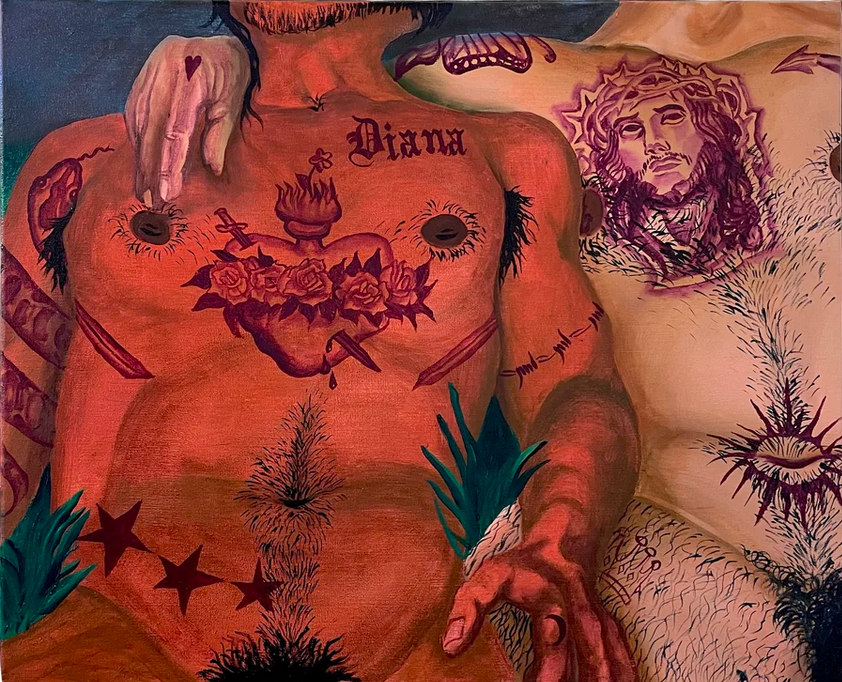
Manuel Vásquez Ortega analyzes the work of La Chola Poblete through her exhibition En el aire (In the air) at BARRO. La Chola intervenes in hegemonic narratives of art history to introduce embodiments and experiences marginalized by colonial systems of representation. What does it mean for a trans, Indigenous, and dissident body to occupy the symbolic space of the “diva” within the cultural imaginary?
If art history books are a kind of family album, we can be certain that—like in all families—there are those who have been marginalized.
For many individuals and communities, revisiting the visual history of human events entails navigating the imposed categories that have shaped us for centuries. Categories forged through “training and repeated punishment, [reinforced] through linguistic invocations and institutional rituals” —methods that ultimately reduce a world of individualities to a limited spectrum of permitted identities.
For many dysphoric bodies, resisting subalternization within this regime of colonial power and knowledge entails a constant struggle against ethno-cultural classification, xenophobia, whitening policies, racism, and discrimination rooted in homophobia and transphobia. This entails understanding dysphoria as a political position—identified by Paul B. Preciado as a contemporary condition of individuals and collectivities whose lives unfold in the dissonance between two epistemological systems: one that dominates the world, and another that emerges through acts of resistance.
From this space of creative potential, throughout the years of her young yet intense artistic career, La Chola Poblete (Guaymallén, Argentina, 1989) has appropriated different images from this hegemonic album in order to “turn around the categories through which we are othered and, in doing so, understand the system that produces differences and hierarchies.” In this process, by drawing on overlapping temporalities, La Chola inserts herself into canons of representation that have historically opposed her ancestors and deliberately sought to erase the values, knowledge, and struggles they embodied.
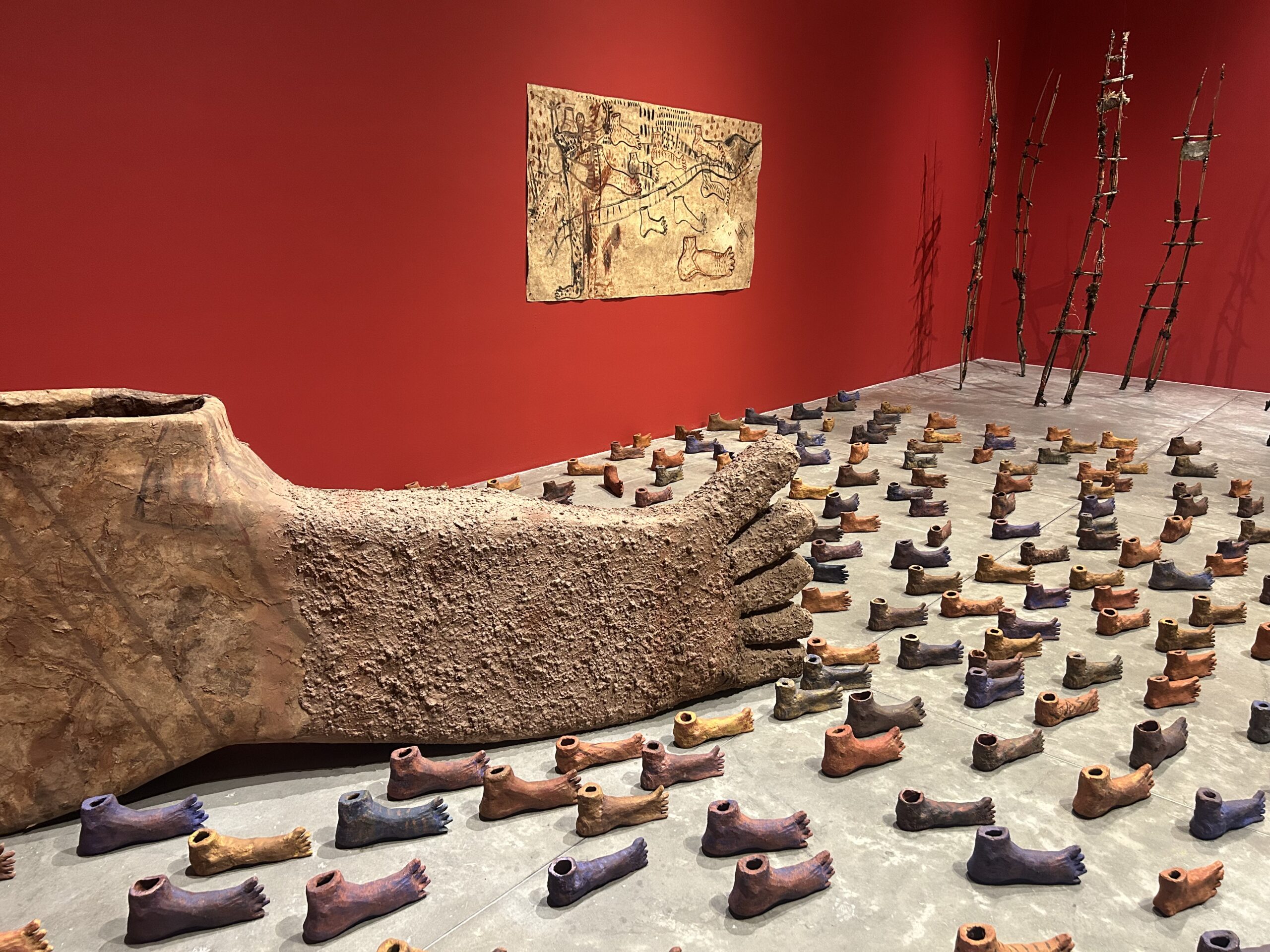
Thus, creating a new layer of possibilities for the construction of a dysphoric history of art, the iconography claimed by La Chola Poblete moves between episodes of Western art and Argentine art—a relationship deeply embedded in the institutional discourses of the nation—but also between local rock and the queer night, popular culture and Indigenous knowledge. She draws on gestures and silhouettes shaped by her own poetic imaginary, composed of the transversal categories that emerge from her lived experience: the trans, the erotic, the rebellious, and the ancestral.
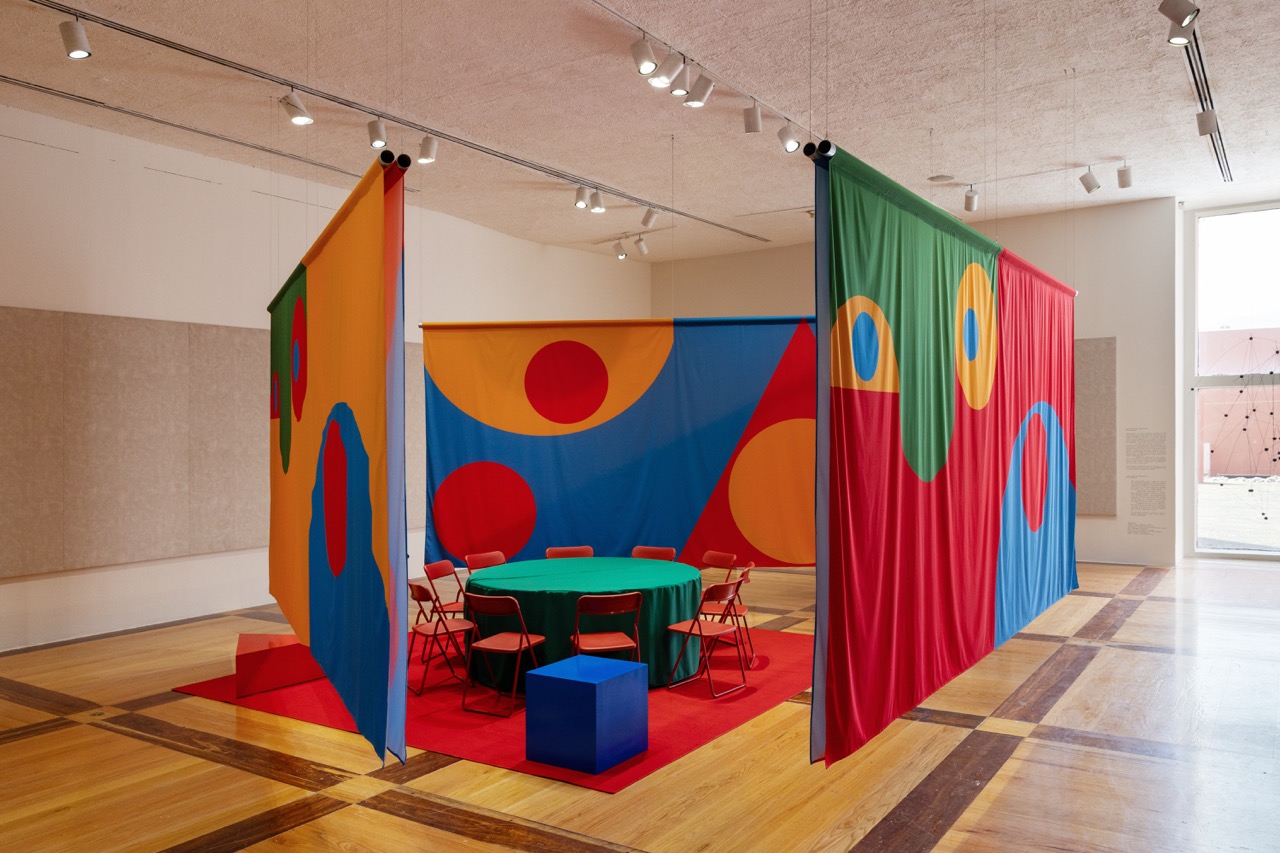
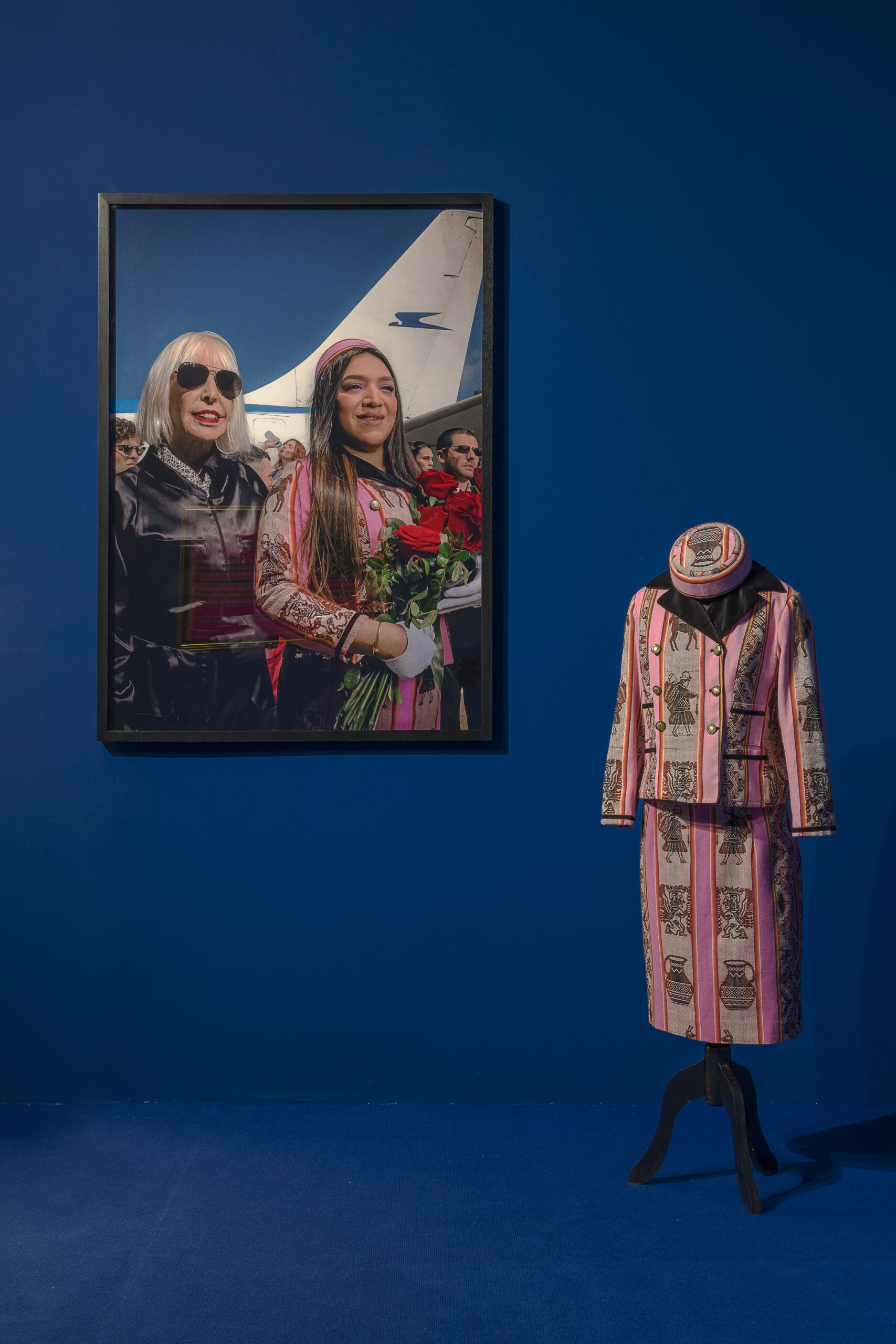
In her most recent solo exhibition at BARRO (Buenos Aires, Argentina), titled En el aire (In the Air), curated by Antonio Villa, La Chola presented a group of paintings, photographs, and scenographic installations whose arrangement and display take the form of a television set and its behind-the-scenes. A framework through which the artist affirms two major philosophical theses that govern modern show business: on the one hand, that things acquire value when they are seen; and on the other, that within spectacle, the end is irrelevant, whilethe unfolding is everything. This latter idea hinges on the perpetual continuity of actions occurring at the rhythm of the economy in which the spectacle operates—an economy that, in the art world, remains entangled with market logics shaped by spheres of power.
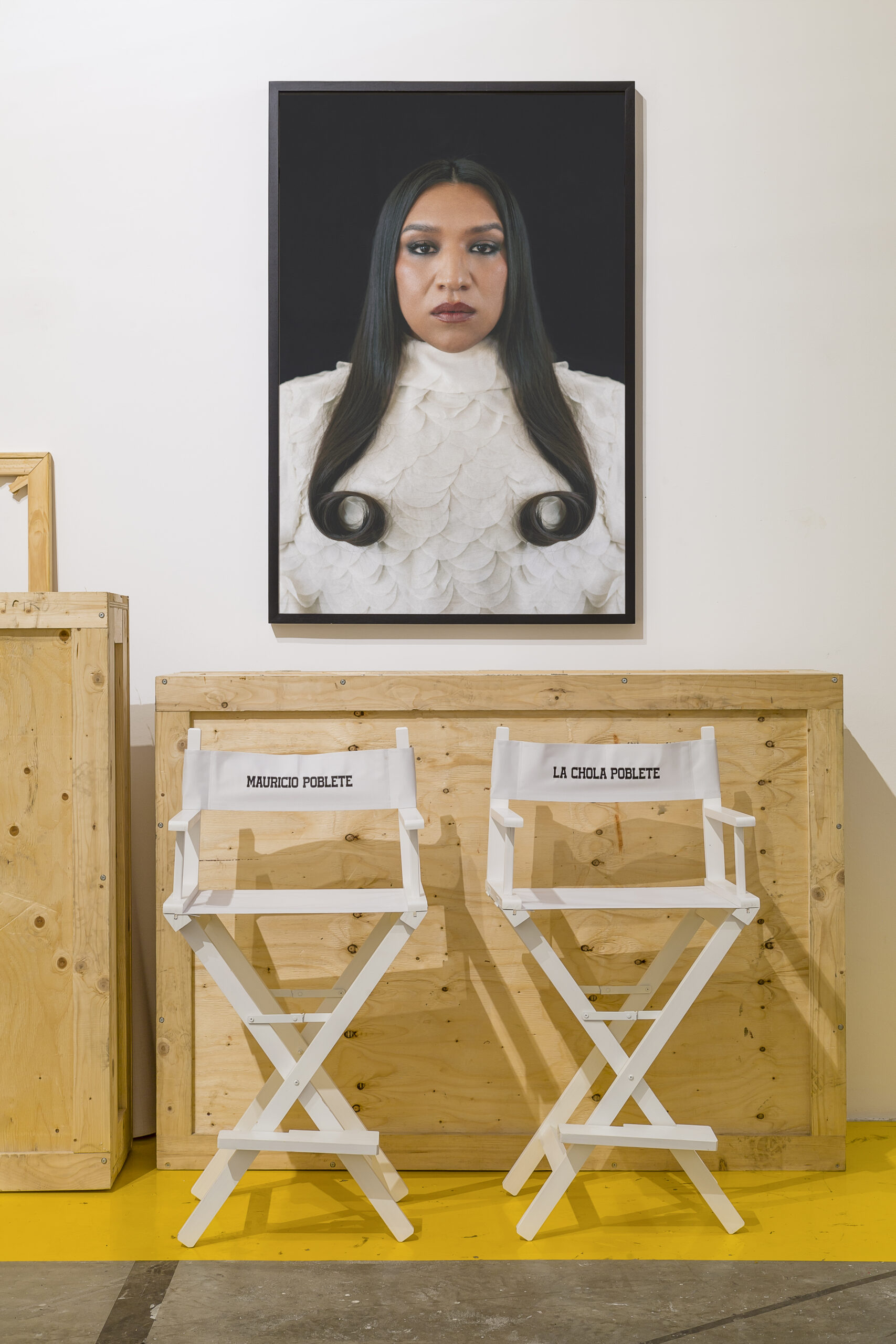
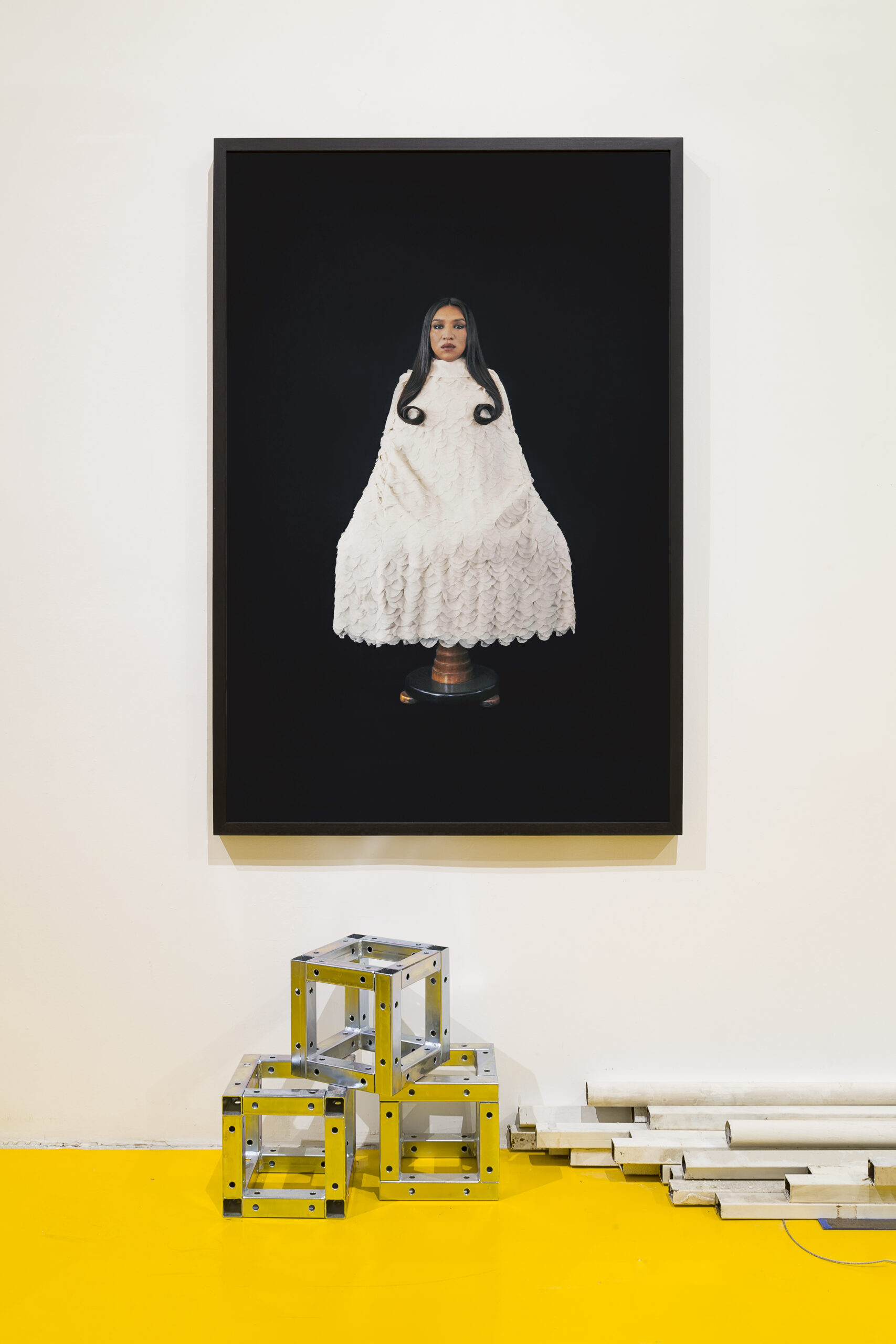
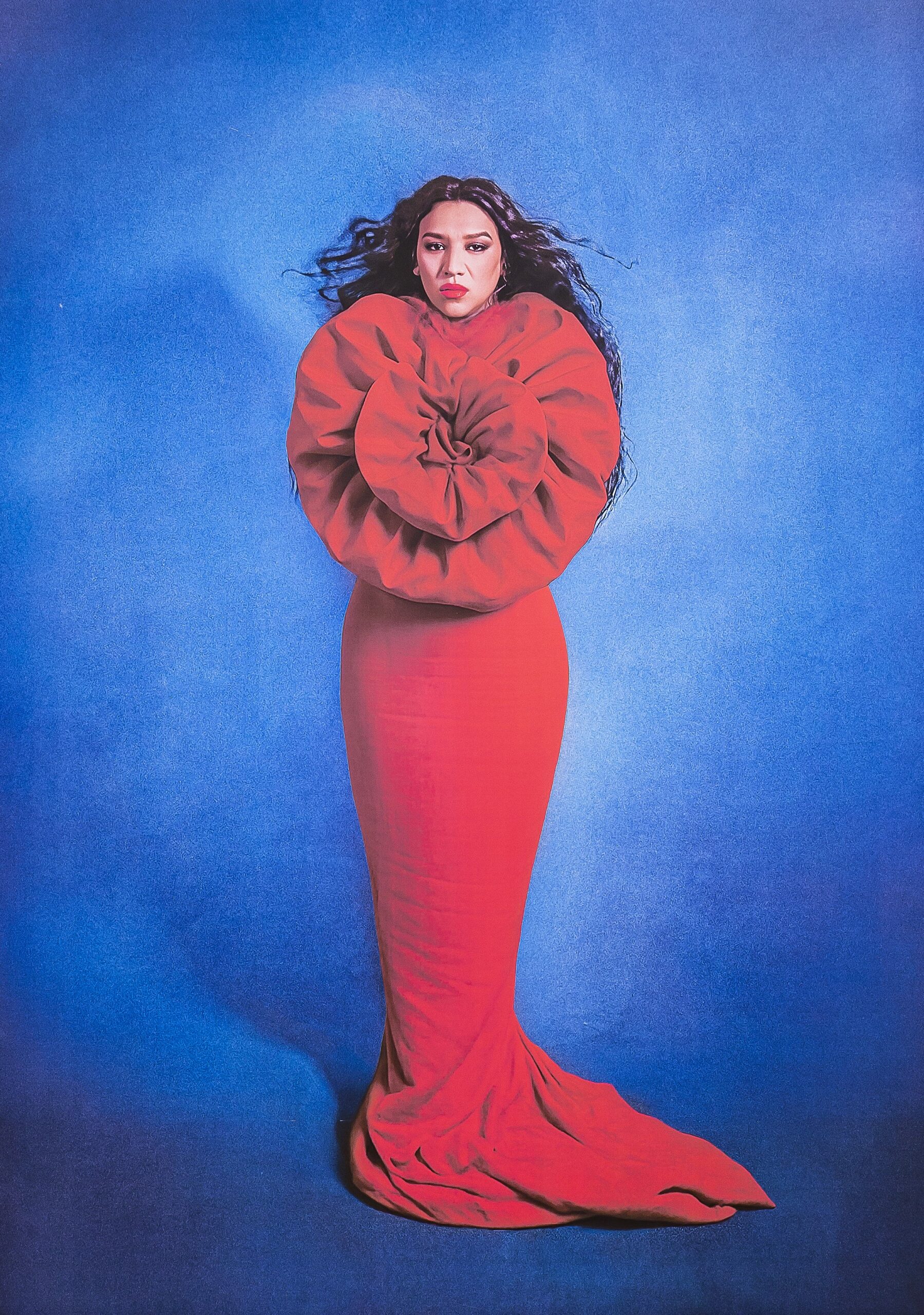
In her staging, the gallery assumes the role of a set, filled with props, scenery, and stage elements that function both as the backdrop for a celebrity’s preparation space and as a metaphorical scaffolding for the construction of a larger symbol: the diva. A figure whose omnipresence is felt throughout the exhibition in multiple portraits that elevate the cult value of her image, while also confronting us with the Benjaminian dilemma of a present saturated with reproducible images: namely, that while cult value has historically depended on inaccessibility and a mythical aura, exposure value lies in visibility and reach; or, in other words, that this value rests on the certainty that one must be seen in order to be. And yet, are artists compelled to expose themselves in order to exist within the art world? Does a diva adhere to these same logics? What happens when both values are set into motion?
In Argentina, divas occupy a special place in popular culture, with widely recognized figures emerging from theater, television, film, music, and their intersections. They embody a spectacle that reflects the prevailing economy of each era, both in its moments of prosperity and of crisis, and whose imprint on the country’s cultural history is largely shaped through images and their politics of visibility, forming a communicational and representational hegemony that dictates what is seen and what is not, what is spoken and what remains unspoken through the mass media of which these figures are a part.
Deeply aware of this imprint, and exposing herself through a choral performance activated periodically throughout the exhibition, La Chola deploys her charisma through a spectacle in which the audience traverses the artist’s personal history and her construction as a popular icon of Argentine art. Joined in these performances by the prominent queer artists Paulina Domínguez, Marcelo Estebecorena, and Valentina Quintero, with dramaturgy by Antonio Villa, the fictional, parodic television program draws on a popular format within Argentine culture in order to question it from within its own forms: the late-night interview show hosted by a diva, a format that thrives on visibility within a spectacularized society driven by controversy, gossip, and intimate detail. However, far from reproducing the stereotypes of a white, affluent Argentina, La Chola: En el aire (The Chola on the Air) magnifies dysphoric bodies and existences—their voices and struggles—through songs, dances, poems, and monologues.
After several acts and interludes, once the broadcast of La Chola’s program comes to an end, only the artist’s aura remains: a halo lingering in the portraits and objects of a deified figure whose mere image generates cult value. A Chola elevated to the status of a diva—trans, Indigenous, marrona, marginalized, dissident, and, above all, triumphant. In light of this, what does her rise to the upper spheres of popular visibility entail? With this achievement, might it be that “Pop dies and Andean Pop is born?”—to quote Andrea Giunta (2025) in the central question of her text for the exhibition. Is the death of Argentine pop a consequence of its inaccessibility, of the inability of people to identify with its hegemonic images, of its cult status transformed into a pantheon?
While these questions begin to find their direction, La Chola’s solo exhibition at BARRO—rather than conquering codes and symbols to propose a new historical category of art, as the artist has done in earlier moments such as Pap Art (Kunsthalle Lissabon, 2023) or in her most recent exhibition Pop Andino (MASP, 2026)—plays with the duality of cult and visibility, inserting itself into the fissures of the power structures underlying spectacle (be it Hollywood, national television, or the contemporary art market), gathering the residual gestures and surviving images that break away from the “official” narrative of a culture in urgent need of transformation.
In a culture shaped by an identity crisis, representations no longer belong exclusively to history books, family albums, or spaces of cult value, but instead circulate within everyone’s reach: inhabiting some anonymous layer of the stratosphere, in an abstract space where an idea or an action—like a jump or a gunshot—bears no authorship. Within this contemporary iconosphere, the scenes staged by La Chola unfold within an economy of spectacle where images circulate as commodities: they are taken, returned, invested, and devalued. Yet her practice does not merely reproduce the logic of capital or cultural extractivism; it is shaped by the knowledge embedded in her body, grounded in the force of an artist who bears the weight of her own embodied discourses—and, with them, her images.
Finally, En el aire stages a spectacle in which the politics of the gaze take center stage. Who decides what is visible? Who can aspire to cult status? If, as Guy Debord warned, “the more we recognize ourselves in the dominant images, the less we understand our own desire,” La Chola Poblete’s operation proposes a possibility of disidentifying from the representational canon by occupying it unexpectedly, constructing her cult figure under conditions defined by herself. For, in her own words, “when they expect me to be a victim, I am a diva.”
In this act, the artist’s work emerges as a departure from the colonial genealogy of an image-history imposed upon our continent and, with it, an opportunity to finally withdraw our gaze from the spectacle that power itself imposes on us: an act in which opposing the canon entails embracing collective dysphoria as the path toward transforming our present.
Notas:
1 Paul B. Preciado, Dysphoria Mundi (Barcelona: Editorial Anagrama, 2022), 11.
2 Ibid
3 Byung-Chul Han, La sociedad de la transparencia (Barcelona: Herder Editorial, 2013), 20.
4 Guy Debord, La sociedad del espectáculo (Santiago de Chile: Ediciones Naufragio, 1967), 12.
5 Byung-Chul Han, La sociedad de la transparencia (Barcelona: Herder Editorial, 2013), 20.
6 Durante la muestra, la obra “Sin título”, de la serie La conquista de la muerte (2025), de La Chola, fue retirada debido a acusaciones con instancias legales de plagio por parte de Carola Bony, hija y heredera del artista argentino Oscar Bony, autor de El triunfo de la muerte (1998). Para más información, ver La Nación.
7 Guy Debord, La sociedad del espectáculo (Santiago de Chile: Ediciones Naufragio, 1967), 18.
8Una frase de La Chola Poblete de su obra-manifiesto Pap Art (2023), presentada en Kunsthalle Lissabon, en Lisboa, Portugal.
If art history books are a kind of family album, we can be certain that—like in all families—there are those who have been marginalized.
For many individuals and communities, revisiting the visual history of human events entails navigating the imposed categories that have shaped us for centuries. Categories forged through “training and repeated punishment, [reinforced] through linguistic invocations and institutional rituals” —methods that ultimately reduce a world of individualities to a limited spectrum of permitted identities.
For many dysphoric bodies, resisting subalternization within this regime of colonial power and knowledge entails a constant struggle against ethno-cultural classification, xenophobia, whitening policies, racism, and discrimination rooted in homophobia and transphobia. This entails understanding dysphoria as a political position—identified by Paul B. Preciado as a contemporary condition of individuals and collectivities whose lives unfold in the dissonance between two epistemological systems: one that dominates the world, and another that emerges through acts of resistance.
From this space of creative potential, throughout the years of her young yet intense artistic career, La Chola Poblete (Guaymallén, Argentina, 1989) has appropriated different images from this hegemonic album in order to “turn around the categories through which we are othered and, in doing so, understand the system that produces differences and hierarchies.” In this process, by drawing on overlapping temporalities, La Chola inserts herself into canons of representation that have historically opposed her ancestors and deliberately sought to erase the values, knowledge, and struggles they embodied.
Thus, creating a new layer of possibilities for the construction of a dysphoric history of art, the iconography claimed by La Chola Poblete moves between episodes of Western art and Argentine art—a relationship deeply embedded in the institutional discourses of the nation—but also between local rock and the queer night, popular culture and Indigenous knowledge. She draws on gestures and silhouettes shaped by her own poetic imaginary, composed of the transversal categories that emerge from her lived experience: the trans, the erotic, the rebellious, and the ancestral.
In her most recent solo exhibition at BARRO (Buenos Aires, Argentina), titled En el aire (In the Air), curated by Antonio Villa, La Chola presented a group of paintings, photographs, and scenographic installations whose arrangement and display take the form of a television set and its behind-the-scenes. A framework through which the artist affirms two major philosophical theses that govern modern show business: on the one hand, that things acquire value when they are seen; and on the other, that within spectacle, the end is irrelevant, whilethe unfolding is everything. This latter idea hinges on the perpetual continuity of actions occurring at the rhythm of the economy in which the spectacle operates—an economy that, in the art world, remains entangled with market logics shaped by spheres of power.
In her staging, the gallery assumes the role of a set, filled with props, scenery, and stage elements that function both as the backdrop for a celebrity’s preparation space and as a metaphorical scaffolding for the construction of a larger symbol: the diva. A figure whose omnipresence is felt throughout the exhibition in multiple portraits that elevate the cult value of her image, while also confronting us with the Benjaminian dilemma of a present saturated with reproducible images: namely, that while cult value has historically depended on inaccessibility and a mythical aura, exposure value lies in visibility and reach; or, in other words, that this value rests on the certainty that one must be seen in order to be. And yet, are artists compelled to expose themselves in order to exist within the art world? Does a diva adhere to these same logics? What happens when both values are set into motion?
In Argentina, divas occupy a special place in popular culture, with widely recognized figures emerging from theater, television, film, music, and their intersections. They embody a spectacle that reflects the prevailing economy of each era, both in its moments of prosperity and of crisis, and whose imprint on the country’s cultural history is largely shaped through images and their politics of visibility, forming a communicational and representational hegemony that dictates what is seen and what is not, what is spoken and what remains unspoken through the mass media of which these figures are a part.
Deeply aware of this imprint, and exposing herself through a choral performance activated periodically throughout the exhibition, La Chola deploys her charisma through a spectacle in which the audience traverses the artist’s personal history and her construction as a popular icon of Argentine art. Joined in these performances by the prominent queer artists Paulina Domínguez, Marcelo Estebecorena, and Valentina Quintero, with dramaturgy by Antonio Villa, the fictional, parodic television program draws on a popular format within Argentine culture in order to question it from within its own forms: the late-night interview show hosted by a diva, a format that thrives on visibility within a spectacularized society driven by controversy, gossip, and intimate detail. However, far from reproducing the stereotypes of a white, affluent Argentina, La Chola: En el aire (The Chola on the Air) magnifies dysphoric bodies and existences—their voices and struggles—through songs, dances, poems, and monologues.
After several acts and interludes, once the broadcast of La Chola’s program comes to an end, only the artist’s aura remains: a halo lingering in the portraits and objects of a deified figure whose mere image generates cult value. A Chola elevated to the status of a diva—trans, Indigenous, marrona, marginalized, dissident, and, above all, triumphant. In light of this, what does her rise to the upper spheres of popular visibility entail? With this achievement, might it be that “Pop dies and Andean Pop is born?”—to quote Andrea Giunta (2025) in the central question of her text for the exhibition. Is the death of Argentine pop a consequence of its inaccessibility, of the inability of people to identify with its hegemonic images, of its cult status transformed into a pantheon?
While these questions begin to find their direction, La Chola’s solo exhibition at BARRO—rather than conquering codes and symbols to propose a new historical category of art, as the artist has done in earlier moments such as Pap Art (Kunsthalle Lissabon, 2023) or in her most recent exhibition Pop Andino (MASP, 2026)—plays with the duality of cult and visibility, inserting itself into the fissures of the power structures underlying spectacle (be it Hollywood, national television, or the contemporary art market), gathering the residual gestures and surviving images that break away from the “official” narrative of a culture in urgent need of transformation.
In a culture shaped by an identity crisis, representations no longer belong exclusively to history books, family albums, or spaces of cult value, but instead circulate within everyone’s reach: inhabiting some anonymous layer of the stratosphere, in an abstract space where an idea or an action—like a jump or a gunshot—bears no authorship. Within this contemporary iconosphere, the scenes staged by La Chola unfold within an economy of spectacle where images circulate as commodities: they are taken, returned, invested, and devalued. Yet her practice does not merely reproduce the logic of capital or cultural extractivism; it is shaped by the knowledge embedded in her body, grounded in the force of an artist who bears the weight of her own embodied discourses—and, with them, her images.
Finally, En el aire stages a spectacle in which the politics of the gaze take center stage. Who decides what is visible? Who can aspire to cult status? If, as Guy Debord warned, “the more we recognize ourselves in the dominant images, the less we understand our own desire,” La Chola Poblete’s operation proposes a possibility of disidentifying from the representational canon by occupying it unexpectedly, constructing her cult figure under conditions defined by herself. For, in her own words, “when they expect me to be a victim, I am a diva.”
In this act, the artist’s work emerges as a departure from the colonial genealogy of an image-history imposed upon our continent and, with it, an opportunity to finally withdraw our gaze from the spectacle that power itself imposes on us: an act in which opposing the canon entails embracing collective dysphoria as the path toward transforming our present.
Notas:
1 Paul B. Preciado, Dysphoria Mundi (Barcelona: Editorial Anagrama, 2022), 11.
2 Ibid
3 Byung-Chul Han, La sociedad de la transparencia (Barcelona: Herder Editorial, 2013), 20.
4 Guy Debord, La sociedad del espectáculo (Santiago de Chile: Ediciones Naufragio, 1967), 12.
5 Byung-Chul Han, La sociedad de la transparencia (Barcelona: Herder Editorial, 2013), 20.
6 Durante la muestra, la obra “Sin título”, de la serie La conquista de la muerte (2025), de La Chola, fue retirada debido a acusaciones con instancias legales de plagio por parte de Carola Bony, hija y heredera del artista argentino Oscar Bony, autor de El triunfo de la muerte (1998). Para más información, ver La Nación.
7 Guy Debord, La sociedad del espectáculo (Santiago de Chile: Ediciones Naufragio, 1967), 18.
8Una frase de La Chola Poblete de su obra-manifiesto Pap Art (2023), presentada en Kunsthalle Lissabon, en Lisboa, Portugal.