
How can we disobey the regime of modern time? Chilean artist Katia Sepúlveda evokes Walter Benjamin’s angel to place it under the scrutiny of radical imagination. She proposes an anti-futurism that does not long for redemption or progress, but instead activates the past as a living force. Here, the archive is not a relic: it is a battlefield. The past is not a ruin: it is a force that erupts. Against the coloniality of power and its linear chronology, the text summons ch’ixi temporalities—simultaneous and held in tension—where ancestors and presents coexist without reconciliation.
For Juampi, who shared his past without asking for anything in return, and for Y. A., who was the angel of Shabbat who appeared just at the moment of escape, when hatred disguised itself as justice.
I
Sold his soul to the devil, at the crossroads in the Deep South. He sold his soul, and in return, he was given the secret of a Black technology, a Black secret technology that we know now to be the blues. The blues begat jazz, the blues begat soul, the blues begat hip hop, the blues begat R&B. [1]
If we begin with the exercise of “dreaming the past”, as Espinosa suggests [2], it becomes very difficult to feel envy for the future. As Benjamin noted in his famous text On the Concept of History, pain produces episodes that never happened. In this essay, he underscores historical materialism that demands rights on behalf of a past filled with violence, suffering, ruptures, voids, and invisibility. This pain becomes tangible when the “present” is questioned from within a modern historical line that constantly turns against itself, precisely by devouring the past in order to later “resurrect” the category of the new. Within this framework, the future appears as an “apocalypse,” accompanied by the implicit arrival of “redemption” through the coming of the Messiah son of David, understood as the sole restorer of Tikun Olam [3] after an erratic past. For this reason, in Kabbalah time is conceived as circular, however, it differs from relational ontologies because its ontogenesis stems from a great Tzim-zum—that is, a divine contraction that gives way to creation. Nevertheless, this creation must be corrected by a “chosen one”. For this reason, this “chosen one” bears the full weight of the past upon his shoulders. In other words, he faces the difficult task of rectifying it. Thus, when he looks back, he sees only “destruction” and “catastrophe” [4].
II
This is the re-emergence of the world of cycles. This is our ceremony. Beneath silent skies, the world breathes again and the fever subsides. The land is quiet, waiting for us to listen.
Rethinking the Apocalypse: An Indigenous Anti-Futurist Manifesto [5].
From an anti-futurist perspective, the past is not regarded as a threat that must disappear, nor is it configured as a “flash of lightning” that illuminates the present as the manifestation of a supposedly ephemeral power. In this sense, Benjamin's “suspended “ or “arrested” dialectic (Dialektik im Stillstand) [6] dilates the “past” and seeks to escape the linear and successive temporality that structures colonial modernity, therby questioning the idea of a homogeneous and cumulative historical time. As Aníbal Quijano argues, this temporality is constitutive of the “coloniality of power” [7], insofar as it institutes a hierarchy of time that relegates other historicities to backwardness, premodernity, or mere cultural survival. Although Benjamin's concept of Stillstand immanently incorporates the notion of interruption (unterbrochen) [8], it should not be understood as a simple chronological pause, but rather as a critical mechanism capable of undoing the colonial temporal order. In this sense, the suspension of time does not invoke inactivity; instead, it generates a space of difference where multiple, heterogeneous, and unreconciled temporalities emerge. Rather than conception in which the present devours the past and expels it from its field of meaning through a logic of overcoming and synthesis, Rivera Cusicanqui [9] mantains that these temporalities coexist in tension Within this framework, the temporal ch'ixi allows a glimpse of an irruption in which past and present do not cancel one another out. This, in turn, makes it possible to dismantle narratives that seek purity, progress and development. From this perspective, the past is not seen as a state afflicted by the instant, nor is it recalled as a self-satisfied or monumental memory; rather, it persists within an open constellation of affects, struggles, and situated knowledge that insistently demand to be uncovered again in the present. This insistence becomes particularly powerful when read through the framework of the critique coloniality of gender [10], which links this critique of coloniality a significant portion of the sexual, embodied, and communal memories that have been systematically disqualified by colonial regimes of knowledge—regimes that separate the body from reason and politics. Within this logic, the past does not appear as an archive that has remained intact over time, but as a battlefield in which subalternized experiences continue to demand ethical and political legibility in the present. Thus, anti-futurism seeks neither a dispirited re-materialization of the past nor a messianic projection of the future; rather, it calls for a critical practice of time that enacts an interruption of the extractivist logic of memory while simultaneously enabling other ways of inhabiting the present—perhaps through non-reconciliation, relationality, and the persistence of the unresolved. This is how the ethos [11] of the anti-future is shared—as part of a counter-history that takes place head-on: in dreams; in the ritual of connecting with the world of ancestors; in the labor of food itself; in dance; in celebration; in the beating of the drum; in the steam of the volcanic-earth bath, in cooking the products of the harvest´s yield. In sum, it is not tormented by “appearance” or by the “moment”, for it has sustained its own flow in life within life itself. One walks slowly, with one's feet turned backwards, as the ciguapa [12] does, moving at a rhythm of abundance, in mutual respect for whatever is encountered. There is no other to be accused. Hierarchies are not vertical, for they emerge from reciprocity with the earth system. In conclusion, we are that unfixed past to which quantum physics alludes, constantly and without cease in relation to an ethics of life.
III
Today's cimarrona wager would entail seeing the invisible, remembering what we were forced to forget, undertaking a journey of no return, going deep into the mountains, returning to and recreating the house, dreaming of the past. [13]
Yuderkys Espinosa Miñoso
Flight is the most “sentesico” [14] and truthful cimarrón gesture in the history of liberation, despite its incompleteness. It could be understood as an ontological flight, for it proposes another way of world-making under the urgency of existence, and from that apex leaves its traces in the mud. In this way, anti-future temporality is articulated as interruption, rupture, a radical chaos of what has come to be modern linear time, whose sediment forms part of the shared ground that leads us to consider the “coloniality of power” not only as an economic or racial structure, but as a temporal regime that imposes a single history of progress, development, and future. This temporality does not emerge as an internal evolution of modernity, but as a loosening provoked by processes of emancipation that operate through and unsettle Eurocentric chronology. In this sense, the trans-modern Jetzt-Zeit [15] is reconfigured here as a time that does not follow the teleological logic of the Marxist revolution, nor does it respond to the Enlightenment promise of the future, but rather simultaneously condenses subalternized, ancestral and contemporary temporalities. In line with Rivera Cusicanqui, this density does not seek internal reconciliation, but rather a conflictive ch'ixi coexistence in which, as already described, temporalities are neither integrated nor suspended, but remain in fruitful tension. The past, therefore, far from being a relic or a threatening spectre of disappearance, is activated as a living force that bursts into the present, destabilizing the idea of the future as a universal horizon. In this way, anti-future time does not advance or progress, but rather folds, overlaps and reactivates itself as a situated practice of “epistemic disobedience” [16] capable of generating forms of “re-existence” [17]—forms that do not seek inclusion with modernity, but instead exist in spite of it. This ontology, with autonomous features, is the proposal that motivates this “angel” to rejoice and dance on the trans-modern Jetzt-Zeit, to the rhythm of the drum-heart that will keep alive the social spirit of the maroons and dissident subjects of the “modern colonial world-system”.
IV
There is a painting by Klee called Angelus Novus. It depitct an angel who seems as though he were about to move away from something that has left him transfixed. [19]
-Walter Benjamin
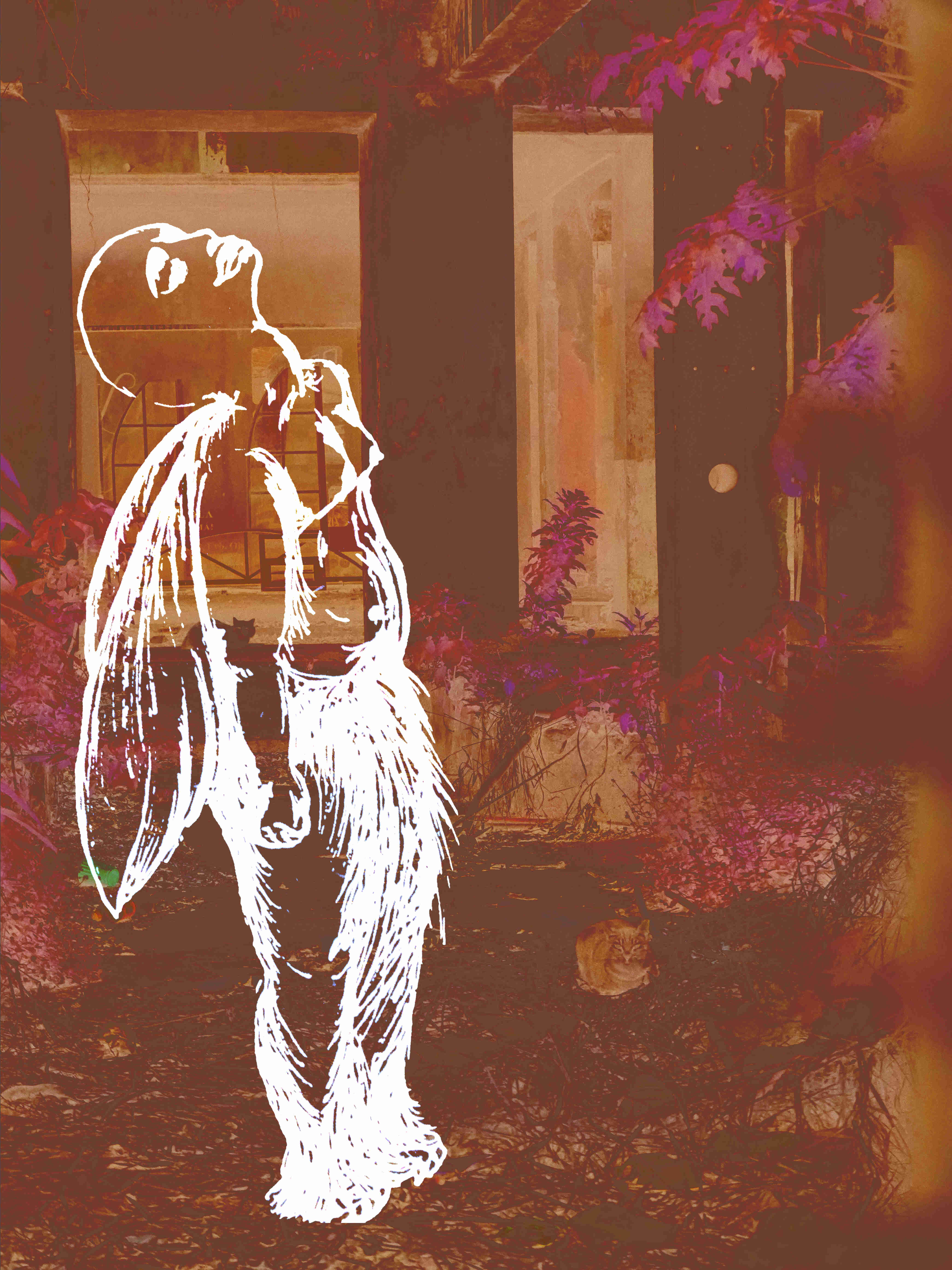
During the second edition of the laboratory seminar Anti-Futurismo cimarrón, held with artists from Puerto Rico, Ketsia Camacho Ramos [20] presents us with an image called criaturas de callejón [alley creatures], a digital photograph in earth tones, as if simultaneously solarized and rendered as a negative. It reveals the reverse side of a hoyken temporality, punctuated by flashes of magenta. Two cats appear as witnesses, declaring their presence. Above this ‘alleyway’ passage—echoing the Arcades Project—an angel perches: outlined in whit, with brown skin, suspended within the image, perhaps leaning against an imaginary wall. This angel is in no hurry. He gazes placidly towards the sky, eyes closed, dreaming a “non-colonized dream” [21]. He looks neither forward nor backward; that is to say, he does not inhabit the longed-for historical leap of Marxism and therefore feels no tension or anxiety, nor concern for progress or what is to come. For when he turns his gaze, “he sees no disaster; he sees life before its destruction” before 1492. His mouth is closed, as if he were on the verge of kissing the immeasurable. The “kiss” in this case, may be understood as a metaphor for affectivity, offered solely as a relational symbol that eludes ontology—an ontology in motion, within which diverse auxiliary temporalities are produced. In this sense, time does not unfold according to the teleological narrative of progress, nor according to the modern horizon of linear succession; rather, it advances as a living simultaneity in which what has been remains active within the fiction of the present. This vision disrupts the Western conception of death as a definitive separation, offering instead an understanding of life as historical and affective continuity; thus, ancestors are not confined to the past but remain an active presence within same fiction of the present. This view of the “angel” is no longer situated in in the expectation of a messianic event or in the promise of future liberation, but, inevitably, in a time that is temporary and continously in transition. This condition could also be summarized as an expanded version of the trans-modern Jetzt-Zeit, set apart from the revolutionary exceptionalism of Walter Benjamin, bringing us closer to a trans-modern temporality [22] understood as the coexistence of different historical eras without merging into a Hegelian synthesis—a time that breaks with the logic of modern or postmodern linearity in order to restore a logic of problematic and imaginative simultaneity. This idea subverts the dominant notion of death in Western thought. In doing so, this multiplication of meanings of history calls into question the figure of the “angel of history”, which, from a decolonial perspective, can be understood as a “maroons angel”. The stance of the angel of history is no longer defined by passive or terrifying contemplation of the ruins of progress, but by continuous resistance in favor of life and against the “coloniality of power”. The angel does move towards “salvation" or towards the end of historical upheaval, but towards a relational self-poiesis [23]: the uninterrupted gesture of generating “existence and meaning” in the upholoding of a narrative that traces the labor of life, linked to re-existence.
The festive dimension, normally depoliticized or confined ot the cultural sphere, acquires vitality within the order of knowledge or within the political order. In this sense, the festive—often relegated or excluded from the cultural sphere—assumes an unresolved epistemological and political dimension; functioning in this way not as something chosen at will, but as the manner in which world-making is bound to memory, body and community. Finally, this ontological order is not grounded in a logic of the demand for recognition or the expectation of institutional legitimation; it is grounded on affirmation. It affirms vernacular existence—an exisitence sustained without a name, prior to the word or the enunciation that names it, and prior to the discourse that grants recognition. In this way, the subject belongs to what Agustín Lao-Montes calls “radical vitality”: a history of political force that not only resists the colonizing practices of death, but also produces alternatives through forms of life, community, and temporality engendered beyond the universal canon.
Axe!
Katia Sepúlveda, Loíza, Puerto Rico, 8 October 2024.
----------
[1] “He sold his soul to the devil at the crossroads in the Deep South. He sold his soul and, in return, he was given the secret of a Black technology — a secret Black technology that we now know as the blues. The blues begat jazz. The blues begat soul. The blues begat hip hop. The blues begat R&B.” The Last Angel of History, directed by John Akomfrah, 1996. Translation by Katia Sepúlveda.[2]Yuderkys Espinosa Miñoso, “Breve esbozo sobre feminismo, descolonialidad y cimarronaje” [“Brief Outline on Feminism, Decoloniality, and Maroonage”], Pikara Magazine, November 11, 2020,[3]It means to perfect the world, to work it. Implicitly, the West took this as the idea of progress; [4]Meanwhile, in the West, this song plays in the background: “Got a sweet black angel / Got a pin-up girl / Got a sweet black angel / Up upon my wall.” “Sweet Black Angel,” by The Rolling Stones, 1972. The song was composed in support of Angela Davis;[5] Indigenous Action Media, “Rethinking the Apocalypse: An Indigenous Anti-Futurist Manifesto,” translated by Yuderkys Espinosa Miñoso and Katia Sepúlveda, La Vorágine: Cultura Crítica, March 30, 2020, https://lavoragine.net/manifiesto-indigena-antifuturista/; [6] The expression “suspended and/or arrested dialectics” refers to the Benjaminian notion of Dialektik im Stillstand developed in the Passagen-Werk. See Walter Benjamin, Das Passagen-Werk, in Gesammelte Schriften, vol. 5.1, ed. Rolf Tiedemann (Frankfurt am Main: Suhrkamp, 1982), 578. For Benjamin, the dialectical image emerges in an instant in which the past and the now are reconfigured as a critical constellation; in that moment, historical and teleological time bursts open;[7]Aníbal Quijano. “Colonialidad del poder, eurocentrismo y América Latina,” in Colonialidad del saber: Eurocentrismo y ciencias sociales: Perspectivas latinoamericanas, ed. Edgardo Lander (Buenos Aires: Consejo Latinoamericano de Ciencias Sociales, 2000), 201–244.; [8]The term Unterbrechung [interruption, rupture] should not be understood here as a direct translation of Stillstand, but rather as a conceptual category traversing Benjamin’s philosophy of history. While in the Passagen-Werk the formula Dialektik im Stillstand designates the critical apprehension in which the dialectical image becomes visible (Benjamin, Das Passagen-Werk, 578), in “Über den Begriff der Geschichte” the logic of messianic irruption—Jetztzeit—implies a shattering of historical becoming that may be understood as a discontinuity of civilization. See Walter Benjamin, “Über den Begriff der Geschichte,” in Gesammelte Schriften, vol. 1.2, ed. Rolf Tiedemann and Hermann Schweppenhäuser (Frankfurt am Main: Suhrkamp, 1974), 701–704. In this sense, Unterbrechung names the critical surgery that makes Stillstand possible: not a mere pause, but an active suspension that disarticulates the linearity of modern colonial history; [9]Silvia Rivera Cusicanqui, Sociología de la imagen: Miradas ch’ixi desde la historia andina (Buenos Aires: Tinta Limón, 2015), https://tintalimon.com.ar/public/pdf_978-987-3687-13-6.pdf; [10] María Lugones, “Colonialidad y género,” Tabula Rasa, no. 9 (December 30, 2008): 73–101, https://doi.org/10.25058/20112742.340;[11] I am referring to the character or disposition embodied in the gestures and modes of enacting cimarrona life, organized around a political project that dissents from the future orchestrated by modernity and experiments with other collective ways of inhabiting time and space;[12] Asociación de Academias de la Lengua Española (ASALE), “Ciguapa,” Diccionario de americanismos, s.v. “ciguapa,” https://www.asale.org/damer/ciguapa. Accessed November 16, 2025. Definition: Dominican Republic. A fantastical being in the form of a beautiful woman with long, thick hair and backward-facing feet who lives at the bottom of lakes and rivers; [13] Yuderkys Espinosa Miñoso, “Breve esbozo sobre feminismo, descolonialidad y cimarronaje” [“Brief Outline on Feminism, Decoloniality, and Maroonage”], Pikara Magazine, November 11, 2020, https://www.pikaramagazine.com/2020/11/breve-esbozo-sobre-feminismo-descolonialidad-y-cimarronaje/.;[14] “Sentesis”: derived from the Latin verb sentire (to feel) and the Greek suffix -sis (action), which we associate with a practice closer to our genealogy. We propose the idea of the “sentesic artist” as someone capable of feeling-thinking the world through gustatory, tactile, auditory, visual, and poetic perception. The sentesico artist possesses oral thinking connected to the spiritual world as well as to the language of emotions and sensitivity, accompanied by an ethic for life (Espinosa and Sepúlveda 2023, 18). This concept emerged from the need to name the art produced in the first seminar-laboratory we directed with Yuderkys Espinosa Miñoso in 2022, within the framework of the exhibition El futuro ya fue: Antifuturismo Cimarrón, presented at La Virreina Centre de la Imatge, Barcelona. We use the term “healer” to describe our role in leading processes of collective research and artistic creation, following Gloria Anzaldúa’s notion of the racialised artist as a shaman or healer of the colonial wound (Borderlands/La Frontera, 1987, 176). “In press.” Editors’ note: At the author’s request, the concept “sentesico” appears without an accent for aesthetic and creative reasons aligned with the decolonial video process. https://journals.ub.uni-heidelberg.de/index.php/miradas/article/view/109417; [15]El término “Jetzt-zeit-trans-moderno” no corresponde a una categoría canónica en sentido estricto, sino que constituye una operación conceptual deliberada. Es decir el Jetztzeit de Benjamin, el “tiempo-ahora” que se refiere a la interrupción/suspensión del tiempo que articula el progreso. Por transmodernidad se retoma la propuesta de Dussel, entendiendo a ésta misma desde un sentido donde se valora la episteme producida en Abya Yala como un transito. La articulación de ambos términos busca nombrar un “ahora” como un paro (strike) histórico situado, no universal, que emerge desde la memoria de lxs condenadxs del mundo por la urgencia de un giro ontológico;[16]Walter Mignolo, Desobediencia epistémica: Retórica de la modernidad, lógica de la colonialidad y gramática de la descolonialidad (Buenos Aires: Ediciones del Signo, 2010); [17] Adolfo Albán Achinte, “Pedagogías de la re-existencia: Artistas indígenas y afrocolombianos,” in Pedagogías decoloniales: Prácticas insurgentes de resistir, (re)existir y (re)vivir, vol. 1, ed. Catherine Walsh (Quito: Abya Yala, 2013), 443–467; [18]Anibal Quijano, “Colonialidad del poder, eurocentrismo y América Latina,” in Colonialidad del saber: Eurocentrismo y ciencias sociales: Perspectivas latinoamericanas, ed. Edgardo Lander (Buenos Aires: Consejo Latinoamericano de Ciencias Sociales, 2000), 201–244; [19]Walter Benjamin, “Sobre el concepto de historia,” in Tesis sobre la historia y otros fragmentos, trans. Bolívar Echeverría (Mexico City: Ítaca, 2008), thesis IX; [20]Ketsia Camacho Ramos is a non-binary transdisciplinary artist from Adjuntas, Puerto Rico. They are the founder of Editorial Casa Cuna and the LA JUNTILLA art and literature festival, and a collaborator and resident artist at Taller Libertá. Their recent group exhibitions include Afrosur (Coamo, 2023) and Trenzando identidades (Carolina, 2023), as well as the photographic exhibition Fiesta Libertá (Mayagüez, 2023). They have published Aceite de palo (2022) and Selección de poesía inédita (2019). They have presented work across the Caribbean and South America, developing artistic initiatives and sharing poetry for over a decade. They are currently part of the Maniobra project, a cultural employment program of the Centre for Creative Economy, and collaborate with the theatre company Vuelta Abajo Sitio. Source: https://www.puertoricoartnews.com/2023/05/doliere-obra-reciente-de-ketsia-camacho.html; [21]indigenous Action Media. “Rethinking the Apocalypse: An Indigenous Anti-Futurist Manifesto.”[22]Enrique Dussel, Transmodernity and Interculturality: An Interpretation from the Philosophy of Liberation (Mexico City: UAM–Iztapalapa, 2005); [23]We propose the notion of “relational autopoiesis” as an expanded conceptual framework articulating multiple forms of planetary existence, integrating living organisms, non-living entities, and material and non-material dimensions of reality. Drawing on the concept of “autopoiesis” developed by Humberto Maturana and Francisco Varela—understood as the capacity of living systems to produce and reproduce their own conditions of existence—this research shifts the concept from a closed, self-referential logic toward a relational and situated understanding in which life is configured through interdependence with human and non-human systems (Espinosa and Sepúlveda 2023). From this perspective, “relational autopoiesis” enters into dialogue with “relational ontologies” and the “ontological turn,” particularly in the work of Eduardo Viveiros de Castro, especially through Amerindian perspectivism. It also resonates with Arturo Escobar’s notion of the “pluriverse.” Thus, the concept functions not only analytically but also as an “ethical-political proposal” challenging modern ontology and opening possibilities for thinking life, memory, and agency through interdependence, care, and relational existence.
For Juampi, who shared his past without asking for anything in return, and for Y. A., who was the angel of Shabbat who appeared just at the moment of escape, when hatred disguised itself as justice.
I
Sold his soul to the devil, at the crossroads in the Deep South. He sold his soul, and in return, he was given the secret of a Black technology, a Black secret technology that we know now to be the blues. The blues begat jazz, the blues begat soul, the blues begat hip hop, the blues begat R&B. [1]
If we begin with the exercise of “dreaming the past”, as Espinosa suggests [2], it becomes very difficult to feel envy for the future. As Benjamin noted in his famous text On the Concept of History, pain produces episodes that never happened. In this essay, he underscores historical materialism that demands rights on behalf of a past filled with violence, suffering, ruptures, voids, and invisibility. This pain becomes tangible when the “present” is questioned from within a modern historical line that constantly turns against itself, precisely by devouring the past in order to later “resurrect” the category of the new. Within this framework, the future appears as an “apocalypse,” accompanied by the implicit arrival of “redemption” through the coming of the Messiah son of David, understood as the sole restorer of Tikun Olam [3] after an erratic past. For this reason, in Kabbalah time is conceived as circular, however, it differs from relational ontologies because its ontogenesis stems from a great Tzim-zum—that is, a divine contraction that gives way to creation. Nevertheless, this creation must be corrected by a “chosen one”. For this reason, this “chosen one” bears the full weight of the past upon his shoulders. In other words, he faces the difficult task of rectifying it. Thus, when he looks back, he sees only “destruction” and “catastrophe” [4].
II
This is the re-emergence of the world of cycles. This is our ceremony. Beneath silent skies, the world breathes again and the fever subsides. The land is quiet, waiting for us to listen.
Rethinking the Apocalypse: An Indigenous Anti-Futurist Manifesto [5].
From an anti-futurist perspective, the past is not regarded as a threat that must disappear, nor is it configured as a “flash of lightning” that illuminates the present as the manifestation of a supposedly ephemeral power. In this sense, Benjamin's “suspended “ or “arrested” dialectic (Dialektik im Stillstand) [6] dilates the “past” and seeks to escape the linear and successive temporality that structures colonial modernity, therby questioning the idea of a homogeneous and cumulative historical time. As Aníbal Quijano argues, this temporality is constitutive of the “coloniality of power” [7], insofar as it institutes a hierarchy of time that relegates other historicities to backwardness, premodernity, or mere cultural survival. Although Benjamin's concept of Stillstand immanently incorporates the notion of interruption (unterbrochen) [8], it should not be understood as a simple chronological pause, but rather as a critical mechanism capable of undoing the colonial temporal order. In this sense, the suspension of time does not invoke inactivity; instead, it generates a space of difference where multiple, heterogeneous, and unreconciled temporalities emerge. Rather than conception in which the present devours the past and expels it from its field of meaning through a logic of overcoming and synthesis, Rivera Cusicanqui [9] mantains that these temporalities coexist in tension Within this framework, the temporal ch'ixi allows a glimpse of an irruption in which past and present do not cancel one another out. This, in turn, makes it possible to dismantle narratives that seek purity, progress and development. From this perspective, the past is not seen as a state afflicted by the instant, nor is it recalled as a self-satisfied or monumental memory; rather, it persists within an open constellation of affects, struggles, and situated knowledge that insistently demand to be uncovered again in the present. This insistence becomes particularly powerful when read through the framework of the critique coloniality of gender [10], which links this critique of coloniality a significant portion of the sexual, embodied, and communal memories that have been systematically disqualified by colonial regimes of knowledge—regimes that separate the body from reason and politics. Within this logic, the past does not appear as an archive that has remained intact over time, but as a battlefield in which subalternized experiences continue to demand ethical and political legibility in the present. Thus, anti-futurism seeks neither a dispirited re-materialization of the past nor a messianic projection of the future; rather, it calls for a critical practice of time that enacts an interruption of the extractivist logic of memory while simultaneously enabling other ways of inhabiting the present—perhaps through non-reconciliation, relationality, and the persistence of the unresolved. This is how the ethos [11] of the anti-future is shared—as part of a counter-history that takes place head-on: in dreams; in the ritual of connecting with the world of ancestors; in the labor of food itself; in dance; in celebration; in the beating of the drum; in the steam of the volcanic-earth bath, in cooking the products of the harvest´s yield. In sum, it is not tormented by “appearance” or by the “moment”, for it has sustained its own flow in life within life itself. One walks slowly, with one's feet turned backwards, as the ciguapa [12] does, moving at a rhythm of abundance, in mutual respect for whatever is encountered. There is no other to be accused. Hierarchies are not vertical, for they emerge from reciprocity with the earth system. In conclusion, we are that unfixed past to which quantum physics alludes, constantly and without cease in relation to an ethics of life.
III
Today's cimarrona wager would entail seeing the invisible, remembering what we were forced to forget, undertaking a journey of no return, going deep into the mountains, returning to and recreating the house, dreaming of the past. [13]
Yuderkys Espinosa Miñoso
Flight is the most “sentesico” [14] and truthful cimarrón gesture in the history of liberation, despite its incompleteness. It could be understood as an ontological flight, for it proposes another way of world-making under the urgency of existence, and from that apex leaves its traces in the mud. In this way, anti-future temporality is articulated as interruption, rupture, a radical chaos of what has come to be modern linear time, whose sediment forms part of the shared ground that leads us to consider the “coloniality of power” not only as an economic or racial structure, but as a temporal regime that imposes a single history of progress, development, and future. This temporality does not emerge as an internal evolution of modernity, but as a loosening provoked by processes of emancipation that operate through and unsettle Eurocentric chronology. In this sense, the trans-modern Jetzt-Zeit [15] is reconfigured here as a time that does not follow the teleological logic of the Marxist revolution, nor does it respond to the Enlightenment promise of the future, but rather simultaneously condenses subalternized, ancestral and contemporary temporalities. In line with Rivera Cusicanqui, this density does not seek internal reconciliation, but rather a conflictive ch'ixi coexistence in which, as already described, temporalities are neither integrated nor suspended, but remain in fruitful tension. The past, therefore, far from being a relic or a threatening spectre of disappearance, is activated as a living force that bursts into the present, destabilizing the idea of the future as a universal horizon. In this way, anti-future time does not advance or progress, but rather folds, overlaps and reactivates itself as a situated practice of “epistemic disobedience” [16] capable of generating forms of “re-existence” [17]—forms that do not seek inclusion with modernity, but instead exist in spite of it. This ontology, with autonomous features, is the proposal that motivates this “angel” to rejoice and dance on the trans-modern Jetzt-Zeit, to the rhythm of the drum-heart that will keep alive the social spirit of the maroons and dissident subjects of the “modern colonial world-system”.
IV
There is a painting by Klee called Angelus Novus. It depitct an angel who seems as though he were about to move away from something that has left him transfixed. [19]
-Walter Benjamin
During the second edition of the laboratory seminar Anti-Futurismo cimarrón, held with artists from Puerto Rico, Ketsia Camacho Ramos [20] presents us with an image called criaturas de callejón [alley creatures], a digital photograph in earth tones, as if simultaneously solarized and rendered as a negative. It reveals the reverse side of a hoyken temporality, punctuated by flashes of magenta. Two cats appear as witnesses, declaring their presence. Above this ‘alleyway’ passage—echoing the Arcades Project—an angel perches: outlined in whit, with brown skin, suspended within the image, perhaps leaning against an imaginary wall. This angel is in no hurry. He gazes placidly towards the sky, eyes closed, dreaming a “non-colonized dream” [21]. He looks neither forward nor backward; that is to say, he does not inhabit the longed-for historical leap of Marxism and therefore feels no tension or anxiety, nor concern for progress or what is to come. For when he turns his gaze, “he sees no disaster; he sees life before its destruction” before 1492. His mouth is closed, as if he were on the verge of kissing the immeasurable. The “kiss” in this case, may be understood as a metaphor for affectivity, offered solely as a relational symbol that eludes ontology—an ontology in motion, within which diverse auxiliary temporalities are produced. In this sense, time does not unfold according to the teleological narrative of progress, nor according to the modern horizon of linear succession; rather, it advances as a living simultaneity in which what has been remains active within the fiction of the present. This vision disrupts the Western conception of death as a definitive separation, offering instead an understanding of life as historical and affective continuity; thus, ancestors are not confined to the past but remain an active presence within same fiction of the present. This view of the “angel” is no longer situated in in the expectation of a messianic event or in the promise of future liberation, but, inevitably, in a time that is temporary and continously in transition. This condition could also be summarized as an expanded version of the trans-modern Jetzt-Zeit, set apart from the revolutionary exceptionalism of Walter Benjamin, bringing us closer to a trans-modern temporality [22] understood as the coexistence of different historical eras without merging into a Hegelian synthesis—a time that breaks with the logic of modern or postmodern linearity in order to restore a logic of problematic and imaginative simultaneity. This idea subverts the dominant notion of death in Western thought. In doing so, this multiplication of meanings of history calls into question the figure of the “angel of history”, which, from a decolonial perspective, can be understood as a “maroons angel”. The stance of the angel of history is no longer defined by passive or terrifying contemplation of the ruins of progress, but by continuous resistance in favor of life and against the “coloniality of power”. The angel does move towards “salvation" or towards the end of historical upheaval, but towards a relational self-poiesis [23]: the uninterrupted gesture of generating “existence and meaning” in the upholoding of a narrative that traces the labor of life, linked to re-existence.
The festive dimension, normally depoliticized or confined ot the cultural sphere, acquires vitality within the order of knowledge or within the political order. In this sense, the festive—often relegated or excluded from the cultural sphere—assumes an unresolved epistemological and political dimension; functioning in this way not as something chosen at will, but as the manner in which world-making is bound to memory, body and community. Finally, this ontological order is not grounded in a logic of the demand for recognition or the expectation of institutional legitimation; it is grounded on affirmation. It affirms vernacular existence—an exisitence sustained without a name, prior to the word or the enunciation that names it, and prior to the discourse that grants recognition. In this way, the subject belongs to what Agustín Lao-Montes calls “radical vitality”: a history of political force that not only resists the colonizing practices of death, but also produces alternatives through forms of life, community, and temporality engendered beyond the universal canon.
Axe!
Katia Sepúlveda, Loíza, Puerto Rico, 8 October 2024.
----------
[1] “He sold his soul to the devil at the crossroads in the Deep South. He sold his soul and, in return, he was given the secret of a Black technology — a secret Black technology that we now know as the blues. The blues begat jazz. The blues begat soul. The blues begat hip hop. The blues begat R&B.” The Last Angel of History, directed by John Akomfrah, 1996. Translation by Katia Sepúlveda.[2]Yuderkys Espinosa Miñoso, “Breve esbozo sobre feminismo, descolonialidad y cimarronaje” [“Brief Outline on Feminism, Decoloniality, and Maroonage”], Pikara Magazine, November 11, 2020,[3]It means to perfect the world, to work it. Implicitly, the West took this as the idea of progress; [4]Meanwhile, in the West, this song plays in the background: “Got a sweet black angel / Got a pin-up girl / Got a sweet black angel / Up upon my wall.” “Sweet Black Angel,” by The Rolling Stones, 1972. The song was composed in support of Angela Davis;[5] Indigenous Action Media, “Rethinking the Apocalypse: An Indigenous Anti-Futurist Manifesto,” translated by Yuderkys Espinosa Miñoso and Katia Sepúlveda, La Vorágine: Cultura Crítica, March 30, 2020, https://lavoragine.net/manifiesto-indigena-antifuturista/; [6] The expression “suspended and/or arrested dialectics” refers to the Benjaminian notion of Dialektik im Stillstand developed in the Passagen-Werk. See Walter Benjamin, Das Passagen-Werk, in Gesammelte Schriften, vol. 5.1, ed. Rolf Tiedemann (Frankfurt am Main: Suhrkamp, 1982), 578. For Benjamin, the dialectical image emerges in an instant in which the past and the now are reconfigured as a critical constellation; in that moment, historical and teleological time bursts open;[7]Aníbal Quijano. “Colonialidad del poder, eurocentrismo y América Latina,” in Colonialidad del saber: Eurocentrismo y ciencias sociales: Perspectivas latinoamericanas, ed. Edgardo Lander (Buenos Aires: Consejo Latinoamericano de Ciencias Sociales, 2000), 201–244.; [8]The term Unterbrechung [interruption, rupture] should not be understood here as a direct translation of Stillstand, but rather as a conceptual category traversing Benjamin’s philosophy of history. While in the Passagen-Werk the formula Dialektik im Stillstand designates the critical apprehension in which the dialectical image becomes visible (Benjamin, Das Passagen-Werk, 578), in “Über den Begriff der Geschichte” the logic of messianic irruption—Jetztzeit—implies a shattering of historical becoming that may be understood as a discontinuity of civilization. See Walter Benjamin, “Über den Begriff der Geschichte,” in Gesammelte Schriften, vol. 1.2, ed. Rolf Tiedemann and Hermann Schweppenhäuser (Frankfurt am Main: Suhrkamp, 1974), 701–704. In this sense, Unterbrechung names the critical surgery that makes Stillstand possible: not a mere pause, but an active suspension that disarticulates the linearity of modern colonial history; [9]Silvia Rivera Cusicanqui, Sociología de la imagen: Miradas ch’ixi desde la historia andina (Buenos Aires: Tinta Limón, 2015), https://tintalimon.com.ar/public/pdf_978-987-3687-13-6.pdf; [10] María Lugones, “Colonialidad y género,” Tabula Rasa, no. 9 (December 30, 2008): 73–101, https://doi.org/10.25058/20112742.340;[11] I am referring to the character or disposition embodied in the gestures and modes of enacting cimarrona life, organized around a political project that dissents from the future orchestrated by modernity and experiments with other collective ways of inhabiting time and space;[12] Asociación de Academias de la Lengua Española (ASALE), “Ciguapa,” Diccionario de americanismos, s.v. “ciguapa,” https://www.asale.org/damer/ciguapa. Accessed November 16, 2025. Definition: Dominican Republic. A fantastical being in the form of a beautiful woman with long, thick hair and backward-facing feet who lives at the bottom of lakes and rivers; [13] Yuderkys Espinosa Miñoso, “Breve esbozo sobre feminismo, descolonialidad y cimarronaje” [“Brief Outline on Feminism, Decoloniality, and Maroonage”], Pikara Magazine, November 11, 2020, https://www.pikaramagazine.com/2020/11/breve-esbozo-sobre-feminismo-descolonialidad-y-cimarronaje/.;[14] “Sentesis”: derived from the Latin verb sentire (to feel) and the Greek suffix -sis (action), which we associate with a practice closer to our genealogy. We propose the idea of the “sentesic artist” as someone capable of feeling-thinking the world through gustatory, tactile, auditory, visual, and poetic perception. The sentesico artist possesses oral thinking connected to the spiritual world as well as to the language of emotions and sensitivity, accompanied by an ethic for life (Espinosa and Sepúlveda 2023, 18). This concept emerged from the need to name the art produced in the first seminar-laboratory we directed with Yuderkys Espinosa Miñoso in 2022, within the framework of the exhibition El futuro ya fue: Antifuturismo Cimarrón, presented at La Virreina Centre de la Imatge, Barcelona. We use the term “healer” to describe our role in leading processes of collective research and artistic creation, following Gloria Anzaldúa’s notion of the racialised artist as a shaman or healer of the colonial wound (Borderlands/La Frontera, 1987, 176). “In press.” Editors’ note: At the author’s request, the concept “sentesico” appears without an accent for aesthetic and creative reasons aligned with the decolonial video process. https://journals.ub.uni-heidelberg.de/index.php/miradas/article/view/109417; [15]El término “Jetzt-zeit-trans-moderno” no corresponde a una categoría canónica en sentido estricto, sino que constituye una operación conceptual deliberada. Es decir el Jetztzeit de Benjamin, el “tiempo-ahora” que se refiere a la interrupción/suspensión del tiempo que articula el progreso. Por transmodernidad se retoma la propuesta de Dussel, entendiendo a ésta misma desde un sentido donde se valora la episteme producida en Abya Yala como un transito. La articulación de ambos términos busca nombrar un “ahora” como un paro (strike) histórico situado, no universal, que emerge desde la memoria de lxs condenadxs del mundo por la urgencia de un giro ontológico;[16]Walter Mignolo, Desobediencia epistémica: Retórica de la modernidad, lógica de la colonialidad y gramática de la descolonialidad (Buenos Aires: Ediciones del Signo, 2010); [17] Adolfo Albán Achinte, “Pedagogías de la re-existencia: Artistas indígenas y afrocolombianos,” in Pedagogías decoloniales: Prácticas insurgentes de resistir, (re)existir y (re)vivir, vol. 1, ed. Catherine Walsh (Quito: Abya Yala, 2013), 443–467; [18]Anibal Quijano, “Colonialidad del poder, eurocentrismo y América Latina,” in Colonialidad del saber: Eurocentrismo y ciencias sociales: Perspectivas latinoamericanas, ed. Edgardo Lander (Buenos Aires: Consejo Latinoamericano de Ciencias Sociales, 2000), 201–244; [19]Walter Benjamin, “Sobre el concepto de historia,” in Tesis sobre la historia y otros fragmentos, trans. Bolívar Echeverría (Mexico City: Ítaca, 2008), thesis IX; [20]Ketsia Camacho Ramos is a non-binary transdisciplinary artist from Adjuntas, Puerto Rico. They are the founder of Editorial Casa Cuna and the LA JUNTILLA art and literature festival, and a collaborator and resident artist at Taller Libertá. Their recent group exhibitions include Afrosur (Coamo, 2023) and Trenzando identidades (Carolina, 2023), as well as the photographic exhibition Fiesta Libertá (Mayagüez, 2023). They have published Aceite de palo (2022) and Selección de poesía inédita (2019). They have presented work across the Caribbean and South America, developing artistic initiatives and sharing poetry for over a decade. They are currently part of the Maniobra project, a cultural employment program of the Centre for Creative Economy, and collaborate with the theatre company Vuelta Abajo Sitio. Source: https://www.puertoricoartnews.com/2023/05/doliere-obra-reciente-de-ketsia-camacho.html; [21]indigenous Action Media. “Rethinking the Apocalypse: An Indigenous Anti-Futurist Manifesto.”[22]Enrique Dussel, Transmodernity and Interculturality: An Interpretation from the Philosophy of Liberation (Mexico City: UAM–Iztapalapa, 2005); [23]We propose the notion of “relational autopoiesis” as an expanded conceptual framework articulating multiple forms of planetary existence, integrating living organisms, non-living entities, and material and non-material dimensions of reality. Drawing on the concept of “autopoiesis” developed by Humberto Maturana and Francisco Varela—understood as the capacity of living systems to produce and reproduce their own conditions of existence—this research shifts the concept from a closed, self-referential logic toward a relational and situated understanding in which life is configured through interdependence with human and non-human systems (Espinosa and Sepúlveda 2023). From this perspective, “relational autopoiesis” enters into dialogue with “relational ontologies” and the “ontological turn,” particularly in the work of Eduardo Viveiros de Castro, especially through Amerindian perspectivism. It also resonates with Arturo Escobar’s notion of the “pluriverse.” Thus, the concept functions not only analytically but also as an “ethical-political proposal” challenging modern ontology and opening possibilities for thinking life, memory, and agency through interdependence, care, and relational existence.


Subscribe to our newsletter!
¡Gracias por suscribirte!











CALLE DEL ARTÍCULO 123 #116 INT. 100,
COLONIA CENTRO, CUAUHTÉMOC,
CDMX 06040, MÉXICO