Logo
When Earth Speaks Back: Óscar Santillán’s New Exhibition Investigates the Limits of the Human
Angélica Cuevas-Guarnizo
Ecuador
2026.02.17
Tiempo de lectura: 16 minutos

What Does It Feel Like to Be Earth? is not just an exhibition—it is an attempt to destabilize our position in the world. On view at the Centro de Arte Contemporáneo de Quito through April 2026, the exhibition brings together ten years of research by Óscar Santillán exploring the more-than-human, ecocriticism, and languages of the Global South. Curated by Sara Garzón, the exhibition proposes a radical shift: to stop thinking of Earth as an object of study and instead recognize it as an agent, as an interlocutor. Written by anthropologist Angélica Cuevas-Guarnizo.

What Is It Like to Be Earth? does not begin with the Earth as ground, nor with technology as a tool. Instead, it begins with a story retold nearly a century ago—one whose resonance still feels inescapable today.

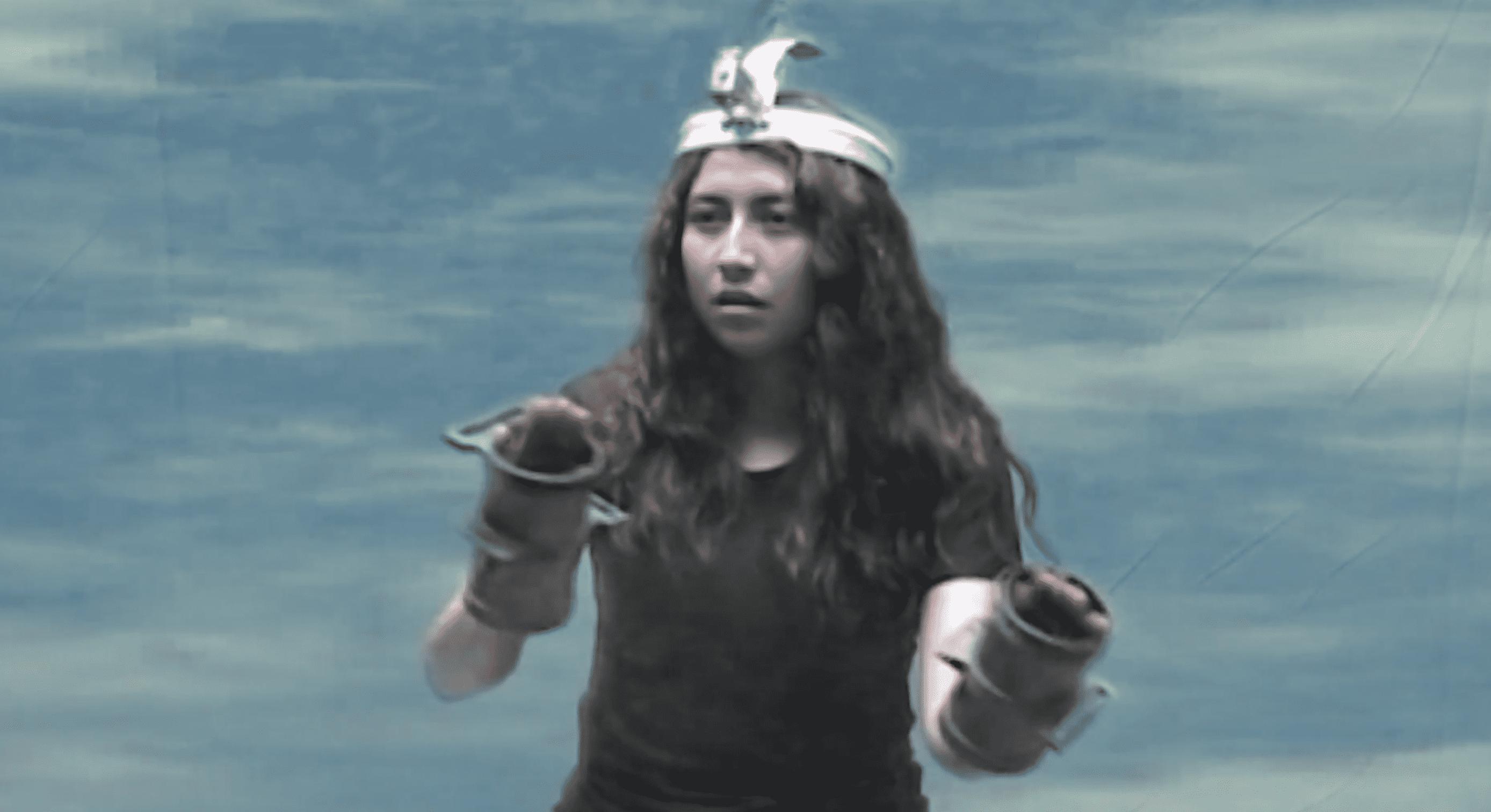
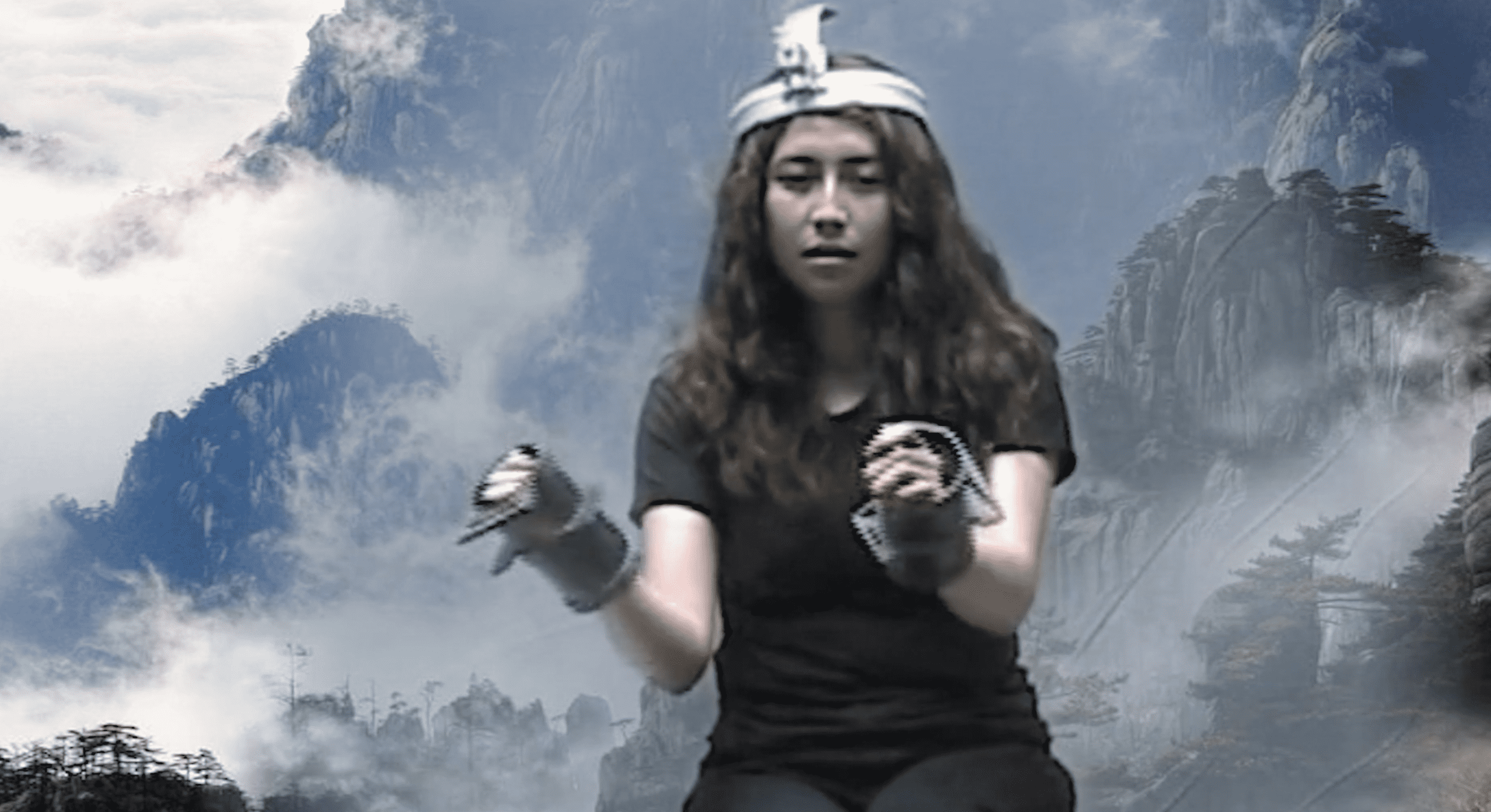
The Woman and the Robot (fig. front page, 2023) is a video adaptation by artist Óscar Santillán, based on a theatrical play written in 1938 by Guatemalan author Miguel Marsicovétere (1912–1974). One of the earliest works of science fiction in Latin America, The Woman and the Robot imagines a dystopian robotic takeover. In the play, an Indigenous Maya K’iche’ woman becomes the sole human survivor and is tasked with repopulating the Earth.

Shot in low definition and deliberately unresolved, the work distances itself from narratives of technological progress. Santillán’s reinterpretation of the story rejects spectacle and appears temporally out of sync. Here, the low-resolution image is not nostalgic but strategic, resulting in an incomplete transmission that refuses the clarity and high definition promised by futurist imaginaries.

Nearly a century after Marsicovétere’s play was written, The Woman and the Robot resonates with contemporary anxieties about automation, ecological collapse, and machine consciousness, while foregrounding a question science fiction has rarely posed: what forms of knowledge will survive the end of the world?

What Is It Like to Be Earth?, presented at the Centro de Arte Contemporáneo de Quito through April 2026, brings together works produced by Óscar Santillán (Ecuador, 1980) over the past decade. The exhibition unfolds as a constellation of installations, video sculptures, augmented reality, and visual essays that weave together art, science, and speculative thought. Curated by Sara Garzón, it proposes a reflection on more-than-human intelligence, Global South epistemologies, and ecocriticism—not as abstract theoretical frameworks, but as situated practices of knowledge production.

The exhibition enacts a radical displacement of the human. Across various works, Santillán mobilizes scientific phenomena, ecological processes, and speculative fictions to interrogate the limits of our conception of the human.

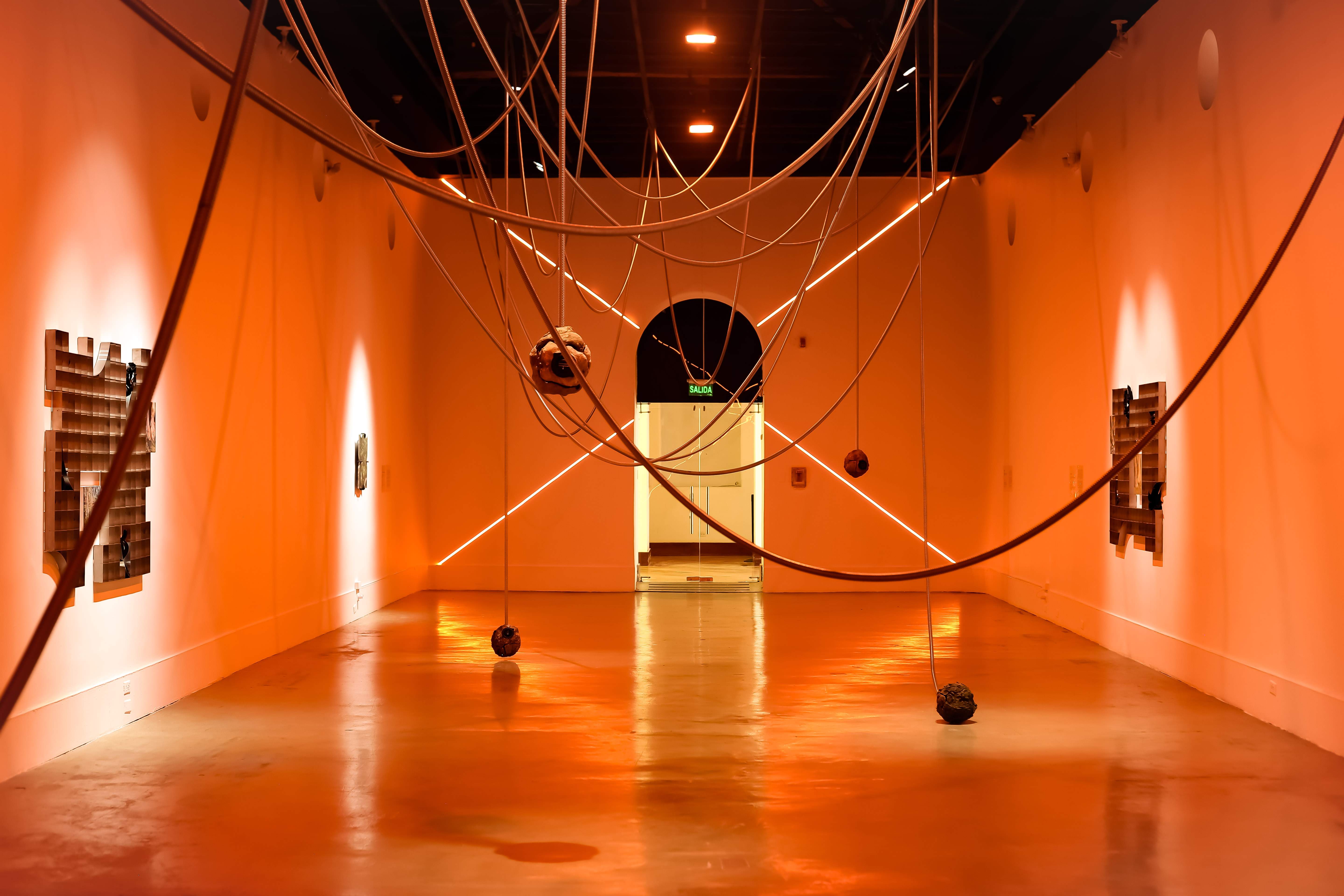
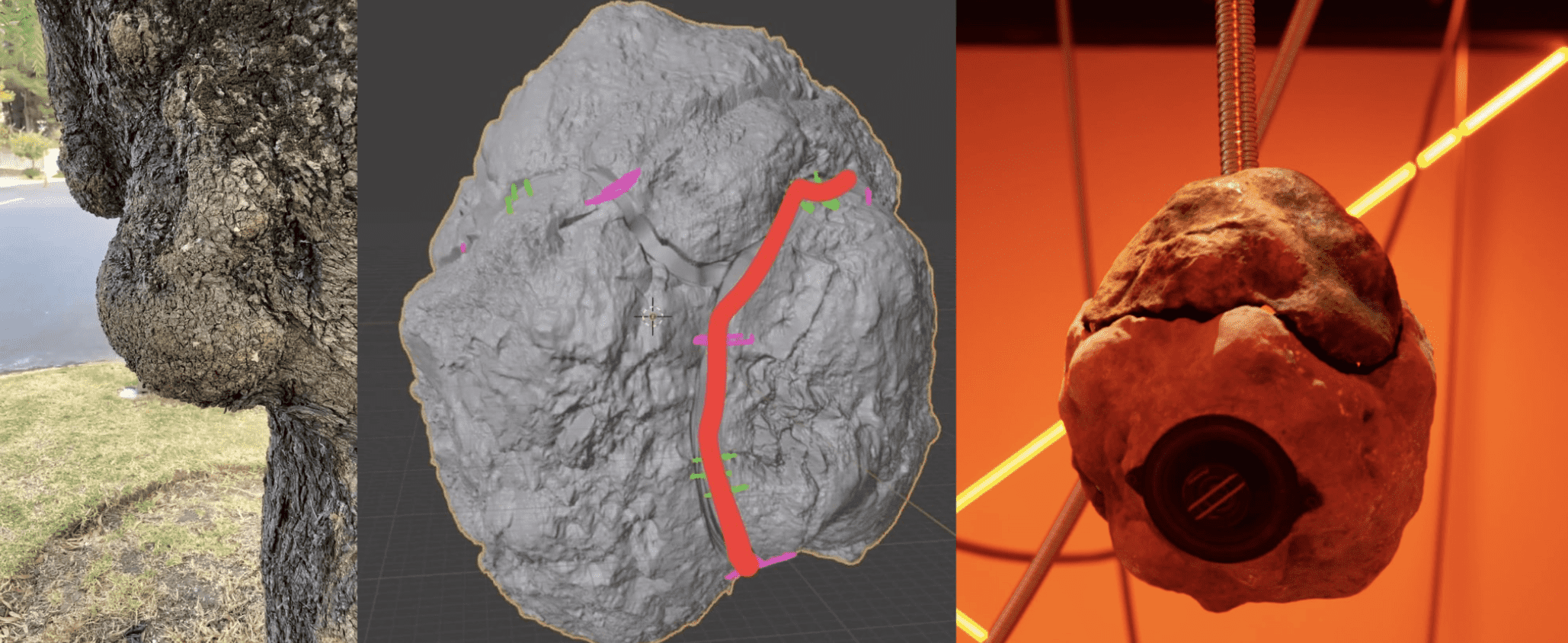
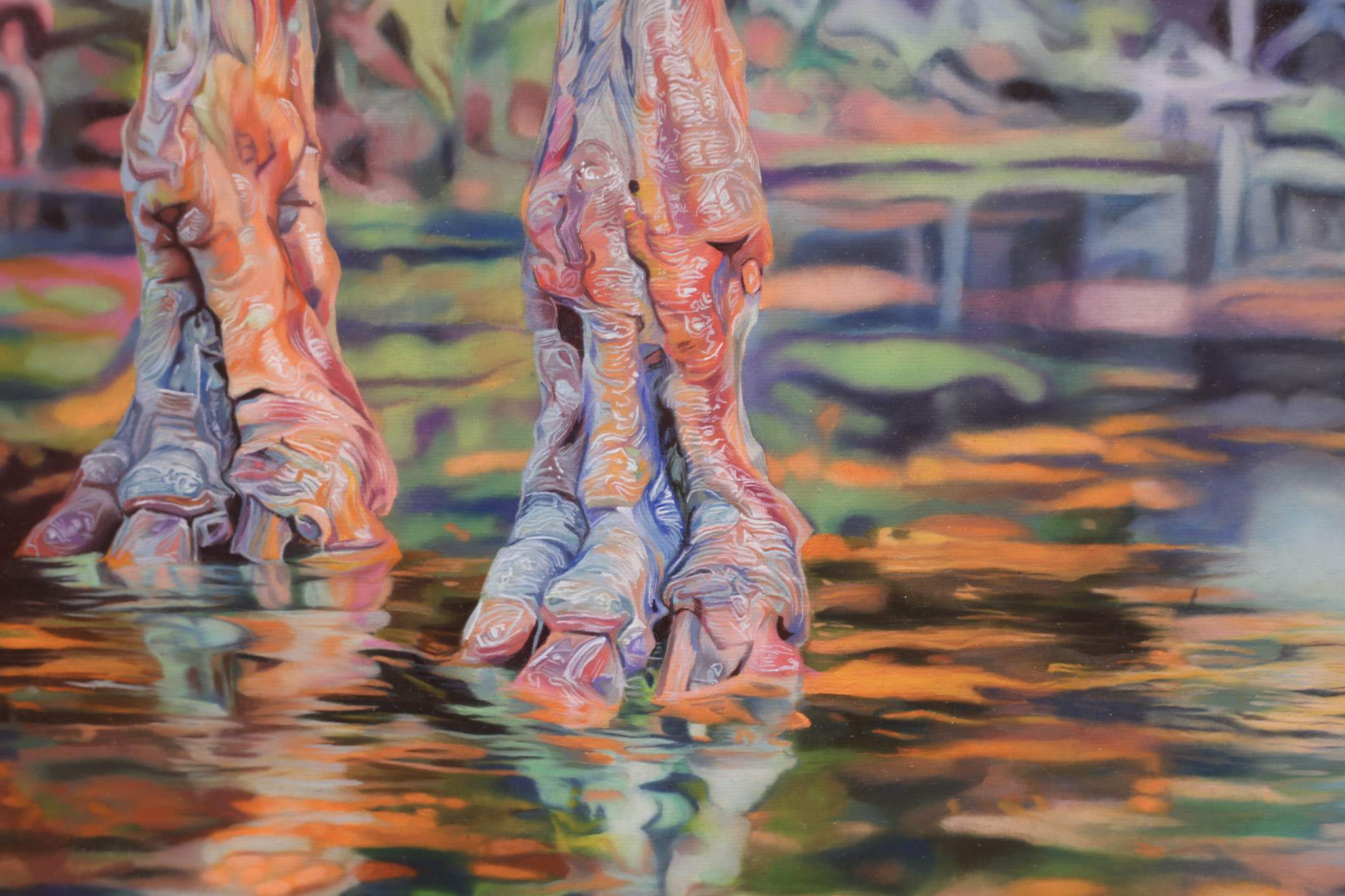
At the center of the exhibition, the artist’s new installation Anthem (fig. 2, 2025) proposes a form of interspecies communication. The interaction simulates a dialogue through an acoustic network of machines that translate, distort, and transmit sounds modeled on animal communication. The work comprises four devices suspended above the ground that emulate tree tumors, natural growths caused by infections in tree bark. Santillán created 3D-printed replicas of these tumors and housed within them speakers, microphones, and sound processors that enabled the simulation of an interspecies exchange (fig. 3).

The acoustic system draws from existing sound libraries containing birds, mammals, and reptiles. These were then interwoven with engineered sounds attributed to mythological beings in an effort to insert unclassified forms of life into the archive. From this layered reservoir, the installation generates new vocalizations shaped by the cadence of the human voice, performed by the mezzo-soprano singer Diana Galarza and designed by Nicolás Fernández in collaboration with composer David Tapia. In the installation, the sound remains in constant transformation. No single origin stabilizes, and no fixed intention or recipient emerges. Rather than a conversation, the audience enters a zone of partial intelligibility. Meaning surfaces, fractures, and recedes, carrying echoes, resonances, and whispers.

Eduardo Kohn’s How Forests Think (2013) is a central reference for Santillán’s research. In it, Kohn argues that intelligence is not exclusively human but a distributed capacity shared across multiple forms of life that interpret, respond to, and produce signs[1]. Similar to Kohn’s forest semiotics, communication in Santillán’s interspecies exchange emerges through interactions among bodies, rhythms, and signs: humans who vocalize, machines that process, and organic materials that resonate.

Anthem occupies a deliberately ambiguous terrain, distancing itself from any linear relationship between research and outcome. The piece responds in real time to visitors’ vocalizations, generating hypothetical calls that evoke, without reproducing, known animal registers. Here, signs are not stable symbols, but material events: sonic vibrations, rhythms, intensities, spatial modulations, and embodied responses.

Participating in the multispecies dialogue is not about speaking on behalf of the Earth or listening to the sounds of nature, but about acknowledging that the Earth has always been speaking its own language. From this perspective, the sound system does not represent nonhuman intelligence; it enacts it as a relational process.

When the Human No Longer Occupies the Center

Curator Sara Garzón situates Santillán’s exhibition in dialogue with the work of the Czech-Brazilian philosopher Vilém Flusser (1920–1991). As a new media scholar, Flusser argued that technology is not neutral but actively shapes perception, knowledge, and our understanding of life.

Flusser’s posthumanist thinking finds one of its most radical articulations in Vampyroteuthis Infernalis (1987), a speculative natural history of the deep-sea vampire squid that stages an ontological reversal of the human. Through this imagined biology, Flusser constructs a counterfigure that unsettles Western anthropocentrism and reframes cognition as neither singular nor exclusively human. As Garzón observes, “in constructing a thorough examination of the vampire squid, Flusser destabilizes the assumption that human thought provides the primary model for understanding life, culture, or nature.”

Reading Santillán’s exhibition through these frameworks reveals how his work belongs to a critical tradition that uses science, technology, and biological speculation to interrogate the boundaries of the human. As Garzón emphasizes, both Flusser and Santillán propose that technological, natural, or spiritual “others” should not be understood as extensions or metaphors of the human, but as autonomous modes of perception and existence that compel us to rethink what we consider human. 

From this standpoint, the exhibition challenges modern notions of the “natural” inherited from Western scientific traditions, particularly the classificatory systems developed since the eighteenth century. Figures such as Carolus Linnaeus, in Systema Naturae (1735), organized the world through hierarchical divisions among the animal, vegetal, and mineral kingdoms. These systems not only sought to order nature but also instituted a separation between the human and that which was to be observed, classified, and administered.

Despite its apparent precision, the Linnaean system soon revealed its limitations, proving incapable of encompassing the full diversity of life forms and elements that constitute the Earth. In response to this insufficiency, Linnaeus introduced an exceptional category, Paradoxa, designed to gather entities that did not fit within any known classification or whose existence remained uncertain, such as dragons, frog-fish, and unicorns.

As curator Sara Garzón notes, it is precisely from this fissure in scientific rationality that Óscar Santillán develops Paradoxa I & II (2025). The work reimagines the taxonomic diagrams that have historically governed the classification of life, populating them with ambiguous entities: limbs of unidentified creatures, plants with sensual or monstrous traits, shells that may or may not exist, and abstract forms derived from scientific experiments on human cognition (fig. 5). Within this visual universe, the boundaries between the natural and the artificial become unstable. As Garzón argues, Santillán’s Paradoxa does not seek to order the world but to open a space for an anti-taxonomy capable of unsettling inherited structures of knowledge.

What Is It Like to Be Earth? functions less as a retrospective than as a conversation in which old and new works reappear transformed, enter into dialogue, and allow earlier investigations to be reactivated in light of contemporary concerns. Through the convergence of scientific and speculative thought, the exhibition reopens one of the most urgent questions of our time: what do we mean by nature when the boundaries among the human, the technological, and the planetary reveal themselves to be unstable? Rather than offering answers, the exhibition makes clear that thinking at the threshold of our imagination does not mean renouncing the pursuit of knowledge, but opening the possibility of other forms of listening, other scales of perception, and other ways of inhabiting a world that has never been exclusively human.


------------

notes:

[1]Kohn, Eduardo. How Forests Think: Toward an Anthropology Beyond the Human. United Kingdom: University of California Press, 2013.



Image Image Image Image Image

What Is It Like to Be Earth? does not begin with the Earth as ground, nor with technology as a tool. Instead, it begins with a story retold nearly a century ago—one whose resonance still feels inescapable today.

The Woman and the Robot (fig. front page, 2023) is a video adaptation by artist Óscar Santillán, based on a theatrical play written in 1938 by Guatemalan author Miguel Marsicovétere (1912–1974). One of the earliest works of science fiction in Latin America, The Woman and the Robot imagines a dystopian robotic takeover. In the play, an Indigenous Maya K’iche’ woman becomes the sole human survivor and is tasked with repopulating the Earth.

Shot in low definition and deliberately unresolved, the work distances itself from narratives of technological progress. Santillán’s reinterpretation of the story rejects spectacle and appears temporally out of sync. Here, the low-resolution image is not nostalgic but strategic, resulting in an incomplete transmission that refuses the clarity and high definition promised by futurist imaginaries.

Nearly a century after Marsicovétere’s play was written, The Woman and the Robot resonates with contemporary anxieties about automation, ecological collapse, and machine consciousness, while foregrounding a question science fiction has rarely posed: what forms of knowledge will survive the end of the world?

What Is It Like to Be Earth?, presented at the Centro de Arte Contemporáneo de Quito through April 2026, brings together works produced by Óscar Santillán (Ecuador, 1980) over the past decade. The exhibition unfolds as a constellation of installations, video sculptures, augmented reality, and visual essays that weave together art, science, and speculative thought. Curated by Sara Garzón, it proposes a reflection on more-than-human intelligence, Global South epistemologies, and ecocriticism—not as abstract theoretical frameworks, but as situated practices of knowledge production.

The exhibition enacts a radical displacement of the human. Across various works, Santillán mobilizes scientific phenomena, ecological processes, and speculative fictions to interrogate the limits of our conception of the human.

At the center of the exhibition, the artist’s new installation Anthem (fig. 2, 2025) proposes a form of interspecies communication. The interaction simulates a dialogue through an acoustic network of machines that translate, distort, and transmit sounds modeled on animal communication. The work comprises four devices suspended above the ground that emulate tree tumors, natural growths caused by infections in tree bark. Santillán created 3D-printed replicas of these tumors and housed within them speakers, microphones, and sound processors that enabled the simulation of an interspecies exchange (fig. 3).

The acoustic system draws from existing sound libraries containing birds, mammals, and reptiles. These were then interwoven with engineered sounds attributed to mythological beings in an effort to insert unclassified forms of life into the archive. From this layered reservoir, the installation generates new vocalizations shaped by the cadence of the human voice, performed by the mezzo-soprano singer Diana Galarza and designed by Nicolás Fernández in collaboration with composer David Tapia. In the installation, the sound remains in constant transformation. No single origin stabilizes, and no fixed intention or recipient emerges. Rather than a conversation, the audience enters a zone of partial intelligibility. Meaning surfaces, fractures, and recedes, carrying echoes, resonances, and whispers.

Eduardo Kohn’s How Forests Think (2013) is a central reference for Santillán’s research. In it, Kohn argues that intelligence is not exclusively human but a distributed capacity shared across multiple forms of life that interpret, respond to, and produce signs[1]. Similar to Kohn’s forest semiotics, communication in Santillán’s interspecies exchange emerges through interactions among bodies, rhythms, and signs: humans who vocalize, machines that process, and organic materials that resonate.

Anthem occupies a deliberately ambiguous terrain, distancing itself from any linear relationship between research and outcome. The piece responds in real time to visitors’ vocalizations, generating hypothetical calls that evoke, without reproducing, known animal registers. Here, signs are not stable symbols, but material events: sonic vibrations, rhythms, intensities, spatial modulations, and embodied responses.

Participating in the multispecies dialogue is not about speaking on behalf of the Earth or listening to the sounds of nature, but about acknowledging that the Earth has always been speaking its own language. From this perspective, the sound system does not represent nonhuman intelligence; it enacts it as a relational process.

When the Human No Longer Occupies the Center

Curator Sara Garzón situates Santillán’s exhibition in dialogue with the work of the Czech-Brazilian philosopher Vilém Flusser (1920–1991). As a new media scholar, Flusser argued that technology is not neutral but actively shapes perception, knowledge, and our understanding of life.

Flusser’s posthumanist thinking finds one of its most radical articulations in Vampyroteuthis Infernalis (1987), a speculative natural history of the deep-sea vampire squid that stages an ontological reversal of the human. Through this imagined biology, Flusser constructs a counterfigure that unsettles Western anthropocentrism and reframes cognition as neither singular nor exclusively human. As Garzón observes, “in constructing a thorough examination of the vampire squid, Flusser destabilizes the assumption that human thought provides the primary model for understanding life, culture, or nature.”

Reading Santillán’s exhibition through these frameworks reveals how his work belongs to a critical tradition that uses science, technology, and biological speculation to interrogate the boundaries of the human. As Garzón emphasizes, both Flusser and Santillán propose that technological, natural, or spiritual “others” should not be understood as extensions or metaphors of the human, but as autonomous modes of perception and existence that compel us to rethink what we consider human. 

From this standpoint, the exhibition challenges modern notions of the “natural” inherited from Western scientific traditions, particularly the classificatory systems developed since the eighteenth century. Figures such as Carolus Linnaeus, in Systema Naturae (1735), organized the world through hierarchical divisions among the animal, vegetal, and mineral kingdoms. These systems not only sought to order nature but also instituted a separation between the human and that which was to be observed, classified, and administered.

Despite its apparent precision, the Linnaean system soon revealed its limitations, proving incapable of encompassing the full diversity of life forms and elements that constitute the Earth. In response to this insufficiency, Linnaeus introduced an exceptional category, Paradoxa, designed to gather entities that did not fit within any known classification or whose existence remained uncertain, such as dragons, frog-fish, and unicorns.

As curator Sara Garzón notes, it is precisely from this fissure in scientific rationality that Óscar Santillán develops Paradoxa I & II (2025). The work reimagines the taxonomic diagrams that have historically governed the classification of life, populating them with ambiguous entities: limbs of unidentified creatures, plants with sensual or monstrous traits, shells that may or may not exist, and abstract forms derived from scientific experiments on human cognition (fig. 5). Within this visual universe, the boundaries between the natural and the artificial become unstable. As Garzón argues, Santillán’s Paradoxa does not seek to order the world but to open a space for an anti-taxonomy capable of unsettling inherited structures of knowledge.

What Is It Like to Be Earth? functions less as a retrospective than as a conversation in which old and new works reappear transformed, enter into dialogue, and allow earlier investigations to be reactivated in light of contemporary concerns. Through the convergence of scientific and speculative thought, the exhibition reopens one of the most urgent questions of our time: what do we mean by nature when the boundaries among the human, the technological, and the planetary reveal themselves to be unstable? Rather than offering answers, the exhibition makes clear that thinking at the threshold of our imagination does not mean renouncing the pursuit of knowledge, but opening the possibility of other forms of listening, other scales of perception, and other ways of inhabiting a world that has never been exclusively human.


------------

notes:

[1]Kohn, Eduardo. How Forests Think: Toward an Anthropology Beyond the Human. United Kingdom: University of California Press, 2013.