Adriana Melchor Betancourt writes about “El espacio vientre”by Colombian artist Delcy Morelos, who transforms Gallery 9 of the Museo Universitario Arte Contemporáneo into a sensory and ritual experience where earth becomes offering, memory, and a political gesture. In this review, Melchor examines Morelos’s work, its local implications, and the relevant frictions and questions surrounding a continental region that once again seems open to plunder.
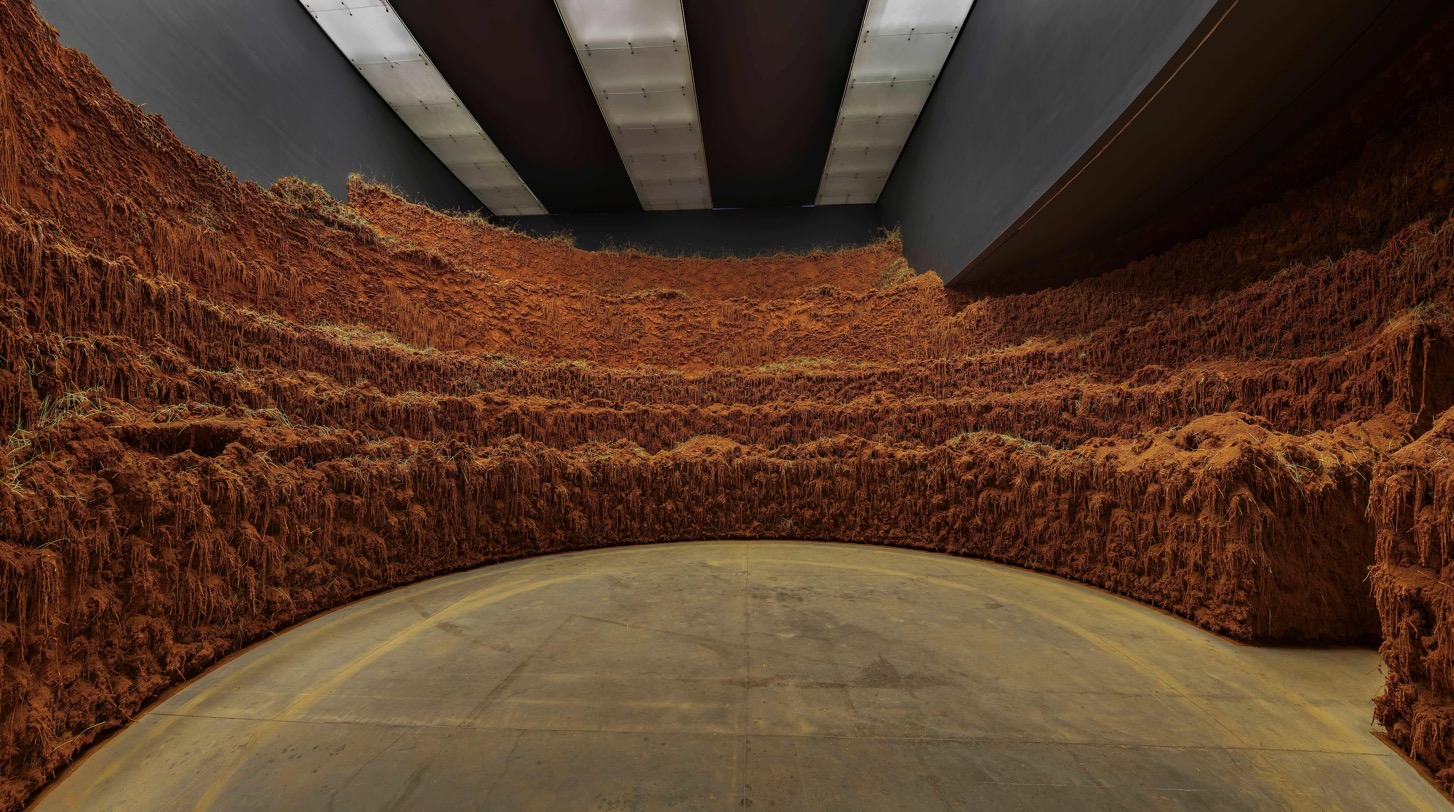
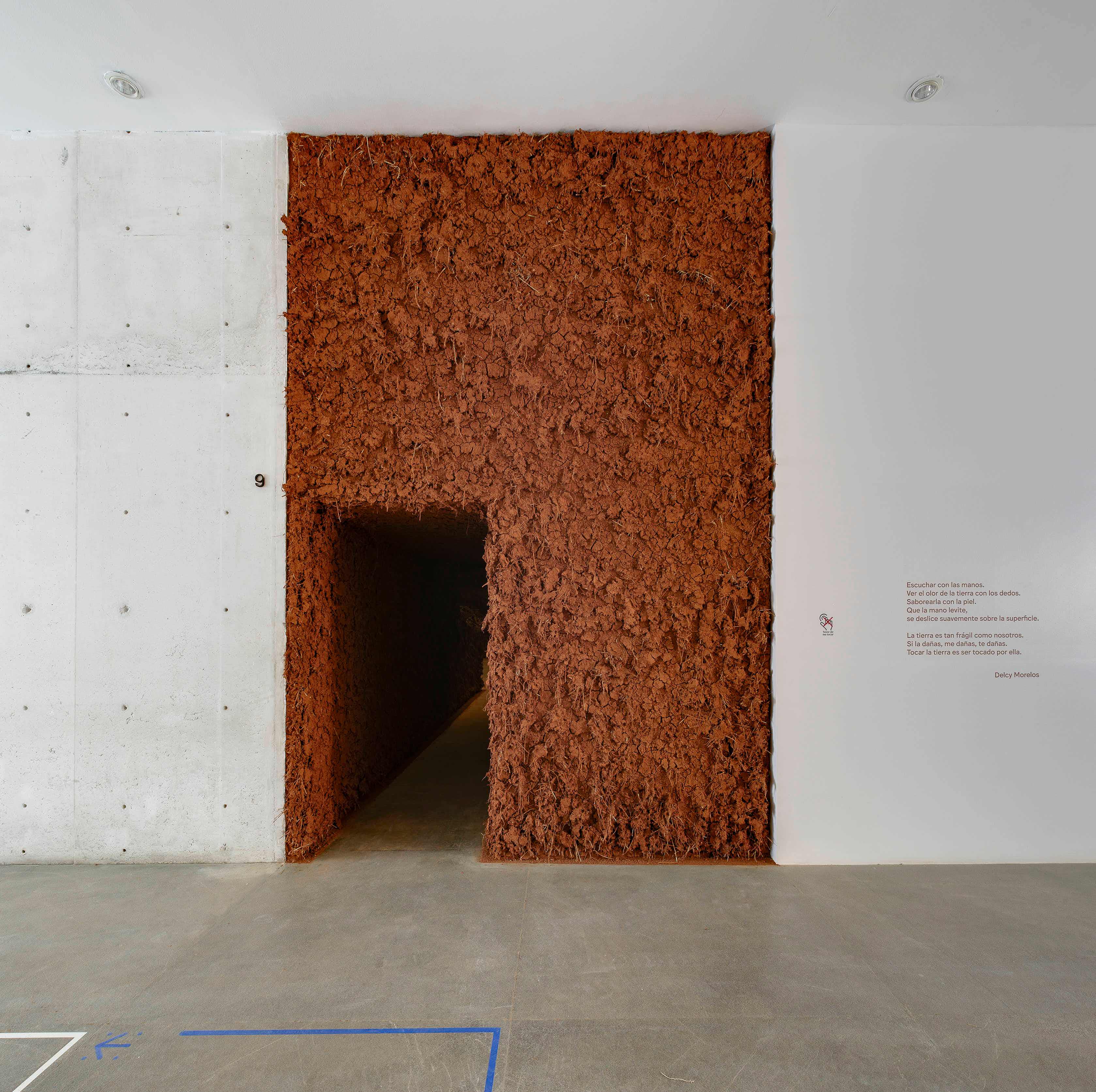
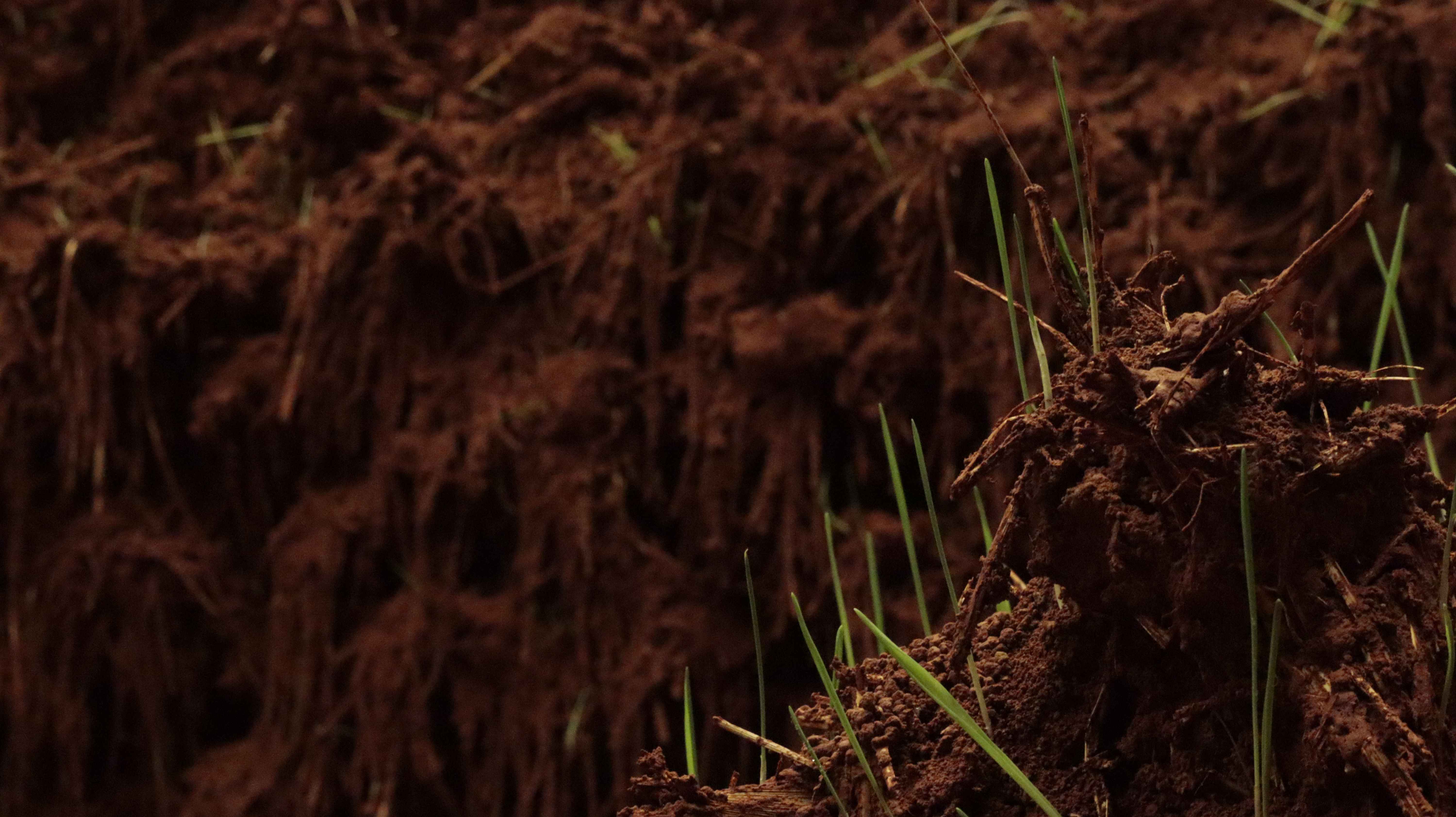
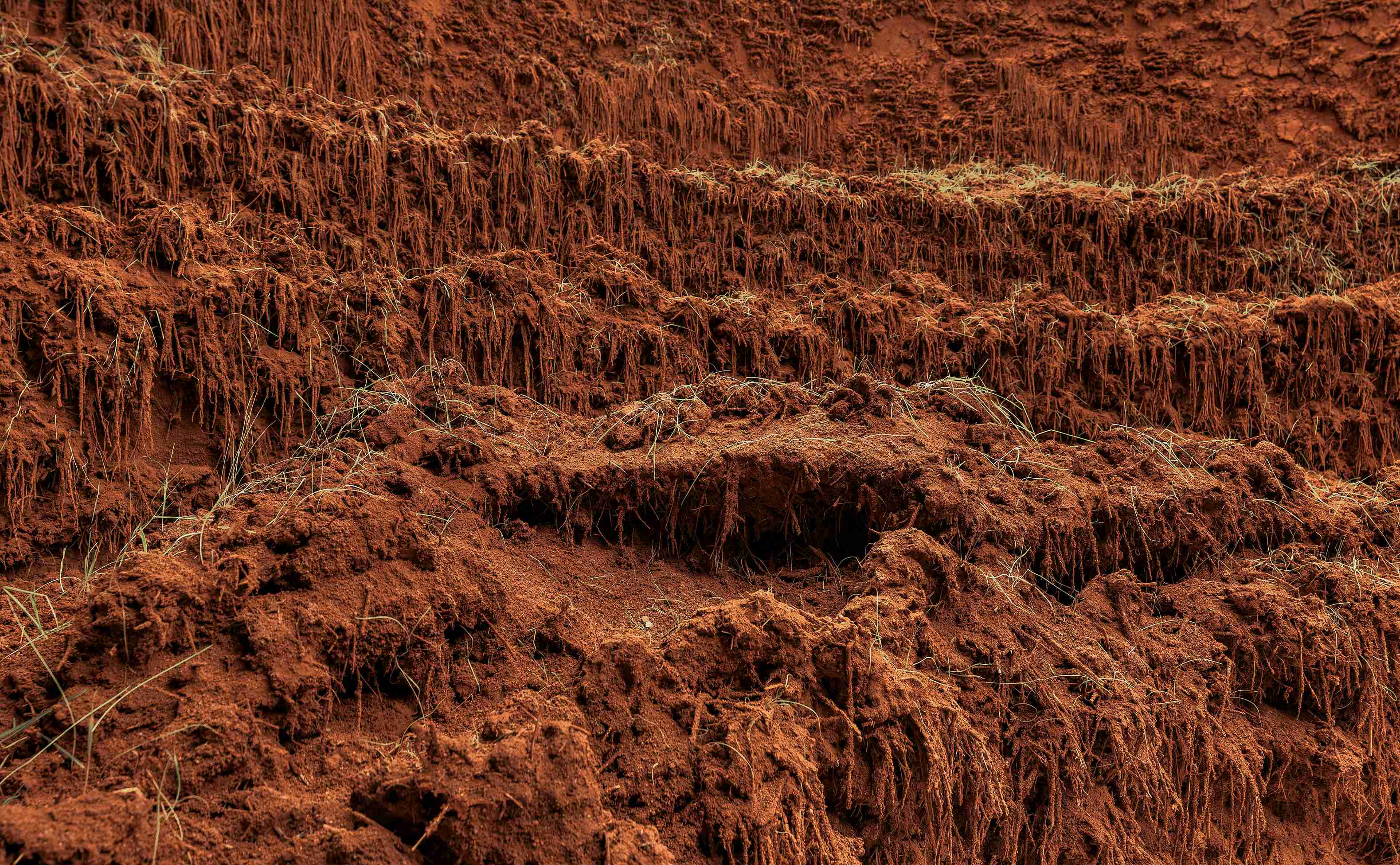
A narrow corridor lined with thick walls of compacted red earth leads you into a space that gradually reveals itself as a womb. You are enveloped by roughly concentric walls of reddish soil that rise in height, at times reaching the ceiling and light fixtures of Gallery 9 at the Museo Universitario Arte Contemporáneo. Standing there, I feel as though I am inside a crater and at the same time in an agora, a space where, if I could climb upward, I would find a place to sit. The space feels cool and slightly humid. As I move through it, I rely on my gaze, scanning the space as one would in open terrain or the countryside, searching the horizon.
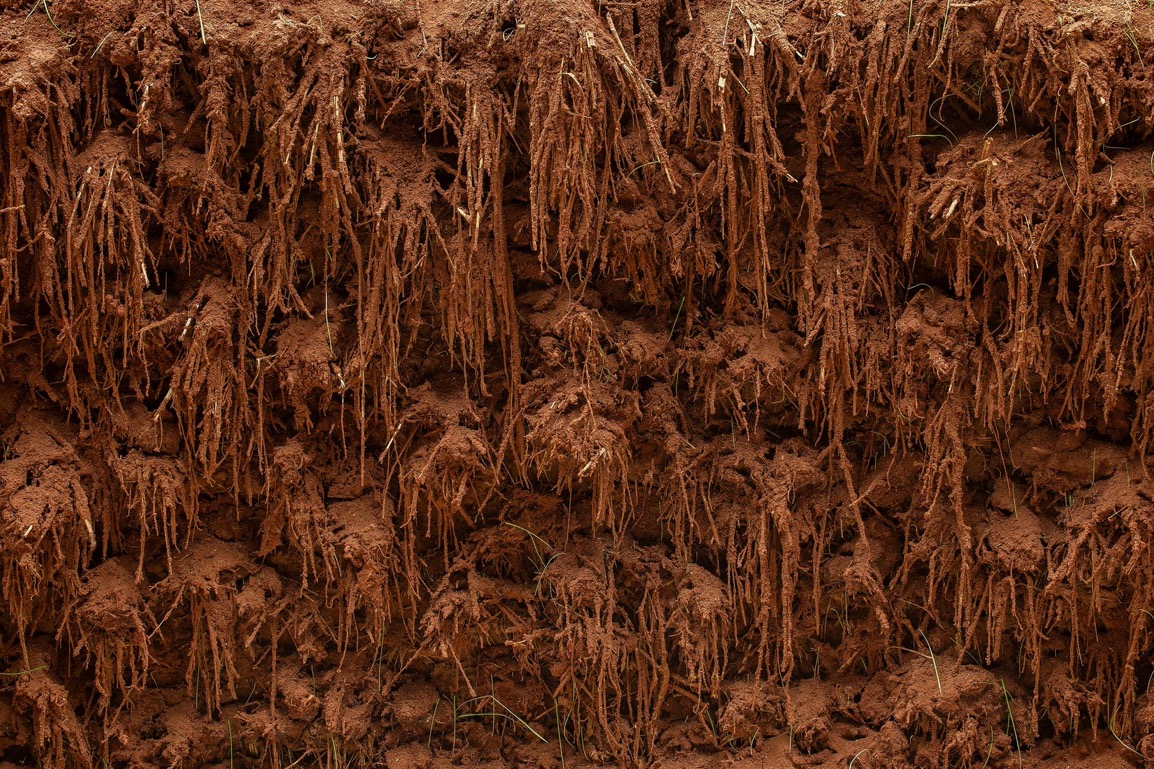
The Womb Space, curated by Alejandra Labastida and Daniel Montero, is the most recent project by Colombian artist Delcy Morelos, who for more than a decade has worked with earth as the primary material in her large-scale interventions and sculptures. Two key references for this work are the Espacio Escultórico at UNAM and the piramid of Cuicuilco; the gallery text also evokes the landscape shaped by the eruption of the Volcán Xitle. All of these sites belong to the geography of southern Mexico City and are located near the Museo Universitario Arte Contemporáneo. Yet the earth itself comes from agricultural fields in Otumba, in the State of Mexico. The reddish soil is mixed with clove, cinnamon, chia, straw, and corn, a recurring gesture in her earth-based works. In several interviews, the artist has explained that this mixture refers to an ancestral tradition from the Argentine Andes that pays tribute to Pachamama, regarded as the soul of the earth. The act involves offering different infusions to the land, each varying subtly from one work to another. Through this gesture, key aspects of her practice emerge: the presence of ancestral cosmologies, spirituality, and ritual as lived experience.
Earth is not merely the raw material of many of her works, but an integral element in a broader reflection on the struggle for territory and on a profound respect for the cycles of life, death, and rebirth. Early in her practice, the artist focused on violence in Colombia, racism, social inequality, and the dispossession of land. Soil lies at the heart of armed conflict, and for Morelos a desire emerged to approach it from another place[1]. To create her works, she uses soil taken from the site where they are presented. Across its many configurations, the work enters into dialogue with different territories; its finish and tonality respond to the specific conditions of each location. For this presentation in Mexico, special attention is given to the incorporation of straw, a deliberate and careful gesture. As Delcy explains, she places each strand individually, exactly where she senses it should rest[2]. After the exhibition, the earth will return to its place of origin.
The title of the work, The Womb Space, points to a feminine component; however, it does not refer to female organs but to the wisdom that women safeguard and transmit orally. Care for the environment and ancestral knowledge constitute a body of understanding that Delcy respects and recognizes as a feminine energy. On other occasions, Morelos has spoken of considering the earth as a womb[3]. In No es un río, es una madre [It Is Not a River, It Is a Mother] (2014), the title refers to Colombia’s Sinú River, severely affected by the construction of the Urrá I hydroelectric dam. For the Embera people, the river had been massacred, prompting forceful protest under the phrase: “It is not a river, it is a mother.” The river was a source of nourishment and helped fertilize the land.[4]
With this installation, the museum launches a new exhibition program that will commission site-specific works for Gallery 9. At the entrance to the gallery, it is stated that these will be “annual large-scale commissions (…) aimed at engaging audiences in experiences that respond in ambitious, critical, and creative ways to contemporary issues.” I am curious to see what they will present next. During the opening talk, it was mentioned that this gallery will host site-specific projects and that no other museum is taking on this challenge. But is the question whether other institutions are doing the same? Do exhibition spaces need to accommodate these kinds of experiences? Or do they already exist in other forms and contexts?
Delcy Morelos is the third Colombian artist to exhibit at MUAC. In 2011, Doris Salcedo presented Plegaria muda [Silent prayer], followed by Beatriz González in 2023. Salcedo’s installation occupied an entire gallery with a forceful presence. A year later, in 2012, Teresa Margolles presented La promesa [The Promise], another large-scale installation that made for a deeply affecting experience, both in its conceptual premise and in its spatial presence. I recall both Salcedo’s and Margolles’s works vividly for the sensory confrontation they produced. In exhibitions composed of multiple works, the experience unfolds differently: the rhythm of the visit shifts and attention disperses, particularly in longer shows. Monumental pieces that fill an entire gallery, by contrast, intensify the encounter: one either passes through rapidly or lingers in contemplation. For Morelos’s installation, capacity and viewing time are limited, as the space cannot accommodate many visitors at once. I am also reminded of comments the artist has made about audience behavior. She has noted that Earthly Paradise (2022), the installation she presented at the 59th Venice Biennale, was subjected to mistreatment. For her, this confirmed that we lack a respectful relationship with an element as vital to life as the earth, as well as with artistic labor itself.
Another dimension to consider is the public program accompanying The Womb Space. Among its activities was the course Histories of Contemporary Colombian Art, taught by Natalia Gutiérrez and Daniel Montero. The course sought to establish a dialogue between the artistic contexts of Mexico and Colombia and broaden the panorama beyond figures such as Fernando Botero[5]. Such programs that accompany exhibitions are often overlooked, and they rarely enter critical discussion. In this case, however, the course felt especially timely. At a moment when political and social tensions are resurfacing across the region, it becomes necessary to revisit the histories of our countries, which are too easily grouped under unstable and problematic categories such as Latin America, Central America, or the Caribbean.
Reviewing the new educational offerings of Campus Expandido, MUAC’s public program dedicated to research and critical pedagogy, I would highlight two courses: Groups and Militant Pedagogies: Art, Participation, and Educational Critique in the 1970s and Rebellious Archives: Critical Methodologies and Artistic Practices in Central America and the Caribbean. From their titles alone, one can anticipate exhibitions and research initiatives engaging with these themes. While other institutions will likely focus their programming on activities related to the World Cup, often in response to governmental directives, it becomes crucial to preserve spaces for reflection on the crises that are already reshaping the geopolitical landscape. During the 1970s, intense debates unfolded around the question of Latin American identity, alongside networks of collaboration among cultural agents across national borders, even under the pressure of dictatorial regimes. Revisiting those experiences now feels not only timely, but necessary.
The contemporary art world often exoticizes and exploits artistic practices that meaningfully engage the ancestral knowledge of Indigenous communities that continue to endure today. Likewise, some artists have leveraged their family histories or lineages to market themselves and secure positions in museums or international biennials. Such conditions demand a careful and critical approach when an institution presents a body of work with these characteristics.
Rather than reading texts about her work, I chose to listen to recordings of the artist speaking, as I was particularly interested in encountering her voice directly. In doing so, I became more attentive to her perspective. This felt especially significant because, during the opening talk, she emphasized the importance of listening—not only as a formal element of the work, but as a practice for everyday life. In the talks and interviews I consulted, she consistently reflects on the lessons she has drawn from others. On several occasions, she refers to her Huitoto teacher of Amazonian philosophy, Isaías Román. She also acknowledges the teachings she received from women elders of the Amazon, as well as what she learned from the Japanese Shinto ceramicists with whom she worked. From them, she learned that everything we make with our hands is filled with spirit; objects are imbued with it, as is everything that surrounds us. Such an understanding calls for treating these objects with respect, especially works of art. At the same time, I would resist romanticizing all ancestral forms of knowledge and remain curious about the contradictions the artist may have encountered throughout her many years of learning.
The Womb Space is an offering to the territory. Despite its monumentality—a quality contemporary art often privileges for its effect on viewers—the work proposes an encounter first through the body and only then through thought, engaging the spiritual and ritual dimensions of the surrounding world. Soil that urban dwellers tend to discard, because it dirties shoes or enters the home, appears ceremonial within an exhibition space such as the MUAC, though at its origin it is earth that is worked and cultivated. Yet this same earth is also a source of familial, national, and international disputes. As Delcy reminds us: “The earth is as fragile as we are / If you damage it, you damage me, you damage yourself.”
[1] Delcy Morelos, “Delcy Morelos: Working with the Earth to Liberate the Soul,” interview by Julián Sánchez González, MoMA Magazine, May 25, 2023, https://www.moma.org/magazine/articles/902; [2] Delcy Morelos, “Delcy Morelos Book Launch,” Dia Art Foundation, YouTube, 17:24, https://www.youtube.com/watch?v=v3j7w__9GZ8&t=89s; [3] Margarita Posada, “Delcy Morelos, the Artist Ambassador of Mother Earth,” El País, December 6, 2023, https://elpais.com/america-colombia/branded/los-lideres-de-colombia/2023-12-06/delcy-morelos-la-artista-embajadora-de-la-madre-tierra.html;[4] Morelos, interview;[5] Course program https://historiarte.esteticas.unam.mx/sites/default/files/2025-07/DrMontero261.pdf.

A narrow corridor lined with thick walls of compacted red earth leads you into a space that gradually reveals itself as a womb. You are enveloped by roughly concentric walls of reddish soil that rise in height, at times reaching the ceiling and light fixtures of Gallery 9 at the Museo Universitario Arte Contemporáneo. Standing there, I feel as though I am inside a crater and at the same time in an agora, a space where, if I could climb upward, I would find a place to sit. The space feels cool and slightly humid. As I move through it, I rely on my gaze, scanning the space as one would in open terrain or the countryside, searching the horizon.
The Womb Space, curated by Alejandra Labastida and Daniel Montero, is the most recent project by Colombian artist Delcy Morelos, who for more than a decade has worked with earth as the primary material in her large-scale interventions and sculptures. Two key references for this work are the Espacio Escultórico at UNAM and the piramid of Cuicuilco; the gallery text also evokes the landscape shaped by the eruption of the Volcán Xitle. All of these sites belong to the geography of southern Mexico City and are located near the Museo Universitario Arte Contemporáneo. Yet the earth itself comes from agricultural fields in Otumba, in the State of Mexico. The reddish soil is mixed with clove, cinnamon, chia, straw, and corn, a recurring gesture in her earth-based works. In several interviews, the artist has explained that this mixture refers to an ancestral tradition from the Argentine Andes that pays tribute to Pachamama, regarded as the soul of the earth. The act involves offering different infusions to the land, each varying subtly from one work to another. Through this gesture, key aspects of her practice emerge: the presence of ancestral cosmologies, spirituality, and ritual as lived experience.
Earth is not merely the raw material of many of her works, but an integral element in a broader reflection on the struggle for territory and on a profound respect for the cycles of life, death, and rebirth. Early in her practice, the artist focused on violence in Colombia, racism, social inequality, and the dispossession of land. Soil lies at the heart of armed conflict, and for Morelos a desire emerged to approach it from another place[1]. To create her works, she uses soil taken from the site where they are presented. Across its many configurations, the work enters into dialogue with different territories; its finish and tonality respond to the specific conditions of each location. For this presentation in Mexico, special attention is given to the incorporation of straw, a deliberate and careful gesture. As Delcy explains, she places each strand individually, exactly where she senses it should rest[2]. After the exhibition, the earth will return to its place of origin.
The title of the work, The Womb Space, points to a feminine component; however, it does not refer to female organs but to the wisdom that women safeguard and transmit orally. Care for the environment and ancestral knowledge constitute a body of understanding that Delcy respects and recognizes as a feminine energy. On other occasions, Morelos has spoken of considering the earth as a womb[3]. In No es un río, es una madre [It Is Not a River, It Is a Mother] (2014), the title refers to Colombia’s Sinú River, severely affected by the construction of the Urrá I hydroelectric dam. For the Embera people, the river had been massacred, prompting forceful protest under the phrase: “It is not a river, it is a mother.” The river was a source of nourishment and helped fertilize the land.[4]
With this installation, the museum launches a new exhibition program that will commission site-specific works for Gallery 9. At the entrance to the gallery, it is stated that these will be “annual large-scale commissions (…) aimed at engaging audiences in experiences that respond in ambitious, critical, and creative ways to contemporary issues.” I am curious to see what they will present next. During the opening talk, it was mentioned that this gallery will host site-specific projects and that no other museum is taking on this challenge. But is the question whether other institutions are doing the same? Do exhibition spaces need to accommodate these kinds of experiences? Or do they already exist in other forms and contexts?
Delcy Morelos is the third Colombian artist to exhibit at MUAC. In 2011, Doris Salcedo presented Plegaria muda [Silent prayer], followed by Beatriz González in 2023. Salcedo’s installation occupied an entire gallery with a forceful presence. A year later, in 2012, Teresa Margolles presented La promesa [The Promise], another large-scale installation that made for a deeply affecting experience, both in its conceptual premise and in its spatial presence. I recall both Salcedo’s and Margolles’s works vividly for the sensory confrontation they produced. In exhibitions composed of multiple works, the experience unfolds differently: the rhythm of the visit shifts and attention disperses, particularly in longer shows. Monumental pieces that fill an entire gallery, by contrast, intensify the encounter: one either passes through rapidly or lingers in contemplation. For Morelos’s installation, capacity and viewing time are limited, as the space cannot accommodate many visitors at once. I am also reminded of comments the artist has made about audience behavior. She has noted that Earthly Paradise (2022), the installation she presented at the 59th Venice Biennale, was subjected to mistreatment. For her, this confirmed that we lack a respectful relationship with an element as vital to life as the earth, as well as with artistic labor itself.
Another dimension to consider is the public program accompanying The Womb Space. Among its activities was the course Histories of Contemporary Colombian Art, taught by Natalia Gutiérrez and Daniel Montero. The course sought to establish a dialogue between the artistic contexts of Mexico and Colombia and broaden the panorama beyond figures such as Fernando Botero[5]. Such programs that accompany exhibitions are often overlooked, and they rarely enter critical discussion. In this case, however, the course felt especially timely. At a moment when political and social tensions are resurfacing across the region, it becomes necessary to revisit the histories of our countries, which are too easily grouped under unstable and problematic categories such as Latin America, Central America, or the Caribbean.
Reviewing the new educational offerings of Campus Expandido, MUAC’s public program dedicated to research and critical pedagogy, I would highlight two courses: Groups and Militant Pedagogies: Art, Participation, and Educational Critique in the 1970s and Rebellious Archives: Critical Methodologies and Artistic Practices in Central America and the Caribbean. From their titles alone, one can anticipate exhibitions and research initiatives engaging with these themes. While other institutions will likely focus their programming on activities related to the World Cup, often in response to governmental directives, it becomes crucial to preserve spaces for reflection on the crises that are already reshaping the geopolitical landscape. During the 1970s, intense debates unfolded around the question of Latin American identity, alongside networks of collaboration among cultural agents across national borders, even under the pressure of dictatorial regimes. Revisiting those experiences now feels not only timely, but necessary.
The contemporary art world often exoticizes and exploits artistic practices that meaningfully engage the ancestral knowledge of Indigenous communities that continue to endure today. Likewise, some artists have leveraged their family histories or lineages to market themselves and secure positions in museums or international biennials. Such conditions demand a careful and critical approach when an institution presents a body of work with these characteristics.
Rather than reading texts about her work, I chose to listen to recordings of the artist speaking, as I was particularly interested in encountering her voice directly. In doing so, I became more attentive to her perspective. This felt especially significant because, during the opening talk, she emphasized the importance of listening—not only as a formal element of the work, but as a practice for everyday life. In the talks and interviews I consulted, she consistently reflects on the lessons she has drawn from others. On several occasions, she refers to her Huitoto teacher of Amazonian philosophy, Isaías Román. She also acknowledges the teachings she received from women elders of the Amazon, as well as what she learned from the Japanese Shinto ceramicists with whom she worked. From them, she learned that everything we make with our hands is filled with spirit; objects are imbued with it, as is everything that surrounds us. Such an understanding calls for treating these objects with respect, especially works of art. At the same time, I would resist romanticizing all ancestral forms of knowledge and remain curious about the contradictions the artist may have encountered throughout her many years of learning.
The Womb Space is an offering to the territory. Despite its monumentality—a quality contemporary art often privileges for its effect on viewers—the work proposes an encounter first through the body and only then through thought, engaging the spiritual and ritual dimensions of the surrounding world. Soil that urban dwellers tend to discard, because it dirties shoes or enters the home, appears ceremonial within an exhibition space such as the MUAC, though at its origin it is earth that is worked and cultivated. Yet this same earth is also a source of familial, national, and international disputes. As Delcy reminds us: “The earth is as fragile as we are / If you damage it, you damage me, you damage yourself.”
[1] Delcy Morelos, “Delcy Morelos: Working with the Earth to Liberate the Soul,” interview by Julián Sánchez González, MoMA Magazine, May 25, 2023, https://www.moma.org/magazine/articles/902; [2] Delcy Morelos, “Delcy Morelos Book Launch,” Dia Art Foundation, YouTube, 17:24, https://www.youtube.com/watch?v=v3j7w__9GZ8&t=89s; [3] Margarita Posada, “Delcy Morelos, the Artist Ambassador of Mother Earth,” El País, December 6, 2023, https://elpais.com/america-colombia/branded/los-lideres-de-colombia/2023-12-06/delcy-morelos-la-artista-embajadora-de-la-madre-tierra.html;[4] Morelos, interview;[5] Course program https://historiarte.esteticas.unam.mx/sites/default/files/2025-07/DrMontero261.pdf.


Subscribe to our newsletter!
¡Gracias por suscribirte!
CALLE DEL ARTÍCULO 123 #116 INT. 100,
COLONIA CENTRO, CUAUHTÉMOC,
CDMX 06040, MÉXICO