“From Centaurs to a Headless Beast: The Return of Yeguada Latinoamericana to Public Space.” From bodies cast into colonial oblivion to streets emptied after the 2019 uprising, this text proposes an insurgent mythology: a headless beast composed of fragments, memories, and synchronized pulses. A theoretical–practical investigation that thinks the body beyond the organism, challenges the idea of nature as a heteropatriarchal order, and rehearses new ways of returning to the streets when previous strategies have been captured. Gassed, mutilated, and disarticulated bodies return as a single multiple body. No head. No face. No servile function.
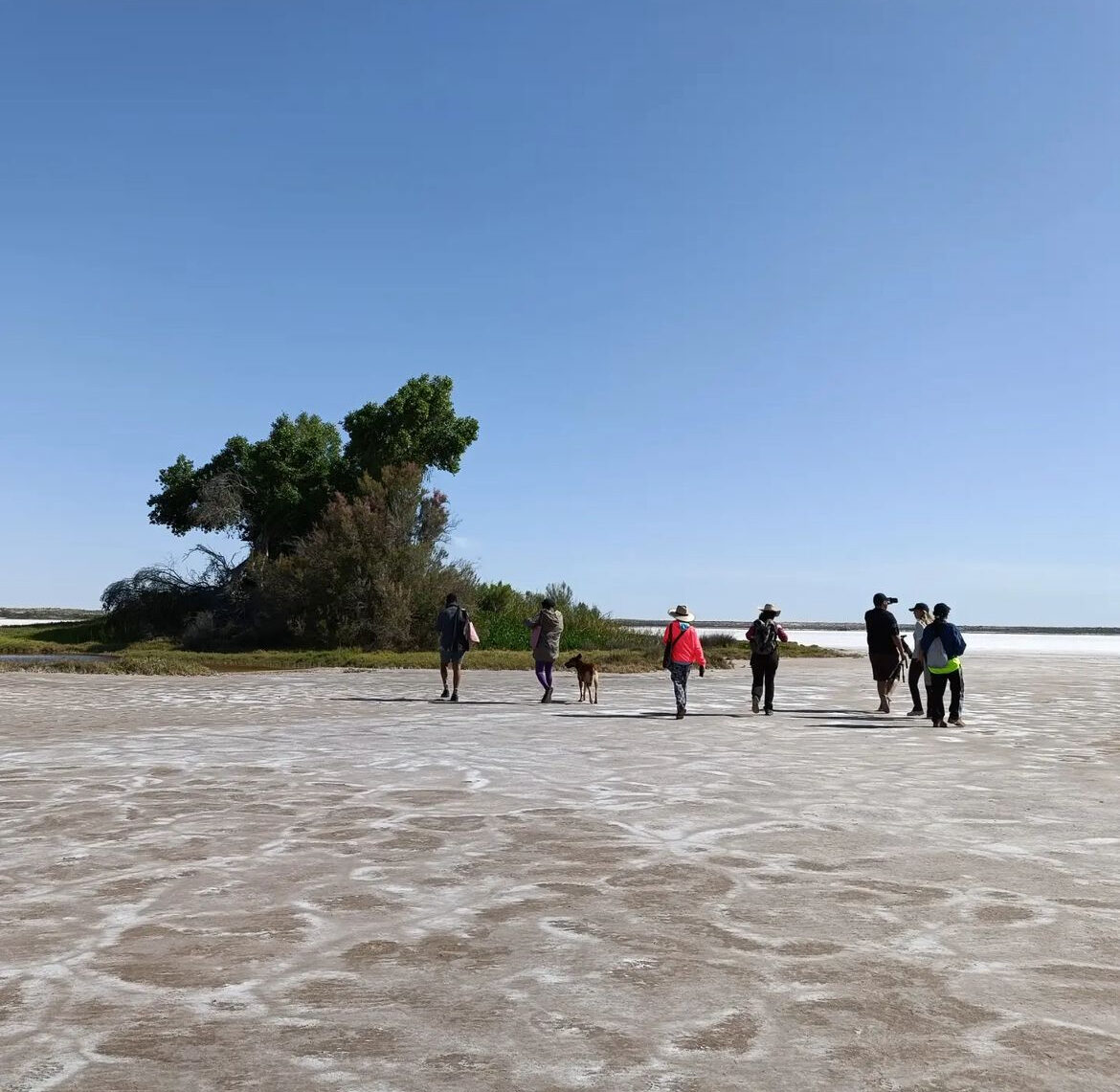
For five centuries, thousands of bodies have been dumped and hidden along the Andes Mountains, which cross seas, volcanic zones, highlands, valleys and deserts. Inhabitants of these territories since before the arrival of the Europeans, unbaptized blood made forgotten throughout Latin America. Sodomites erased from history during colonization, lesbians, transgender people and transvestites considered deviant blood. Combatants kidnapped, tortured, executed and forcibly disappeared by the dictatorships of the southern cone, incited by the global north. Workers and slaves in rebellion, massacred and lying underground. People removed from the map for seeking asylum far from their homeland. Suicidal people, refusing to become accomplices of regulatory systems with no room for dissent or human dignity: committed suicide.
Murmurs, shouts, and whispers stirred the Nazca oceanic plate; they moved it and it collided beneath the surface with the continental part of the South American plate. When the pressure from the poisonous gases and molten rock was sufficient to cause an explosion, the eruption occurred. Anuses and sexual organs sprouted all along the mountain range. The anuses opened to defecate, exposing their walls. From those openings, red and bright, in the surface layers of the mountain, fragments of riddled bodies emerged. Large emanations of sperm, flows of hair, menstrual irrigations, explosions of sweat, and rivers of saliva spilled across the land.
A great magnetic force attracted the human remains scattered across the mountain: flows and tissues, organs and membranes, mucous and muscles, limbs and joints. Machines coupled by the desire and predilection for subversion. They say “La sangre tira”[1]. That's why the beast hooked onto itself the pieces of all those people it found along the way, forming a disjointed, slippery, and polymorphous body. Its organs acquire new functions as it moves and travels. It breathes through its shoulder blades instead of its lungs; then, through one of its stomachs. It inflates and deflates rhythmically. Its parts drool over each other. Instead of phonetic words, it produces snores from within, which mutate into flashing bursts. It eats and fucks itself. It keeps breaking down.
It comes from a new world, but from an old cosmogony. With profane desire, it sets out on its journey towards the places where the spilled blood has been covered with cement.
So far, we have confronted law enforcement like a pack of centaurs. However, after the 2019 uprising, the streets in Chile emptied out and we have lost sovereignty over their use. The State and its agents took ruthless and violent measures to criminalize social protest. Police repression caused irreparable damage to the bodies of protesters, through the fragmentation of political articulations, eye mutilation, and attacks on civilians with projectiles such as tear gas and pellets. Traditional political forces attempted to give an institutional direction to the unease and indignation, which paved the way for the advance of the conservative far right in public discourse and made it clear that the forces seeking to overthrow the government did not have as much weight as we once believed. Given this, we ask ourselves: if the strategies of 2019 failed, how do we return to the streets?
De centauras a bestia acéfala [From centaurs to headless beast], the new work of the performance project Yeguada Latinoamericana[2], is a theoretical-practical research, an original idea by Cheril Linett, who proposed to a team of performers to explore body couplings and study references of posthuman philosophy, under her direction. The research considers a written systematization in three axes: creating a mythology about the birth of the headless beast, consolidating a theoretical framework and an instruction manual to become a beast.
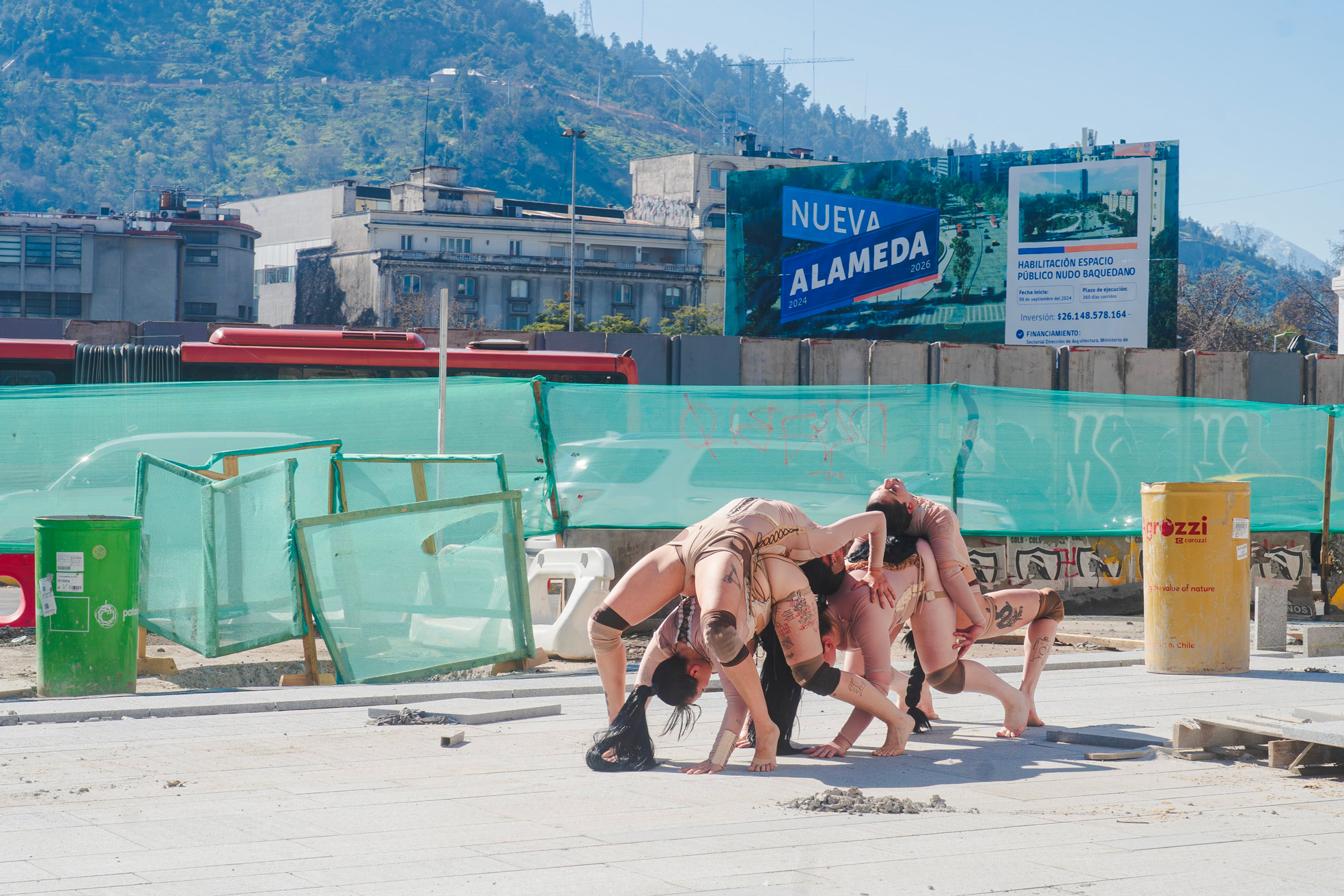
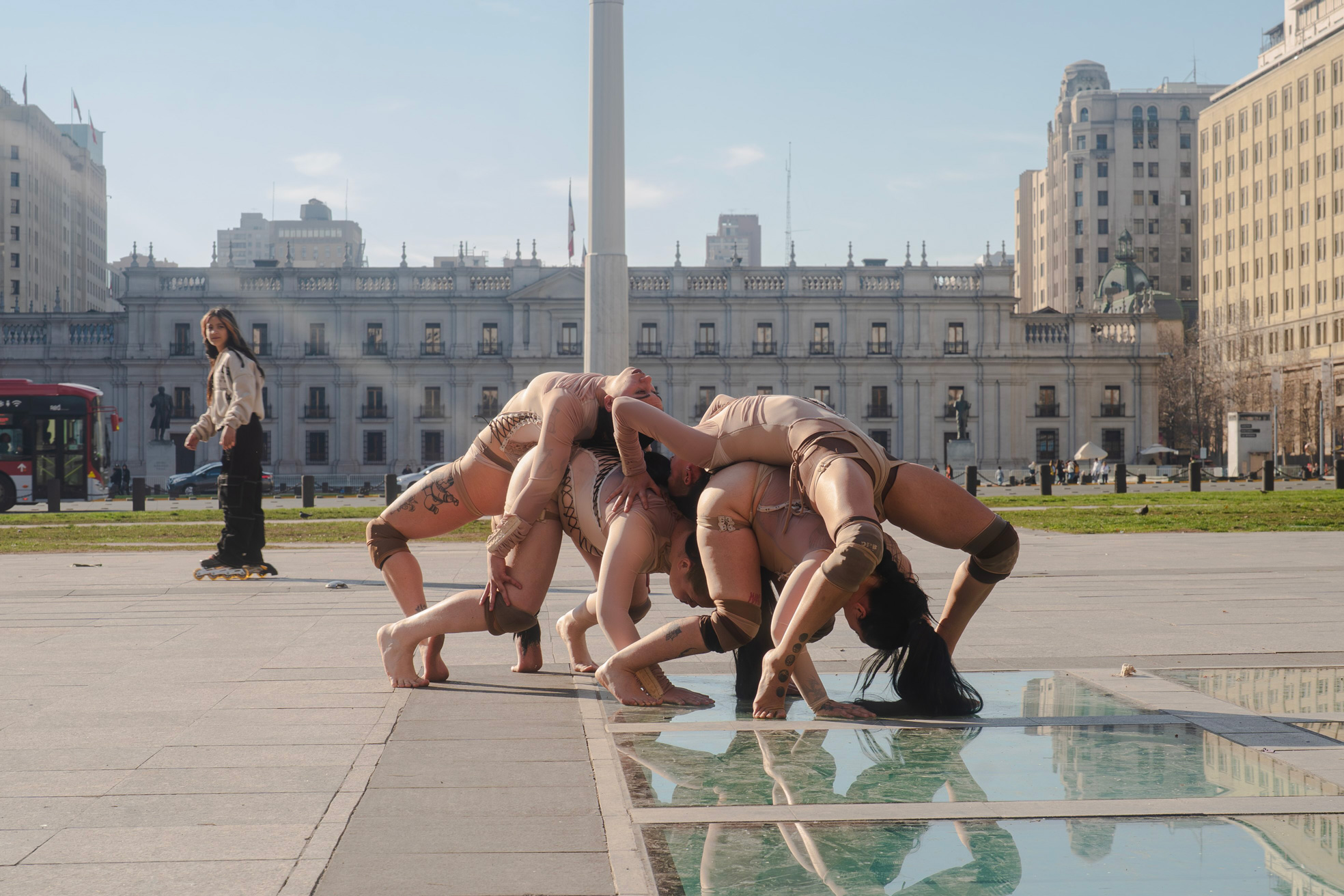
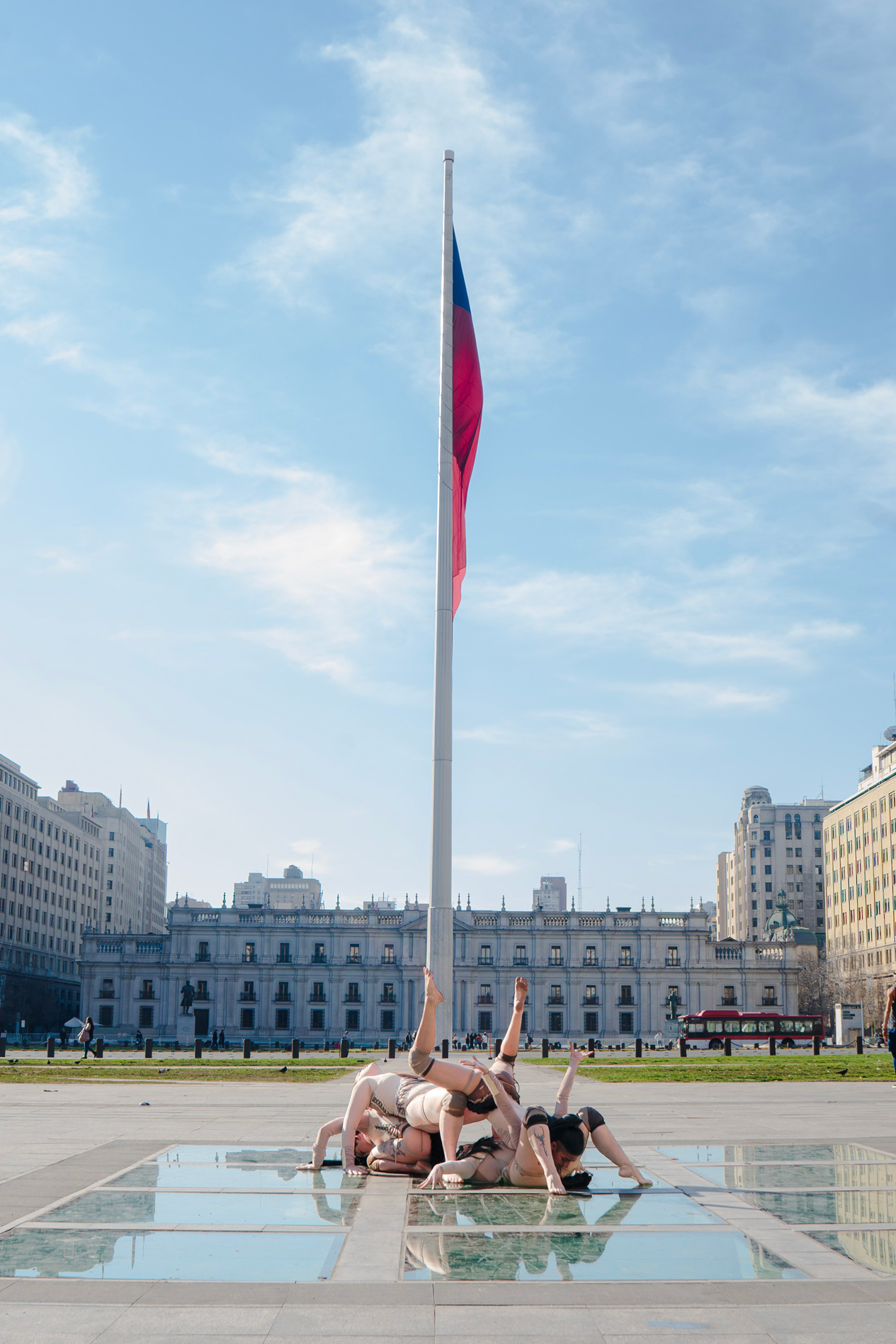
The performance proposes that bodies gassed, mutilated, tortured and disarticulated by colonial and state repression, return to the public space as a single being with multiple tails, limbs and organs. A beast composed of bodies that synchronize their pulses and breathing rhythms to adapt to new sociopolitical contexts. The birth of the headless beast is an outrage against nature, understood as a heteropatriarchal order that designates a mode of functioning of the organs, useful for reproduction and work. We experience rhythms of mythological beasts that synchronize their pulses and breathing rhythms, dissolving the individual outline of the performers through body couplings, to compose forms that do not exist organically. Moving from being individual subjects to a multiple body that assembles and disassembles, the explorations were focused on sensitive and perceptual openness, finding anchor points in the bodies of others and producing a single flow.
This mutant exposes the ideological construction behind the idea of nature, because as it moves, its organs acquire new functions in service of social movements:
“The outrage that is intended to be inflicted on Nature would consist of ceasing to be an individual, in order to immediately and simultaneously totalize everything that Nature contains: that would be to achieve a pseudo-eternity, a temporary existence, that of perverse polymorphism.” (Pierre Klossowski in Acéphale Magazine, 1936)
We committed an intellectual and symbolic crime, a sacrilege. In this proposal, destroying the real presence of figures of power does not necessarily mean destroying their material existence, but what that figure of power represents.
The performance took place on August 24th in five locations in Santiago, Chile. First, at the Baquedano Station, the epicenter of the 2019 uprising, which was popularly identified as a space of torture by the police. Today, it is in the midst of a transformation process towards the Nueva Alameda Project, which seeks to erase the memory of what happened there through infrastructure renovations.
Then, in front of the Monument to American Liberty, which is located in the center of the Plaza de Armas, the exact site where the gallows were located in the colonial period and where people convicted by Royal Justice were executed.
We continue on to the Crypt of the Liberator, an underground vault in front of the La Moneda Palace, inaugurated during the dictatorship of Augusto Pinochet, where the skeletal remains of Bernardo O’Higgins, supreme director and captain general of the Republic of Chile, founder of the Military School and considered father of the nation, for his participation in the independence process, are located.
The street route continued in the Plaza de la Ciudadania, right in front of the La Moneda Palace, the seat of the President of the Republic of Chile, which was bombed on September 11, 1973, after the coup d'état perpetrated by the army.
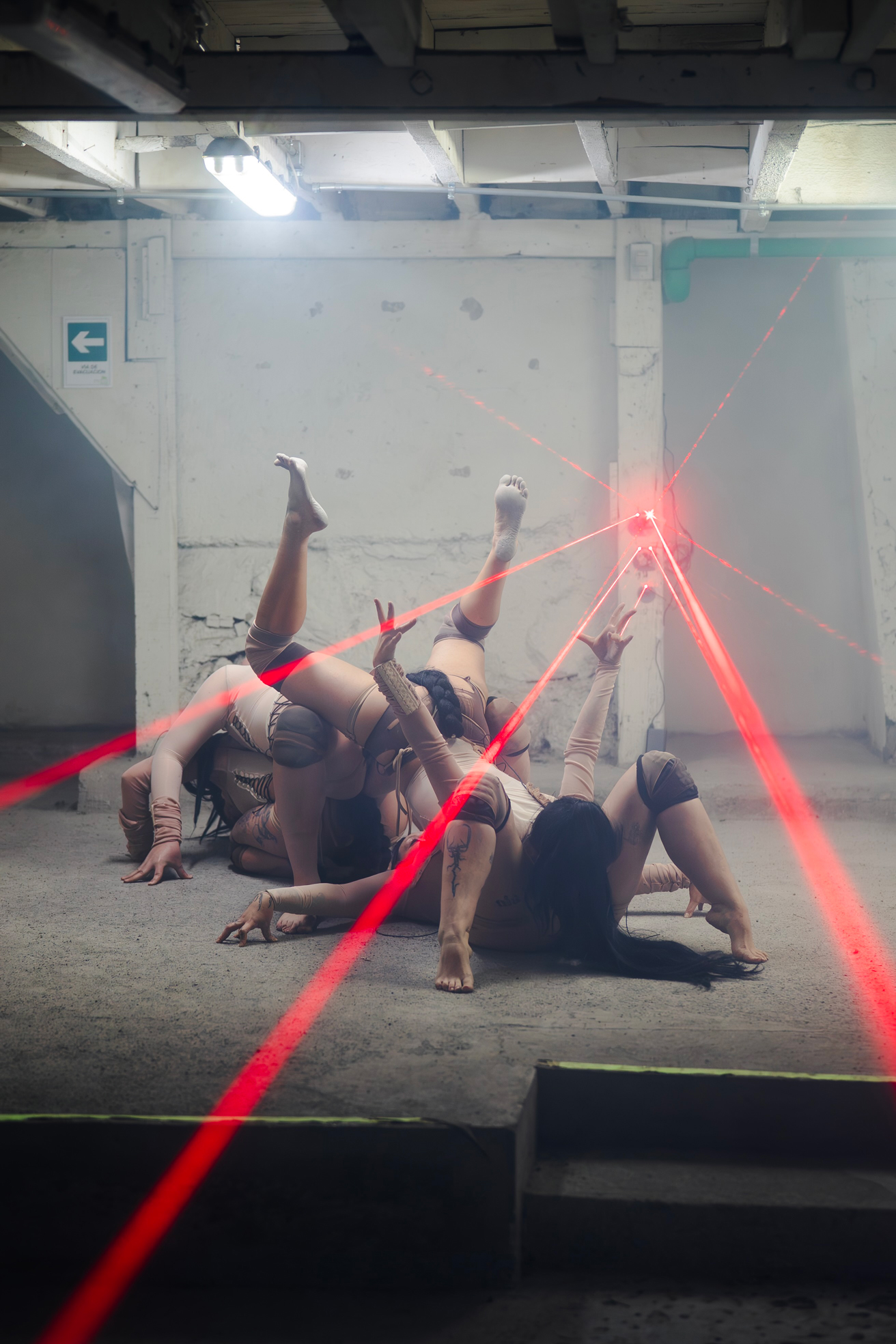
The route ended in the basement of Casa Palacio, where laser sound strings were used in collaboration with Taller Dinamo, which were activated upon contact with bodies and were associated with sounds of volcanoes, viscera, horses and protests. The use of lasers is directly linked to the 2019 uprising, where it was a subversive device, used to shoot down surveillance drones and hinder air and ground police.
“The body is the body, it stands alone and it doesn't need organs. The body is never an organism; organisms are the enemies of the body."[3]
This passage from Antonin Artaud was taken up by the French philosophers Gilles Deleuze and Felix Guattari to develop the concept of the body without organs (El Anti Edipo [Anti-Oedipus], 1972; Mil Mesetas [A Thousand Plateaus], 1980), which has been one of the main theoretical references during the creative process. We fabricate a new anatomy, borrowing this tool. The body without organs is a process of experimentation to free the flesh from its organic function that is, from the organism as a power system that designates that each organ has a particular function. It is an invitation to psychosis and madness, to take the body out of the organism without completely eliminating it, to connect with the dimension of the body that is between the organs and take it beyond its usual uses. It is possible to create a body without organs through constant practice outside of identity and the centrality of the face, arranging bodies to fit together to produce something new and intensely preserve it. This transformation is happening in plain sight. Its energy and affections find alternative paths to the normalized body, turning it inside out, mutilating it, uniting it, and exposing its internal flows. Exploring it is a constant task that is not definitively fixed, and that is where our work is located.
However, creating a body without organs is not a counter-hegemonic procedure in itself. Everything can be captured by capitalism, even the fruits of this practice. The body without organs and capitalism have in common that, for their consummation, anything goes; absolutely nullifying the codes of each territory.
The “headless” part indicates the absence of a head and face as the driving forces of human life. The head, in the sense of normative, rational, and disembodied thought. And the face, since it is subservient to criminalizing identification. The headless beast is innocence and crime, and does not obey the commands of the head. On the other hand, the “headless” part, applied to society, refers to a leaderless multitude:
“Being free means not being a function. To allow oneself to be confined to a function is to allow life to be castrated. The head, conscious authority or God, represents the servile functions that it gives and takes itself as an end, and is therefore the one that should be the object of the most vivid aversion” (Georges Bataille in Acéphale Magazine, 1936).
In this sense, the Bolivian sociologist Silvia Rivera Cusicanqui recovers elements of Aymara epistemology that accompany the acts of thinking and knowing to enrich the debate on the functional diversification of the body. These acts have two meanings in Aymara. On the one hand, lup’iña, which is thinking with a clear head, is identified with sunlight and rationality. And, on the other hand, amuyt’aña, a way of thinking associated with the postcolonial memories of the Andes, which:
“Does not reside in the head, but in the chuyma, which is usually translated as ‘heart’, although it is not that either, but the upper entrails, which include the heart, but also the lungs and the liver, that is to say the absorption and purification functions that our body performs in exchange with the cosmos. It could be said, then, that our breathing and heartbeat constitute the rhythm of this form of thinking. We are talking about the thought of walking, the thought of the ritual, the thought of a song and a dance.” (Silvia Rivera Cusicanqui, Un mundo chi’xi es posible, 2018)
The headless beast carries the memories of colonial genocides in Latin America, a geopolitical context from which Deleuze and Guattari are criticized for conceiving the body as a machine, in the productive and industrial sense of the term. By conceiving the body without organs as an action that is pure experimentation —without purpose—, it excludes the possibility of putting the organs at the service of common and emancipatory projects. What do these organs allow us to do? Hands break the pavement to make stones to throw at the police; butts and tails have been the weapons of the Yeguada Latinoamericana in the streets for years. The tail desires, the butt thinks, and those are not normative uses.
_______
FROM CENTAURS TO HEADLESS BEAST ORIGIN OF THE BEAST
Original idea and direction: Cheril Linett; Performers: Esperanza Vega, Ivon Figueroa Taucan, Daniela Rocio and Cheril Linett; Texts: Ivon Figueroa Taucan and Cheril Linett; Costume design and tailoring: Blingggfantasy; Hair: 777cyberhair; Laser sound strings: Taller Dinamo; Photographic record: Forever; Audiovisual recording and color post-production: Nicole Vilches ; Audiovisual production: Andres Valenzuela Arellano; Contributors: Nau Ivanow, Fundacion Cuerpo Sur, Casa Palacio, Fundacion Mecenas and Taller Dinamo
The process began with a creative and research residency at Nau Ivanow (May 2023, Barcelona), which continued at the Estacion Mapocho Cultural Center (June to October 2023, Santiago) with support from Fundacion Cuerpo Sur. Then, rehearsals were carried out at Casa Palacio (December 2024 to January 2025, Santiago) and at Fundacion Mecenas (August 2025, Santiago).
For five centuries, thousands of bodies have been dumped and hidden along the Andes Mountains, which cross seas, volcanic zones, highlands, valleys and deserts. Inhabitants of these territories since before the arrival of the Europeans, unbaptized blood made forgotten throughout Latin America. Sodomites erased from history during colonization, lesbians, transgender people and transvestites considered deviant blood. Combatants kidnapped, tortured, executed and forcibly disappeared by the dictatorships of the southern cone, incited by the global north. Workers and slaves in rebellion, massacred and lying underground. People removed from the map for seeking asylum far from their homeland. Suicidal people, refusing to become accomplices of regulatory systems with no room for dissent or human dignity: committed suicide.
Murmurs, shouts, and whispers stirred the Nazca oceanic plate; they moved it and it collided beneath the surface with the continental part of the South American plate. When the pressure from the poisonous gases and molten rock was sufficient to cause an explosion, the eruption occurred. Anuses and sexual organs sprouted all along the mountain range. The anuses opened to defecate, exposing their walls. From those openings, red and bright, in the surface layers of the mountain, fragments of riddled bodies emerged. Large emanations of sperm, flows of hair, menstrual irrigations, explosions of sweat, and rivers of saliva spilled across the land.
A great magnetic force attracted the human remains scattered across the mountain: flows and tissues, organs and membranes, mucous and muscles, limbs and joints. Machines coupled by the desire and predilection for subversion. They say “La sangre tira”[1]. That's why the beast hooked onto itself the pieces of all those people it found along the way, forming a disjointed, slippery, and polymorphous body. Its organs acquire new functions as it moves and travels. It breathes through its shoulder blades instead of its lungs; then, through one of its stomachs. It inflates and deflates rhythmically. Its parts drool over each other. Instead of phonetic words, it produces snores from within, which mutate into flashing bursts. It eats and fucks itself. It keeps breaking down.
It comes from a new world, but from an old cosmogony. With profane desire, it sets out on its journey towards the places where the spilled blood has been covered with cement.
So far, we have confronted law enforcement like a pack of centaurs. However, after the 2019 uprising, the streets in Chile emptied out and we have lost sovereignty over their use. The State and its agents took ruthless and violent measures to criminalize social protest. Police repression caused irreparable damage to the bodies of protesters, through the fragmentation of political articulations, eye mutilation, and attacks on civilians with projectiles such as tear gas and pellets. Traditional political forces attempted to give an institutional direction to the unease and indignation, which paved the way for the advance of the conservative far right in public discourse and made it clear that the forces seeking to overthrow the government did not have as much weight as we once believed. Given this, we ask ourselves: if the strategies of 2019 failed, how do we return to the streets?
De centauras a bestia acéfala [From centaurs to headless beast], the new work of the performance project Yeguada Latinoamericana[2], is a theoretical-practical research, an original idea by Cheril Linett, who proposed to a team of performers to explore body couplings and study references of posthuman philosophy, under her direction. The research considers a written systematization in three axes: creating a mythology about the birth of the headless beast, consolidating a theoretical framework and an instruction manual to become a beast.
The performance proposes that bodies gassed, mutilated, tortured and disarticulated by colonial and state repression, return to the public space as a single being with multiple tails, limbs and organs. A beast composed of bodies that synchronize their pulses and breathing rhythms to adapt to new sociopolitical contexts. The birth of the headless beast is an outrage against nature, understood as a heteropatriarchal order that designates a mode of functioning of the organs, useful for reproduction and work. We experience rhythms of mythological beasts that synchronize their pulses and breathing rhythms, dissolving the individual outline of the performers through body couplings, to compose forms that do not exist organically. Moving from being individual subjects to a multiple body that assembles and disassembles, the explorations were focused on sensitive and perceptual openness, finding anchor points in the bodies of others and producing a single flow.
This mutant exposes the ideological construction behind the idea of nature, because as it moves, its organs acquire new functions in service of social movements:
“The outrage that is intended to be inflicted on Nature would consist of ceasing to be an individual, in order to immediately and simultaneously totalize everything that Nature contains: that would be to achieve a pseudo-eternity, a temporary existence, that of perverse polymorphism.” (Pierre Klossowski in Acéphale Magazine, 1936)
We committed an intellectual and symbolic crime, a sacrilege. In this proposal, destroying the real presence of figures of power does not necessarily mean destroying their material existence, but what that figure of power represents.
The performance took place on August 24th in five locations in Santiago, Chile. First, at the Baquedano Station, the epicenter of the 2019 uprising, which was popularly identified as a space of torture by the police. Today, it is in the midst of a transformation process towards the Nueva Alameda Project, which seeks to erase the memory of what happened there through infrastructure renovations.
Then, in front of the Monument to American Liberty, which is located in the center of the Plaza de Armas, the exact site where the gallows were located in the colonial period and where people convicted by Royal Justice were executed.
We continue on to the Crypt of the Liberator, an underground vault in front of the La Moneda Palace, inaugurated during the dictatorship of Augusto Pinochet, where the skeletal remains of Bernardo O’Higgins, supreme director and captain general of the Republic of Chile, founder of the Military School and considered father of the nation, for his participation in the independence process, are located.
The street route continued in the Plaza de la Ciudadania, right in front of the La Moneda Palace, the seat of the President of the Republic of Chile, which was bombed on September 11, 1973, after the coup d'état perpetrated by the army.
The route ended in the basement of Casa Palacio, where laser sound strings were used in collaboration with Taller Dinamo, which were activated upon contact with bodies and were associated with sounds of volcanoes, viscera, horses and protests. The use of lasers is directly linked to the 2019 uprising, where it was a subversive device, used to shoot down surveillance drones and hinder air and ground police.
“The body is the body, it stands alone and it doesn't need organs. The body is never an organism; organisms are the enemies of the body."[3]
This passage from Antonin Artaud was taken up by the French philosophers Gilles Deleuze and Felix Guattari to develop the concept of the body without organs (El Anti Edipo [Anti-Oedipus], 1972; Mil Mesetas [A Thousand Plateaus], 1980), which has been one of the main theoretical references during the creative process. We fabricate a new anatomy, borrowing this tool. The body without organs is a process of experimentation to free the flesh from its organic function that is, from the organism as a power system that designates that each organ has a particular function. It is an invitation to psychosis and madness, to take the body out of the organism without completely eliminating it, to connect with the dimension of the body that is between the organs and take it beyond its usual uses. It is possible to create a body without organs through constant practice outside of identity and the centrality of the face, arranging bodies to fit together to produce something new and intensely preserve it. This transformation is happening in plain sight. Its energy and affections find alternative paths to the normalized body, turning it inside out, mutilating it, uniting it, and exposing its internal flows. Exploring it is a constant task that is not definitively fixed, and that is where our work is located.
However, creating a body without organs is not a counter-hegemonic procedure in itself. Everything can be captured by capitalism, even the fruits of this practice. The body without organs and capitalism have in common that, for their consummation, anything goes; absolutely nullifying the codes of each territory.
The “headless” part indicates the absence of a head and face as the driving forces of human life. The head, in the sense of normative, rational, and disembodied thought. And the face, since it is subservient to criminalizing identification. The headless beast is innocence and crime, and does not obey the commands of the head. On the other hand, the “headless” part, applied to society, refers to a leaderless multitude:
“Being free means not being a function. To allow oneself to be confined to a function is to allow life to be castrated. The head, conscious authority or God, represents the servile functions that it gives and takes itself as an end, and is therefore the one that should be the object of the most vivid aversion” (Georges Bataille in Acéphale Magazine, 1936).
In this sense, the Bolivian sociologist Silvia Rivera Cusicanqui recovers elements of Aymara epistemology that accompany the acts of thinking and knowing to enrich the debate on the functional diversification of the body. These acts have two meanings in Aymara. On the one hand, lup’iña, which is thinking with a clear head, is identified with sunlight and rationality. And, on the other hand, amuyt’aña, a way of thinking associated with the postcolonial memories of the Andes, which:
“Does not reside in the head, but in the chuyma, which is usually translated as ‘heart’, although it is not that either, but the upper entrails, which include the heart, but also the lungs and the liver, that is to say the absorption and purification functions that our body performs in exchange with the cosmos. It could be said, then, that our breathing and heartbeat constitute the rhythm of this form of thinking. We are talking about the thought of walking, the thought of the ritual, the thought of a song and a dance.” (Silvia Rivera Cusicanqui, Un mundo chi’xi es posible, 2018)
The headless beast carries the memories of colonial genocides in Latin America, a geopolitical context from which Deleuze and Guattari are criticized for conceiving the body as a machine, in the productive and industrial sense of the term. By conceiving the body without organs as an action that is pure experimentation —without purpose—, it excludes the possibility of putting the organs at the service of common and emancipatory projects. What do these organs allow us to do? Hands break the pavement to make stones to throw at the police; butts and tails have been the weapons of the Yeguada Latinoamericana in the streets for years. The tail desires, the butt thinks, and those are not normative uses.
_______
FROM CENTAURS TO HEADLESS BEAST ORIGIN OF THE BEAST
Original idea and direction: Cheril Linett; Performers: Esperanza Vega, Ivon Figueroa Taucan, Daniela Rocio and Cheril Linett; Texts: Ivon Figueroa Taucan and Cheril Linett; Costume design and tailoring: Blingggfantasy; Hair: 777cyberhair; Laser sound strings: Taller Dinamo; Photographic record: Forever; Audiovisual recording and color post-production: Nicole Vilches ; Audiovisual production: Andres Valenzuela Arellano; Contributors: Nau Ivanow, Fundacion Cuerpo Sur, Casa Palacio, Fundacion Mecenas and Taller Dinamo
The process began with a creative and research residency at Nau Ivanow (May 2023, Barcelona), which continued at the Estacion Mapocho Cultural Center (June to October 2023, Santiago) with support from Fundacion Cuerpo Sur. Then, rehearsals were carried out at Casa Palacio (December 2024 to January 2025, Santiago) and at Fundacion Mecenas (August 2025, Santiago).


Subscribe to our newsletter!
¡Gracias por suscribirte!











CALLE DEL ARTÍCULO 123 #116 INT. 100,
COLONIA CENTRO, CUAUHTÉMOC,
CDMX 06040, MÉXICO