In his installation presented at Gonzalo Fonseca’s Torre de los Vientos, Enrique Argote activates a machine of historical tension: wooden structures, pedals, pulleys, and silver-plated machetes that transform the space into a choreographic device where every gesture—sitting, triggering, pausing—reveals the silent violence of extraction. Drawing on André Lepecki’s writings, the text examines how Argote makes visible the choreopolice of extractivism—its rhythms, coercions, and flows—only to fracture it through slowness, friction, and inefficiency. Here, choreography becomes a mode of thought: a way to interrupt the productivist logic that organizes bodies, resources, and memories.
What would happen if we understood Enrique Argote’s installation coreografía de una extracción silenciosa [choreography of a silent extraction] as a political laboratory of movement? Inaugurated on September 6 inside Gonzalo Fonseca’s futuristic, habitation-like structure along the Ruta de la Amistad, Argote presents a machine of historical tension in which, according to the artist, “the hybrid machetes function as objectual syntheses of territorial tensions, materializing the struggle between local subsistence and global extraction.”
By installing his intervention in what was originally conceived in 1968 as a refuge for pedestrians along Periférico Sur, Argote not only reanimates a historical space: he confronts it with realities that its surrounding context has long attempted to conceal. The tower ceases to be a utopian shelter and becomes an active stage for thinking about extraction, memory, and situated resistance.
The curatorial text, written by Alberto Ríos de la Rosa, highlights precisely how the silver-plated machetes become symbols of struggle—not of romanticized nonviolence, but of an active, rotating sharpening machine: a tangible, visible mechanism that exposes centuries of mining extraction and territorial inequality.
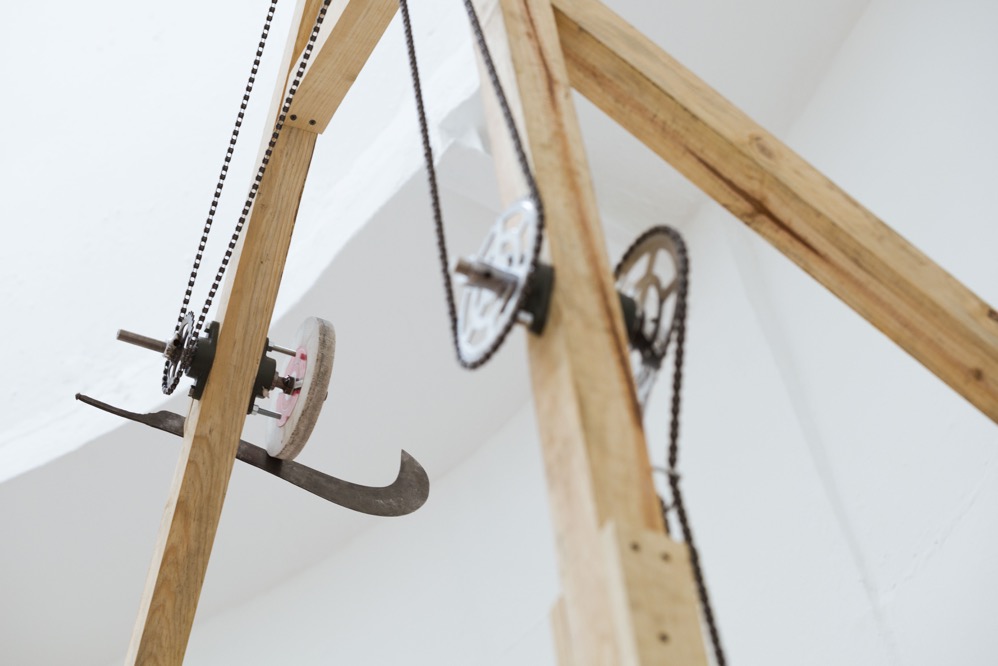
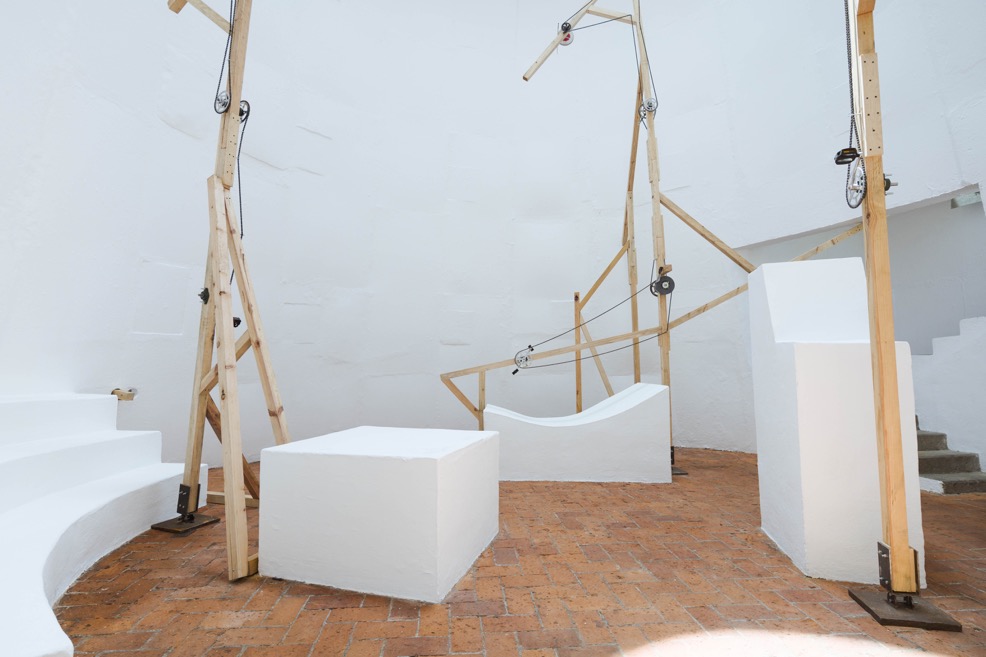
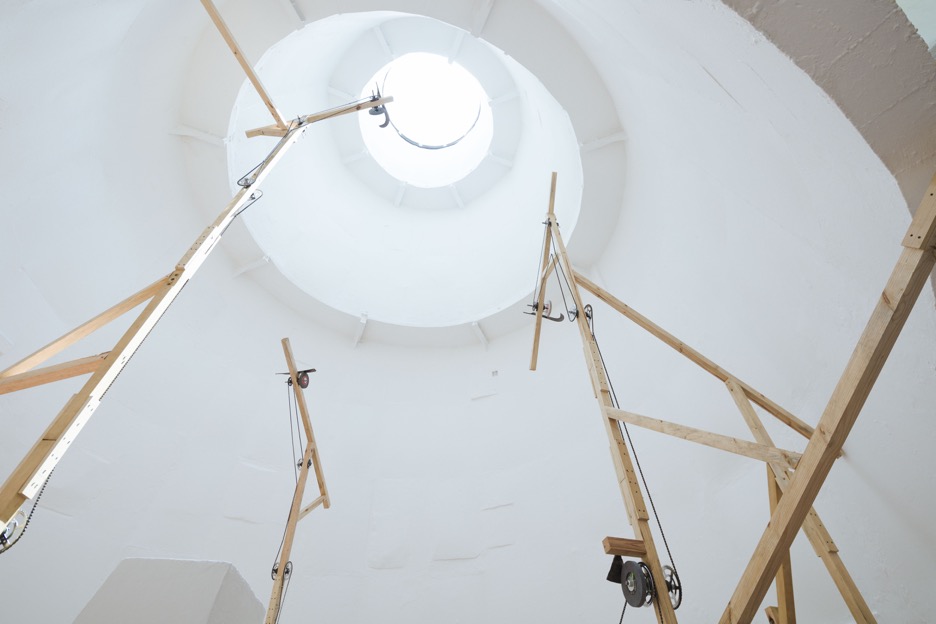
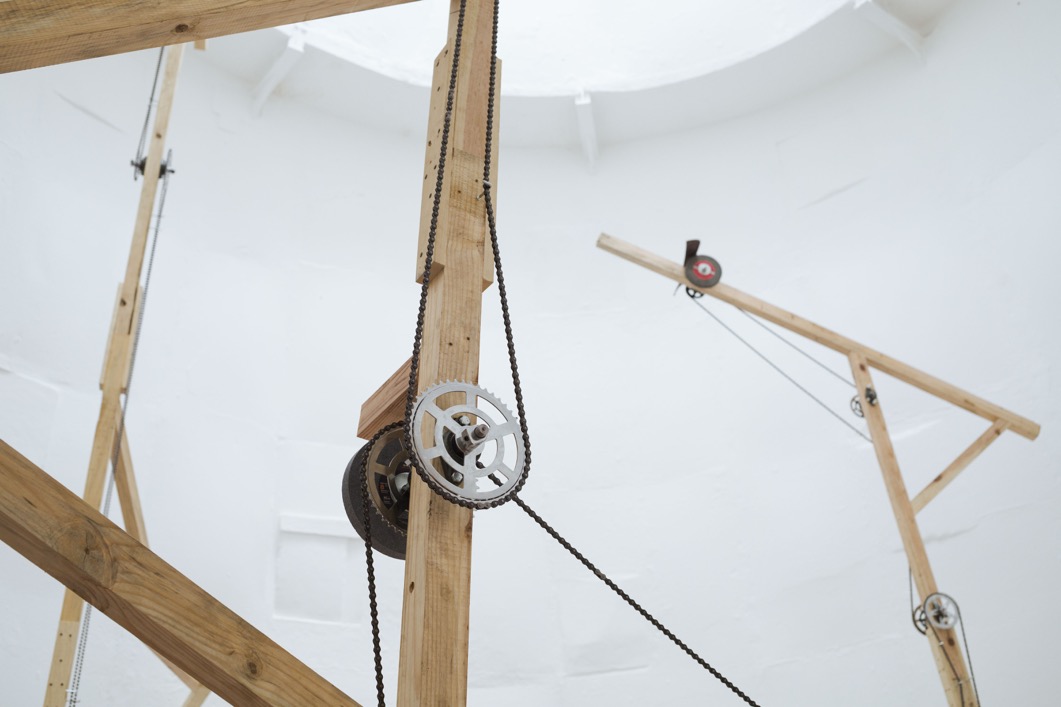
Upon entering the Torre de los Vientos, we encounter wooden structures leaning toward the zenithal light entering through the tower, suspended by pulleys, chains, connecting rods, and bicycle pedals—devices that here function as levers—topped with sharpening stones and silvered machetes. In the tower’s white interior, these mechanical armatures seem to set a choreographic tempo: stems bending, arms rotating, elements oscillating between the artisanal and the industrial.
Argote activates this furniture as part of a machine. The white surfaces that Fonseca designed as seats or platforms now operate as bases for pulleys, counterweights, pedals connected to the sharpening of the machetes. The space ceases to be contemplative and becomes choreographic: a site where each bodily position—sitting, operating, walking, pausing—becomes part of the apparatus. This shift resonates with André Lepecki’s key thesis: “to choreograph is to order the movement of bodies in space; to politicize choreography is to reveal who has the power to order, and who is compelled to move or to stop.”
In the tower, choreography is imposed by extractivism—its machinery, its rhythms, its violences—and appears reconstructed at human scale. But Argote also turns the visitor into an agent: those who activate the pedals participate in the sharpening process, reenact the campesino gesture, and tighten the historical charge attributed to the machete. Moving within the work means assuming, even momentarily, a place within the conflictual territorial apparatus.
Lepecki distinguishes between choreopolitics and choreopolice. Choreopolice is the coercive organization of movement: the choreography of the State, of commodities, of the extractive order. Choreopolitics, on the other hand, is interruption, detour, the disobedience of imposed movement. In this sense, I would like to think that the machine in choreography of a silent extraction represents choreopolice: the structure that orders movement toward productivity, efficiency, and the extraction of value. Each turn of the chain, each rotation of the pulley recalls the tempos of mining capital, whose flows are not merely material but kinetic as well: bodies displaced, territories perforated, ecosystems reorganized according to the speed of the market.
As Ríos de la Rosa emphasizes in his curatorial text, silent extraction does not refer to the spectacle of open-pit mines, but to the “discrete operations that function within bureaucratic and administrative opacity”—those that consume 247 million cubic meters of water per year and produce forced displacements, murders of environmental defenders, and “social ruins” rarely inscribed in the public arena. Argote introduces a gesture of rupture: the machine is almost clumsy, slow, and deliberately imperfect; if the machetes are sharpened too much, they cease to fulfill their function in the first place. The mechanisms are exposed, vulnerable, unshielded by casings that might hide their precariousness. Instead of efficiency, there is contingency; instead of optimization, friction; instead of productivity, risk.
This is where Enrique Argote’s proposal approaches choreopolitics, in Lepecki’s sense: movement that resists capture by slowing down, jamming, deviating. Over-sharpening becomes a metaphor for social numbness—as the curator notes—but also a sign that the extractive machine can fail, can wear down, can be disobeyed from within. And indeed, following Lepeckian thought, political resistance does not follow the linear logic of productivity; it operates in irregular rhythms, in pauses and interruptions that block the circulation of power.
A non-time emerges when the chains move slowly, the pedals demand human effort, the machetes join almost ritual motions, and the zenithal light enters as a natural pulse that contrasts with the system’s mechanical character. The space moves, but does not advance. It oscillates, it breathes. In this suspended rhythm, the tower ceases to be a historical monument and becomes a living body: an organism where choreography becomes a form of critical thought. Slowness turns into a political technology, a form of obstruction against the extractive acceleration that defines both contemporary mining and neoliberal urbanism.
Argote mobilizes a device that not only represents extraction but stages it in order to dismantle it. His mechanisms, far from mechanizing the visitor, allow them to perceive the machinery of power. Their slowness, far from anesthetizing, opens a space for political reflection. His machetes, far from threatening, return to the territory a memory of resistance that has never stopped sharpening itself. In dialogue with Lepecki, the exhibition can be read as an exercise in radical choreopolitics, a practice that reveals, slows down, and reimagines the movements that organize territorial life.
In times of extractive acceleration, Argote proposes another temporality: one where resistance is not a grand gesture but the silent friction of a chain; one where politics is not spectacle but the tension between machine and territory; one where choreography is, above all, an act of thinking movement in order to transform it.
What would happen if we understood Enrique Argote’s installation coreografía de una extracción silenciosa [choreography of a silent extraction] as a political laboratory of movement? Inaugurated on September 6 inside Gonzalo Fonseca’s futuristic, habitation-like structure along the Ruta de la Amistad, Argote presents a machine of historical tension in which, according to the artist, “the hybrid machetes function as objectual syntheses of territorial tensions, materializing the struggle between local subsistence and global extraction.”
By installing his intervention in what was originally conceived in 1968 as a refuge for pedestrians along Periférico Sur, Argote not only reanimates a historical space: he confronts it with realities that its surrounding context has long attempted to conceal. The tower ceases to be a utopian shelter and becomes an active stage for thinking about extraction, memory, and situated resistance.
The curatorial text, written by Alberto Ríos de la Rosa, highlights precisely how the silver-plated machetes become symbols of struggle—not of romanticized nonviolence, but of an active, rotating sharpening machine: a tangible, visible mechanism that exposes centuries of mining extraction and territorial inequality.
Upon entering the Torre de los Vientos, we encounter wooden structures leaning toward the zenithal light entering through the tower, suspended by pulleys, chains, connecting rods, and bicycle pedals—devices that here function as levers—topped with sharpening stones and silvered machetes. In the tower’s white interior, these mechanical armatures seem to set a choreographic tempo: stems bending, arms rotating, elements oscillating between the artisanal and the industrial.
Argote activates this furniture as part of a machine. The white surfaces that Fonseca designed as seats or platforms now operate as bases for pulleys, counterweights, pedals connected to the sharpening of the machetes. The space ceases to be contemplative and becomes choreographic: a site where each bodily position—sitting, operating, walking, pausing—becomes part of the apparatus. This shift resonates with André Lepecki’s key thesis: “to choreograph is to order the movement of bodies in space; to politicize choreography is to reveal who has the power to order, and who is compelled to move or to stop.”
In the tower, choreography is imposed by extractivism—its machinery, its rhythms, its violences—and appears reconstructed at human scale. But Argote also turns the visitor into an agent: those who activate the pedals participate in the sharpening process, reenact the campesino gesture, and tighten the historical charge attributed to the machete. Moving within the work means assuming, even momentarily, a place within the conflictual territorial apparatus.
Lepecki distinguishes between choreopolitics and choreopolice. Choreopolice is the coercive organization of movement: the choreography of the State, of commodities, of the extractive order. Choreopolitics, on the other hand, is interruption, detour, the disobedience of imposed movement. In this sense, I would like to think that the machine in choreography of a silent extraction represents choreopolice: the structure that orders movement toward productivity, efficiency, and the extraction of value. Each turn of the chain, each rotation of the pulley recalls the tempos of mining capital, whose flows are not merely material but kinetic as well: bodies displaced, territories perforated, ecosystems reorganized according to the speed of the market.
As Ríos de la Rosa emphasizes in his curatorial text, silent extraction does not refer to the spectacle of open-pit mines, but to the “discrete operations that function within bureaucratic and administrative opacity”—those that consume 247 million cubic meters of water per year and produce forced displacements, murders of environmental defenders, and “social ruins” rarely inscribed in the public arena. Argote introduces a gesture of rupture: the machine is almost clumsy, slow, and deliberately imperfect; if the machetes are sharpened too much, they cease to fulfill their function in the first place. The mechanisms are exposed, vulnerable, unshielded by casings that might hide their precariousness. Instead of efficiency, there is contingency; instead of optimization, friction; instead of productivity, risk.
This is where Enrique Argote’s proposal approaches choreopolitics, in Lepecki’s sense: movement that resists capture by slowing down, jamming, deviating. Over-sharpening becomes a metaphor for social numbness—as the curator notes—but also a sign that the extractive machine can fail, can wear down, can be disobeyed from within. And indeed, following Lepeckian thought, political resistance does not follow the linear logic of productivity; it operates in irregular rhythms, in pauses and interruptions that block the circulation of power.
A non-time emerges when the chains move slowly, the pedals demand human effort, the machetes join almost ritual motions, and the zenithal light enters as a natural pulse that contrasts with the system’s mechanical character. The space moves, but does not advance. It oscillates, it breathes. In this suspended rhythm, the tower ceases to be a historical monument and becomes a living body: an organism where choreography becomes a form of critical thought. Slowness turns into a political technology, a form of obstruction against the extractive acceleration that defines both contemporary mining and neoliberal urbanism.
Argote mobilizes a device that not only represents extraction but stages it in order to dismantle it. His mechanisms, far from mechanizing the visitor, allow them to perceive the machinery of power. Their slowness, far from anesthetizing, opens a space for political reflection. His machetes, far from threatening, return to the territory a memory of resistance that has never stopped sharpening itself. In dialogue with Lepecki, the exhibition can be read as an exercise in radical choreopolitics, a practice that reveals, slows down, and reimagines the movements that organize territorial life.
In times of extractive acceleration, Argote proposes another temporality: one where resistance is not a grand gesture but the silent friction of a chain; one where politics is not spectacle but the tension between machine and territory; one where choreography is, above all, an act of thinking movement in order to transform it.


Subscribe to our newsletter!
¡Gracias por suscribirte!











CALLE DEL ARTÍCULO 123 #116 INT. 100,
COLONIA CENTRO, CUAUHTÉMOC,
CDMX 06040, MÉXICO